🎉 Up to 70% Off Selected ItemsShop Sale

1 / 2
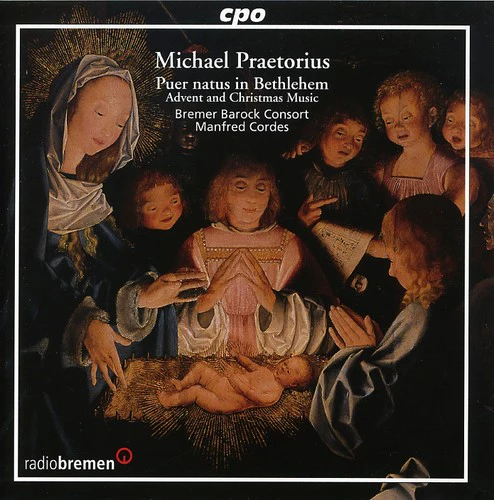
Michael Praetorius: Puer Natus In Bethlehem, Etc
PRAETORIUS Nun komm der Heiden Heiland. In dulci jubilo. Vom Himmel hoch. Puer natus in Bethlehem. Conditor alme siderum. Gelobet seist du, Jesu Christ. Resonet in laudibus. A solis ortus cardine • Manfred Cordes, dir; Bremer Barock Consort • cpo 777 327 (67:33 Text and Translation)
Straightforward, “musicologically correct” recordings of Michael Praetorius’s music are more present in the imagination than they are thick on the ground. While several of his simpler arrangements of chorale tunes can be found scattered among a myriad of seasonal albums, the more complicated concerted works, which, while based often on the same familiar tunes, stake a greater claim for his brilliance as a composer, are much harder to find. So this present, absorbing account of eight of his concerted motets is especially welcome. Performed as well as they are here, one quickly forgets that it is quite “out of season” to be reviewing them in early spring.
Most of his motets—or at least most of the ones that people bother to record—are built on famous hymn and chorale tunes penned much earlier, ranging from the ubiquitous In dulci jubilo to the most famous Lutheran melodies from the previous century, including Vom Himmel hoch and Nun komm der Heiden Heiland. Puer Natus in Bethlehem and Gelobet seist du Jesu Christ derive from less familiar source material, but are no less compelling. In some cases, Praetorius built his compositions on versions of the texts that interleaved the Latin original.
However, the surprisingly sparse discography of the nearly 1,000 hymns and concerted motets by this earlier (1571–1621) contemporary of the great Heinrich Schütz makes it difficult to assess his full range. The most direct competition for the present disc would seem to come from a now 10-year old Sony anthology on two CDs of concerted motets with Musica Fiata conducted by Roland Wilson (Sony 62929). But Praetorius composed multiple responses to the most familiar hymns, and none of the five similarly titled items is actually duplicated between the releases. Moreover, the two recordings present Praetorius on two different scales: the earlier disc opts for grander polychoral versions, fleshed out with a full 17th-century orchestra of strings, trumpets, cornettos, and sackbuts. Cpo’s Bremen release scales the works to medium grouping of four recorders, four violas da gamba, harp, and an organ positive, accompanying a seven-voice choir. Even these pointed differences, though, do not prevent comparisons, because the different repertoire items present shared challenges of ornamentation, textural clarity, and rhythm. Now over 10 years old, the Roland Wilson release was undercut by a muddier soundscape, with recessed strings and a longer echo in cavernous surroundings. The occasionally resplendent solo singing was inconsistent, falling short of the madrigalesque incisiveness of Manfred Cordes’s assembled singers for cpo. Even on its lighter, 17th-century scale, the brass tended there to overwhelm the male voices. And, while Wilson often succeeded in conveying the monumentality of some of this music—though surely not as powerfully as Paul McCreesh in his fabled “Praetorius Christmas Mass” recording (Archiv 439250)—it often lacked engagement and rhythmic excitement, qualities Cordes supplies in abundance.
Immediately one is struck here, by not only the strength and thoughtfulness of the solo vocal work, but also by Cordes’s sonic imagination, particularly the different colors massaged from his foregrounded gambas and harp. The recorders are also more adept and well tuned than Wilson’s. This pays dividends in the more complicated numbers like the thrillingly canonic In dulci jubilo setting and in the Vom Himmel hoch and Puer natus in Bethlehem , both of which are straightforward multi-verse settings of the complete hymns.
The recording opens with a fascinating, nine-minute “variation concerto” on the hymn tune Nun komm der Heiden Heiland , but listeners may be drawn more immediately to the hypnotically over-layered canons of Resonent in laudibus/Joseph lieber, Joseph mein or the aforementioned In dulci Jubilo . The recording is caught in the natural but not overly reverberant acoustic of the Stiftskirche in Bassum, a small town about 25 kilometers south of Bremen. Of much more than seasonal interest, this disc draws a glowing recommendation.
FANFARE: Christopher Williams
PRAETORIUS Nun komm der Heiden Heiland. In dulci jubilo. Vom Himmel hoch. Puer natus in Bethlehem. Conditor alme siderum. Gelobet seist du, Jesu Christ. Resonet in laudibus. A solis ortus cardine • Manfred Cordes, dir; Bremer Barock Consort • cpo 777 327 (67:33 Text and Translation)
Straightforward, “musicologically correct” recordings of Michael Praetorius’s music are more present in the imagination than they are thick on the ground. While several of his simpler arrangements of chorale tunes can be found scattered among a myriad of seasonal albums, the more complicated concerted works, which, while based often on the same familiar tunes, stake a greater claim for his brilliance as a composer, are much harder to find. So this present, absorbing account of eight of his concerted motets is especially welcome. Performed as well as they are here, one quickly forgets that it is quite “out of season” to be reviewing them in early spring.
Most of his motets—or at least most of the ones that people bother to record—are built on famous hymn and chorale tunes penned much earlier, ranging from the ubiquitous In dulci jubilo to the most famous Lutheran melodies from the previous century, including Vom Himmel hoch and Nun komm der Heiden Heiland. Puer Natus in Bethlehem and Gelobet seist du Jesu Christ derive from less familiar source material, but are no less compelling. In some cases, Praetorius built his compositions on versions of the texts that interleaved the Latin original.
However, the surprisingly sparse discography of the nearly 1,000 hymns and concerted motets by this earlier (1571–1621) contemporary of the great Heinrich Schütz makes it difficult to assess his full range. The most direct competition for the present disc would seem to come from a now 10-year old Sony anthology on two CDs of concerted motets with Musica Fiata conducted by Roland Wilson (Sony 62929). But Praetorius composed multiple responses to the most familiar hymns, and none of the five similarly titled items is actually duplicated between the releases. Moreover, the two recordings present Praetorius on two different scales: the earlier disc opts for grander polychoral versions, fleshed out with a full 17th-century orchestra of strings, trumpets, cornettos, and sackbuts. Cpo’s Bremen release scales the works to medium grouping of four recorders, four violas da gamba, harp, and an organ positive, accompanying a seven-voice choir. Even these pointed differences, though, do not prevent comparisons, because the different repertoire items present shared challenges of ornamentation, textural clarity, and rhythm. Now over 10 years old, the Roland Wilson release was undercut by a muddier soundscape, with recessed strings and a longer echo in cavernous surroundings. The occasionally resplendent solo singing was inconsistent, falling short of the madrigalesque incisiveness of Manfred Cordes’s assembled singers for cpo. Even on its lighter, 17th-century scale, the brass tended there to overwhelm the male voices. And, while Wilson often succeeded in conveying the monumentality of some of this music—though surely not as powerfully as Paul McCreesh in his fabled “Praetorius Christmas Mass” recording (Archiv 439250)—it often lacked engagement and rhythmic excitement, qualities Cordes supplies in abundance.
Immediately one is struck here, by not only the strength and thoughtfulness of the solo vocal work, but also by Cordes’s sonic imagination, particularly the different colors massaged from his foregrounded gambas and harp. The recorders are also more adept and well tuned than Wilson’s. This pays dividends in the more complicated numbers like the thrillingly canonic In dulci jubilo setting and in the Vom Himmel hoch and Puer natus in Bethlehem , both of which are straightforward multi-verse settings of the complete hymns.
The recording opens with a fascinating, nine-minute “variation concerto” on the hymn tune Nun komm der Heiden Heiland , but listeners may be drawn more immediately to the hypnotically over-layered canons of Resonent in laudibus/Joseph lieber, Joseph mein or the aforementioned In dulci Jubilo . The recording is caught in the natural but not overly reverberant acoustic of the Stiftskirche in Bassum, a small town about 25 kilometers south of Bremen. Of much more than seasonal interest, this disc draws a glowing recommendation.
FANFARE: Christopher Williams
$13.99
Michael Praetorius: Puer Natus In Bethlehem, Etc—
$13.99
Description
PRAETORIUS Nun komm der Heiden Heiland. In dulci jubilo. Vom Himmel hoch. Puer natus in Bethlehem. Conditor alme siderum. Gelobet seist du, Jesu Christ. Resonet in laudibus. A solis ortus cardine • Manfred Cordes, dir; Bremer Barock Consort • cpo 777 327 (67:33 Text and Translation)
Straightforward, “musicologically correct” recordings of Michael Praetorius’s music are more present in the imagination than they are thick on the ground. While several of his simpler arrangements of chorale tunes can be found scattered among a myriad of seasonal albums, the more complicated concerted works, which, while based often on the same familiar tunes, stake a greater claim for his brilliance as a composer, are much harder to find. So this present, absorbing account of eight of his concerted motets is especially welcome. Performed as well as they are here, one quickly forgets that it is quite “out of season” to be reviewing them in early spring.
Most of his motets—or at least most of the ones that people bother to record—are built on famous hymn and chorale tunes penned much earlier, ranging from the ubiquitous In dulci jubilo to the most famous Lutheran melodies from the previous century, including Vom Himmel hoch and Nun komm der Heiden Heiland. Puer Natus in Bethlehem and Gelobet seist du Jesu Christ derive from less familiar source material, but are no less compelling. In some cases, Praetorius built his compositions on versions of the texts that interleaved the Latin original.
However, the surprisingly sparse discography of the nearly 1,000 hymns and concerted motets by this earlier (1571–1621) contemporary of the great Heinrich Schütz makes it difficult to assess his full range. The most direct competition for the present disc would seem to come from a now 10-year old Sony anthology on two CDs of concerted motets with Musica Fiata conducted by Roland Wilson (Sony 62929). But Praetorius composed multiple responses to the most familiar hymns, and none of the five similarly titled items is actually duplicated between the releases. Moreover, the two recordings present Praetorius on two different scales: the earlier disc opts for grander polychoral versions, fleshed out with a full 17th-century orchestra of strings, trumpets, cornettos, and sackbuts. Cpo’s Bremen release scales the works to medium grouping of four recorders, four violas da gamba, harp, and an organ positive, accompanying a seven-voice choir. Even these pointed differences, though, do not prevent comparisons, because the different repertoire items present shared challenges of ornamentation, textural clarity, and rhythm. Now over 10 years old, the Roland Wilson release was undercut by a muddier soundscape, with recessed strings and a longer echo in cavernous surroundings. The occasionally resplendent solo singing was inconsistent, falling short of the madrigalesque incisiveness of Manfred Cordes’s assembled singers for cpo. Even on its lighter, 17th-century scale, the brass tended there to overwhelm the male voices. And, while Wilson often succeeded in conveying the monumentality of some of this music—though surely not as powerfully as Paul McCreesh in his fabled “Praetorius Christmas Mass” recording (Archiv 439250)—it often lacked engagement and rhythmic excitement, qualities Cordes supplies in abundance.
Immediately one is struck here, by not only the strength and thoughtfulness of the solo vocal work, but also by Cordes’s sonic imagination, particularly the different colors massaged from his foregrounded gambas and harp. The recorders are also more adept and well tuned than Wilson’s. This pays dividends in the more complicated numbers like the thrillingly canonic In dulci jubilo setting and in the Vom Himmel hoch and Puer natus in Bethlehem , both of which are straightforward multi-verse settings of the complete hymns.
The recording opens with a fascinating, nine-minute “variation concerto” on the hymn tune Nun komm der Heiden Heiland , but listeners may be drawn more immediately to the hypnotically over-layered canons of Resonent in laudibus/Joseph lieber, Joseph mein or the aforementioned In dulci Jubilo . The recording is caught in the natural but not overly reverberant acoustic of the Stiftskirche in Bassum, a small town about 25 kilometers south of Bremen. Of much more than seasonal interest, this disc draws a glowing recommendation.
FANFARE: Christopher Williams