🎉 Up to 70% Off Selected ItemsShop Sale

1 / 2
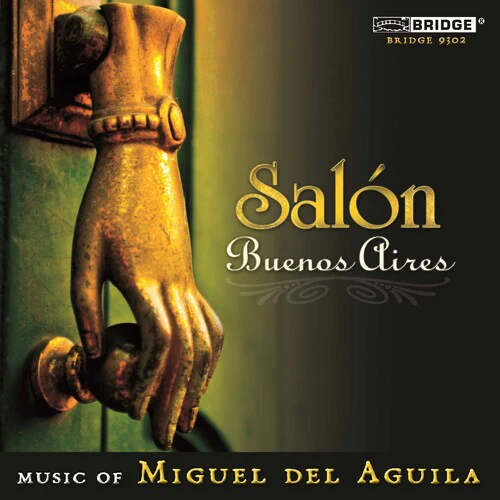
Miguel Del Aguila / Salon Buenos Aires
Miguel del Aguila has for several years now been making quite a name for himself throughout the Americas. He has been a prize-winner of awards such as the Kennedy Centre Friedheim. He was Composer-in-Residence with the New Mexico Symphony Orchestra. However his music has hardly ever percolated beyond America.
This is not the first CD to contain some of his music but I believe it’s the first to be devoted entirely to him. He has been described as a composer of “turbulent fantasy” and the anonymous booklet notes here comment that in his music there is “captivating interplay, even fertile tension, between Classical formal balance and Romantic excess”. I have to say that this Uruguayan composer is a typical example of cross-over, not though manufactured, but with a real living and genuine language so beloved of those for whom modern music normally takes too much concentration time.
The opening work is infectious and clever. “Charango Capriccioso” is built gradually from a very still and quiet start to a manic climax via repeated and obsessive syncopated rhythmic patterns. It then peters out after massive chords to a thoughtful and forgiving coda. The recording seems a little choked when the music is at its most wild. Perhaps the volume is tricky to adjust at the beginning; nevertheless this piece creates a promising opening impression.
The second work ‘Presto II’ is an enlarged version of the finale of his Second String Quartet which Aguila wrote whilst living in Vienna where the form is considered to be ‘sacrosanct’. Apparently its performance was reviewed as “not serious” by the local press. It is frenetic and spends most of its time in 7/8 time. It finds time to take a bow towards 1920s Jazz. It also contains ‘col legno’ and ‘sul pont’ effects and ends with a shout from the players. Good fun.
I have to describe ‘Life is a dream’ as a heroic failure, despite the fact that it is quite original and at times catchy. The composer has translated a poem by Pedro Calderon del Barca (1600-1681) about the meaning of life. This is narrated, practically twice - incidentally there are two narrators; the female not named - at varying points during the work’s progress. The “reality” is represented on stage but there is a “distant reality ... personified by the first violin who finlly joins the on-stage performers.” There is then a dance - “a dysfunctional jota” - with the evocation of guitars. There’s a flavour of Andalusia and the Phrygian mode present throughout old Spanish music is much in evidence. It is a complex tapestry of a work and one hearing I felt was probably quite adequate. However for the purposes of this review I listened again and, sadly, found it even less revealing.
If you felt, as I did that Aguila is the musical grandson as it were of Astor Piazzolla then ‘Salon Buenos Aires’ will add further ‘confirmation’. The first movement is a Samba, which in addition to the rich instrumental mix adds some (uncredited) disembodied, vocalising, and demonstrates what we are told in the booklet notes that “The three movements comprise a nostalgic musical portrait of 1950s Buenos Aires” which “springs from the composer’s childhood memories”. The middle movement grows from and ends in mist but builds to a powerful climax. This is a ‘Tango to Dream’ transition. Its thickly contrapuntal middle section would have benefited from more air around the players. In fact the recording as a whole is rather too close for comfort at times. This is the longest movement but we move on to an irritating - to this reviewer anyway - ‘Obsessed Milonga’. I should not have been surprised because the notes quote the newspaper the Wiener Zeitung as describing the composer as “of obsessive vitality”. A Milonga is incidentally an earlier Uruguayan tango form. The flute leads off manically with the melody and the other players repeat it in various keys for the next four minutes.
If I have been a little luke-warm so far then all changes with the last work. ‘Clocks’ is for piano quintet and the composer might well have called it ‘A Clock Museum’. This is original, colourful and pleasing. It falls into six sections. The first 'Shelves of Clocks’ sets up a ‘tocking and a ticking’ with the use of a polyphony of very high pizzicatos and harmonics. There are sharp staccato piano notes. In movement two, ‘Midnight Strikes’ there are clangorous, resonant chords. The third is ‘The Old Clock’s tale’ which is romantic and generally slightly ‘Hollywood’ in effect. ‘Sundial 2000BC’ is great fun incorporating some rugged rather primeval vocal work with which we might associate Roman ritual. It features a 3+3+2 dance rhythm. ‘Romance of Swiss Clocks’ makes a fascinating contrast being rather twee and flecked with bon-bons. Finally there is the longest movement, the riotous ‘The Joy of keeping time’ based on various South-American dance rhythms. This ends with the clocks in an empty museum indulging in something near to a musical orgy.
The whole disc is played with great enthusiasm. I’m not mad on the recording quality as mentioned above but the booklet is useful with photos and succinct musical asides.
-- Gary Higginson, MusicWeb International
This is not the first CD to contain some of his music but I believe it’s the first to be devoted entirely to him. He has been described as a composer of “turbulent fantasy” and the anonymous booklet notes here comment that in his music there is “captivating interplay, even fertile tension, between Classical formal balance and Romantic excess”. I have to say that this Uruguayan composer is a typical example of cross-over, not though manufactured, but with a real living and genuine language so beloved of those for whom modern music normally takes too much concentration time.
The opening work is infectious and clever. “Charango Capriccioso” is built gradually from a very still and quiet start to a manic climax via repeated and obsessive syncopated rhythmic patterns. It then peters out after massive chords to a thoughtful and forgiving coda. The recording seems a little choked when the music is at its most wild. Perhaps the volume is tricky to adjust at the beginning; nevertheless this piece creates a promising opening impression.
The second work ‘Presto II’ is an enlarged version of the finale of his Second String Quartet which Aguila wrote whilst living in Vienna where the form is considered to be ‘sacrosanct’. Apparently its performance was reviewed as “not serious” by the local press. It is frenetic and spends most of its time in 7/8 time. It finds time to take a bow towards 1920s Jazz. It also contains ‘col legno’ and ‘sul pont’ effects and ends with a shout from the players. Good fun.
I have to describe ‘Life is a dream’ as a heroic failure, despite the fact that it is quite original and at times catchy. The composer has translated a poem by Pedro Calderon del Barca (1600-1681) about the meaning of life. This is narrated, practically twice - incidentally there are two narrators; the female not named - at varying points during the work’s progress. The “reality” is represented on stage but there is a “distant reality ... personified by the first violin who finlly joins the on-stage performers.” There is then a dance - “a dysfunctional jota” - with the evocation of guitars. There’s a flavour of Andalusia and the Phrygian mode present throughout old Spanish music is much in evidence. It is a complex tapestry of a work and one hearing I felt was probably quite adequate. However for the purposes of this review I listened again and, sadly, found it even less revealing.
If you felt, as I did that Aguila is the musical grandson as it were of Astor Piazzolla then ‘Salon Buenos Aires’ will add further ‘confirmation’. The first movement is a Samba, which in addition to the rich instrumental mix adds some (uncredited) disembodied, vocalising, and demonstrates what we are told in the booklet notes that “The three movements comprise a nostalgic musical portrait of 1950s Buenos Aires” which “springs from the composer’s childhood memories”. The middle movement grows from and ends in mist but builds to a powerful climax. This is a ‘Tango to Dream’ transition. Its thickly contrapuntal middle section would have benefited from more air around the players. In fact the recording as a whole is rather too close for comfort at times. This is the longest movement but we move on to an irritating - to this reviewer anyway - ‘Obsessed Milonga’. I should not have been surprised because the notes quote the newspaper the Wiener Zeitung as describing the composer as “of obsessive vitality”. A Milonga is incidentally an earlier Uruguayan tango form. The flute leads off manically with the melody and the other players repeat it in various keys for the next four minutes.
If I have been a little luke-warm so far then all changes with the last work. ‘Clocks’ is for piano quintet and the composer might well have called it ‘A Clock Museum’. This is original, colourful and pleasing. It falls into six sections. The first 'Shelves of Clocks’ sets up a ‘tocking and a ticking’ with the use of a polyphony of very high pizzicatos and harmonics. There are sharp staccato piano notes. In movement two, ‘Midnight Strikes’ there are clangorous, resonant chords. The third is ‘The Old Clock’s tale’ which is romantic and generally slightly ‘Hollywood’ in effect. ‘Sundial 2000BC’ is great fun incorporating some rugged rather primeval vocal work with which we might associate Roman ritual. It features a 3+3+2 dance rhythm. ‘Romance of Swiss Clocks’ makes a fascinating contrast being rather twee and flecked with bon-bons. Finally there is the longest movement, the riotous ‘The Joy of keeping time’ based on various South-American dance rhythms. This ends with the clocks in an empty museum indulging in something near to a musical orgy.
The whole disc is played with great enthusiasm. I’m not mad on the recording quality as mentioned above but the booklet is useful with photos and succinct musical asides.
-- Gary Higginson, MusicWeb International
Miguel del Aguila has for several years now been making quite a name for himself throughout the Americas. He has been a prize-winner of awards such as the Kennedy Centre Friedheim. He was Composer-in-Residence with the New Mexico Symphony Orchestra. However his music has hardly ever percolated beyond America.
This is not the first CD to contain some of his music but I believe it’s the first to be devoted entirely to him. He has been described as a composer of “turbulent fantasy” and the anonymous booklet notes here comment that in his music there is “captivating interplay, even fertile tension, between Classical formal balance and Romantic excess”. I have to say that this Uruguayan composer is a typical example of cross-over, not though manufactured, but with a real living and genuine language so beloved of those for whom modern music normally takes too much concentration time.
The opening work is infectious and clever. “Charango Capriccioso” is built gradually from a very still and quiet start to a manic climax via repeated and obsessive syncopated rhythmic patterns. It then peters out after massive chords to a thoughtful and forgiving coda. The recording seems a little choked when the music is at its most wild. Perhaps the volume is tricky to adjust at the beginning; nevertheless this piece creates a promising opening impression.
The second work ‘Presto II’ is an enlarged version of the finale of his Second String Quartet which Aguila wrote whilst living in Vienna where the form is considered to be ‘sacrosanct’. Apparently its performance was reviewed as “not serious” by the local press. It is frenetic and spends most of its time in 7/8 time. It finds time to take a bow towards 1920s Jazz. It also contains ‘col legno’ and ‘sul pont’ effects and ends with a shout from the players. Good fun.
I have to describe ‘Life is a dream’ as a heroic failure, despite the fact that it is quite original and at times catchy. The composer has translated a poem by Pedro Calderon del Barca (1600-1681) about the meaning of life. This is narrated, practically twice - incidentally there are two narrators; the female not named - at varying points during the work’s progress. The “reality” is represented on stage but there is a “distant reality ... personified by the first violin who finlly joins the on-stage performers.” There is then a dance - “a dysfunctional jota” - with the evocation of guitars. There’s a flavour of Andalusia and the Phrygian mode present throughout old Spanish music is much in evidence. It is a complex tapestry of a work and one hearing I felt was probably quite adequate. However for the purposes of this review I listened again and, sadly, found it even less revealing.
If you felt, as I did that Aguila is the musical grandson as it were of Astor Piazzolla then ‘Salon Buenos Aires’ will add further ‘confirmation’. The first movement is a Samba, which in addition to the rich instrumental mix adds some (uncredited) disembodied, vocalising, and demonstrates what we are told in the booklet notes that “The three movements comprise a nostalgic musical portrait of 1950s Buenos Aires” which “springs from the composer’s childhood memories”. The middle movement grows from and ends in mist but builds to a powerful climax. This is a ‘Tango to Dream’ transition. Its thickly contrapuntal middle section would have benefited from more air around the players. In fact the recording as a whole is rather too close for comfort at times. This is the longest movement but we move on to an irritating - to this reviewer anyway - ‘Obsessed Milonga’. I should not have been surprised because the notes quote the newspaper the Wiener Zeitung as describing the composer as “of obsessive vitality”. A Milonga is incidentally an earlier Uruguayan tango form. The flute leads off manically with the melody and the other players repeat it in various keys for the next four minutes.
If I have been a little luke-warm so far then all changes with the last work. ‘Clocks’ is for piano quintet and the composer might well have called it ‘A Clock Museum’. This is original, colourful and pleasing. It falls into six sections. The first 'Shelves of Clocks’ sets up a ‘tocking and a ticking’ with the use of a polyphony of very high pizzicatos and harmonics. There are sharp staccato piano notes. In movement two, ‘Midnight Strikes’ there are clangorous, resonant chords. The third is ‘The Old Clock’s tale’ which is romantic and generally slightly ‘Hollywood’ in effect. ‘Sundial 2000BC’ is great fun incorporating some rugged rather primeval vocal work with which we might associate Roman ritual. It features a 3+3+2 dance rhythm. ‘Romance of Swiss Clocks’ makes a fascinating contrast being rather twee and flecked with bon-bons. Finally there is the longest movement, the riotous ‘The Joy of keeping time’ based on various South-American dance rhythms. This ends with the clocks in an empty museum indulging in something near to a musical orgy.
The whole disc is played with great enthusiasm. I’m not mad on the recording quality as mentioned above but the booklet is useful with photos and succinct musical asides.
-- Gary Higginson, MusicWeb International
This is not the first CD to contain some of his music but I believe it’s the first to be devoted entirely to him. He has been described as a composer of “turbulent fantasy” and the anonymous booklet notes here comment that in his music there is “captivating interplay, even fertile tension, between Classical formal balance and Romantic excess”. I have to say that this Uruguayan composer is a typical example of cross-over, not though manufactured, but with a real living and genuine language so beloved of those for whom modern music normally takes too much concentration time.
The opening work is infectious and clever. “Charango Capriccioso” is built gradually from a very still and quiet start to a manic climax via repeated and obsessive syncopated rhythmic patterns. It then peters out after massive chords to a thoughtful and forgiving coda. The recording seems a little choked when the music is at its most wild. Perhaps the volume is tricky to adjust at the beginning; nevertheless this piece creates a promising opening impression.
The second work ‘Presto II’ is an enlarged version of the finale of his Second String Quartet which Aguila wrote whilst living in Vienna where the form is considered to be ‘sacrosanct’. Apparently its performance was reviewed as “not serious” by the local press. It is frenetic and spends most of its time in 7/8 time. It finds time to take a bow towards 1920s Jazz. It also contains ‘col legno’ and ‘sul pont’ effects and ends with a shout from the players. Good fun.
I have to describe ‘Life is a dream’ as a heroic failure, despite the fact that it is quite original and at times catchy. The composer has translated a poem by Pedro Calderon del Barca (1600-1681) about the meaning of life. This is narrated, practically twice - incidentally there are two narrators; the female not named - at varying points during the work’s progress. The “reality” is represented on stage but there is a “distant reality ... personified by the first violin who finlly joins the on-stage performers.” There is then a dance - “a dysfunctional jota” - with the evocation of guitars. There’s a flavour of Andalusia and the Phrygian mode present throughout old Spanish music is much in evidence. It is a complex tapestry of a work and one hearing I felt was probably quite adequate. However for the purposes of this review I listened again and, sadly, found it even less revealing.
If you felt, as I did that Aguila is the musical grandson as it were of Astor Piazzolla then ‘Salon Buenos Aires’ will add further ‘confirmation’. The first movement is a Samba, which in addition to the rich instrumental mix adds some (uncredited) disembodied, vocalising, and demonstrates what we are told in the booklet notes that “The three movements comprise a nostalgic musical portrait of 1950s Buenos Aires” which “springs from the composer’s childhood memories”. The middle movement grows from and ends in mist but builds to a powerful climax. This is a ‘Tango to Dream’ transition. Its thickly contrapuntal middle section would have benefited from more air around the players. In fact the recording as a whole is rather too close for comfort at times. This is the longest movement but we move on to an irritating - to this reviewer anyway - ‘Obsessed Milonga’. I should not have been surprised because the notes quote the newspaper the Wiener Zeitung as describing the composer as “of obsessive vitality”. A Milonga is incidentally an earlier Uruguayan tango form. The flute leads off manically with the melody and the other players repeat it in various keys for the next four minutes.
If I have been a little luke-warm so far then all changes with the last work. ‘Clocks’ is for piano quintet and the composer might well have called it ‘A Clock Museum’. This is original, colourful and pleasing. It falls into six sections. The first 'Shelves of Clocks’ sets up a ‘tocking and a ticking’ with the use of a polyphony of very high pizzicatos and harmonics. There are sharp staccato piano notes. In movement two, ‘Midnight Strikes’ there are clangorous, resonant chords. The third is ‘The Old Clock’s tale’ which is romantic and generally slightly ‘Hollywood’ in effect. ‘Sundial 2000BC’ is great fun incorporating some rugged rather primeval vocal work with which we might associate Roman ritual. It features a 3+3+2 dance rhythm. ‘Romance of Swiss Clocks’ makes a fascinating contrast being rather twee and flecked with bon-bons. Finally there is the longest movement, the riotous ‘The Joy of keeping time’ based on various South-American dance rhythms. This ends with the clocks in an empty museum indulging in something near to a musical orgy.
The whole disc is played with great enthusiasm. I’m not mad on the recording quality as mentioned above but the booklet is useful with photos and succinct musical asides.
-- Gary Higginson, MusicWeb International
$18.99
Miguel Del Aguila / Salon Buenos Aires—
$18.99
Description
Miguel del Aguila has for several years now been making quite a name for himself throughout the Americas. He has been a prize-winner of awards such as the Kennedy Centre Friedheim. He was Composer-in-Residence with the New Mexico Symphony Orchestra. However his music has hardly ever percolated beyond America.
This is not the first CD to contain some of his music but I believe it’s the first to be devoted entirely to him. He has been described as a composer of “turbulent fantasy” and the anonymous booklet notes here comment that in his music there is “captivating interplay, even fertile tension, between Classical formal balance and Romantic excess”. I have to say that this Uruguayan composer is a typical example of cross-over, not though manufactured, but with a real living and genuine language so beloved of those for whom modern music normally takes too much concentration time.
The opening work is infectious and clever. “Charango Capriccioso” is built gradually from a very still and quiet start to a manic climax via repeated and obsessive syncopated rhythmic patterns. It then peters out after massive chords to a thoughtful and forgiving coda. The recording seems a little choked when the music is at its most wild. Perhaps the volume is tricky to adjust at the beginning; nevertheless this piece creates a promising opening impression.
The second work ‘Presto II’ is an enlarged version of the finale of his Second String Quartet which Aguila wrote whilst living in Vienna where the form is considered to be ‘sacrosanct’. Apparently its performance was reviewed as “not serious” by the local press. It is frenetic and spends most of its time in 7/8 time. It finds time to take a bow towards 1920s Jazz. It also contains ‘col legno’ and ‘sul pont’ effects and ends with a shout from the players. Good fun.
I have to describe ‘Life is a dream’ as a heroic failure, despite the fact that it is quite original and at times catchy. The composer has translated a poem by Pedro Calderon del Barca (1600-1681) about the meaning of life. This is narrated, practically twice - incidentally there are two narrators; the female not named - at varying points during the work’s progress. The “reality” is represented on stage but there is a “distant reality ... personified by the first violin who finlly joins the on-stage performers.” There is then a dance - “a dysfunctional jota” - with the evocation of guitars. There’s a flavour of Andalusia and the Phrygian mode present throughout old Spanish music is much in evidence. It is a complex tapestry of a work and one hearing I felt was probably quite adequate. However for the purposes of this review I listened again and, sadly, found it even less revealing.
If you felt, as I did that Aguila is the musical grandson as it were of Astor Piazzolla then ‘Salon Buenos Aires’ will add further ‘confirmation’. The first movement is a Samba, which in addition to the rich instrumental mix adds some (uncredited) disembodied, vocalising, and demonstrates what we are told in the booklet notes that “The three movements comprise a nostalgic musical portrait of 1950s Buenos Aires” which “springs from the composer’s childhood memories”. The middle movement grows from and ends in mist but builds to a powerful climax. This is a ‘Tango to Dream’ transition. Its thickly contrapuntal middle section would have benefited from more air around the players. In fact the recording as a whole is rather too close for comfort at times. This is the longest movement but we move on to an irritating - to this reviewer anyway - ‘Obsessed Milonga’. I should not have been surprised because the notes quote the newspaper the Wiener Zeitung as describing the composer as “of obsessive vitality”. A Milonga is incidentally an earlier Uruguayan tango form. The flute leads off manically with the melody and the other players repeat it in various keys for the next four minutes.
If I have been a little luke-warm so far then all changes with the last work. ‘Clocks’ is for piano quintet and the composer might well have called it ‘A Clock Museum’. This is original, colourful and pleasing. It falls into six sections. The first 'Shelves of Clocks’ sets up a ‘tocking and a ticking’ with the use of a polyphony of very high pizzicatos and harmonics. There are sharp staccato piano notes. In movement two, ‘Midnight Strikes’ there are clangorous, resonant chords. The third is ‘The Old Clock’s tale’ which is romantic and generally slightly ‘Hollywood’ in effect. ‘Sundial 2000BC’ is great fun incorporating some rugged rather primeval vocal work with which we might associate Roman ritual. It features a 3+3+2 dance rhythm. ‘Romance of Swiss Clocks’ makes a fascinating contrast being rather twee and flecked with bon-bons. Finally there is the longest movement, the riotous ‘The Joy of keeping time’ based on various South-American dance rhythms. This ends with the clocks in an empty museum indulging in something near to a musical orgy.
The whole disc is played with great enthusiasm. I’m not mad on the recording quality as mentioned above but the booklet is useful with photos and succinct musical asides.
-- Gary Higginson, MusicWeb International
This is not the first CD to contain some of his music but I believe it’s the first to be devoted entirely to him. He has been described as a composer of “turbulent fantasy” and the anonymous booklet notes here comment that in his music there is “captivating interplay, even fertile tension, between Classical formal balance and Romantic excess”. I have to say that this Uruguayan composer is a typical example of cross-over, not though manufactured, but with a real living and genuine language so beloved of those for whom modern music normally takes too much concentration time.
The opening work is infectious and clever. “Charango Capriccioso” is built gradually from a very still and quiet start to a manic climax via repeated and obsessive syncopated rhythmic patterns. It then peters out after massive chords to a thoughtful and forgiving coda. The recording seems a little choked when the music is at its most wild. Perhaps the volume is tricky to adjust at the beginning; nevertheless this piece creates a promising opening impression.
The second work ‘Presto II’ is an enlarged version of the finale of his Second String Quartet which Aguila wrote whilst living in Vienna where the form is considered to be ‘sacrosanct’. Apparently its performance was reviewed as “not serious” by the local press. It is frenetic and spends most of its time in 7/8 time. It finds time to take a bow towards 1920s Jazz. It also contains ‘col legno’ and ‘sul pont’ effects and ends with a shout from the players. Good fun.
I have to describe ‘Life is a dream’ as a heroic failure, despite the fact that it is quite original and at times catchy. The composer has translated a poem by Pedro Calderon del Barca (1600-1681) about the meaning of life. This is narrated, practically twice - incidentally there are two narrators; the female not named - at varying points during the work’s progress. The “reality” is represented on stage but there is a “distant reality ... personified by the first violin who finlly joins the on-stage performers.” There is then a dance - “a dysfunctional jota” - with the evocation of guitars. There’s a flavour of Andalusia and the Phrygian mode present throughout old Spanish music is much in evidence. It is a complex tapestry of a work and one hearing I felt was probably quite adequate. However for the purposes of this review I listened again and, sadly, found it even less revealing.
If you felt, as I did that Aguila is the musical grandson as it were of Astor Piazzolla then ‘Salon Buenos Aires’ will add further ‘confirmation’. The first movement is a Samba, which in addition to the rich instrumental mix adds some (uncredited) disembodied, vocalising, and demonstrates what we are told in the booklet notes that “The three movements comprise a nostalgic musical portrait of 1950s Buenos Aires” which “springs from the composer’s childhood memories”. The middle movement grows from and ends in mist but builds to a powerful climax. This is a ‘Tango to Dream’ transition. Its thickly contrapuntal middle section would have benefited from more air around the players. In fact the recording as a whole is rather too close for comfort at times. This is the longest movement but we move on to an irritating - to this reviewer anyway - ‘Obsessed Milonga’. I should not have been surprised because the notes quote the newspaper the Wiener Zeitung as describing the composer as “of obsessive vitality”. A Milonga is incidentally an earlier Uruguayan tango form. The flute leads off manically with the melody and the other players repeat it in various keys for the next four minutes.
If I have been a little luke-warm so far then all changes with the last work. ‘Clocks’ is for piano quintet and the composer might well have called it ‘A Clock Museum’. This is original, colourful and pleasing. It falls into six sections. The first 'Shelves of Clocks’ sets up a ‘tocking and a ticking’ with the use of a polyphony of very high pizzicatos and harmonics. There are sharp staccato piano notes. In movement two, ‘Midnight Strikes’ there are clangorous, resonant chords. The third is ‘The Old Clock’s tale’ which is romantic and generally slightly ‘Hollywood’ in effect. ‘Sundial 2000BC’ is great fun incorporating some rugged rather primeval vocal work with which we might associate Roman ritual. It features a 3+3+2 dance rhythm. ‘Romance of Swiss Clocks’ makes a fascinating contrast being rather twee and flecked with bon-bons. Finally there is the longest movement, the riotous ‘The Joy of keeping time’ based on various South-American dance rhythms. This ends with the clocks in an empty museum indulging in something near to a musical orgy.
The whole disc is played with great enthusiasm. I’m not mad on the recording quality as mentioned above but the booklet is useful with photos and succinct musical asides.
-- Gary Higginson, MusicWeb International