🎉 Up to 70% Off Selected ItemsShop Sale

Milken Archive - Amram: Symphony, Etc / Wilkins, Et Al
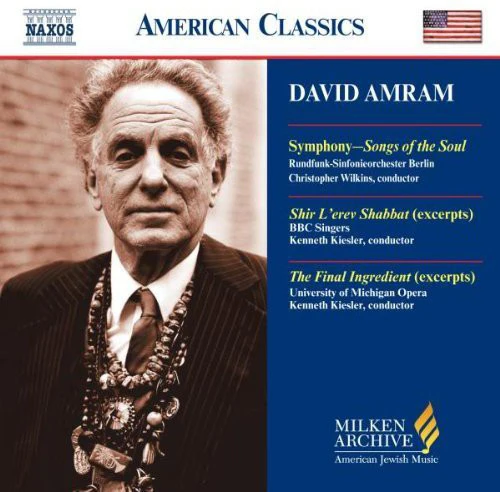
AMRAM Symphony, “Songs of the Soul.”1 Shir L’erev Shabbat; Excerpts.2 The Final Ingredient: Scenes 5, 9, 103 -- Christopher Wilkins, cond;1 Berlin RSO;1 Richard Troxell (ten);2 Christopher Bowers-Broadbent (org);2 Kenneth Kiesler, cond;2 BBC Singers;2 Kenneth Kiesler, cond;3 Deborah Selig (sop);3 Pei Yi Wang (mez);3 Sarah Elizabeth Williams (mez);3 Thomas Glenn (ten);3 Brian Pfaltzgraf (ten);3 Nicholas Phan (ten);3 Jesse Blumberg (bar);3 Tyler Oliphant (bar);3 Mark Kent (bass);3 Univ of Michigan SO & Ch3 -- NAXOS 8.559420 (63:12 ?)
Here we have three works by Philadelphia-born composer and “Renaissance man of American music” (according to the Boston Globe), David Amram (b. 1930). His biography is long and colorful, and, as always, fully documented by Neil Levin’s encyclopedic notes. In a nutshell, Amram has had a mixed musical and cultural background, studying at the Manhattan School of Music under Vitttorio Giannini, Gunther Schuller, and Dimitri Mitropoulos, while simultaneously becoming involved with a number of prominent jazz musicians and ensembles. He has written a considerable amount of music, from incidental scores to Shakespeare plays, Ibsen’s Peer Gynt, Camus’s Caligula, and plays by Eugene O’Neill and T. S. Eliot; to the sound track for an experimental documentary film by Jack Kerouac; to a number of well-known film scores, including Splendor in the Grass, the Manchurian Candidate, and The Young Savages; to over 100 orchestral and chamber works. Amram’s 1987 Symphony, subtitled “Songs of the Soul,” is in some respects similar to Weisgall’s T’kiatot discussed above. Programmatic movement titles notwithstanding, it is a three-movement orchestral score that may be heard as purely abstract music. The work reflects Amram’s interest in authentic Jewish/Oriental ethnic musical modalities. Put that together with the composer’s film-score background, and you have a richly Romantic, exotically perfumed work that could play well as the sound track for a Biblical docudrama. Don’t get me wrong. This is gorgeous sounding music. I’m just trying to describe it and put it into context so you’ll know what to expect. It is performed here by Christopher Wilkin conducting the Berlin Rundfunk Orchestra, in co-production with German Radio and the ROC Berlin.
In 1960, Amram became yet another recipient of one of Cantor Putterman’s commissions to write a liturgical work for his long-running Sabbath Eve Service program. For more information on Putterman and his program, please see the entry under Diamond noted above in Fanfare 27:7. From Amram’s Shir L’erev Shabbat we hear five numbers. According to Neil Levin’s notes, the work was premiered in 1961, but the CD back-flap dates it 1965, perhaps referring to a subsequent performance at the Hebrew Congregation in Washington, DC. Make no mistake about it, Amram is at heart a Romantic composer. The melodic and harmonic language is liberally spiced with 20th-century seasonings, but the idiom remains essentially tonal.
Much the same can be said of the three excerpts heard here from The Final Ingredient (1966), Amram’s second opera. In fact, passages from scene 5, the first of the three excerpts, kept reminding me of the section near the end of Verdi’s Requiem where the solo soprano is set against a cappella choir. The literary reference at least may be an appropriate one in that Amram’s opera is a Holocaust story that tells of the indomitable spirit of a group of Belsen concentration camp inmates determined to observe the ritual of the Passover Seder. The “final ingredient” refers to the egg, one of the items required for the traditional Passover plate, and the one that symbolizes the renewal and continuity of life. As the headnote indicates, a large cast is involved in the production. I hesitate to single out any individual vocal soloist, for all are outstanding, but I will give special mention to Kenneth Kiesler and the University of Michigan Opera Chorus and Orchestra, who do a superb job of cementing together what might otherwise turn unwieldy.
Jerry Dubins, FANFARE
Click here to view all available releases in the Milken Archive Series at ArkivMusic.
Here we have three works by Philadelphia-born composer and “Renaissance man of American music” (according to the Boston Globe), David Amram (b. 1930). His biography is long and colorful, and, as always, fully documented by Neil Levin’s encyclopedic notes. In a nutshell, Amram has had a mixed musical and cultural background, studying at the Manhattan School of Music under Vitttorio Giannini, Gunther Schuller, and Dimitri Mitropoulos, while simultaneously becoming involved with a number of prominent jazz musicians and ensembles. He has written a considerable amount of music, from incidental scores to Shakespeare plays, Ibsen’s Peer Gynt, Camus’s Caligula, and plays by Eugene O’Neill and T. S. Eliot; to the sound track for an experimental documentary film by Jack Kerouac; to a number of well-known film scores, including Splendor in the Grass, the Manchurian Candidate, and The Young Savages; to over 100 orchestral and chamber works. Amram’s 1987 Symphony, subtitled “Songs of the Soul,” is in some respects similar to Weisgall’s T’kiatot discussed above. Programmatic movement titles notwithstanding, it is a three-movement orchestral score that may be heard as purely abstract music. The work reflects Amram’s interest in authentic Jewish/Oriental ethnic musical modalities. Put that together with the composer’s film-score background, and you have a richly Romantic, exotically perfumed work that could play well as the sound track for a Biblical docudrama. Don’t get me wrong. This is gorgeous sounding music. I’m just trying to describe it and put it into context so you’ll know what to expect. It is performed here by Christopher Wilkin conducting the Berlin Rundfunk Orchestra, in co-production with German Radio and the ROC Berlin.
In 1960, Amram became yet another recipient of one of Cantor Putterman’s commissions to write a liturgical work for his long-running Sabbath Eve Service program. For more information on Putterman and his program, please see the entry under Diamond noted above in Fanfare 27:7. From Amram’s Shir L’erev Shabbat we hear five numbers. According to Neil Levin’s notes, the work was premiered in 1961, but the CD back-flap dates it 1965, perhaps referring to a subsequent performance at the Hebrew Congregation in Washington, DC. Make no mistake about it, Amram is at heart a Romantic composer. The melodic and harmonic language is liberally spiced with 20th-century seasonings, but the idiom remains essentially tonal.
Much the same can be said of the three excerpts heard here from The Final Ingredient (1966), Amram’s second opera. In fact, passages from scene 5, the first of the three excerpts, kept reminding me of the section near the end of Verdi’s Requiem where the solo soprano is set against a cappella choir. The literary reference at least may be an appropriate one in that Amram’s opera is a Holocaust story that tells of the indomitable spirit of a group of Belsen concentration camp inmates determined to observe the ritual of the Passover Seder. The “final ingredient” refers to the egg, one of the items required for the traditional Passover plate, and the one that symbolizes the renewal and continuity of life. As the headnote indicates, a large cast is involved in the production. I hesitate to single out any individual vocal soloist, for all are outstanding, but I will give special mention to Kenneth Kiesler and the University of Michigan Opera Chorus and Orchestra, who do a superb job of cementing together what might otherwise turn unwieldy.
Jerry Dubins, FANFARE
Click here to view all available releases in the Milken Archive Series at ArkivMusic.
AMRAM Symphony, “Songs of the Soul.”1 Shir L’erev Shabbat; Excerpts.2 The Final Ingredient: Scenes 5, 9, 103 -- Christopher Wilkins, cond;1 Berlin RSO;1 Richard Troxell (ten);2 Christopher Bowers-Broadbent (org);2 Kenneth Kiesler, cond;2 BBC Singers;2 Kenneth Kiesler, cond;3 Deborah Selig (sop);3 Pei Yi Wang (mez);3 Sarah Elizabeth Williams (mez);3 Thomas Glenn (ten);3 Brian Pfaltzgraf (ten);3 Nicholas Phan (ten);3 Jesse Blumberg (bar);3 Tyler Oliphant (bar);3 Mark Kent (bass);3 Univ of Michigan SO & Ch3 -- NAXOS 8.559420 (63:12 ?)
Here we have three works by Philadelphia-born composer and “Renaissance man of American music” (according to the Boston Globe), David Amram (b. 1930). His biography is long and colorful, and, as always, fully documented by Neil Levin’s encyclopedic notes. In a nutshell, Amram has had a mixed musical and cultural background, studying at the Manhattan School of Music under Vitttorio Giannini, Gunther Schuller, and Dimitri Mitropoulos, while simultaneously becoming involved with a number of prominent jazz musicians and ensembles. He has written a considerable amount of music, from incidental scores to Shakespeare plays, Ibsen’s Peer Gynt, Camus’s Caligula, and plays by Eugene O’Neill and T. S. Eliot; to the sound track for an experimental documentary film by Jack Kerouac; to a number of well-known film scores, including Splendor in the Grass, the Manchurian Candidate, and The Young Savages; to over 100 orchestral and chamber works. Amram’s 1987 Symphony, subtitled “Songs of the Soul,” is in some respects similar to Weisgall’s T’kiatot discussed above. Programmatic movement titles notwithstanding, it is a three-movement orchestral score that may be heard as purely abstract music. The work reflects Amram’s interest in authentic Jewish/Oriental ethnic musical modalities. Put that together with the composer’s film-score background, and you have a richly Romantic, exotically perfumed work that could play well as the sound track for a Biblical docudrama. Don’t get me wrong. This is gorgeous sounding music. I’m just trying to describe it and put it into context so you’ll know what to expect. It is performed here by Christopher Wilkin conducting the Berlin Rundfunk Orchestra, in co-production with German Radio and the ROC Berlin.
In 1960, Amram became yet another recipient of one of Cantor Putterman’s commissions to write a liturgical work for his long-running Sabbath Eve Service program. For more information on Putterman and his program, please see the entry under Diamond noted above in Fanfare 27:7. From Amram’s Shir L’erev Shabbat we hear five numbers. According to Neil Levin’s notes, the work was premiered in 1961, but the CD back-flap dates it 1965, perhaps referring to a subsequent performance at the Hebrew Congregation in Washington, DC. Make no mistake about it, Amram is at heart a Romantic composer. The melodic and harmonic language is liberally spiced with 20th-century seasonings, but the idiom remains essentially tonal.
Much the same can be said of the three excerpts heard here from The Final Ingredient (1966), Amram’s second opera. In fact, passages from scene 5, the first of the three excerpts, kept reminding me of the section near the end of Verdi’s Requiem where the solo soprano is set against a cappella choir. The literary reference at least may be an appropriate one in that Amram’s opera is a Holocaust story that tells of the indomitable spirit of a group of Belsen concentration camp inmates determined to observe the ritual of the Passover Seder. The “final ingredient” refers to the egg, one of the items required for the traditional Passover plate, and the one that symbolizes the renewal and continuity of life. As the headnote indicates, a large cast is involved in the production. I hesitate to single out any individual vocal soloist, for all are outstanding, but I will give special mention to Kenneth Kiesler and the University of Michigan Opera Chorus and Orchestra, who do a superb job of cementing together what might otherwise turn unwieldy.
Jerry Dubins, FANFARE
Click here to view all available releases in the Milken Archive Series at ArkivMusic.
Here we have three works by Philadelphia-born composer and “Renaissance man of American music” (according to the Boston Globe), David Amram (b. 1930). His biography is long and colorful, and, as always, fully documented by Neil Levin’s encyclopedic notes. In a nutshell, Amram has had a mixed musical and cultural background, studying at the Manhattan School of Music under Vitttorio Giannini, Gunther Schuller, and Dimitri Mitropoulos, while simultaneously becoming involved with a number of prominent jazz musicians and ensembles. He has written a considerable amount of music, from incidental scores to Shakespeare plays, Ibsen’s Peer Gynt, Camus’s Caligula, and plays by Eugene O’Neill and T. S. Eliot; to the sound track for an experimental documentary film by Jack Kerouac; to a number of well-known film scores, including Splendor in the Grass, the Manchurian Candidate, and The Young Savages; to over 100 orchestral and chamber works. Amram’s 1987 Symphony, subtitled “Songs of the Soul,” is in some respects similar to Weisgall’s T’kiatot discussed above. Programmatic movement titles notwithstanding, it is a three-movement orchestral score that may be heard as purely abstract music. The work reflects Amram’s interest in authentic Jewish/Oriental ethnic musical modalities. Put that together with the composer’s film-score background, and you have a richly Romantic, exotically perfumed work that could play well as the sound track for a Biblical docudrama. Don’t get me wrong. This is gorgeous sounding music. I’m just trying to describe it and put it into context so you’ll know what to expect. It is performed here by Christopher Wilkin conducting the Berlin Rundfunk Orchestra, in co-production with German Radio and the ROC Berlin.
In 1960, Amram became yet another recipient of one of Cantor Putterman’s commissions to write a liturgical work for his long-running Sabbath Eve Service program. For more information on Putterman and his program, please see the entry under Diamond noted above in Fanfare 27:7. From Amram’s Shir L’erev Shabbat we hear five numbers. According to Neil Levin’s notes, the work was premiered in 1961, but the CD back-flap dates it 1965, perhaps referring to a subsequent performance at the Hebrew Congregation in Washington, DC. Make no mistake about it, Amram is at heart a Romantic composer. The melodic and harmonic language is liberally spiced with 20th-century seasonings, but the idiom remains essentially tonal.
Much the same can be said of the three excerpts heard here from The Final Ingredient (1966), Amram’s second opera. In fact, passages from scene 5, the first of the three excerpts, kept reminding me of the section near the end of Verdi’s Requiem where the solo soprano is set against a cappella choir. The literary reference at least may be an appropriate one in that Amram’s opera is a Holocaust story that tells of the indomitable spirit of a group of Belsen concentration camp inmates determined to observe the ritual of the Passover Seder. The “final ingredient” refers to the egg, one of the items required for the traditional Passover plate, and the one that symbolizes the renewal and continuity of life. As the headnote indicates, a large cast is involved in the production. I hesitate to single out any individual vocal soloist, for all are outstanding, but I will give special mention to Kenneth Kiesler and the University of Michigan Opera Chorus and Orchestra, who do a superb job of cementing together what might otherwise turn unwieldy.
Jerry Dubins, FANFARE
Click here to view all available releases in the Milken Archive Series at ArkivMusic.
$10.99
Milken Archive - Amram: Symphony, Etc / Wilkins, Et Al—
$10.99
Description
AMRAM Symphony, “Songs of the Soul.”1 Shir L’erev Shabbat; Excerpts.2 The Final Ingredient: Scenes 5, 9, 103 -- Christopher Wilkins, cond;1 Berlin RSO;1 Richard Troxell (ten);2 Christopher Bowers-Broadbent (org);2 Kenneth Kiesler, cond;2 BBC Singers;2 Kenneth Kiesler, cond;3 Deborah Selig (sop);3 Pei Yi Wang (mez);3 Sarah Elizabeth Williams (mez);3 Thomas Glenn (ten);3 Brian Pfaltzgraf (ten);3 Nicholas Phan (ten);3 Jesse Blumberg (bar);3 Tyler Oliphant (bar);3 Mark Kent (bass);3 Univ of Michigan SO & Ch3 -- NAXOS 8.559420 (63:12 ?)
Here we have three works by Philadelphia-born composer and “Renaissance man of American music” (according to the Boston Globe), David Amram (b. 1930). His biography is long and colorful, and, as always, fully documented by Neil Levin’s encyclopedic notes. In a nutshell, Amram has had a mixed musical and cultural background, studying at the Manhattan School of Music under Vitttorio Giannini, Gunther Schuller, and Dimitri Mitropoulos, while simultaneously becoming involved with a number of prominent jazz musicians and ensembles. He has written a considerable amount of music, from incidental scores to Shakespeare plays, Ibsen’s Peer Gynt, Camus’s Caligula, and plays by Eugene O’Neill and T. S. Eliot; to the sound track for an experimental documentary film by Jack Kerouac; to a number of well-known film scores, including Splendor in the Grass, the Manchurian Candidate, and The Young Savages; to over 100 orchestral and chamber works. Amram’s 1987 Symphony, subtitled “Songs of the Soul,” is in some respects similar to Weisgall’s T’kiatot discussed above. Programmatic movement titles notwithstanding, it is a three-movement orchestral score that may be heard as purely abstract music. The work reflects Amram’s interest in authentic Jewish/Oriental ethnic musical modalities. Put that together with the composer’s film-score background, and you have a richly Romantic, exotically perfumed work that could play well as the sound track for a Biblical docudrama. Don’t get me wrong. This is gorgeous sounding music. I’m just trying to describe it and put it into context so you’ll know what to expect. It is performed here by Christopher Wilkin conducting the Berlin Rundfunk Orchestra, in co-production with German Radio and the ROC Berlin.
In 1960, Amram became yet another recipient of one of Cantor Putterman’s commissions to write a liturgical work for his long-running Sabbath Eve Service program. For more information on Putterman and his program, please see the entry under Diamond noted above in Fanfare 27:7. From Amram’s Shir L’erev Shabbat we hear five numbers. According to Neil Levin’s notes, the work was premiered in 1961, but the CD back-flap dates it 1965, perhaps referring to a subsequent performance at the Hebrew Congregation in Washington, DC. Make no mistake about it, Amram is at heart a Romantic composer. The melodic and harmonic language is liberally spiced with 20th-century seasonings, but the idiom remains essentially tonal.
Much the same can be said of the three excerpts heard here from The Final Ingredient (1966), Amram’s second opera. In fact, passages from scene 5, the first of the three excerpts, kept reminding me of the section near the end of Verdi’s Requiem where the solo soprano is set against a cappella choir. The literary reference at least may be an appropriate one in that Amram’s opera is a Holocaust story that tells of the indomitable spirit of a group of Belsen concentration camp inmates determined to observe the ritual of the Passover Seder. The “final ingredient” refers to the egg, one of the items required for the traditional Passover plate, and the one that symbolizes the renewal and continuity of life. As the headnote indicates, a large cast is involved in the production. I hesitate to single out any individual vocal soloist, for all are outstanding, but I will give special mention to Kenneth Kiesler and the University of Michigan Opera Chorus and Orchestra, who do a superb job of cementing together what might otherwise turn unwieldy.
Jerry Dubins, FANFARE
Click here to view all available releases in the Milken Archive Series at ArkivMusic.
Here we have three works by Philadelphia-born composer and “Renaissance man of American music” (according to the Boston Globe), David Amram (b. 1930). His biography is long and colorful, and, as always, fully documented by Neil Levin’s encyclopedic notes. In a nutshell, Amram has had a mixed musical and cultural background, studying at the Manhattan School of Music under Vitttorio Giannini, Gunther Schuller, and Dimitri Mitropoulos, while simultaneously becoming involved with a number of prominent jazz musicians and ensembles. He has written a considerable amount of music, from incidental scores to Shakespeare plays, Ibsen’s Peer Gynt, Camus’s Caligula, and plays by Eugene O’Neill and T. S. Eliot; to the sound track for an experimental documentary film by Jack Kerouac; to a number of well-known film scores, including Splendor in the Grass, the Manchurian Candidate, and The Young Savages; to over 100 orchestral and chamber works. Amram’s 1987 Symphony, subtitled “Songs of the Soul,” is in some respects similar to Weisgall’s T’kiatot discussed above. Programmatic movement titles notwithstanding, it is a three-movement orchestral score that may be heard as purely abstract music. The work reflects Amram’s interest in authentic Jewish/Oriental ethnic musical modalities. Put that together with the composer’s film-score background, and you have a richly Romantic, exotically perfumed work that could play well as the sound track for a Biblical docudrama. Don’t get me wrong. This is gorgeous sounding music. I’m just trying to describe it and put it into context so you’ll know what to expect. It is performed here by Christopher Wilkin conducting the Berlin Rundfunk Orchestra, in co-production with German Radio and the ROC Berlin.
In 1960, Amram became yet another recipient of one of Cantor Putterman’s commissions to write a liturgical work for his long-running Sabbath Eve Service program. For more information on Putterman and his program, please see the entry under Diamond noted above in Fanfare 27:7. From Amram’s Shir L’erev Shabbat we hear five numbers. According to Neil Levin’s notes, the work was premiered in 1961, but the CD back-flap dates it 1965, perhaps referring to a subsequent performance at the Hebrew Congregation in Washington, DC. Make no mistake about it, Amram is at heart a Romantic composer. The melodic and harmonic language is liberally spiced with 20th-century seasonings, but the idiom remains essentially tonal.
Much the same can be said of the three excerpts heard here from The Final Ingredient (1966), Amram’s second opera. In fact, passages from scene 5, the first of the three excerpts, kept reminding me of the section near the end of Verdi’s Requiem where the solo soprano is set against a cappella choir. The literary reference at least may be an appropriate one in that Amram’s opera is a Holocaust story that tells of the indomitable spirit of a group of Belsen concentration camp inmates determined to observe the ritual of the Passover Seder. The “final ingredient” refers to the egg, one of the items required for the traditional Passover plate, and the one that symbolizes the renewal and continuity of life. As the headnote indicates, a large cast is involved in the production. I hesitate to single out any individual vocal soloist, for all are outstanding, but I will give special mention to Kenneth Kiesler and the University of Michigan Opera Chorus and Orchestra, who do a superb job of cementing together what might otherwise turn unwieldy.
Jerry Dubins, FANFARE
Click here to view all available releases in the Milken Archive Series at ArkivMusic.