🎉 Up to 70% Off Selected ItemsShop Sale

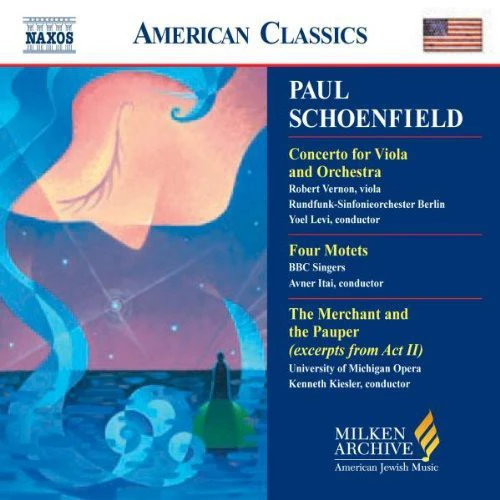
Milken Archive - Schoenfield: Viola Concerto, Etc
Paul Schoenfield (b. 1947) writes music that is easily grasped but not easily forgotten. A quote from the booklet note states that his works “do for Hassidic music what Astor Piazzolla did for the Argentine tango.” If what is meant by this is that Schoenfield’s music is animated by a strong rhythmic component informed by certain Klezmer-like dance elements, I guess I would go along with the characterization. But there is nothing dance-like about the extraordinarily sorrowful and moving “Soliloquy” of the Viola Concerto. Here is a major new concerted work for viola and orchestra (and how many of them are there?) that is sure to be snapped up by every viola player of note. The piece was written in 1997–98 expressly for Robert Vernon, concertmaster of the Cleveland Orchestra, who gave its premiere performance in 1998, and who plays it here on this CD. Clearly, the work has it origins in Israeli and Eastern European folk song and dance, as well as Hassidic liturgical sources. This is especially evident in the last movement, titled “King David Dancing before the Ark,” a kind of Jewish saltarello, but the overall impression of this concerto is not of a lightweight, pops-concert piece. I believe it is an important new contribution to the viola literature. Vernon is in top form.
The Four Motets, each indicated only by a tempo marking, are settings of four of the seven verses from Psalm 86: “Incline Your ear, O Lord, answer me, for I am poor and needy.” These may be the most beautiful pieces William Byrd ever wrote. I jest of course, but the writing bears a strong resemblance to the Church style of Byrd and Tallis, with just enough 20th-century “irregularities” in voice leading and harmonic progression thrown in to assure you that you haven’t entered a time-warp. Benjamin Britten was quite masterful at writing this type of choral music too.
Schoenfield’s opera, The Merchant and the Pauper, is based on a tale by the great 18th-century Hassidic Rabbi, Reb Nahman. As usual, Neil Levin, author of the encyclopedic notes, and artistic director behind the Milken Archive of American Jewish Music project, goes on for pages of microscopic-print about who Reb Nahman was and the role he played in the evolving Jewish mythology and mysticism that are central to the Hassidic movement. Suffice it here to say that he was a highly controversial figure, as were many of his tales that—through allegory, riddles, and symbolism—drew many fervent believers. The plot of the Merchant and the Pauper presents an original twist on a familiar theme. The Pauper’s wife is kidnapped, but safely returned by the Merchant. The wives of both Pauper and Merchant give birth, the former to a daughter, the latter to a son. In gratitude to the Merchant for the rescue of his wife, the Pauper promises his newborn daughter’s hand in marriage to the Merchant’s son. Meanwhile, as the daughter blossoms into womanhood, her beauty increases, as do the Pauper’s wealth and fortunes. Soon, power and greed corrupt the Pauper, who now no longer wishes his daughter to marry the Merchant’s son. To prevent the marriage, he goes to great lengths to ruin the Merchant, and eventually to have the Merchant’s son abducted, put into a sack, and thrown into the sea (shades of Rigoletto). But this story has a happy ending for all except the Pauper. The son escapes, to be reunited with the Merchant’s daughter in “everlasting joy” (right!), and through the magic of fantasy the Pauper is once again returned to “pauperdom” and the Merchant to “merchanthood.” The story is no sillier than many an opera libretto. What matters is the music. On that score, I can say that even in these relatively short chunks excerpted from act II Schoenfield demonstrates a real flair for the stage and dramatic writing. There is some gorgeous music here, and all of the participants are excellent.
Another winner from this tremendously important project. I recommend it enthusiastically.
Jerry Dubins, FANFARE
The Four Motets, each indicated only by a tempo marking, are settings of four of the seven verses from Psalm 86: “Incline Your ear, O Lord, answer me, for I am poor and needy.” These may be the most beautiful pieces William Byrd ever wrote. I jest of course, but the writing bears a strong resemblance to the Church style of Byrd and Tallis, with just enough 20th-century “irregularities” in voice leading and harmonic progression thrown in to assure you that you haven’t entered a time-warp. Benjamin Britten was quite masterful at writing this type of choral music too.
Schoenfield’s opera, The Merchant and the Pauper, is based on a tale by the great 18th-century Hassidic Rabbi, Reb Nahman. As usual, Neil Levin, author of the encyclopedic notes, and artistic director behind the Milken Archive of American Jewish Music project, goes on for pages of microscopic-print about who Reb Nahman was and the role he played in the evolving Jewish mythology and mysticism that are central to the Hassidic movement. Suffice it here to say that he was a highly controversial figure, as were many of his tales that—through allegory, riddles, and symbolism—drew many fervent believers. The plot of the Merchant and the Pauper presents an original twist on a familiar theme. The Pauper’s wife is kidnapped, but safely returned by the Merchant. The wives of both Pauper and Merchant give birth, the former to a daughter, the latter to a son. In gratitude to the Merchant for the rescue of his wife, the Pauper promises his newborn daughter’s hand in marriage to the Merchant’s son. Meanwhile, as the daughter blossoms into womanhood, her beauty increases, as do the Pauper’s wealth and fortunes. Soon, power and greed corrupt the Pauper, who now no longer wishes his daughter to marry the Merchant’s son. To prevent the marriage, he goes to great lengths to ruin the Merchant, and eventually to have the Merchant’s son abducted, put into a sack, and thrown into the sea (shades of Rigoletto). But this story has a happy ending for all except the Pauper. The son escapes, to be reunited with the Merchant’s daughter in “everlasting joy” (right!), and through the magic of fantasy the Pauper is once again returned to “pauperdom” and the Merchant to “merchanthood.” The story is no sillier than many an opera libretto. What matters is the music. On that score, I can say that even in these relatively short chunks excerpted from act II Schoenfield demonstrates a real flair for the stage and dramatic writing. There is some gorgeous music here, and all of the participants are excellent.
Another winner from this tremendously important project. I recommend it enthusiastically.
Jerry Dubins, FANFARE
Paul Schoenfield (b. 1947) writes music that is easily grasped but not easily forgotten. A quote from the booklet note states that his works “do for Hassidic music what Astor Piazzolla did for the Argentine tango.” If what is meant by this is that Schoenfield’s music is animated by a strong rhythmic component informed by certain Klezmer-like dance elements, I guess I would go along with the characterization. But there is nothing dance-like about the extraordinarily sorrowful and moving “Soliloquy” of the Viola Concerto. Here is a major new concerted work for viola and orchestra (and how many of them are there?) that is sure to be snapped up by every viola player of note. The piece was written in 1997–98 expressly for Robert Vernon, concertmaster of the Cleveland Orchestra, who gave its premiere performance in 1998, and who plays it here on this CD. Clearly, the work has it origins in Israeli and Eastern European folk song and dance, as well as Hassidic liturgical sources. This is especially evident in the last movement, titled “King David Dancing before the Ark,” a kind of Jewish saltarello, but the overall impression of this concerto is not of a lightweight, pops-concert piece. I believe it is an important new contribution to the viola literature. Vernon is in top form.
The Four Motets, each indicated only by a tempo marking, are settings of four of the seven verses from Psalm 86: “Incline Your ear, O Lord, answer me, for I am poor and needy.” These may be the most beautiful pieces William Byrd ever wrote. I jest of course, but the writing bears a strong resemblance to the Church style of Byrd and Tallis, with just enough 20th-century “irregularities” in voice leading and harmonic progression thrown in to assure you that you haven’t entered a time-warp. Benjamin Britten was quite masterful at writing this type of choral music too.
Schoenfield’s opera, The Merchant and the Pauper, is based on a tale by the great 18th-century Hassidic Rabbi, Reb Nahman. As usual, Neil Levin, author of the encyclopedic notes, and artistic director behind the Milken Archive of American Jewish Music project, goes on for pages of microscopic-print about who Reb Nahman was and the role he played in the evolving Jewish mythology and mysticism that are central to the Hassidic movement. Suffice it here to say that he was a highly controversial figure, as were many of his tales that—through allegory, riddles, and symbolism—drew many fervent believers. The plot of the Merchant and the Pauper presents an original twist on a familiar theme. The Pauper’s wife is kidnapped, but safely returned by the Merchant. The wives of both Pauper and Merchant give birth, the former to a daughter, the latter to a son. In gratitude to the Merchant for the rescue of his wife, the Pauper promises his newborn daughter’s hand in marriage to the Merchant’s son. Meanwhile, as the daughter blossoms into womanhood, her beauty increases, as do the Pauper’s wealth and fortunes. Soon, power and greed corrupt the Pauper, who now no longer wishes his daughter to marry the Merchant’s son. To prevent the marriage, he goes to great lengths to ruin the Merchant, and eventually to have the Merchant’s son abducted, put into a sack, and thrown into the sea (shades of Rigoletto). But this story has a happy ending for all except the Pauper. The son escapes, to be reunited with the Merchant’s daughter in “everlasting joy” (right!), and through the magic of fantasy the Pauper is once again returned to “pauperdom” and the Merchant to “merchanthood.” The story is no sillier than many an opera libretto. What matters is the music. On that score, I can say that even in these relatively short chunks excerpted from act II Schoenfield demonstrates a real flair for the stage and dramatic writing. There is some gorgeous music here, and all of the participants are excellent.
Another winner from this tremendously important project. I recommend it enthusiastically.
Jerry Dubins, FANFARE
The Four Motets, each indicated only by a tempo marking, are settings of four of the seven verses from Psalm 86: “Incline Your ear, O Lord, answer me, for I am poor and needy.” These may be the most beautiful pieces William Byrd ever wrote. I jest of course, but the writing bears a strong resemblance to the Church style of Byrd and Tallis, with just enough 20th-century “irregularities” in voice leading and harmonic progression thrown in to assure you that you haven’t entered a time-warp. Benjamin Britten was quite masterful at writing this type of choral music too.
Schoenfield’s opera, The Merchant and the Pauper, is based on a tale by the great 18th-century Hassidic Rabbi, Reb Nahman. As usual, Neil Levin, author of the encyclopedic notes, and artistic director behind the Milken Archive of American Jewish Music project, goes on for pages of microscopic-print about who Reb Nahman was and the role he played in the evolving Jewish mythology and mysticism that are central to the Hassidic movement. Suffice it here to say that he was a highly controversial figure, as were many of his tales that—through allegory, riddles, and symbolism—drew many fervent believers. The plot of the Merchant and the Pauper presents an original twist on a familiar theme. The Pauper’s wife is kidnapped, but safely returned by the Merchant. The wives of both Pauper and Merchant give birth, the former to a daughter, the latter to a son. In gratitude to the Merchant for the rescue of his wife, the Pauper promises his newborn daughter’s hand in marriage to the Merchant’s son. Meanwhile, as the daughter blossoms into womanhood, her beauty increases, as do the Pauper’s wealth and fortunes. Soon, power and greed corrupt the Pauper, who now no longer wishes his daughter to marry the Merchant’s son. To prevent the marriage, he goes to great lengths to ruin the Merchant, and eventually to have the Merchant’s son abducted, put into a sack, and thrown into the sea (shades of Rigoletto). But this story has a happy ending for all except the Pauper. The son escapes, to be reunited with the Merchant’s daughter in “everlasting joy” (right!), and through the magic of fantasy the Pauper is once again returned to “pauperdom” and the Merchant to “merchanthood.” The story is no sillier than many an opera libretto. What matters is the music. On that score, I can say that even in these relatively short chunks excerpted from act II Schoenfield demonstrates a real flair for the stage and dramatic writing. There is some gorgeous music here, and all of the participants are excellent.
Another winner from this tremendously important project. I recommend it enthusiastically.
Jerry Dubins, FANFARE
$10.99
Milken Archive - Schoenfield: Viola Concerto, Etc—
$10.99
Description
Paul Schoenfield (b. 1947) writes music that is easily grasped but not easily forgotten. A quote from the booklet note states that his works “do for Hassidic music what Astor Piazzolla did for the Argentine tango.” If what is meant by this is that Schoenfield’s music is animated by a strong rhythmic component informed by certain Klezmer-like dance elements, I guess I would go along with the characterization. But there is nothing dance-like about the extraordinarily sorrowful and moving “Soliloquy” of the Viola Concerto. Here is a major new concerted work for viola and orchestra (and how many of them are there?) that is sure to be snapped up by every viola player of note. The piece was written in 1997–98 expressly for Robert Vernon, concertmaster of the Cleveland Orchestra, who gave its premiere performance in 1998, and who plays it here on this CD. Clearly, the work has it origins in Israeli and Eastern European folk song and dance, as well as Hassidic liturgical sources. This is especially evident in the last movement, titled “King David Dancing before the Ark,” a kind of Jewish saltarello, but the overall impression of this concerto is not of a lightweight, pops-concert piece. I believe it is an important new contribution to the viola literature. Vernon is in top form.
The Four Motets, each indicated only by a tempo marking, are settings of four of the seven verses from Psalm 86: “Incline Your ear, O Lord, answer me, for I am poor and needy.” These may be the most beautiful pieces William Byrd ever wrote. I jest of course, but the writing bears a strong resemblance to the Church style of Byrd and Tallis, with just enough 20th-century “irregularities” in voice leading and harmonic progression thrown in to assure you that you haven’t entered a time-warp. Benjamin Britten was quite masterful at writing this type of choral music too.
Schoenfield’s opera, The Merchant and the Pauper, is based on a tale by the great 18th-century Hassidic Rabbi, Reb Nahman. As usual, Neil Levin, author of the encyclopedic notes, and artistic director behind the Milken Archive of American Jewish Music project, goes on for pages of microscopic-print about who Reb Nahman was and the role he played in the evolving Jewish mythology and mysticism that are central to the Hassidic movement. Suffice it here to say that he was a highly controversial figure, as were many of his tales that—through allegory, riddles, and symbolism—drew many fervent believers. The plot of the Merchant and the Pauper presents an original twist on a familiar theme. The Pauper’s wife is kidnapped, but safely returned by the Merchant. The wives of both Pauper and Merchant give birth, the former to a daughter, the latter to a son. In gratitude to the Merchant for the rescue of his wife, the Pauper promises his newborn daughter’s hand in marriage to the Merchant’s son. Meanwhile, as the daughter blossoms into womanhood, her beauty increases, as do the Pauper’s wealth and fortunes. Soon, power and greed corrupt the Pauper, who now no longer wishes his daughter to marry the Merchant’s son. To prevent the marriage, he goes to great lengths to ruin the Merchant, and eventually to have the Merchant’s son abducted, put into a sack, and thrown into the sea (shades of Rigoletto). But this story has a happy ending for all except the Pauper. The son escapes, to be reunited with the Merchant’s daughter in “everlasting joy” (right!), and through the magic of fantasy the Pauper is once again returned to “pauperdom” and the Merchant to “merchanthood.” The story is no sillier than many an opera libretto. What matters is the music. On that score, I can say that even in these relatively short chunks excerpted from act II Schoenfield demonstrates a real flair for the stage and dramatic writing. There is some gorgeous music here, and all of the participants are excellent.
Another winner from this tremendously important project. I recommend it enthusiastically.
Jerry Dubins, FANFARE
The Four Motets, each indicated only by a tempo marking, are settings of four of the seven verses from Psalm 86: “Incline Your ear, O Lord, answer me, for I am poor and needy.” These may be the most beautiful pieces William Byrd ever wrote. I jest of course, but the writing bears a strong resemblance to the Church style of Byrd and Tallis, with just enough 20th-century “irregularities” in voice leading and harmonic progression thrown in to assure you that you haven’t entered a time-warp. Benjamin Britten was quite masterful at writing this type of choral music too.
Schoenfield’s opera, The Merchant and the Pauper, is based on a tale by the great 18th-century Hassidic Rabbi, Reb Nahman. As usual, Neil Levin, author of the encyclopedic notes, and artistic director behind the Milken Archive of American Jewish Music project, goes on for pages of microscopic-print about who Reb Nahman was and the role he played in the evolving Jewish mythology and mysticism that are central to the Hassidic movement. Suffice it here to say that he was a highly controversial figure, as were many of his tales that—through allegory, riddles, and symbolism—drew many fervent believers. The plot of the Merchant and the Pauper presents an original twist on a familiar theme. The Pauper’s wife is kidnapped, but safely returned by the Merchant. The wives of both Pauper and Merchant give birth, the former to a daughter, the latter to a son. In gratitude to the Merchant for the rescue of his wife, the Pauper promises his newborn daughter’s hand in marriage to the Merchant’s son. Meanwhile, as the daughter blossoms into womanhood, her beauty increases, as do the Pauper’s wealth and fortunes. Soon, power and greed corrupt the Pauper, who now no longer wishes his daughter to marry the Merchant’s son. To prevent the marriage, he goes to great lengths to ruin the Merchant, and eventually to have the Merchant’s son abducted, put into a sack, and thrown into the sea (shades of Rigoletto). But this story has a happy ending for all except the Pauper. The son escapes, to be reunited with the Merchant’s daughter in “everlasting joy” (right!), and through the magic of fantasy the Pauper is once again returned to “pauperdom” and the Merchant to “merchanthood.” The story is no sillier than many an opera libretto. What matters is the music. On that score, I can say that even in these relatively short chunks excerpted from act II Schoenfield demonstrates a real flair for the stage and dramatic writing. There is some gorgeous music here, and all of the participants are excellent.
Another winner from this tremendously important project. I recommend it enthusiastically.
Jerry Dubins, FANFARE