Moyreau: Complete Harpsichord Music / Luca
Christophe Moyreau (1700-1774) was born and spent most of his life in Orléans. He became organist at Orléans Collégiale Saint-Aignan in February 1719 and at Orléans Cathedral in January 1738 and occupied this position until around 1772. In French music of his era (secular and also religious), an important place was reserved for the rhythms and structures of the dance. In 1753 Moyreau published his “Pièces de clavecin”, 124 pieces grouped in 6 books. The dances Allemande, Courante, Sarabande, Gigue, Rigaudon, Menuet are part of Suites, while these books also include concertos and sonatas. Some of the pieces bear titles (in the style of Couperin and Rameau) like La Flotante, Le Baccante, Le Jaloux, La Coquette, Le Preludant, L'Euridice, La Comique, L'Orphée and Le Caprice. Book 6, uniquely for French harpsichord music, consists of several three-movement keyboard simphonies written in Italian style.
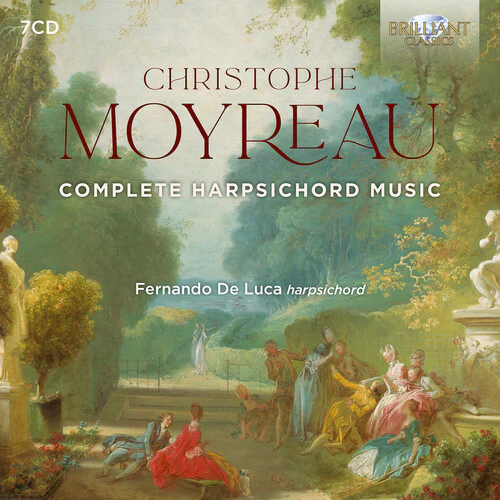
Played by Fernando De Luca, one of Italy’s foremost harpsichord players, who recorded to great critical acclaim the complete keyboard works by Graupner, published by Brilliant Classics. The first-ever survey on record of the complete surviving output by a significant contemporary of Rameau: a missing piece in the jigsaw of the French Baroque.
Christophe Moyreau (1700-1774) was born and spent most of his life in Orléans. He became organist at Orléans Collégiale Saint-Aignan in February 1719 and at Orléans Cathedral in January 1738 and occupied this position until around 1772. In French music of his era (secular and also religious), an important place was reserved for the rhythms and structures of the dance. In 1753 Moyreau published his “Pièces de clavecin”, 124 pieces grouped in 6 books. The dances Allemande, Courante, Sarabande, Gigue, Rigaudon, Menuet are part of Suites, while these books also include concertos and sonatas. Some of the pieces bear titles (in the style of Couperin and Rameau) like La Flotante, Le Baccante, Le Jaloux, La Coquette, Le Preludant, L'Euridice, La Comique, L'Orphée and Le Caprice. Book 6, uniquely for French harpsichord music, consists of several three-movement keyboard simphonies written in Italian style.
Played by Fernando De Luca, one of Italy’s foremost harpsichord players, who recorded to great critical acclaim the complete keyboard works by Graupner, published by Brilliant Classics. The first-ever survey on record of the complete surviving output by a significant contemporary of Rameau: a missing piece in the jigsaw of the French Baroque.
Description
Christophe Moyreau (1700-1774) was born and spent most of his life in Orléans. He became organist at Orléans Collégiale Saint-Aignan in February 1719 and at Orléans Cathedral in January 1738 and occupied this position until around 1772. In French music of his era (secular and also religious), an important place was reserved for the rhythms and structures of the dance. In 1753 Moyreau published his “Pièces de clavecin”, 124 pieces grouped in 6 books. The dances Allemande, Courante, Sarabande, Gigue, Rigaudon, Menuet are part of Suites, while these books also include concertos and sonatas. Some of the pieces bear titles (in the style of Couperin and Rameau) like La Flotante, Le Baccante, Le Jaloux, La Coquette, Le Preludant, L'Euridice, La Comique, L'Orphée and Le Caprice. Book 6, uniquely for French harpsichord music, consists of several three-movement keyboard simphonies written in Italian style.
Played by Fernando De Luca, one of Italy’s foremost harpsichord players, who recorded to great critical acclaim the complete keyboard works by Graupner, published by Brilliant Classics. The first-ever survey on record of the complete surviving output by a significant contemporary of Rameau: a missing piece in the jigsaw of the French Baroque.