🎉 Up to 70% Off Selected ItemsShop Sale

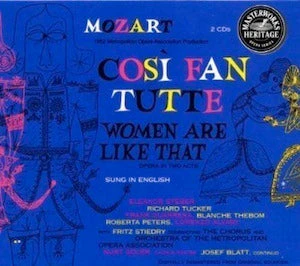
Mozart: Cosi Fan Tutte / Steber, Peters, Stiedry
This recording restores a different variety of "period performance" to the catalog. Recorded in mid-1952, the opera is performed in English (in the Martin translation) by most of the cast that gave the premiere of the Met's 1951 production. 'Cosí fan tutte' was thought to be improved most by leaving a lot of it out. Dorabella and Ferrando lose their second act arias as well as the usual omission of the little duet in act I. Aside from the absence of vocal embellishment and the sheer weight of the forces used, the performance is surprisingly close to historically informed performance practice. Tempos are fleet, the recitatives--albeit much abridged--are accompanied by a piano, and the tone is conversational.
The four lovers were cast with big voices that today would be associated with Verdi. Of the women, Eleanor Steber's weighty and beautifully sung Fiordiligi and, in contrast, the quite young Roberta Peters' very pert Despina are the standouts. Richard Tucker as Ferrando is the best of the men, very funny and surprisingly fluent, deploying his golden tone in a role unexpected in light of his fame as a Verdi singer. An interesting window on the history of Mozart performance.
The four lovers were cast with big voices that today would be associated with Verdi. Of the women, Eleanor Steber's weighty and beautifully sung Fiordiligi and, in contrast, the quite young Roberta Peters' very pert Despina are the standouts. Richard Tucker as Ferrando is the best of the men, very funny and surprisingly fluent, deploying his golden tone in a role unexpected in light of his fame as a Verdi singer. An interesting window on the history of Mozart performance.
This recording restores a different variety of "period performance" to the catalog. Recorded in mid-1952, the opera is performed in English (in the Martin translation) by most of the cast that gave the premiere of the Met's 1951 production. 'Cosí fan tutte' was thought to be improved most by leaving a lot of it out. Dorabella and Ferrando lose their second act arias as well as the usual omission of the little duet in act I. Aside from the absence of vocal embellishment and the sheer weight of the forces used, the performance is surprisingly close to historically informed performance practice. Tempos are fleet, the recitatives--albeit much abridged--are accompanied by a piano, and the tone is conversational.
The four lovers were cast with big voices that today would be associated with Verdi. Of the women, Eleanor Steber's weighty and beautifully sung Fiordiligi and, in contrast, the quite young Roberta Peters' very pert Despina are the standouts. Richard Tucker as Ferrando is the best of the men, very funny and surprisingly fluent, deploying his golden tone in a role unexpected in light of his fame as a Verdi singer. An interesting window on the history of Mozart performance.
The four lovers were cast with big voices that today would be associated with Verdi. Of the women, Eleanor Steber's weighty and beautifully sung Fiordiligi and, in contrast, the quite young Roberta Peters' very pert Despina are the standouts. Richard Tucker as Ferrando is the best of the men, very funny and surprisingly fluent, deploying his golden tone in a role unexpected in light of his fame as a Verdi singer. An interesting window on the history of Mozart performance.
$8.05
Original: $22.99
-65%Mozart: Cosi Fan Tutte / Steber, Peters, Stiedry—
$22.99
$8.05Description
This recording restores a different variety of "period performance" to the catalog. Recorded in mid-1952, the opera is performed in English (in the Martin translation) by most of the cast that gave the premiere of the Met's 1951 production. 'Cosí fan tutte' was thought to be improved most by leaving a lot of it out. Dorabella and Ferrando lose their second act arias as well as the usual omission of the little duet in act I. Aside from the absence of vocal embellishment and the sheer weight of the forces used, the performance is surprisingly close to historically informed performance practice. Tempos are fleet, the recitatives--albeit much abridged--are accompanied by a piano, and the tone is conversational.
The four lovers were cast with big voices that today would be associated with Verdi. Of the women, Eleanor Steber's weighty and beautifully sung Fiordiligi and, in contrast, the quite young Roberta Peters' very pert Despina are the standouts. Richard Tucker as Ferrando is the best of the men, very funny and surprisingly fluent, deploying his golden tone in a role unexpected in light of his fame as a Verdi singer. An interesting window on the history of Mozart performance.
The four lovers were cast with big voices that today would be associated with Verdi. Of the women, Eleanor Steber's weighty and beautifully sung Fiordiligi and, in contrast, the quite young Roberta Peters' very pert Despina are the standouts. Richard Tucker as Ferrando is the best of the men, very funny and surprisingly fluent, deploying his golden tone in a role unexpected in light of his fame as a Verdi singer. An interesting window on the history of Mozart performance.