🎉 Up to 70% Off Selected ItemsShop Sale

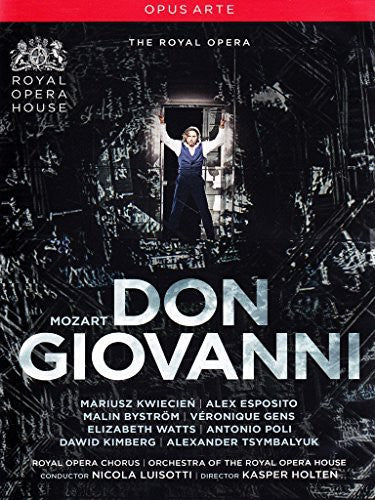
Mozart: Don Giovanni / Luisotti, Gens, Watts, Esposito, Kwiecien
Also available on Blu-ray
Don Giovanni, Mozart’s sublime tragic comedy, offers boundless scope for directors. Kasper Holten shifts the emphasis from Don Giovanni’s sex life into a darker place, showing Giovanni’s womanizing as an attempt to stave off his own mortality. Each woman he seduces represents a life he could have had. Though it is a dark piece, Holten handles it all with a light touch. Led by conductor Nicola Luisotti, the superb cast features Mariusz Kwiecien as Don Giovanni, Alex Esposito and French soprano Véronique Gens. ‘‘…a cast that can’t be bettered today…demands to be seen.’’ Seen and Heard Int’l
Wolfgang Amadeus Mozart
DON GIOVANNI
Don Giovanni - Mariusz Kwiecien
Leporello - Alex Esposito
Donna Anna - Malin Byström
Commendatore - Alexander Tsymbalyuk
Don Ottavio - Antonio Poli
Donna Elvira - Véronique Gens
Zerlina - Elizabeth Watts
Masetto - Dawid Kimberg
Donna Elvira’s Maid - Josephine Arden
Royal Opera Chorus
(chorus master: Renato Balsadonna)
Royal Opera House Orchestra
Nicola Luisotti, conductor
Kasper Holten, stage director
Es Devlin, set designer
Anja Vang Kragh, costume designer
Bruno Poet, lighting designer
Signe Fabricius, choreographer
Recorded live at the Royal Opera House, February 2014
Bonus:
- Introductions: Don Giovanni’s Women
- Director’s Commentary
Picture format: NTSC 16:9 anamorphic
Sound format: LPCM 2. 0 / DTS 5.1
Region code: 0 (worldwide)
Subtitles: English, French, German, Japanese, Korean
Running time: 187 mins
No. of DVDs: 1
R E V I E W:
There used to be an old line about leaving the theater humming the scenery; often it applied to Franco Zeffirelli-like productions–lavish, flowery, big-boned, visually melodious eye-candy. Well, the same might be said for this recent Covent Garden show designed by Es Devlin and directed by Kasper Holton with video designs by Luke Halls, except that one would have to be able to hum scenery that was atonal and intensely complex, albeit spectacularly interesting.
Riveting to behold and almost constantly changing either subtly or dramatically, it is a two-storey structure that takes up the whole stage and is made up of rooms with doors that appear and disappear, as well as interior and exterior staircases that, Escher-like, seem to end in mid-journey, or in fact never end at all. And it revolves. Onto its vast surfaces video designer Lukas Hall offers projections of everything from the names of Giovanni’s lovers (written in script) to subtle or dramatic changes in color, to a labyrinthine confusion of rooms in which each character seems lost and wandering, to sheer meaningless graffiti and scribbling. Rather than distracting from the drama, it allows it to be fluid: corners can be created instantly, allowing, for instance, Leporello and Giovanni to hide from Elvira and her maid in Act 2. (A brilliant effect has Leporello disappear into the scenery by imposing projections on top of him.) In short, it’s inspired and fascinating, and aside from a few moments that dazzle so thoroughly that they take our mind off the music, I suspect you’ll be riveted.
Anja Vang Kragh’s costumes imply a late-Victorian era; the dress and winged cape for Elvira make her look vaguely like an angel of death. Masetto looks like a prim clerk in a lawyer’s office and Zerlina always wears her wedding dress; Ottavio is a stuffed shirt (which he finally unbuttons at one point). The Don wears a blue fur-collared coat; Leporello is dressed as the perfect sad sack. The dead Commendatore, in white black-smeared sheet and face, is quite scary.
And so, musically and dramatically, there is only one performance that lives up to the scenery, and the direction, which gets clearer as the evening goes on, seems wayward for the first three quarters of the opera. The punchline is that Giovanni’s punishment is madness and loneliness–a type of hell. Throughout, it is difficult to figure out each character’s motivation, or even personality. Anna seems less than bothered by her “rape” by Giovanni in the first scene: there he is, doing up his cuffs, while she is embracing him; later, during Ottavio’s “Dalla sua pace”, she spots the Don up on the set’s second level and goes to him and follows him into a room. Of course, who can blame her for walking out on Ottavio: when she sings “Don Ottavio, son morta!” and goes on to explain that “that man” is the man who attacked her and killed her father, Ottavio giggles! He’s simply a dope.
Donna Elvira seems merely lost, although my instinct about her being an angel of death may not be too far off: she kisses Giovanni tenderly at one point when most Elvira’s are loony. Perhaps she and she alone senses his isolation? Zerlina, by Act 2, is repentant for her bad, flirty behavior in Act 1 (she starts tearing off her clothes in the finale), and she and Masetto–a nerd if ever there were one–stroll off happily. Leporello adores the Don while trying to stop him from being crazy; he weeps uncontrollably in the final scene when it becomes clear that Giovanni is going mad. And the Don, who invariably is somewhere on stage during all of the action, is always seeking and increasingly alone.
Real problems: Kasper Holten eliminates the flames, or any sense of hell; instead of a handshake (from the Commendatore, who is two storeys above the Don), the Don grips his heart and stumbles into a corner. Worse: Holten cuts the first part of the final scene, the sextet in which the others explain what their lives will be like now that the Don is gone. All we get is the opera’s two-minute moral, sung offstage: ”Questo e il fin di chi fa mal.” I know that Mozart himself (may have) cut part or all of the opera’s last moments for Vienna, but with your main character in hell, it almost makes sense. The six characters have a right to express themselves, unless, of course, the director’s entire concept has implied their lack of importance, with the Don the utter center of his own universe and the others just throw-aways who no longer exist. It’s problematic–not foolish or outlandish, but problematic–and goes along with the lack of characterization of these people throughout.
Holten succeeds with his idea, but is it a good idea? You will either buy it or not; I suspect that you’ll wonder where it’s all going until the end, and even then, when you understand (“Ah – he’s alone!”), the musical cut will irritate you. All that being said, anyone who misses Marius Kweicien’s performance here will regret it. In 40 years of opera-going, and having seen 15 different Dons, never have I seen a final scene so aggressively personal, so mad, so viciously without repentance, so insane. It will leave you exhausted (and wishing for the usual sextet!). He’s terrific throughout the opera even if we don’t quite understand his raison d’etre, singing with accuracy, charm, bite when necessary, dead-center pitch, and a smooth, seductive legato. He also moves like a born actor. Malin Byström’s Anna acts demurely but sings with passion–occasionally harridan-like and in strange-sounding Italian–but invariably involved, although apparently not interested in vengeance. Véronique Gens is a glamorous Elvira even if her character is undersized here; she dispatches her second-act aria with aplomb. Elizabeth Watts’ Zerlina is charming and pure-toned.
Alex Esposito offers a star turn as Leporello. Looking downtrodden, somewhat like a silent-movie bum, he is fascinated and infuriated by his boss. He’s funny (he seems to have some of Rolando Villazon’s comic charm, although they look nothing alike) and not a fool, and his singing is rich and nuanced. Antonio Poli is vocally better than good as Ottavio and the same can be said of Dawid Kimberg’s Masetto, but their blandness may have something to do with Holten’s outlook. (Maybe all men are either duds, servants, or dead, except for Don Giovanni?) Alexander Tsymbalyuk makes little impression as the Commendatore until the final scene, where he may be amplified. Nicola Luisotti’s leadership varies–the overture is splendid, but much of Act 1 just passes by without highlights; he certainly pulls out the stops later, however. The Covent Garden forces are downright magnificent.
At the conclusion, what can one say about a Don Giovanni that is neither sexy nor dangerous, but interestingly philosophical? If the answer is that the Hell is, in fact, not other people, but loneliness, then we have a hypothesis, not a great opera. But as I said, Kweicien will knock you out by the end.
A truly great DVD version of this opera? Well, except for the weird constant changes of hairstyles and outfits (yes, we get it–the story is universal), the Riccardo Muti-led performance on TDK is magnificent, while Terfel, Furlanetto, and Fleming lead a terrific cast from the Met on DG on Zeffirelli’s rather ordinary set. Most of the others (more than a dozen) have too many quirks: one takes place in a mattress showroom; in another the Don and Leporello are junkies; in a third, the Don is killed in Act 1 but the opera continues…. It’s up to you.
-- Robert Levine, ClassicsToday.com
Don Giovanni, Mozart’s sublime tragic comedy, offers boundless scope for directors. Kasper Holten shifts the emphasis from Don Giovanni’s sex life into a darker place, showing Giovanni’s womanizing as an attempt to stave off his own mortality. Each woman he seduces represents a life he could have had. Though it is a dark piece, Holten handles it all with a light touch. Led by conductor Nicola Luisotti, the superb cast features Mariusz Kwiecien as Don Giovanni, Alex Esposito and French soprano Véronique Gens. ‘‘…a cast that can’t be bettered today…demands to be seen.’’ Seen and Heard Int’l
Wolfgang Amadeus Mozart
DON GIOVANNI
Don Giovanni - Mariusz Kwiecien
Leporello - Alex Esposito
Donna Anna - Malin Byström
Commendatore - Alexander Tsymbalyuk
Don Ottavio - Antonio Poli
Donna Elvira - Véronique Gens
Zerlina - Elizabeth Watts
Masetto - Dawid Kimberg
Donna Elvira’s Maid - Josephine Arden
Royal Opera Chorus
(chorus master: Renato Balsadonna)
Royal Opera House Orchestra
Nicola Luisotti, conductor
Kasper Holten, stage director
Es Devlin, set designer
Anja Vang Kragh, costume designer
Bruno Poet, lighting designer
Signe Fabricius, choreographer
Recorded live at the Royal Opera House, February 2014
Bonus:
- Introductions: Don Giovanni’s Women
- Director’s Commentary
Picture format: NTSC 16:9 anamorphic
Sound format: LPCM 2. 0 / DTS 5.1
Region code: 0 (worldwide)
Subtitles: English, French, German, Japanese, Korean
Running time: 187 mins
No. of DVDs: 1
R E V I E W:
There used to be an old line about leaving the theater humming the scenery; often it applied to Franco Zeffirelli-like productions–lavish, flowery, big-boned, visually melodious eye-candy. Well, the same might be said for this recent Covent Garden show designed by Es Devlin and directed by Kasper Holton with video designs by Luke Halls, except that one would have to be able to hum scenery that was atonal and intensely complex, albeit spectacularly interesting.
Riveting to behold and almost constantly changing either subtly or dramatically, it is a two-storey structure that takes up the whole stage and is made up of rooms with doors that appear and disappear, as well as interior and exterior staircases that, Escher-like, seem to end in mid-journey, or in fact never end at all. And it revolves. Onto its vast surfaces video designer Lukas Hall offers projections of everything from the names of Giovanni’s lovers (written in script) to subtle or dramatic changes in color, to a labyrinthine confusion of rooms in which each character seems lost and wandering, to sheer meaningless graffiti and scribbling. Rather than distracting from the drama, it allows it to be fluid: corners can be created instantly, allowing, for instance, Leporello and Giovanni to hide from Elvira and her maid in Act 2. (A brilliant effect has Leporello disappear into the scenery by imposing projections on top of him.) In short, it’s inspired and fascinating, and aside from a few moments that dazzle so thoroughly that they take our mind off the music, I suspect you’ll be riveted.
Anja Vang Kragh’s costumes imply a late-Victorian era; the dress and winged cape for Elvira make her look vaguely like an angel of death. Masetto looks like a prim clerk in a lawyer’s office and Zerlina always wears her wedding dress; Ottavio is a stuffed shirt (which he finally unbuttons at one point). The Don wears a blue fur-collared coat; Leporello is dressed as the perfect sad sack. The dead Commendatore, in white black-smeared sheet and face, is quite scary.
And so, musically and dramatically, there is only one performance that lives up to the scenery, and the direction, which gets clearer as the evening goes on, seems wayward for the first three quarters of the opera. The punchline is that Giovanni’s punishment is madness and loneliness–a type of hell. Throughout, it is difficult to figure out each character’s motivation, or even personality. Anna seems less than bothered by her “rape” by Giovanni in the first scene: there he is, doing up his cuffs, while she is embracing him; later, during Ottavio’s “Dalla sua pace”, she spots the Don up on the set’s second level and goes to him and follows him into a room. Of course, who can blame her for walking out on Ottavio: when she sings “Don Ottavio, son morta!” and goes on to explain that “that man” is the man who attacked her and killed her father, Ottavio giggles! He’s simply a dope.
Donna Elvira seems merely lost, although my instinct about her being an angel of death may not be too far off: she kisses Giovanni tenderly at one point when most Elvira’s are loony. Perhaps she and she alone senses his isolation? Zerlina, by Act 2, is repentant for her bad, flirty behavior in Act 1 (she starts tearing off her clothes in the finale), and she and Masetto–a nerd if ever there were one–stroll off happily. Leporello adores the Don while trying to stop him from being crazy; he weeps uncontrollably in the final scene when it becomes clear that Giovanni is going mad. And the Don, who invariably is somewhere on stage during all of the action, is always seeking and increasingly alone.
Real problems: Kasper Holten eliminates the flames, or any sense of hell; instead of a handshake (from the Commendatore, who is two storeys above the Don), the Don grips his heart and stumbles into a corner. Worse: Holten cuts the first part of the final scene, the sextet in which the others explain what their lives will be like now that the Don is gone. All we get is the opera’s two-minute moral, sung offstage: ”Questo e il fin di chi fa mal.” I know that Mozart himself (may have) cut part or all of the opera’s last moments for Vienna, but with your main character in hell, it almost makes sense. The six characters have a right to express themselves, unless, of course, the director’s entire concept has implied their lack of importance, with the Don the utter center of his own universe and the others just throw-aways who no longer exist. It’s problematic–not foolish or outlandish, but problematic–and goes along with the lack of characterization of these people throughout.
Holten succeeds with his idea, but is it a good idea? You will either buy it or not; I suspect that you’ll wonder where it’s all going until the end, and even then, when you understand (“Ah – he’s alone!”), the musical cut will irritate you. All that being said, anyone who misses Marius Kweicien’s performance here will regret it. In 40 years of opera-going, and having seen 15 different Dons, never have I seen a final scene so aggressively personal, so mad, so viciously without repentance, so insane. It will leave you exhausted (and wishing for the usual sextet!). He’s terrific throughout the opera even if we don’t quite understand his raison d’etre, singing with accuracy, charm, bite when necessary, dead-center pitch, and a smooth, seductive legato. He also moves like a born actor. Malin Byström’s Anna acts demurely but sings with passion–occasionally harridan-like and in strange-sounding Italian–but invariably involved, although apparently not interested in vengeance. Véronique Gens is a glamorous Elvira even if her character is undersized here; she dispatches her second-act aria with aplomb. Elizabeth Watts’ Zerlina is charming and pure-toned.
Alex Esposito offers a star turn as Leporello. Looking downtrodden, somewhat like a silent-movie bum, he is fascinated and infuriated by his boss. He’s funny (he seems to have some of Rolando Villazon’s comic charm, although they look nothing alike) and not a fool, and his singing is rich and nuanced. Antonio Poli is vocally better than good as Ottavio and the same can be said of Dawid Kimberg’s Masetto, but their blandness may have something to do with Holten’s outlook. (Maybe all men are either duds, servants, or dead, except for Don Giovanni?) Alexander Tsymbalyuk makes little impression as the Commendatore until the final scene, where he may be amplified. Nicola Luisotti’s leadership varies–the overture is splendid, but much of Act 1 just passes by without highlights; he certainly pulls out the stops later, however. The Covent Garden forces are downright magnificent.
At the conclusion, what can one say about a Don Giovanni that is neither sexy nor dangerous, but interestingly philosophical? If the answer is that the Hell is, in fact, not other people, but loneliness, then we have a hypothesis, not a great opera. But as I said, Kweicien will knock you out by the end.
A truly great DVD version of this opera? Well, except for the weird constant changes of hairstyles and outfits (yes, we get it–the story is universal), the Riccardo Muti-led performance on TDK is magnificent, while Terfel, Furlanetto, and Fleming lead a terrific cast from the Met on DG on Zeffirelli’s rather ordinary set. Most of the others (more than a dozen) have too many quirks: one takes place in a mattress showroom; in another the Don and Leporello are junkies; in a third, the Don is killed in Act 1 but the opera continues…. It’s up to you.
-- Robert Levine, ClassicsToday.com
Also available on Blu-ray
Don Giovanni, Mozart’s sublime tragic comedy, offers boundless scope for directors. Kasper Holten shifts the emphasis from Don Giovanni’s sex life into a darker place, showing Giovanni’s womanizing as an attempt to stave off his own mortality. Each woman he seduces represents a life he could have had. Though it is a dark piece, Holten handles it all with a light touch. Led by conductor Nicola Luisotti, the superb cast features Mariusz Kwiecien as Don Giovanni, Alex Esposito and French soprano Véronique Gens. ‘‘…a cast that can’t be bettered today…demands to be seen.’’ Seen and Heard Int’l
Wolfgang Amadeus Mozart
DON GIOVANNI
Don Giovanni - Mariusz Kwiecien
Leporello - Alex Esposito
Donna Anna - Malin Byström
Commendatore - Alexander Tsymbalyuk
Don Ottavio - Antonio Poli
Donna Elvira - Véronique Gens
Zerlina - Elizabeth Watts
Masetto - Dawid Kimberg
Donna Elvira’s Maid - Josephine Arden
Royal Opera Chorus
(chorus master: Renato Balsadonna)
Royal Opera House Orchestra
Nicola Luisotti, conductor
Kasper Holten, stage director
Es Devlin, set designer
Anja Vang Kragh, costume designer
Bruno Poet, lighting designer
Signe Fabricius, choreographer
Recorded live at the Royal Opera House, February 2014
Bonus:
- Introductions: Don Giovanni’s Women
- Director’s Commentary
Picture format: NTSC 16:9 anamorphic
Sound format: LPCM 2. 0 / DTS 5.1
Region code: 0 (worldwide)
Subtitles: English, French, German, Japanese, Korean
Running time: 187 mins
No. of DVDs: 1
R E V I E W:
There used to be an old line about leaving the theater humming the scenery; often it applied to Franco Zeffirelli-like productions–lavish, flowery, big-boned, visually melodious eye-candy. Well, the same might be said for this recent Covent Garden show designed by Es Devlin and directed by Kasper Holton with video designs by Luke Halls, except that one would have to be able to hum scenery that was atonal and intensely complex, albeit spectacularly interesting.
Riveting to behold and almost constantly changing either subtly or dramatically, it is a two-storey structure that takes up the whole stage and is made up of rooms with doors that appear and disappear, as well as interior and exterior staircases that, Escher-like, seem to end in mid-journey, or in fact never end at all. And it revolves. Onto its vast surfaces video designer Lukas Hall offers projections of everything from the names of Giovanni’s lovers (written in script) to subtle or dramatic changes in color, to a labyrinthine confusion of rooms in which each character seems lost and wandering, to sheer meaningless graffiti and scribbling. Rather than distracting from the drama, it allows it to be fluid: corners can be created instantly, allowing, for instance, Leporello and Giovanni to hide from Elvira and her maid in Act 2. (A brilliant effect has Leporello disappear into the scenery by imposing projections on top of him.) In short, it’s inspired and fascinating, and aside from a few moments that dazzle so thoroughly that they take our mind off the music, I suspect you’ll be riveted.
Anja Vang Kragh’s costumes imply a late-Victorian era; the dress and winged cape for Elvira make her look vaguely like an angel of death. Masetto looks like a prim clerk in a lawyer’s office and Zerlina always wears her wedding dress; Ottavio is a stuffed shirt (which he finally unbuttons at one point). The Don wears a blue fur-collared coat; Leporello is dressed as the perfect sad sack. The dead Commendatore, in white black-smeared sheet and face, is quite scary.
And so, musically and dramatically, there is only one performance that lives up to the scenery, and the direction, which gets clearer as the evening goes on, seems wayward for the first three quarters of the opera. The punchline is that Giovanni’s punishment is madness and loneliness–a type of hell. Throughout, it is difficult to figure out each character’s motivation, or even personality. Anna seems less than bothered by her “rape” by Giovanni in the first scene: there he is, doing up his cuffs, while she is embracing him; later, during Ottavio’s “Dalla sua pace”, she spots the Don up on the set’s second level and goes to him and follows him into a room. Of course, who can blame her for walking out on Ottavio: when she sings “Don Ottavio, son morta!” and goes on to explain that “that man” is the man who attacked her and killed her father, Ottavio giggles! He’s simply a dope.
Donna Elvira seems merely lost, although my instinct about her being an angel of death may not be too far off: she kisses Giovanni tenderly at one point when most Elvira’s are loony. Perhaps she and she alone senses his isolation? Zerlina, by Act 2, is repentant for her bad, flirty behavior in Act 1 (she starts tearing off her clothes in the finale), and she and Masetto–a nerd if ever there were one–stroll off happily. Leporello adores the Don while trying to stop him from being crazy; he weeps uncontrollably in the final scene when it becomes clear that Giovanni is going mad. And the Don, who invariably is somewhere on stage during all of the action, is always seeking and increasingly alone.
Real problems: Kasper Holten eliminates the flames, or any sense of hell; instead of a handshake (from the Commendatore, who is two storeys above the Don), the Don grips his heart and stumbles into a corner. Worse: Holten cuts the first part of the final scene, the sextet in which the others explain what their lives will be like now that the Don is gone. All we get is the opera’s two-minute moral, sung offstage: ”Questo e il fin di chi fa mal.” I know that Mozart himself (may have) cut part or all of the opera’s last moments for Vienna, but with your main character in hell, it almost makes sense. The six characters have a right to express themselves, unless, of course, the director’s entire concept has implied their lack of importance, with the Don the utter center of his own universe and the others just throw-aways who no longer exist. It’s problematic–not foolish or outlandish, but problematic–and goes along with the lack of characterization of these people throughout.
Holten succeeds with his idea, but is it a good idea? You will either buy it or not; I suspect that you’ll wonder where it’s all going until the end, and even then, when you understand (“Ah – he’s alone!”), the musical cut will irritate you. All that being said, anyone who misses Marius Kweicien’s performance here will regret it. In 40 years of opera-going, and having seen 15 different Dons, never have I seen a final scene so aggressively personal, so mad, so viciously without repentance, so insane. It will leave you exhausted (and wishing for the usual sextet!). He’s terrific throughout the opera even if we don’t quite understand his raison d’etre, singing with accuracy, charm, bite when necessary, dead-center pitch, and a smooth, seductive legato. He also moves like a born actor. Malin Byström’s Anna acts demurely but sings with passion–occasionally harridan-like and in strange-sounding Italian–but invariably involved, although apparently not interested in vengeance. Véronique Gens is a glamorous Elvira even if her character is undersized here; she dispatches her second-act aria with aplomb. Elizabeth Watts’ Zerlina is charming and pure-toned.
Alex Esposito offers a star turn as Leporello. Looking downtrodden, somewhat like a silent-movie bum, he is fascinated and infuriated by his boss. He’s funny (he seems to have some of Rolando Villazon’s comic charm, although they look nothing alike) and not a fool, and his singing is rich and nuanced. Antonio Poli is vocally better than good as Ottavio and the same can be said of Dawid Kimberg’s Masetto, but their blandness may have something to do with Holten’s outlook. (Maybe all men are either duds, servants, or dead, except for Don Giovanni?) Alexander Tsymbalyuk makes little impression as the Commendatore until the final scene, where he may be amplified. Nicola Luisotti’s leadership varies–the overture is splendid, but much of Act 1 just passes by without highlights; he certainly pulls out the stops later, however. The Covent Garden forces are downright magnificent.
At the conclusion, what can one say about a Don Giovanni that is neither sexy nor dangerous, but interestingly philosophical? If the answer is that the Hell is, in fact, not other people, but loneliness, then we have a hypothesis, not a great opera. But as I said, Kweicien will knock you out by the end.
A truly great DVD version of this opera? Well, except for the weird constant changes of hairstyles and outfits (yes, we get it–the story is universal), the Riccardo Muti-led performance on TDK is magnificent, while Terfel, Furlanetto, and Fleming lead a terrific cast from the Met on DG on Zeffirelli’s rather ordinary set. Most of the others (more than a dozen) have too many quirks: one takes place in a mattress showroom; in another the Don and Leporello are junkies; in a third, the Don is killed in Act 1 but the opera continues…. It’s up to you.
-- Robert Levine, ClassicsToday.com
Don Giovanni, Mozart’s sublime tragic comedy, offers boundless scope for directors. Kasper Holten shifts the emphasis from Don Giovanni’s sex life into a darker place, showing Giovanni’s womanizing as an attempt to stave off his own mortality. Each woman he seduces represents a life he could have had. Though it is a dark piece, Holten handles it all with a light touch. Led by conductor Nicola Luisotti, the superb cast features Mariusz Kwiecien as Don Giovanni, Alex Esposito and French soprano Véronique Gens. ‘‘…a cast that can’t be bettered today…demands to be seen.’’ Seen and Heard Int’l
Wolfgang Amadeus Mozart
DON GIOVANNI
Don Giovanni - Mariusz Kwiecien
Leporello - Alex Esposito
Donna Anna - Malin Byström
Commendatore - Alexander Tsymbalyuk
Don Ottavio - Antonio Poli
Donna Elvira - Véronique Gens
Zerlina - Elizabeth Watts
Masetto - Dawid Kimberg
Donna Elvira’s Maid - Josephine Arden
Royal Opera Chorus
(chorus master: Renato Balsadonna)
Royal Opera House Orchestra
Nicola Luisotti, conductor
Kasper Holten, stage director
Es Devlin, set designer
Anja Vang Kragh, costume designer
Bruno Poet, lighting designer
Signe Fabricius, choreographer
Recorded live at the Royal Opera House, February 2014
Bonus:
- Introductions: Don Giovanni’s Women
- Director’s Commentary
Picture format: NTSC 16:9 anamorphic
Sound format: LPCM 2. 0 / DTS 5.1
Region code: 0 (worldwide)
Subtitles: English, French, German, Japanese, Korean
Running time: 187 mins
No. of DVDs: 1
R E V I E W:
There used to be an old line about leaving the theater humming the scenery; often it applied to Franco Zeffirelli-like productions–lavish, flowery, big-boned, visually melodious eye-candy. Well, the same might be said for this recent Covent Garden show designed by Es Devlin and directed by Kasper Holton with video designs by Luke Halls, except that one would have to be able to hum scenery that was atonal and intensely complex, albeit spectacularly interesting.
Riveting to behold and almost constantly changing either subtly or dramatically, it is a two-storey structure that takes up the whole stage and is made up of rooms with doors that appear and disappear, as well as interior and exterior staircases that, Escher-like, seem to end in mid-journey, or in fact never end at all. And it revolves. Onto its vast surfaces video designer Lukas Hall offers projections of everything from the names of Giovanni’s lovers (written in script) to subtle or dramatic changes in color, to a labyrinthine confusion of rooms in which each character seems lost and wandering, to sheer meaningless graffiti and scribbling. Rather than distracting from the drama, it allows it to be fluid: corners can be created instantly, allowing, for instance, Leporello and Giovanni to hide from Elvira and her maid in Act 2. (A brilliant effect has Leporello disappear into the scenery by imposing projections on top of him.) In short, it’s inspired and fascinating, and aside from a few moments that dazzle so thoroughly that they take our mind off the music, I suspect you’ll be riveted.
Anja Vang Kragh’s costumes imply a late-Victorian era; the dress and winged cape for Elvira make her look vaguely like an angel of death. Masetto looks like a prim clerk in a lawyer’s office and Zerlina always wears her wedding dress; Ottavio is a stuffed shirt (which he finally unbuttons at one point). The Don wears a blue fur-collared coat; Leporello is dressed as the perfect sad sack. The dead Commendatore, in white black-smeared sheet and face, is quite scary.
And so, musically and dramatically, there is only one performance that lives up to the scenery, and the direction, which gets clearer as the evening goes on, seems wayward for the first three quarters of the opera. The punchline is that Giovanni’s punishment is madness and loneliness–a type of hell. Throughout, it is difficult to figure out each character’s motivation, or even personality. Anna seems less than bothered by her “rape” by Giovanni in the first scene: there he is, doing up his cuffs, while she is embracing him; later, during Ottavio’s “Dalla sua pace”, she spots the Don up on the set’s second level and goes to him and follows him into a room. Of course, who can blame her for walking out on Ottavio: when she sings “Don Ottavio, son morta!” and goes on to explain that “that man” is the man who attacked her and killed her father, Ottavio giggles! He’s simply a dope.
Donna Elvira seems merely lost, although my instinct about her being an angel of death may not be too far off: she kisses Giovanni tenderly at one point when most Elvira’s are loony. Perhaps she and she alone senses his isolation? Zerlina, by Act 2, is repentant for her bad, flirty behavior in Act 1 (she starts tearing off her clothes in the finale), and she and Masetto–a nerd if ever there were one–stroll off happily. Leporello adores the Don while trying to stop him from being crazy; he weeps uncontrollably in the final scene when it becomes clear that Giovanni is going mad. And the Don, who invariably is somewhere on stage during all of the action, is always seeking and increasingly alone.
Real problems: Kasper Holten eliminates the flames, or any sense of hell; instead of a handshake (from the Commendatore, who is two storeys above the Don), the Don grips his heart and stumbles into a corner. Worse: Holten cuts the first part of the final scene, the sextet in which the others explain what their lives will be like now that the Don is gone. All we get is the opera’s two-minute moral, sung offstage: ”Questo e il fin di chi fa mal.” I know that Mozart himself (may have) cut part or all of the opera’s last moments for Vienna, but with your main character in hell, it almost makes sense. The six characters have a right to express themselves, unless, of course, the director’s entire concept has implied their lack of importance, with the Don the utter center of his own universe and the others just throw-aways who no longer exist. It’s problematic–not foolish or outlandish, but problematic–and goes along with the lack of characterization of these people throughout.
Holten succeeds with his idea, but is it a good idea? You will either buy it or not; I suspect that you’ll wonder where it’s all going until the end, and even then, when you understand (“Ah – he’s alone!”), the musical cut will irritate you. All that being said, anyone who misses Marius Kweicien’s performance here will regret it. In 40 years of opera-going, and having seen 15 different Dons, never have I seen a final scene so aggressively personal, so mad, so viciously without repentance, so insane. It will leave you exhausted (and wishing for the usual sextet!). He’s terrific throughout the opera even if we don’t quite understand his raison d’etre, singing with accuracy, charm, bite when necessary, dead-center pitch, and a smooth, seductive legato. He also moves like a born actor. Malin Byström’s Anna acts demurely but sings with passion–occasionally harridan-like and in strange-sounding Italian–but invariably involved, although apparently not interested in vengeance. Véronique Gens is a glamorous Elvira even if her character is undersized here; she dispatches her second-act aria with aplomb. Elizabeth Watts’ Zerlina is charming and pure-toned.
Alex Esposito offers a star turn as Leporello. Looking downtrodden, somewhat like a silent-movie bum, he is fascinated and infuriated by his boss. He’s funny (he seems to have some of Rolando Villazon’s comic charm, although they look nothing alike) and not a fool, and his singing is rich and nuanced. Antonio Poli is vocally better than good as Ottavio and the same can be said of Dawid Kimberg’s Masetto, but their blandness may have something to do with Holten’s outlook. (Maybe all men are either duds, servants, or dead, except for Don Giovanni?) Alexander Tsymbalyuk makes little impression as the Commendatore until the final scene, where he may be amplified. Nicola Luisotti’s leadership varies–the overture is splendid, but much of Act 1 just passes by without highlights; he certainly pulls out the stops later, however. The Covent Garden forces are downright magnificent.
At the conclusion, what can one say about a Don Giovanni that is neither sexy nor dangerous, but interestingly philosophical? If the answer is that the Hell is, in fact, not other people, but loneliness, then we have a hypothesis, not a great opera. But as I said, Kweicien will knock you out by the end.
A truly great DVD version of this opera? Well, except for the weird constant changes of hairstyles and outfits (yes, we get it–the story is universal), the Riccardo Muti-led performance on TDK is magnificent, while Terfel, Furlanetto, and Fleming lead a terrific cast from the Met on DG on Zeffirelli’s rather ordinary set. Most of the others (more than a dozen) have too many quirks: one takes place in a mattress showroom; in another the Don and Leporello are junkies; in a third, the Don is killed in Act 1 but the opera continues…. It’s up to you.
-- Robert Levine, ClassicsToday.com
$14.00
Original: $39.99
-65%Mozart: Don Giovanni / Luisotti, Gens, Watts, Esposito, Kwiecien—
$39.99
$14.00Description
Also available on Blu-ray
Don Giovanni, Mozart’s sublime tragic comedy, offers boundless scope for directors. Kasper Holten shifts the emphasis from Don Giovanni’s sex life into a darker place, showing Giovanni’s womanizing as an attempt to stave off his own mortality. Each woman he seduces represents a life he could have had. Though it is a dark piece, Holten handles it all with a light touch. Led by conductor Nicola Luisotti, the superb cast features Mariusz Kwiecien as Don Giovanni, Alex Esposito and French soprano Véronique Gens. ‘‘…a cast that can’t be bettered today…demands to be seen.’’ Seen and Heard Int’l
Wolfgang Amadeus Mozart
DON GIOVANNI
Don Giovanni - Mariusz Kwiecien
Leporello - Alex Esposito
Donna Anna - Malin Byström
Commendatore - Alexander Tsymbalyuk
Don Ottavio - Antonio Poli
Donna Elvira - Véronique Gens
Zerlina - Elizabeth Watts
Masetto - Dawid Kimberg
Donna Elvira’s Maid - Josephine Arden
Royal Opera Chorus
(chorus master: Renato Balsadonna)
Royal Opera House Orchestra
Nicola Luisotti, conductor
Kasper Holten, stage director
Es Devlin, set designer
Anja Vang Kragh, costume designer
Bruno Poet, lighting designer
Signe Fabricius, choreographer
Recorded live at the Royal Opera House, February 2014
Bonus:
- Introductions: Don Giovanni’s Women
- Director’s Commentary
Picture format: NTSC 16:9 anamorphic
Sound format: LPCM 2. 0 / DTS 5.1
Region code: 0 (worldwide)
Subtitles: English, French, German, Japanese, Korean
Running time: 187 mins
No. of DVDs: 1
R E V I E W:
There used to be an old line about leaving the theater humming the scenery; often it applied to Franco Zeffirelli-like productions–lavish, flowery, big-boned, visually melodious eye-candy. Well, the same might be said for this recent Covent Garden show designed by Es Devlin and directed by Kasper Holton with video designs by Luke Halls, except that one would have to be able to hum scenery that was atonal and intensely complex, albeit spectacularly interesting.
Riveting to behold and almost constantly changing either subtly or dramatically, it is a two-storey structure that takes up the whole stage and is made up of rooms with doors that appear and disappear, as well as interior and exterior staircases that, Escher-like, seem to end in mid-journey, or in fact never end at all. And it revolves. Onto its vast surfaces video designer Lukas Hall offers projections of everything from the names of Giovanni’s lovers (written in script) to subtle or dramatic changes in color, to a labyrinthine confusion of rooms in which each character seems lost and wandering, to sheer meaningless graffiti and scribbling. Rather than distracting from the drama, it allows it to be fluid: corners can be created instantly, allowing, for instance, Leporello and Giovanni to hide from Elvira and her maid in Act 2. (A brilliant effect has Leporello disappear into the scenery by imposing projections on top of him.) In short, it’s inspired and fascinating, and aside from a few moments that dazzle so thoroughly that they take our mind off the music, I suspect you’ll be riveted.
Anja Vang Kragh’s costumes imply a late-Victorian era; the dress and winged cape for Elvira make her look vaguely like an angel of death. Masetto looks like a prim clerk in a lawyer’s office and Zerlina always wears her wedding dress; Ottavio is a stuffed shirt (which he finally unbuttons at one point). The Don wears a blue fur-collared coat; Leporello is dressed as the perfect sad sack. The dead Commendatore, in white black-smeared sheet and face, is quite scary.
And so, musically and dramatically, there is only one performance that lives up to the scenery, and the direction, which gets clearer as the evening goes on, seems wayward for the first three quarters of the opera. The punchline is that Giovanni’s punishment is madness and loneliness–a type of hell. Throughout, it is difficult to figure out each character’s motivation, or even personality. Anna seems less than bothered by her “rape” by Giovanni in the first scene: there he is, doing up his cuffs, while she is embracing him; later, during Ottavio’s “Dalla sua pace”, she spots the Don up on the set’s second level and goes to him and follows him into a room. Of course, who can blame her for walking out on Ottavio: when she sings “Don Ottavio, son morta!” and goes on to explain that “that man” is the man who attacked her and killed her father, Ottavio giggles! He’s simply a dope.
Donna Elvira seems merely lost, although my instinct about her being an angel of death may not be too far off: she kisses Giovanni tenderly at one point when most Elvira’s are loony. Perhaps she and she alone senses his isolation? Zerlina, by Act 2, is repentant for her bad, flirty behavior in Act 1 (she starts tearing off her clothes in the finale), and she and Masetto–a nerd if ever there were one–stroll off happily. Leporello adores the Don while trying to stop him from being crazy; he weeps uncontrollably in the final scene when it becomes clear that Giovanni is going mad. And the Don, who invariably is somewhere on stage during all of the action, is always seeking and increasingly alone.
Real problems: Kasper Holten eliminates the flames, or any sense of hell; instead of a handshake (from the Commendatore, who is two storeys above the Don), the Don grips his heart and stumbles into a corner. Worse: Holten cuts the first part of the final scene, the sextet in which the others explain what their lives will be like now that the Don is gone. All we get is the opera’s two-minute moral, sung offstage: ”Questo e il fin di chi fa mal.” I know that Mozart himself (may have) cut part or all of the opera’s last moments for Vienna, but with your main character in hell, it almost makes sense. The six characters have a right to express themselves, unless, of course, the director’s entire concept has implied their lack of importance, with the Don the utter center of his own universe and the others just throw-aways who no longer exist. It’s problematic–not foolish or outlandish, but problematic–and goes along with the lack of characterization of these people throughout.
Holten succeeds with his idea, but is it a good idea? You will either buy it or not; I suspect that you’ll wonder where it’s all going until the end, and even then, when you understand (“Ah – he’s alone!”), the musical cut will irritate you. All that being said, anyone who misses Marius Kweicien’s performance here will regret it. In 40 years of opera-going, and having seen 15 different Dons, never have I seen a final scene so aggressively personal, so mad, so viciously without repentance, so insane. It will leave you exhausted (and wishing for the usual sextet!). He’s terrific throughout the opera even if we don’t quite understand his raison d’etre, singing with accuracy, charm, bite when necessary, dead-center pitch, and a smooth, seductive legato. He also moves like a born actor. Malin Byström’s Anna acts demurely but sings with passion–occasionally harridan-like and in strange-sounding Italian–but invariably involved, although apparently not interested in vengeance. Véronique Gens is a glamorous Elvira even if her character is undersized here; she dispatches her second-act aria with aplomb. Elizabeth Watts’ Zerlina is charming and pure-toned.
Alex Esposito offers a star turn as Leporello. Looking downtrodden, somewhat like a silent-movie bum, he is fascinated and infuriated by his boss. He’s funny (he seems to have some of Rolando Villazon’s comic charm, although they look nothing alike) and not a fool, and his singing is rich and nuanced. Antonio Poli is vocally better than good as Ottavio and the same can be said of Dawid Kimberg’s Masetto, but their blandness may have something to do with Holten’s outlook. (Maybe all men are either duds, servants, or dead, except for Don Giovanni?) Alexander Tsymbalyuk makes little impression as the Commendatore until the final scene, where he may be amplified. Nicola Luisotti’s leadership varies–the overture is splendid, but much of Act 1 just passes by without highlights; he certainly pulls out the stops later, however. The Covent Garden forces are downright magnificent.
At the conclusion, what can one say about a Don Giovanni that is neither sexy nor dangerous, but interestingly philosophical? If the answer is that the Hell is, in fact, not other people, but loneliness, then we have a hypothesis, not a great opera. But as I said, Kweicien will knock you out by the end.
A truly great DVD version of this opera? Well, except for the weird constant changes of hairstyles and outfits (yes, we get it–the story is universal), the Riccardo Muti-led performance on TDK is magnificent, while Terfel, Furlanetto, and Fleming lead a terrific cast from the Met on DG on Zeffirelli’s rather ordinary set. Most of the others (more than a dozen) have too many quirks: one takes place in a mattress showroom; in another the Don and Leporello are junkies; in a third, the Don is killed in Act 1 but the opera continues…. It’s up to you.
-- Robert Levine, ClassicsToday.com
Don Giovanni, Mozart’s sublime tragic comedy, offers boundless scope for directors. Kasper Holten shifts the emphasis from Don Giovanni’s sex life into a darker place, showing Giovanni’s womanizing as an attempt to stave off his own mortality. Each woman he seduces represents a life he could have had. Though it is a dark piece, Holten handles it all with a light touch. Led by conductor Nicola Luisotti, the superb cast features Mariusz Kwiecien as Don Giovanni, Alex Esposito and French soprano Véronique Gens. ‘‘…a cast that can’t be bettered today…demands to be seen.’’ Seen and Heard Int’l
Wolfgang Amadeus Mozart
DON GIOVANNI
Don Giovanni - Mariusz Kwiecien
Leporello - Alex Esposito
Donna Anna - Malin Byström
Commendatore - Alexander Tsymbalyuk
Don Ottavio - Antonio Poli
Donna Elvira - Véronique Gens
Zerlina - Elizabeth Watts
Masetto - Dawid Kimberg
Donna Elvira’s Maid - Josephine Arden
Royal Opera Chorus
(chorus master: Renato Balsadonna)
Royal Opera House Orchestra
Nicola Luisotti, conductor
Kasper Holten, stage director
Es Devlin, set designer
Anja Vang Kragh, costume designer
Bruno Poet, lighting designer
Signe Fabricius, choreographer
Recorded live at the Royal Opera House, February 2014
Bonus:
- Introductions: Don Giovanni’s Women
- Director’s Commentary
Picture format: NTSC 16:9 anamorphic
Sound format: LPCM 2. 0 / DTS 5.1
Region code: 0 (worldwide)
Subtitles: English, French, German, Japanese, Korean
Running time: 187 mins
No. of DVDs: 1
R E V I E W:
There used to be an old line about leaving the theater humming the scenery; often it applied to Franco Zeffirelli-like productions–lavish, flowery, big-boned, visually melodious eye-candy. Well, the same might be said for this recent Covent Garden show designed by Es Devlin and directed by Kasper Holton with video designs by Luke Halls, except that one would have to be able to hum scenery that was atonal and intensely complex, albeit spectacularly interesting.
Riveting to behold and almost constantly changing either subtly or dramatically, it is a two-storey structure that takes up the whole stage and is made up of rooms with doors that appear and disappear, as well as interior and exterior staircases that, Escher-like, seem to end in mid-journey, or in fact never end at all. And it revolves. Onto its vast surfaces video designer Lukas Hall offers projections of everything from the names of Giovanni’s lovers (written in script) to subtle or dramatic changes in color, to a labyrinthine confusion of rooms in which each character seems lost and wandering, to sheer meaningless graffiti and scribbling. Rather than distracting from the drama, it allows it to be fluid: corners can be created instantly, allowing, for instance, Leporello and Giovanni to hide from Elvira and her maid in Act 2. (A brilliant effect has Leporello disappear into the scenery by imposing projections on top of him.) In short, it’s inspired and fascinating, and aside from a few moments that dazzle so thoroughly that they take our mind off the music, I suspect you’ll be riveted.
Anja Vang Kragh’s costumes imply a late-Victorian era; the dress and winged cape for Elvira make her look vaguely like an angel of death. Masetto looks like a prim clerk in a lawyer’s office and Zerlina always wears her wedding dress; Ottavio is a stuffed shirt (which he finally unbuttons at one point). The Don wears a blue fur-collared coat; Leporello is dressed as the perfect sad sack. The dead Commendatore, in white black-smeared sheet and face, is quite scary.
And so, musically and dramatically, there is only one performance that lives up to the scenery, and the direction, which gets clearer as the evening goes on, seems wayward for the first three quarters of the opera. The punchline is that Giovanni’s punishment is madness and loneliness–a type of hell. Throughout, it is difficult to figure out each character’s motivation, or even personality. Anna seems less than bothered by her “rape” by Giovanni in the first scene: there he is, doing up his cuffs, while she is embracing him; later, during Ottavio’s “Dalla sua pace”, she spots the Don up on the set’s second level and goes to him and follows him into a room. Of course, who can blame her for walking out on Ottavio: when she sings “Don Ottavio, son morta!” and goes on to explain that “that man” is the man who attacked her and killed her father, Ottavio giggles! He’s simply a dope.
Donna Elvira seems merely lost, although my instinct about her being an angel of death may not be too far off: she kisses Giovanni tenderly at one point when most Elvira’s are loony. Perhaps she and she alone senses his isolation? Zerlina, by Act 2, is repentant for her bad, flirty behavior in Act 1 (she starts tearing off her clothes in the finale), and she and Masetto–a nerd if ever there were one–stroll off happily. Leporello adores the Don while trying to stop him from being crazy; he weeps uncontrollably in the final scene when it becomes clear that Giovanni is going mad. And the Don, who invariably is somewhere on stage during all of the action, is always seeking and increasingly alone.
Real problems: Kasper Holten eliminates the flames, or any sense of hell; instead of a handshake (from the Commendatore, who is two storeys above the Don), the Don grips his heart and stumbles into a corner. Worse: Holten cuts the first part of the final scene, the sextet in which the others explain what their lives will be like now that the Don is gone. All we get is the opera’s two-minute moral, sung offstage: ”Questo e il fin di chi fa mal.” I know that Mozart himself (may have) cut part or all of the opera’s last moments for Vienna, but with your main character in hell, it almost makes sense. The six characters have a right to express themselves, unless, of course, the director’s entire concept has implied their lack of importance, with the Don the utter center of his own universe and the others just throw-aways who no longer exist. It’s problematic–not foolish or outlandish, but problematic–and goes along with the lack of characterization of these people throughout.
Holten succeeds with his idea, but is it a good idea? You will either buy it or not; I suspect that you’ll wonder where it’s all going until the end, and even then, when you understand (“Ah – he’s alone!”), the musical cut will irritate you. All that being said, anyone who misses Marius Kweicien’s performance here will regret it. In 40 years of opera-going, and having seen 15 different Dons, never have I seen a final scene so aggressively personal, so mad, so viciously without repentance, so insane. It will leave you exhausted (and wishing for the usual sextet!). He’s terrific throughout the opera even if we don’t quite understand his raison d’etre, singing with accuracy, charm, bite when necessary, dead-center pitch, and a smooth, seductive legato. He also moves like a born actor. Malin Byström’s Anna acts demurely but sings with passion–occasionally harridan-like and in strange-sounding Italian–but invariably involved, although apparently not interested in vengeance. Véronique Gens is a glamorous Elvira even if her character is undersized here; she dispatches her second-act aria with aplomb. Elizabeth Watts’ Zerlina is charming and pure-toned.
Alex Esposito offers a star turn as Leporello. Looking downtrodden, somewhat like a silent-movie bum, he is fascinated and infuriated by his boss. He’s funny (he seems to have some of Rolando Villazon’s comic charm, although they look nothing alike) and not a fool, and his singing is rich and nuanced. Antonio Poli is vocally better than good as Ottavio and the same can be said of Dawid Kimberg’s Masetto, but their blandness may have something to do with Holten’s outlook. (Maybe all men are either duds, servants, or dead, except for Don Giovanni?) Alexander Tsymbalyuk makes little impression as the Commendatore until the final scene, where he may be amplified. Nicola Luisotti’s leadership varies–the overture is splendid, but much of Act 1 just passes by without highlights; he certainly pulls out the stops later, however. The Covent Garden forces are downright magnificent.
At the conclusion, what can one say about a Don Giovanni that is neither sexy nor dangerous, but interestingly philosophical? If the answer is that the Hell is, in fact, not other people, but loneliness, then we have a hypothesis, not a great opera. But as I said, Kweicien will knock you out by the end.
A truly great DVD version of this opera? Well, except for the weird constant changes of hairstyles and outfits (yes, we get it–the story is universal), the Riccardo Muti-led performance on TDK is magnificent, while Terfel, Furlanetto, and Fleming lead a terrific cast from the Met on DG on Zeffirelli’s rather ordinary set. Most of the others (more than a dozen) have too many quirks: one takes place in a mattress showroom; in another the Don and Leporello are junkies; in a third, the Don is killed in Act 1 but the opera continues…. It’s up to you.
-- Robert Levine, ClassicsToday.com