🎉 Up to 70% Off Selected ItemsShop Sale

1 / 2
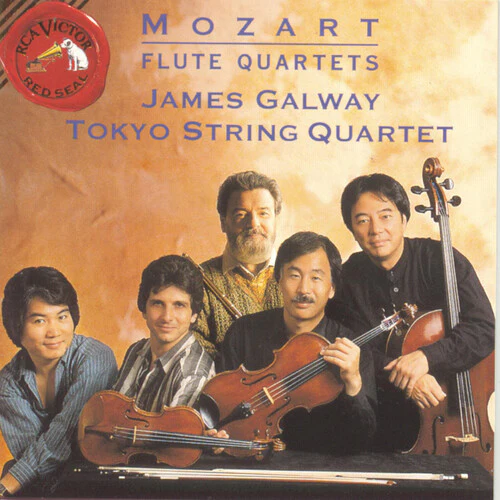
Mozart: Flute Quartets / Galway, Tokyo String Quartet
According to Roger Lustig's well-researched programme notes, Mozart's self-declared dislike for the flute says more about the circumstances surrounding the composition of his works for the instrument than it does about any real hatred for the instrument itself. Furthermore, the performances of the Flute Quartets by James Galway and the Tokyo Quartet, here under review, speak equally eloquently for Mozart's evident care in their composition—this despite Hans Keller's dismissal of them.
The first two quartets, K285 and K285a were written in 1776/7 for the Dutch nobleman Dejean. The playing here is full of Mozartian grace and sensuous melodiousness. At the beginning of the possibly inauthentic C major Quartet, K285b, Galway achieves a delightful liquid quality. The later Quartet, K298 is more substantial and draws playing of haunting intensity from Galway and the Tokyo. The slow tempo of this Quartet's second movement is slower than in the Bennett/Grumiaux version on Philips whose performance has a much more jaunty feel to it. Galway's disc is rounded off with his own arrangement of the Oboe Quartet, K370, whose sumptuous slow movement and elegant finale make this an attractive added bonus. One minor reservation: it is useful to have individual variations separately tracked (K285b.2 and K298.1) but, in the earlier Quartet, there is an annoying click on my disc as the tracks change.
The principal difference between the Galway/ Tokyo and the Bennett/Grumiaux versions reflects the recordings and the circumstances surrounding them. Galway's choice of slower tempos might well have been conditioned, at least in part, by the spacious church acoustic in which it was recorded. The Bennett/Grumiaux was recorded in 1969, but the digital transfer is excellent. These are both fine discs, so choice will be determined by personal taste.'
-- Gramophone [6/1993]
The first two quartets, K285 and K285a were written in 1776/7 for the Dutch nobleman Dejean. The playing here is full of Mozartian grace and sensuous melodiousness. At the beginning of the possibly inauthentic C major Quartet, K285b, Galway achieves a delightful liquid quality. The later Quartet, K298 is more substantial and draws playing of haunting intensity from Galway and the Tokyo. The slow tempo of this Quartet's second movement is slower than in the Bennett/Grumiaux version on Philips whose performance has a much more jaunty feel to it. Galway's disc is rounded off with his own arrangement of the Oboe Quartet, K370, whose sumptuous slow movement and elegant finale make this an attractive added bonus. One minor reservation: it is useful to have individual variations separately tracked (K285b.2 and K298.1) but, in the earlier Quartet, there is an annoying click on my disc as the tracks change.
The principal difference between the Galway/ Tokyo and the Bennett/Grumiaux versions reflects the recordings and the circumstances surrounding them. Galway's choice of slower tempos might well have been conditioned, at least in part, by the spacious church acoustic in which it was recorded. The Bennett/Grumiaux was recorded in 1969, but the digital transfer is excellent. These are both fine discs, so choice will be determined by personal taste.'
-- Gramophone [6/1993]
According to Roger Lustig's well-researched programme notes, Mozart's self-declared dislike for the flute says more about the circumstances surrounding the composition of his works for the instrument than it does about any real hatred for the instrument itself. Furthermore, the performances of the Flute Quartets by James Galway and the Tokyo Quartet, here under review, speak equally eloquently for Mozart's evident care in their composition—this despite Hans Keller's dismissal of them.
The first two quartets, K285 and K285a were written in 1776/7 for the Dutch nobleman Dejean. The playing here is full of Mozartian grace and sensuous melodiousness. At the beginning of the possibly inauthentic C major Quartet, K285b, Galway achieves a delightful liquid quality. The later Quartet, K298 is more substantial and draws playing of haunting intensity from Galway and the Tokyo. The slow tempo of this Quartet's second movement is slower than in the Bennett/Grumiaux version on Philips whose performance has a much more jaunty feel to it. Galway's disc is rounded off with his own arrangement of the Oboe Quartet, K370, whose sumptuous slow movement and elegant finale make this an attractive added bonus. One minor reservation: it is useful to have individual variations separately tracked (K285b.2 and K298.1) but, in the earlier Quartet, there is an annoying click on my disc as the tracks change.
The principal difference between the Galway/ Tokyo and the Bennett/Grumiaux versions reflects the recordings and the circumstances surrounding them. Galway's choice of slower tempos might well have been conditioned, at least in part, by the spacious church acoustic in which it was recorded. The Bennett/Grumiaux was recorded in 1969, but the digital transfer is excellent. These are both fine discs, so choice will be determined by personal taste.'
-- Gramophone [6/1993]
The first two quartets, K285 and K285a were written in 1776/7 for the Dutch nobleman Dejean. The playing here is full of Mozartian grace and sensuous melodiousness. At the beginning of the possibly inauthentic C major Quartet, K285b, Galway achieves a delightful liquid quality. The later Quartet, K298 is more substantial and draws playing of haunting intensity from Galway and the Tokyo. The slow tempo of this Quartet's second movement is slower than in the Bennett/Grumiaux version on Philips whose performance has a much more jaunty feel to it. Galway's disc is rounded off with his own arrangement of the Oboe Quartet, K370, whose sumptuous slow movement and elegant finale make this an attractive added bonus. One minor reservation: it is useful to have individual variations separately tracked (K285b.2 and K298.1) but, in the earlier Quartet, there is an annoying click on my disc as the tracks change.
The principal difference between the Galway/ Tokyo and the Bennett/Grumiaux versions reflects the recordings and the circumstances surrounding them. Galway's choice of slower tempos might well have been conditioned, at least in part, by the spacious church acoustic in which it was recorded. The Bennett/Grumiaux was recorded in 1969, but the digital transfer is excellent. These are both fine discs, so choice will be determined by personal taste.'
-- Gramophone [6/1993]
$6.30
Original: $17.99
-65%Mozart: Flute Quartets / Galway, Tokyo String Quartet—
$17.99
$6.30Description
According to Roger Lustig's well-researched programme notes, Mozart's self-declared dislike for the flute says more about the circumstances surrounding the composition of his works for the instrument than it does about any real hatred for the instrument itself. Furthermore, the performances of the Flute Quartets by James Galway and the Tokyo Quartet, here under review, speak equally eloquently for Mozart's evident care in their composition—this despite Hans Keller's dismissal of them.
The first two quartets, K285 and K285a were written in 1776/7 for the Dutch nobleman Dejean. The playing here is full of Mozartian grace and sensuous melodiousness. At the beginning of the possibly inauthentic C major Quartet, K285b, Galway achieves a delightful liquid quality. The later Quartet, K298 is more substantial and draws playing of haunting intensity from Galway and the Tokyo. The slow tempo of this Quartet's second movement is slower than in the Bennett/Grumiaux version on Philips whose performance has a much more jaunty feel to it. Galway's disc is rounded off with his own arrangement of the Oboe Quartet, K370, whose sumptuous slow movement and elegant finale make this an attractive added bonus. One minor reservation: it is useful to have individual variations separately tracked (K285b.2 and K298.1) but, in the earlier Quartet, there is an annoying click on my disc as the tracks change.
The principal difference between the Galway/ Tokyo and the Bennett/Grumiaux versions reflects the recordings and the circumstances surrounding them. Galway's choice of slower tempos might well have been conditioned, at least in part, by the spacious church acoustic in which it was recorded. The Bennett/Grumiaux was recorded in 1969, but the digital transfer is excellent. These are both fine discs, so choice will be determined by personal taste.'
-- Gramophone [6/1993]
The first two quartets, K285 and K285a were written in 1776/7 for the Dutch nobleman Dejean. The playing here is full of Mozartian grace and sensuous melodiousness. At the beginning of the possibly inauthentic C major Quartet, K285b, Galway achieves a delightful liquid quality. The later Quartet, K298 is more substantial and draws playing of haunting intensity from Galway and the Tokyo. The slow tempo of this Quartet's second movement is slower than in the Bennett/Grumiaux version on Philips whose performance has a much more jaunty feel to it. Galway's disc is rounded off with his own arrangement of the Oboe Quartet, K370, whose sumptuous slow movement and elegant finale make this an attractive added bonus. One minor reservation: it is useful to have individual variations separately tracked (K285b.2 and K298.1) but, in the earlier Quartet, there is an annoying click on my disc as the tracks change.
The principal difference between the Galway/ Tokyo and the Bennett/Grumiaux versions reflects the recordings and the circumstances surrounding them. Galway's choice of slower tempos might well have been conditioned, at least in part, by the spacious church acoustic in which it was recorded. The Bennett/Grumiaux was recorded in 1969, but the digital transfer is excellent. These are both fine discs, so choice will be determined by personal taste.'
-- Gramophone [6/1993]