🎉 Up to 70% Off Selected ItemsShop Sale

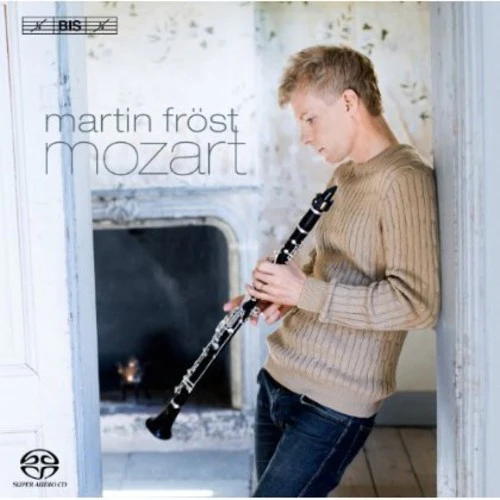
Mozart / Frost
MOZART Clarinet Concerto. 1 Trio for Clarinet, Viola, and Piano, K 498 “Kegelstatt” 2. Allegro for Clarinet and String Quartet, K Anh 91 (516c) 3 • Martin Fröst (cl); 1 cond; 2 Antoine Tamestit (va); 2 Leif Ove Andsnes (pn); 3 Janine Jansen, 3 Boris Brovtsyn (vn); 3 Maxim Rysanov (va); 3 Torleif Thedéen (vc); 1 Deutsche Kammerphilharmonie Bremen • BIS 1893 (SACD: 53:43)
This is Martin Fröst’s second take on the Mozart Clarinet Concerto, recorded some decade after his first bestselling album. He here performs the Concerto, as in his first take, on a basset clarinet. Rather than including the Clarinet Quintet—the standard offering on most albums and his choice for his first disc—Fröst has brought together an array of artists and recorded two other chamber works: the “Kegelstatt” Trio for Clarinet, Viola, and Piano, and the fragmentary Allegro for Clarinet and String Quartet, which was completed only in the 1960s by Robert Levin. Fröst here also follows the path of many a pianist nowadays and chooses to conduct the orchestra himself in the Concerto. It is obviously a work he knows inside and out and loves deeply, as his simple yet heartfelt way with the piece shows. In some ways he sees the piece ever more inwardly speaking than he did his first time around. Though he may be one of the most technically proficient players of his instrument around today, and the ease of his performances is at times bewildering, this should not be confused with emotional distance. His Mozart Concerto sings occasionally, but more often it speaks: the first lone appearance of the instrument seems to grieve over some great loss, the sighing motives made palpable by his ever careful phrasing of them—and this all in the bright key of A Major! His full attention to details of articulation, his use of orchestral swelling to add tension (sometimes a bit much for my taste), and his ability to color his line differently than the orchestra all add to the overall interest in the movement. The Adagio which follows is perhaps even more inward looking than the first, yet it reveals that glimmer of hope that will be fulfilled in the final lighter-hearted, almost bubbling Rondo.
The mood is perfectly set for the more intimate nature of the “Kegelstatt” Trio. Joined by pianist Leif Ove Andsnes and violist Antoine Tamestit, here Fröst and company adopt a much more lyrical, singing approach to the work than that taken in the Concerto, though the energy at times feels a bit low—once again a mellow, inward-looking approach is taken. And though one may quibble about certain details, this is spectacular chamber playing, as just a quick glance at the final Rondo will show: each and every lyrical phrase is carefully performed and thoughtfully answered, producing a wonderful sense of give and take, a palpable sense of dialogue. The small Allegro for Clarinet and String Quartet, of which Mozart left an entire exposition, carefully and tastefully completed by Levin, makes for a fine encore to the recital. The energy that the players bring, along with their fine sense of stylistic matters in terms of articulation, instrumental balance, and gracefulness all add to the overall joie de vivre.
Perhaps my biggest complaint is that this recording gives us only 53 minutes of music; were it not for the final fragmentary Allegro recorded here, or even if a few repeats were to be left out in the mix of movements throughout the recital, the entire Clarinet Quintet could also have fit onto the current recording, and with a stellar roster to perform it! And yet the performances themselves—recorded in spectacularly vivid SACD sound, making one’s home feel like a concert hall—make one forget one’s prejudices about such trivialities. So the real question should be: which Fröst/Mozart should you go for? At least one, and that might depend more on how you like it served: with a side of Clarinet Quintet or a “Kegelstatt” Trio. Either way, you’re in for a treat.
FANFARE: Scott Noriega
MOZART Clarinet Concerto. 1 Trio for Clarinet, Viola, and Piano, K 498 “Kegelstatt” 2. Allegro for Clarinet and String Quartet, K Anh 91 (516c) 3 • Martin Fröst (cl); 1 cond; 2 Antoine Tamestit (va); 2 Leif Ove Andsnes (pn); 3 Janine Jansen, 3 Boris Brovtsyn (vn); 3 Maxim Rysanov (va); 3 Torleif Thedéen (vc); 1 Deutsche Kammerphilharmonie Bremen • BIS 1893 (SACD: 53:43)
This is Martin Fröst’s second take on the Mozart Clarinet Concerto, recorded some decade after his first bestselling album. He here performs the Concerto, as in his first take, on a basset clarinet. Rather than including the Clarinet Quintet—the standard offering on most albums and his choice for his first disc—Fröst has brought together an array of artists and recorded two other chamber works: the “Kegelstatt” Trio for Clarinet, Viola, and Piano, and the fragmentary Allegro for Clarinet and String Quartet, which was completed only in the 1960s by Robert Levin. Fröst here also follows the path of many a pianist nowadays and chooses to conduct the orchestra himself in the Concerto. It is obviously a work he knows inside and out and loves deeply, as his simple yet heartfelt way with the piece shows. In some ways he sees the piece ever more inwardly speaking than he did his first time around. Though he may be one of the most technically proficient players of his instrument around today, and the ease of his performances is at times bewildering, this should not be confused with emotional distance. His Mozart Concerto sings occasionally, but more often it speaks: the first lone appearance of the instrument seems to grieve over some great loss, the sighing motives made palpable by his ever careful phrasing of them—and this all in the bright key of A Major! His full attention to details of articulation, his use of orchestral swelling to add tension (sometimes a bit much for my taste), and his ability to color his line differently than the orchestra all add to the overall interest in the movement. The Adagio which follows is perhaps even more inward looking than the first, yet it reveals that glimmer of hope that will be fulfilled in the final lighter-hearted, almost bubbling Rondo.
The mood is perfectly set for the more intimate nature of the “Kegelstatt” Trio. Joined by pianist Leif Ove Andsnes and violist Antoine Tamestit, here Fröst and company adopt a much more lyrical, singing approach to the work than that taken in the Concerto, though the energy at times feels a bit low—once again a mellow, inward-looking approach is taken. And though one may quibble about certain details, this is spectacular chamber playing, as just a quick glance at the final Rondo will show: each and every lyrical phrase is carefully performed and thoughtfully answered, producing a wonderful sense of give and take, a palpable sense of dialogue. The small Allegro for Clarinet and String Quartet, of which Mozart left an entire exposition, carefully and tastefully completed by Levin, makes for a fine encore to the recital. The energy that the players bring, along with their fine sense of stylistic matters in terms of articulation, instrumental balance, and gracefulness all add to the overall joie de vivre.
Perhaps my biggest complaint is that this recording gives us only 53 minutes of music; were it not for the final fragmentary Allegro recorded here, or even if a few repeats were to be left out in the mix of movements throughout the recital, the entire Clarinet Quintet could also have fit onto the current recording, and with a stellar roster to perform it! And yet the performances themselves—recorded in spectacularly vivid SACD sound, making one’s home feel like a concert hall—make one forget one’s prejudices about such trivialities. So the real question should be: which Fröst/Mozart should you go for? At least one, and that might depend more on how you like it served: with a side of Clarinet Quintet or a “Kegelstatt” Trio. Either way, you’re in for a treat.
FANFARE: Scott Noriega
$7.70
Original: $21.99
-65%Mozart / Frost—
$21.99
$7.70Description
MOZART Clarinet Concerto. 1 Trio for Clarinet, Viola, and Piano, K 498 “Kegelstatt” 2. Allegro for Clarinet and String Quartet, K Anh 91 (516c) 3 • Martin Fröst (cl); 1 cond; 2 Antoine Tamestit (va); 2 Leif Ove Andsnes (pn); 3 Janine Jansen, 3 Boris Brovtsyn (vn); 3 Maxim Rysanov (va); 3 Torleif Thedéen (vc); 1 Deutsche Kammerphilharmonie Bremen • BIS 1893 (SACD: 53:43)
This is Martin Fröst’s second take on the Mozart Clarinet Concerto, recorded some decade after his first bestselling album. He here performs the Concerto, as in his first take, on a basset clarinet. Rather than including the Clarinet Quintet—the standard offering on most albums and his choice for his first disc—Fröst has brought together an array of artists and recorded two other chamber works: the “Kegelstatt” Trio for Clarinet, Viola, and Piano, and the fragmentary Allegro for Clarinet and String Quartet, which was completed only in the 1960s by Robert Levin. Fröst here also follows the path of many a pianist nowadays and chooses to conduct the orchestra himself in the Concerto. It is obviously a work he knows inside and out and loves deeply, as his simple yet heartfelt way with the piece shows. In some ways he sees the piece ever more inwardly speaking than he did his first time around. Though he may be one of the most technically proficient players of his instrument around today, and the ease of his performances is at times bewildering, this should not be confused with emotional distance. His Mozart Concerto sings occasionally, but more often it speaks: the first lone appearance of the instrument seems to grieve over some great loss, the sighing motives made palpable by his ever careful phrasing of them—and this all in the bright key of A Major! His full attention to details of articulation, his use of orchestral swelling to add tension (sometimes a bit much for my taste), and his ability to color his line differently than the orchestra all add to the overall interest in the movement. The Adagio which follows is perhaps even more inward looking than the first, yet it reveals that glimmer of hope that will be fulfilled in the final lighter-hearted, almost bubbling Rondo.
The mood is perfectly set for the more intimate nature of the “Kegelstatt” Trio. Joined by pianist Leif Ove Andsnes and violist Antoine Tamestit, here Fröst and company adopt a much more lyrical, singing approach to the work than that taken in the Concerto, though the energy at times feels a bit low—once again a mellow, inward-looking approach is taken. And though one may quibble about certain details, this is spectacular chamber playing, as just a quick glance at the final Rondo will show: each and every lyrical phrase is carefully performed and thoughtfully answered, producing a wonderful sense of give and take, a palpable sense of dialogue. The small Allegro for Clarinet and String Quartet, of which Mozart left an entire exposition, carefully and tastefully completed by Levin, makes for a fine encore to the recital. The energy that the players bring, along with their fine sense of stylistic matters in terms of articulation, instrumental balance, and gracefulness all add to the overall joie de vivre.
Perhaps my biggest complaint is that this recording gives us only 53 minutes of music; were it not for the final fragmentary Allegro recorded here, or even if a few repeats were to be left out in the mix of movements throughout the recital, the entire Clarinet Quintet could also have fit onto the current recording, and with a stellar roster to perform it! And yet the performances themselves—recorded in spectacularly vivid SACD sound, making one’s home feel like a concert hall—make one forget one’s prejudices about such trivialities. So the real question should be: which Fröst/Mozart should you go for? At least one, and that might depend more on how you like it served: with a side of Clarinet Quintet or a “Kegelstatt” Trio. Either way, you’re in for a treat.
FANFARE: Scott Noriega