🎉 Up to 70% Off Selected ItemsShop Sale

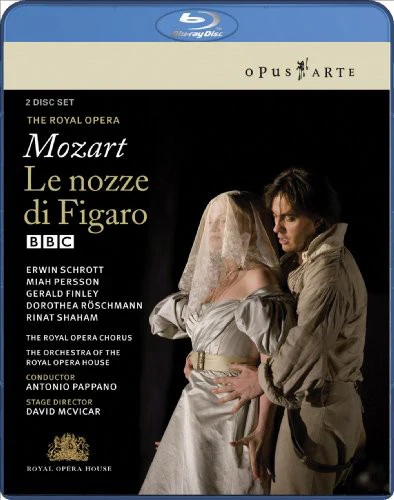
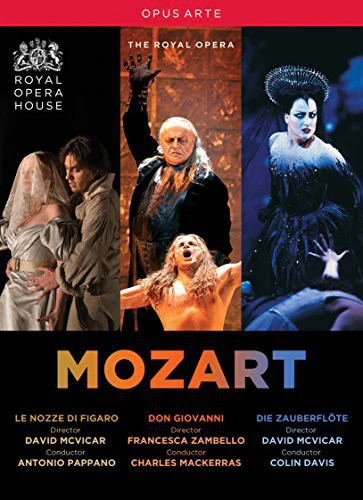
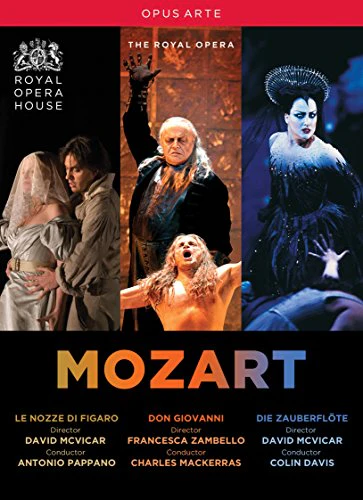
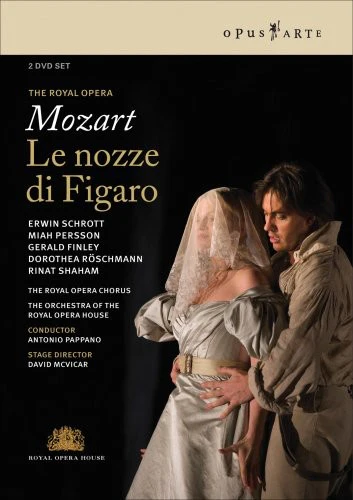
Mozart: Le Nozze Di Figaro / Pappano, Schrott, Persson, Finley
Also available on standard DVD
Countess Almaviva: Dorothea Röschmann
Marcellina: Graciela Araya
Barbarina: Ana James
Cherubino: Rinat Shaham
The Royal Opera Chorus
The Orchestra of the Royal Opera House
Conductor: Antonio Pappano
Stage Director: David McVicar
Recorded live at the Royal Opera House, Covent Garden, London on 10th, 13th and 17th February 2006.
Plus
The Magic of Mozart: Interviews with Antonio Pappano, David McVicar and principal cast.
Cast gallery and illustrated synopsis.
Reviews ‘This sexy, raunchy, romp of an opera is a triumph. Director David McVicar has searched for the essence of the composer and found it; fun filled, sensitive, romantic and serious by turns, all reflected in this production.This is a 'Must See' opera! ...You'll regret it if you don't!’ Musical Opinion
Awards & Accolades:
'BEST OF THE YEAR' 2008 - Opera News (January 2009)
BEST DVD OF THE YEAR The Metropolitan Opera (January 2009)DVD OF THE YEAR 2008 Classic FM Gramophone Awards (September 2008)
REGIONS: All Regions
PICTURE FORMAT: 1080i
LENGTH: 202 Mins
SOUND: 2.0 & 5.0 PCM
SUBTITLES: ENGLISH/FRENCH/GERMAN/SPANISH/ITALIAN
NO OF DISCS: 2
3334340.zz80_MOZART_Le_Figaro.html
MOZART Le nozze di Figaro & • Antonio Pappano, cond; Erwin Schrott ( Figaro ); Miah Persson ( Susanna ); Gerald Finley ( Count Almaviva ); Dorothea Röschmann ( Countess Almaviva ); Rinat Shaham ( Cherubino ); Jonathan Veira ( Dr. Bartolo ); Graciela Araya ( Marcellina ); Philip Langridge ( Don Basilio ); Jeremy White ( Antonio ); Francis Egerton ( Don Curzio ); Ana James ( Barbarina ); Royal Op House Covent Garden O & Ch • OPUS ARTE 7033 (2 Blu-ray Discs: 202:00) Live: London 2/10,13,17/2006
& “The Magic of Mozart”: interviews with performers and director. Cast gallery and synopsis
Reviewing the DVD version of this performance, Lynn René Bayley called it “fabulous,” and claimed that “if not definitive, [it is] at least a touchstone against which all future performances can be judged” (32:1). In his companion review in the same issue, Barry Brenesal was slightly less giddy, pointing to a number of flaws but nonetheless concluding with high praise: while “not everything works,” he said, “more than enough does to invest this Le nozze with a distinctive energy and a level of interaction beyond most DVD versions.” I’m more in Brenesal’s camp here—this is an exceptional release, but it doesn’t quite erase the very considerable competition.
Virtues first. While this cast may not quite knock out Böhm’s all-star assemblage (Freni, Te Kanawa, Ewing, Prey, and Fischer-Dieskau), it’s as solid, from top to bottom, as any group of singers you’re realistically likely to assemble today. Miah Persson, whose radiant Zerlina was a highpoint in Mackerras’s Don Giovanni (33:2), is even more impressive here, where her voice is equally lustrous and dexterous, and where there’s even more opportunity to demonstrate psychological nuance. As but one example, try her act III duet with the Count, where she just manages to hide (from him, although not from us) her palpable disgust (especially when he kisses her) under a veneer of flirtation. Until now, my favorite modern Susanna has been Alison Hagley, but Persson is just as winning.
Finley is a magnificent foil. From the beginning, he seems a more intellectual Count than most, a man of learning driven less by animal lust than by a kind of intellectual challenge and love of life. At first, I wondered: was I listening to this Figaro through the experience of Finley as Figaro (on the Haitink DVD) and as Robert Oppenheimer in Adams’s Doctor Atomic (33:2)? Perhaps I was. But the opening of act III—where the Count, in glasses, studies a mechanical contraption that screams out Enlightenment and Scientific Progress—shows that stage director David McVicar, too, was thinking of Almaviva in similar terms. He’s a surprisingly sympathetic character, one who seems truly transformed (although for how long?) in the final minutes.
Brenesal found Röschmann a bit too uncontrolled as the Countess, but I rather like the variety of moods she expresses: less youthful, perhaps, than Annette Dash on Jacobs’ DVD, she nonetheless does remind us (as the regal Te Kanawa, for all her virtues, does not) that Rosina is not yet the Marschallin, but is rather an inexperienced post-teen still learning how to become a great lady. Schrott’s Figaro is immensely attractive, and Shaham is a bundle of nerves as Cherubino; the minor singers are first-rate, too. Brenesal complained that the old guard folks were treated as caricatures—I, in contrast, found them less slapsticky and more vocally attractive than is usually the case. Figaro depends, of course, more on ensembles than on arias—and the voices fit together exceptionally well, whether in the blend of Susanna and the Countess toward the end of act III or in the balance of the largest scenes.
The staging is generally first-rate. Yes, having two doors into Susanna and Figaro’s bedroom makes hash of the plot complications in act I; and—like so many other directors—McVicar has to abandon his impressively detailed realism (down to cracks in the plaster) in act IV, where, even so, it’s just as hard as usual to figure out why neither Figaro nor the Count can see what’s going on. (Generally speaking, the more abstract the production, the less silly the final act seems.) The performers are all skilled actors—and McVicar has drawn the best from them.
So what keeps this Figaro from first place? Well, perhaps I’ve been swayed by the period-performance crowd, but Pappano’s conducting—“witty,” “spry,” and “sensitive to his singers” as Brenesal rightly claims it is—still seems just a bit too deliberate to me. It’s not really a matter of tempo by the clock (although Gardiner’s DVD is generally quicker); but the string-dominated sonority, the lack of acid in the winds, the slightly burnished articulation, and the sweetness of the phrasing all serve to suck up energy, particularly in the last act—where the inclusion of both Marcellina’s and Bartolo’s arias only adds to the sense that this Figaro is simply taking too long to wind up.
So my first choices remain: Jacobs’ SACD for an audio Figaro , Gardiner’s DVD (with Terfel, Hagley, and Gilfrey in excellent form) for a video version, and Böhm’s DVD as a supplement. Still, those who opt for this version will have little to complain about—especially on Blu-ray, where technical matters are, quite simply, spectacular.
FANFARE: Peter J. Rabinowitz
Countess Almaviva: Dorothea Röschmann
Marcellina: Graciela Araya
Barbarina: Ana James
Cherubino: Rinat Shaham
The Royal Opera Chorus
The Orchestra of the Royal Opera House
Conductor: Antonio Pappano
Stage Director: David McVicar
Recorded live at the Royal Opera House, Covent Garden, London on 10th, 13th and 17th February 2006.
Plus
The Magic of Mozart: Interviews with Antonio Pappano, David McVicar and principal cast.
Cast gallery and illustrated synopsis.
Reviews ‘This sexy, raunchy, romp of an opera is a triumph. Director David McVicar has searched for the essence of the composer and found it; fun filled, sensitive, romantic and serious by turns, all reflected in this production.This is a 'Must See' opera! ...You'll regret it if you don't!’ Musical Opinion
Awards & Accolades:
'BEST OF THE YEAR' 2008 - Opera News (January 2009)
BEST DVD OF THE YEAR The Metropolitan Opera (January 2009)DVD OF THE YEAR 2008 Classic FM Gramophone Awards (September 2008)
REGIONS: All Regions
PICTURE FORMAT: 1080i
LENGTH: 202 Mins
SOUND: 2.0 & 5.0 PCM
SUBTITLES: ENGLISH/FRENCH/GERMAN/SPANISH/ITALIAN
NO OF DISCS: 2
MOZART Le nozze di Figaro & • Antonio Pappano, cond; Erwin Schrott ( Figaro ); Miah Persson ( Susanna ); Gerald Finley ( Count Almaviva ); Dorothea Röschmann ( Countess Almaviva ); Rinat Shaham ( Cherubino ); Jonathan Veira ( Dr. Bartolo ); Graciela Araya ( Marcellina ); Philip Langridge ( Don Basilio ); Jeremy White ( Antonio ); Francis Egerton ( Don Curzio ); Ana James ( Barbarina ); Royal Op House Covent Garden O & Ch • OPUS ARTE 7033 (2 Blu-ray Discs: 202:00) Live: London 2/10,13,17/2006
& “The Magic of Mozart”: interviews with performers and director. Cast gallery and synopsis
Reviewing the DVD version of this performance, Lynn René Bayley called it “fabulous,” and claimed that “if not definitive, [it is] at least a touchstone against which all future performances can be judged” (32:1). In his companion review in the same issue, Barry Brenesal was slightly less giddy, pointing to a number of flaws but nonetheless concluding with high praise: while “not everything works,” he said, “more than enough does to invest this Le nozze with a distinctive energy and a level of interaction beyond most DVD versions.” I’m more in Brenesal’s camp here—this is an exceptional release, but it doesn’t quite erase the very considerable competition.
Virtues first. While this cast may not quite knock out Böhm’s all-star assemblage (Freni, Te Kanawa, Ewing, Prey, and Fischer-Dieskau), it’s as solid, from top to bottom, as any group of singers you’re realistically likely to assemble today. Miah Persson, whose radiant Zerlina was a highpoint in Mackerras’s Don Giovanni (33:2), is even more impressive here, where her voice is equally lustrous and dexterous, and where there’s even more opportunity to demonstrate psychological nuance. As but one example, try her act III duet with the Count, where she just manages to hide (from him, although not from us) her palpable disgust (especially when he kisses her) under a veneer of flirtation. Until now, my favorite modern Susanna has been Alison Hagley, but Persson is just as winning.
Finley is a magnificent foil. From the beginning, he seems a more intellectual Count than most, a man of learning driven less by animal lust than by a kind of intellectual challenge and love of life. At first, I wondered: was I listening to this Figaro through the experience of Finley as Figaro (on the Haitink DVD) and as Robert Oppenheimer in Adams’s Doctor Atomic (33:2)? Perhaps I was. But the opening of act III—where the Count, in glasses, studies a mechanical contraption that screams out Enlightenment and Scientific Progress—shows that stage director David McVicar, too, was thinking of Almaviva in similar terms. He’s a surprisingly sympathetic character, one who seems truly transformed (although for how long?) in the final minutes.
Brenesal found Röschmann a bit too uncontrolled as the Countess, but I rather like the variety of moods she expresses: less youthful, perhaps, than Annette Dash on Jacobs’ DVD, she nonetheless does remind us (as the regal Te Kanawa, for all her virtues, does not) that Rosina is not yet the Marschallin, but is rather an inexperienced post-teen still learning how to become a great lady. Schrott’s Figaro is immensely attractive, and Shaham is a bundle of nerves as Cherubino; the minor singers are first-rate, too. Brenesal complained that the old guard folks were treated as caricatures—I, in contrast, found them less slapsticky and more vocally attractive than is usually the case. Figaro depends, of course, more on ensembles than on arias—and the voices fit together exceptionally well, whether in the blend of Susanna and the Countess toward the end of act III or in the balance of the largest scenes.
The staging is generally first-rate. Yes, having two doors into Susanna and Figaro’s bedroom makes hash of the plot complications in act I; and—like so many other directors—McVicar has to abandon his impressively detailed realism (down to cracks in the plaster) in act IV, where, even so, it’s just as hard as usual to figure out why neither Figaro nor the Count can see what’s going on. (Generally speaking, the more abstract the production, the less silly the final act seems.) The performers are all skilled actors—and McVicar has drawn the best from them.
So what keeps this Figaro from first place? Well, perhaps I’ve been swayed by the period-performance crowd, but Pappano’s conducting—“witty,” “spry,” and “sensitive to his singers” as Brenesal rightly claims it is—still seems just a bit too deliberate to me. It’s not really a matter of tempo by the clock (although Gardiner’s DVD is generally quicker); but the string-dominated sonority, the lack of acid in the winds, the slightly burnished articulation, and the sweetness of the phrasing all serve to suck up energy, particularly in the last act—where the inclusion of both Marcellina’s and Bartolo’s arias only adds to the sense that this Figaro is simply taking too long to wind up.
So my first choices remain: Jacobs’ SACD for an audio Figaro , Gardiner’s DVD (with Terfel, Hagley, and Gilfrey in excellent form) for a video version, and Böhm’s DVD as a supplement. Still, those who opt for this version will have little to complain about—especially on Blu-ray, where technical matters are, quite simply, spectacular.
FANFARE: Peter J. Rabinowitz
Also available on standard DVD
Countess Almaviva: Dorothea Röschmann
Marcellina: Graciela Araya
Barbarina: Ana James
Cherubino: Rinat Shaham
The Royal Opera Chorus
The Orchestra of the Royal Opera House
Conductor: Antonio Pappano
Stage Director: David McVicar
Recorded live at the Royal Opera House, Covent Garden, London on 10th, 13th and 17th February 2006.
Plus
The Magic of Mozart: Interviews with Antonio Pappano, David McVicar and principal cast.
Cast gallery and illustrated synopsis.
Reviews ‘This sexy, raunchy, romp of an opera is a triumph. Director David McVicar has searched for the essence of the composer and found it; fun filled, sensitive, romantic and serious by turns, all reflected in this production.This is a 'Must See' opera! ...You'll regret it if you don't!’ Musical Opinion
Awards & Accolades:
'BEST OF THE YEAR' 2008 - Opera News (January 2009)
BEST DVD OF THE YEAR The Metropolitan Opera (January 2009)DVD OF THE YEAR 2008 Classic FM Gramophone Awards (September 2008)
REGIONS: All Regions
PICTURE FORMAT: 1080i
LENGTH: 202 Mins
SOUND: 2.0 & 5.0 PCM
SUBTITLES: ENGLISH/FRENCH/GERMAN/SPANISH/ITALIAN
NO OF DISCS: 2
3334340.zz80_MOZART_Le_Figaro.html
MOZART Le nozze di Figaro & • Antonio Pappano, cond; Erwin Schrott ( Figaro ); Miah Persson ( Susanna ); Gerald Finley ( Count Almaviva ); Dorothea Röschmann ( Countess Almaviva ); Rinat Shaham ( Cherubino ); Jonathan Veira ( Dr. Bartolo ); Graciela Araya ( Marcellina ); Philip Langridge ( Don Basilio ); Jeremy White ( Antonio ); Francis Egerton ( Don Curzio ); Ana James ( Barbarina ); Royal Op House Covent Garden O & Ch • OPUS ARTE 7033 (2 Blu-ray Discs: 202:00) Live: London 2/10,13,17/2006
& “The Magic of Mozart”: interviews with performers and director. Cast gallery and synopsis
Reviewing the DVD version of this performance, Lynn René Bayley called it “fabulous,” and claimed that “if not definitive, [it is] at least a touchstone against which all future performances can be judged” (32:1). In his companion review in the same issue, Barry Brenesal was slightly less giddy, pointing to a number of flaws but nonetheless concluding with high praise: while “not everything works,” he said, “more than enough does to invest this Le nozze with a distinctive energy and a level of interaction beyond most DVD versions.” I’m more in Brenesal’s camp here—this is an exceptional release, but it doesn’t quite erase the very considerable competition.
Virtues first. While this cast may not quite knock out Böhm’s all-star assemblage (Freni, Te Kanawa, Ewing, Prey, and Fischer-Dieskau), it’s as solid, from top to bottom, as any group of singers you’re realistically likely to assemble today. Miah Persson, whose radiant Zerlina was a highpoint in Mackerras’s Don Giovanni (33:2), is even more impressive here, where her voice is equally lustrous and dexterous, and where there’s even more opportunity to demonstrate psychological nuance. As but one example, try her act III duet with the Count, where she just manages to hide (from him, although not from us) her palpable disgust (especially when he kisses her) under a veneer of flirtation. Until now, my favorite modern Susanna has been Alison Hagley, but Persson is just as winning.
Finley is a magnificent foil. From the beginning, he seems a more intellectual Count than most, a man of learning driven less by animal lust than by a kind of intellectual challenge and love of life. At first, I wondered: was I listening to this Figaro through the experience of Finley as Figaro (on the Haitink DVD) and as Robert Oppenheimer in Adams’s Doctor Atomic (33:2)? Perhaps I was. But the opening of act III—where the Count, in glasses, studies a mechanical contraption that screams out Enlightenment and Scientific Progress—shows that stage director David McVicar, too, was thinking of Almaviva in similar terms. He’s a surprisingly sympathetic character, one who seems truly transformed (although for how long?) in the final minutes.
Brenesal found Röschmann a bit too uncontrolled as the Countess, but I rather like the variety of moods she expresses: less youthful, perhaps, than Annette Dash on Jacobs’ DVD, she nonetheless does remind us (as the regal Te Kanawa, for all her virtues, does not) that Rosina is not yet the Marschallin, but is rather an inexperienced post-teen still learning how to become a great lady. Schrott’s Figaro is immensely attractive, and Shaham is a bundle of nerves as Cherubino; the minor singers are first-rate, too. Brenesal complained that the old guard folks were treated as caricatures—I, in contrast, found them less slapsticky and more vocally attractive than is usually the case. Figaro depends, of course, more on ensembles than on arias—and the voices fit together exceptionally well, whether in the blend of Susanna and the Countess toward the end of act III or in the balance of the largest scenes.
The staging is generally first-rate. Yes, having two doors into Susanna and Figaro’s bedroom makes hash of the plot complications in act I; and—like so many other directors—McVicar has to abandon his impressively detailed realism (down to cracks in the plaster) in act IV, where, even so, it’s just as hard as usual to figure out why neither Figaro nor the Count can see what’s going on. (Generally speaking, the more abstract the production, the less silly the final act seems.) The performers are all skilled actors—and McVicar has drawn the best from them.
So what keeps this Figaro from first place? Well, perhaps I’ve been swayed by the period-performance crowd, but Pappano’s conducting—“witty,” “spry,” and “sensitive to his singers” as Brenesal rightly claims it is—still seems just a bit too deliberate to me. It’s not really a matter of tempo by the clock (although Gardiner’s DVD is generally quicker); but the string-dominated sonority, the lack of acid in the winds, the slightly burnished articulation, and the sweetness of the phrasing all serve to suck up energy, particularly in the last act—where the inclusion of both Marcellina’s and Bartolo’s arias only adds to the sense that this Figaro is simply taking too long to wind up.
So my first choices remain: Jacobs’ SACD for an audio Figaro , Gardiner’s DVD (with Terfel, Hagley, and Gilfrey in excellent form) for a video version, and Böhm’s DVD as a supplement. Still, those who opt for this version will have little to complain about—especially on Blu-ray, where technical matters are, quite simply, spectacular.
FANFARE: Peter J. Rabinowitz
Countess Almaviva: Dorothea Röschmann
Marcellina: Graciela Araya
Barbarina: Ana James
Cherubino: Rinat Shaham
The Royal Opera Chorus
The Orchestra of the Royal Opera House
Conductor: Antonio Pappano
Stage Director: David McVicar
Recorded live at the Royal Opera House, Covent Garden, London on 10th, 13th and 17th February 2006.
Plus
The Magic of Mozart: Interviews with Antonio Pappano, David McVicar and principal cast.
Cast gallery and illustrated synopsis.
Reviews ‘This sexy, raunchy, romp of an opera is a triumph. Director David McVicar has searched for the essence of the composer and found it; fun filled, sensitive, romantic and serious by turns, all reflected in this production.This is a 'Must See' opera! ...You'll regret it if you don't!’ Musical Opinion
Awards & Accolades:
'BEST OF THE YEAR' 2008 - Opera News (January 2009)
BEST DVD OF THE YEAR The Metropolitan Opera (January 2009)DVD OF THE YEAR 2008 Classic FM Gramophone Awards (September 2008)
REGIONS: All Regions
PICTURE FORMAT: 1080i
LENGTH: 202 Mins
SOUND: 2.0 & 5.0 PCM
SUBTITLES: ENGLISH/FRENCH/GERMAN/SPANISH/ITALIAN
NO OF DISCS: 2
MOZART Le nozze di Figaro & • Antonio Pappano, cond; Erwin Schrott ( Figaro ); Miah Persson ( Susanna ); Gerald Finley ( Count Almaviva ); Dorothea Röschmann ( Countess Almaviva ); Rinat Shaham ( Cherubino ); Jonathan Veira ( Dr. Bartolo ); Graciela Araya ( Marcellina ); Philip Langridge ( Don Basilio ); Jeremy White ( Antonio ); Francis Egerton ( Don Curzio ); Ana James ( Barbarina ); Royal Op House Covent Garden O & Ch • OPUS ARTE 7033 (2 Blu-ray Discs: 202:00) Live: London 2/10,13,17/2006
& “The Magic of Mozart”: interviews with performers and director. Cast gallery and synopsis
Reviewing the DVD version of this performance, Lynn René Bayley called it “fabulous,” and claimed that “if not definitive, [it is] at least a touchstone against which all future performances can be judged” (32:1). In his companion review in the same issue, Barry Brenesal was slightly less giddy, pointing to a number of flaws but nonetheless concluding with high praise: while “not everything works,” he said, “more than enough does to invest this Le nozze with a distinctive energy and a level of interaction beyond most DVD versions.” I’m more in Brenesal’s camp here—this is an exceptional release, but it doesn’t quite erase the very considerable competition.
Virtues first. While this cast may not quite knock out Böhm’s all-star assemblage (Freni, Te Kanawa, Ewing, Prey, and Fischer-Dieskau), it’s as solid, from top to bottom, as any group of singers you’re realistically likely to assemble today. Miah Persson, whose radiant Zerlina was a highpoint in Mackerras’s Don Giovanni (33:2), is even more impressive here, where her voice is equally lustrous and dexterous, and where there’s even more opportunity to demonstrate psychological nuance. As but one example, try her act III duet with the Count, where she just manages to hide (from him, although not from us) her palpable disgust (especially when he kisses her) under a veneer of flirtation. Until now, my favorite modern Susanna has been Alison Hagley, but Persson is just as winning.
Finley is a magnificent foil. From the beginning, he seems a more intellectual Count than most, a man of learning driven less by animal lust than by a kind of intellectual challenge and love of life. At first, I wondered: was I listening to this Figaro through the experience of Finley as Figaro (on the Haitink DVD) and as Robert Oppenheimer in Adams’s Doctor Atomic (33:2)? Perhaps I was. But the opening of act III—where the Count, in glasses, studies a mechanical contraption that screams out Enlightenment and Scientific Progress—shows that stage director David McVicar, too, was thinking of Almaviva in similar terms. He’s a surprisingly sympathetic character, one who seems truly transformed (although for how long?) in the final minutes.
Brenesal found Röschmann a bit too uncontrolled as the Countess, but I rather like the variety of moods she expresses: less youthful, perhaps, than Annette Dash on Jacobs’ DVD, she nonetheless does remind us (as the regal Te Kanawa, for all her virtues, does not) that Rosina is not yet the Marschallin, but is rather an inexperienced post-teen still learning how to become a great lady. Schrott’s Figaro is immensely attractive, and Shaham is a bundle of nerves as Cherubino; the minor singers are first-rate, too. Brenesal complained that the old guard folks were treated as caricatures—I, in contrast, found them less slapsticky and more vocally attractive than is usually the case. Figaro depends, of course, more on ensembles than on arias—and the voices fit together exceptionally well, whether in the blend of Susanna and the Countess toward the end of act III or in the balance of the largest scenes.
The staging is generally first-rate. Yes, having two doors into Susanna and Figaro’s bedroom makes hash of the plot complications in act I; and—like so many other directors—McVicar has to abandon his impressively detailed realism (down to cracks in the plaster) in act IV, where, even so, it’s just as hard as usual to figure out why neither Figaro nor the Count can see what’s going on. (Generally speaking, the more abstract the production, the less silly the final act seems.) The performers are all skilled actors—and McVicar has drawn the best from them.
So what keeps this Figaro from first place? Well, perhaps I’ve been swayed by the period-performance crowd, but Pappano’s conducting—“witty,” “spry,” and “sensitive to his singers” as Brenesal rightly claims it is—still seems just a bit too deliberate to me. It’s not really a matter of tempo by the clock (although Gardiner’s DVD is generally quicker); but the string-dominated sonority, the lack of acid in the winds, the slightly burnished articulation, and the sweetness of the phrasing all serve to suck up energy, particularly in the last act—where the inclusion of both Marcellina’s and Bartolo’s arias only adds to the sense that this Figaro is simply taking too long to wind up.
So my first choices remain: Jacobs’ SACD for an audio Figaro , Gardiner’s DVD (with Terfel, Hagley, and Gilfrey in excellent form) for a video version, and Böhm’s DVD as a supplement. Still, those who opt for this version will have little to complain about—especially on Blu-ray, where technical matters are, quite simply, spectacular.
FANFARE: Peter J. Rabinowitz
$52.99
Mozart: Le Nozze Di Figaro / Pappano, Schrott, Persson, Finley—
$52.99
Description
Also available on standard DVD
Countess Almaviva: Dorothea Röschmann
Marcellina: Graciela Araya
Barbarina: Ana James
Cherubino: Rinat Shaham
The Royal Opera Chorus
The Orchestra of the Royal Opera House
Conductor: Antonio Pappano
Stage Director: David McVicar
Recorded live at the Royal Opera House, Covent Garden, London on 10th, 13th and 17th February 2006.
Plus
The Magic of Mozart: Interviews with Antonio Pappano, David McVicar and principal cast.
Cast gallery and illustrated synopsis.
Reviews ‘This sexy, raunchy, romp of an opera is a triumph. Director David McVicar has searched for the essence of the composer and found it; fun filled, sensitive, romantic and serious by turns, all reflected in this production.This is a 'Must See' opera! ...You'll regret it if you don't!’ Musical Opinion
Awards & Accolades:
'BEST OF THE YEAR' 2008 - Opera News (January 2009)
BEST DVD OF THE YEAR The Metropolitan Opera (January 2009)DVD OF THE YEAR 2008 Classic FM Gramophone Awards (September 2008)
REGIONS: All Regions
PICTURE FORMAT: 1080i
LENGTH: 202 Mins
SOUND: 2.0 & 5.0 PCM
SUBTITLES: ENGLISH/FRENCH/GERMAN/SPANISH/ITALIAN
NO OF DISCS: 2
3334340.zz80_MOZART_Le_Figaro.html
MOZART Le nozze di Figaro & • Antonio Pappano, cond; Erwin Schrott ( Figaro ); Miah Persson ( Susanna ); Gerald Finley ( Count Almaviva ); Dorothea Röschmann ( Countess Almaviva ); Rinat Shaham ( Cherubino ); Jonathan Veira ( Dr. Bartolo ); Graciela Araya ( Marcellina ); Philip Langridge ( Don Basilio ); Jeremy White ( Antonio ); Francis Egerton ( Don Curzio ); Ana James ( Barbarina ); Royal Op House Covent Garden O & Ch • OPUS ARTE 7033 (2 Blu-ray Discs: 202:00) Live: London 2/10,13,17/2006
& “The Magic of Mozart”: interviews with performers and director. Cast gallery and synopsis
Reviewing the DVD version of this performance, Lynn René Bayley called it “fabulous,” and claimed that “if not definitive, [it is] at least a touchstone against which all future performances can be judged” (32:1). In his companion review in the same issue, Barry Brenesal was slightly less giddy, pointing to a number of flaws but nonetheless concluding with high praise: while “not everything works,” he said, “more than enough does to invest this Le nozze with a distinctive energy and a level of interaction beyond most DVD versions.” I’m more in Brenesal’s camp here—this is an exceptional release, but it doesn’t quite erase the very considerable competition.
Virtues first. While this cast may not quite knock out Böhm’s all-star assemblage (Freni, Te Kanawa, Ewing, Prey, and Fischer-Dieskau), it’s as solid, from top to bottom, as any group of singers you’re realistically likely to assemble today. Miah Persson, whose radiant Zerlina was a highpoint in Mackerras’s Don Giovanni (33:2), is even more impressive here, where her voice is equally lustrous and dexterous, and where there’s even more opportunity to demonstrate psychological nuance. As but one example, try her act III duet with the Count, where she just manages to hide (from him, although not from us) her palpable disgust (especially when he kisses her) under a veneer of flirtation. Until now, my favorite modern Susanna has been Alison Hagley, but Persson is just as winning.
Finley is a magnificent foil. From the beginning, he seems a more intellectual Count than most, a man of learning driven less by animal lust than by a kind of intellectual challenge and love of life. At first, I wondered: was I listening to this Figaro through the experience of Finley as Figaro (on the Haitink DVD) and as Robert Oppenheimer in Adams’s Doctor Atomic (33:2)? Perhaps I was. But the opening of act III—where the Count, in glasses, studies a mechanical contraption that screams out Enlightenment and Scientific Progress—shows that stage director David McVicar, too, was thinking of Almaviva in similar terms. He’s a surprisingly sympathetic character, one who seems truly transformed (although for how long?) in the final minutes.
Brenesal found Röschmann a bit too uncontrolled as the Countess, but I rather like the variety of moods she expresses: less youthful, perhaps, than Annette Dash on Jacobs’ DVD, she nonetheless does remind us (as the regal Te Kanawa, for all her virtues, does not) that Rosina is not yet the Marschallin, but is rather an inexperienced post-teen still learning how to become a great lady. Schrott’s Figaro is immensely attractive, and Shaham is a bundle of nerves as Cherubino; the minor singers are first-rate, too. Brenesal complained that the old guard folks were treated as caricatures—I, in contrast, found them less slapsticky and more vocally attractive than is usually the case. Figaro depends, of course, more on ensembles than on arias—and the voices fit together exceptionally well, whether in the blend of Susanna and the Countess toward the end of act III or in the balance of the largest scenes.
The staging is generally first-rate. Yes, having two doors into Susanna and Figaro’s bedroom makes hash of the plot complications in act I; and—like so many other directors—McVicar has to abandon his impressively detailed realism (down to cracks in the plaster) in act IV, where, even so, it’s just as hard as usual to figure out why neither Figaro nor the Count can see what’s going on. (Generally speaking, the more abstract the production, the less silly the final act seems.) The performers are all skilled actors—and McVicar has drawn the best from them.
So what keeps this Figaro from first place? Well, perhaps I’ve been swayed by the period-performance crowd, but Pappano’s conducting—“witty,” “spry,” and “sensitive to his singers” as Brenesal rightly claims it is—still seems just a bit too deliberate to me. It’s not really a matter of tempo by the clock (although Gardiner’s DVD is generally quicker); but the string-dominated sonority, the lack of acid in the winds, the slightly burnished articulation, and the sweetness of the phrasing all serve to suck up energy, particularly in the last act—where the inclusion of both Marcellina’s and Bartolo’s arias only adds to the sense that this Figaro is simply taking too long to wind up.
So my first choices remain: Jacobs’ SACD for an audio Figaro , Gardiner’s DVD (with Terfel, Hagley, and Gilfrey in excellent form) for a video version, and Böhm’s DVD as a supplement. Still, those who opt for this version will have little to complain about—especially on Blu-ray, where technical matters are, quite simply, spectacular.
FANFARE: Peter J. Rabinowitz
Countess Almaviva: Dorothea Röschmann
Marcellina: Graciela Araya
Barbarina: Ana James
Cherubino: Rinat Shaham
The Royal Opera Chorus
The Orchestra of the Royal Opera House
Conductor: Antonio Pappano
Stage Director: David McVicar
Recorded live at the Royal Opera House, Covent Garden, London on 10th, 13th and 17th February 2006.
Plus
The Magic of Mozart: Interviews with Antonio Pappano, David McVicar and principal cast.
Cast gallery and illustrated synopsis.
Reviews ‘This sexy, raunchy, romp of an opera is a triumph. Director David McVicar has searched for the essence of the composer and found it; fun filled, sensitive, romantic and serious by turns, all reflected in this production.This is a 'Must See' opera! ...You'll regret it if you don't!’ Musical Opinion
Awards & Accolades:
'BEST OF THE YEAR' 2008 - Opera News (January 2009)
BEST DVD OF THE YEAR The Metropolitan Opera (January 2009)DVD OF THE YEAR 2008 Classic FM Gramophone Awards (September 2008)
REGIONS: All Regions
PICTURE FORMAT: 1080i
LENGTH: 202 Mins
SOUND: 2.0 & 5.0 PCM
SUBTITLES: ENGLISH/FRENCH/GERMAN/SPANISH/ITALIAN
NO OF DISCS: 2
MOZART Le nozze di Figaro & • Antonio Pappano, cond; Erwin Schrott ( Figaro ); Miah Persson ( Susanna ); Gerald Finley ( Count Almaviva ); Dorothea Röschmann ( Countess Almaviva ); Rinat Shaham ( Cherubino ); Jonathan Veira ( Dr. Bartolo ); Graciela Araya ( Marcellina ); Philip Langridge ( Don Basilio ); Jeremy White ( Antonio ); Francis Egerton ( Don Curzio ); Ana James ( Barbarina ); Royal Op House Covent Garden O & Ch • OPUS ARTE 7033 (2 Blu-ray Discs: 202:00) Live: London 2/10,13,17/2006
& “The Magic of Mozart”: interviews with performers and director. Cast gallery and synopsis
Reviewing the DVD version of this performance, Lynn René Bayley called it “fabulous,” and claimed that “if not definitive, [it is] at least a touchstone against which all future performances can be judged” (32:1). In his companion review in the same issue, Barry Brenesal was slightly less giddy, pointing to a number of flaws but nonetheless concluding with high praise: while “not everything works,” he said, “more than enough does to invest this Le nozze with a distinctive energy and a level of interaction beyond most DVD versions.” I’m more in Brenesal’s camp here—this is an exceptional release, but it doesn’t quite erase the very considerable competition.
Virtues first. While this cast may not quite knock out Böhm’s all-star assemblage (Freni, Te Kanawa, Ewing, Prey, and Fischer-Dieskau), it’s as solid, from top to bottom, as any group of singers you’re realistically likely to assemble today. Miah Persson, whose radiant Zerlina was a highpoint in Mackerras’s Don Giovanni (33:2), is even more impressive here, where her voice is equally lustrous and dexterous, and where there’s even more opportunity to demonstrate psychological nuance. As but one example, try her act III duet with the Count, where she just manages to hide (from him, although not from us) her palpable disgust (especially when he kisses her) under a veneer of flirtation. Until now, my favorite modern Susanna has been Alison Hagley, but Persson is just as winning.
Finley is a magnificent foil. From the beginning, he seems a more intellectual Count than most, a man of learning driven less by animal lust than by a kind of intellectual challenge and love of life. At first, I wondered: was I listening to this Figaro through the experience of Finley as Figaro (on the Haitink DVD) and as Robert Oppenheimer in Adams’s Doctor Atomic (33:2)? Perhaps I was. But the opening of act III—where the Count, in glasses, studies a mechanical contraption that screams out Enlightenment and Scientific Progress—shows that stage director David McVicar, too, was thinking of Almaviva in similar terms. He’s a surprisingly sympathetic character, one who seems truly transformed (although for how long?) in the final minutes.
Brenesal found Röschmann a bit too uncontrolled as the Countess, but I rather like the variety of moods she expresses: less youthful, perhaps, than Annette Dash on Jacobs’ DVD, she nonetheless does remind us (as the regal Te Kanawa, for all her virtues, does not) that Rosina is not yet the Marschallin, but is rather an inexperienced post-teen still learning how to become a great lady. Schrott’s Figaro is immensely attractive, and Shaham is a bundle of nerves as Cherubino; the minor singers are first-rate, too. Brenesal complained that the old guard folks were treated as caricatures—I, in contrast, found them less slapsticky and more vocally attractive than is usually the case. Figaro depends, of course, more on ensembles than on arias—and the voices fit together exceptionally well, whether in the blend of Susanna and the Countess toward the end of act III or in the balance of the largest scenes.
The staging is generally first-rate. Yes, having two doors into Susanna and Figaro’s bedroom makes hash of the plot complications in act I; and—like so many other directors—McVicar has to abandon his impressively detailed realism (down to cracks in the plaster) in act IV, where, even so, it’s just as hard as usual to figure out why neither Figaro nor the Count can see what’s going on. (Generally speaking, the more abstract the production, the less silly the final act seems.) The performers are all skilled actors—and McVicar has drawn the best from them.
So what keeps this Figaro from first place? Well, perhaps I’ve been swayed by the period-performance crowd, but Pappano’s conducting—“witty,” “spry,” and “sensitive to his singers” as Brenesal rightly claims it is—still seems just a bit too deliberate to me. It’s not really a matter of tempo by the clock (although Gardiner’s DVD is generally quicker); but the string-dominated sonority, the lack of acid in the winds, the slightly burnished articulation, and the sweetness of the phrasing all serve to suck up energy, particularly in the last act—where the inclusion of both Marcellina’s and Bartolo’s arias only adds to the sense that this Figaro is simply taking too long to wind up.
So my first choices remain: Jacobs’ SACD for an audio Figaro , Gardiner’s DVD (with Terfel, Hagley, and Gilfrey in excellent form) for a video version, and Böhm’s DVD as a supplement. Still, those who opt for this version will have little to complain about—especially on Blu-ray, where technical matters are, quite simply, spectacular.
FANFARE: Peter J. Rabinowitz