🎉 Up to 70% Off Selected ItemsShop Sale

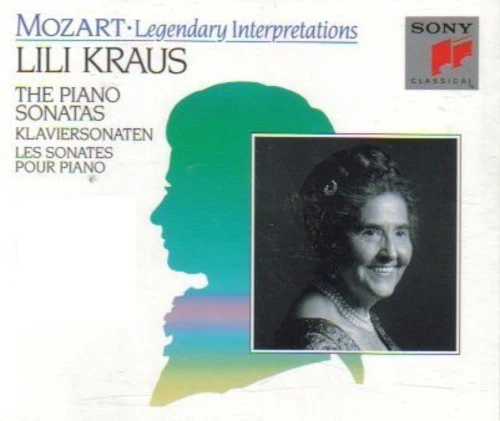
Mozart Legendary Interpretations - Lili Kraus - The Piano Sonatas
These 1967/68 recordings are not to be confused with the earlier Mozart cycle Lili Kraus made for the Haydn Society and recently reissued by Music & Arts. Close microphone placement yielded a bright, slightly flinty sonority that I remember from CBS/Odyssey's vinyl incarnation. Although I have not heard Sony's earlier CD reissue, the present edition's warmer, more rounded equalization unmasks subtleties of touch and nuance that showcase Kraus' pianism in more flattering, colorful light than before. In contrast to Joyce Hatto's operatic cultivation, Walter Gieseking's classical poise, and András Schiff's ornamental flair, Kraus is all passion and drama. An expressionist aesthetic governs her boldly contrasted dynamics, hard-hitting accents, and faster-than-common slow movements, along with angular phrasings and pedal effects that underline harmonic felicities and underplay barlines.
This approach best suits darker, more serious pieces such as the C minor Fantasy/Sonata K. 475/457 and the A minor K. 310 sonata. Similarly, Kraus' gaunt, stinging way with K. 331's famous first-movement variations and concluding Rondo Alla Turca liberates the music from decade's worth of interpretive cotton candy.
Perhaps the early sonatas, the bubbly D major Rondo, and "easy" C major K. 545 lack surface charm and elegance, largely due to Kraus' tendency to "think ahead" and push rapid passages slightly ahead of the beat (a habit of her one-time teacher Artur Schnabel), yet her nervous energy always enlivens rather than obliterates Mozart's intentions. I only wish that Kraus also had recorded the wonderful F major Sonata K. 533/494. It's good to have these invigorating, often provocative performances available again.
--Jed Distler, ClassicsToday.com
This approach best suits darker, more serious pieces such as the C minor Fantasy/Sonata K. 475/457 and the A minor K. 310 sonata. Similarly, Kraus' gaunt, stinging way with K. 331's famous first-movement variations and concluding Rondo Alla Turca liberates the music from decade's worth of interpretive cotton candy.
Perhaps the early sonatas, the bubbly D major Rondo, and "easy" C major K. 545 lack surface charm and elegance, largely due to Kraus' tendency to "think ahead" and push rapid passages slightly ahead of the beat (a habit of her one-time teacher Artur Schnabel), yet her nervous energy always enlivens rather than obliterates Mozart's intentions. I only wish that Kraus also had recorded the wonderful F major Sonata K. 533/494. It's good to have these invigorating, often provocative performances available again.
--Jed Distler, ClassicsToday.com
These 1967/68 recordings are not to be confused with the earlier Mozart cycle Lili Kraus made for the Haydn Society and recently reissued by Music & Arts. Close microphone placement yielded a bright, slightly flinty sonority that I remember from CBS/Odyssey's vinyl incarnation. Although I have not heard Sony's earlier CD reissue, the present edition's warmer, more rounded equalization unmasks subtleties of touch and nuance that showcase Kraus' pianism in more flattering, colorful light than before. In contrast to Joyce Hatto's operatic cultivation, Walter Gieseking's classical poise, and András Schiff's ornamental flair, Kraus is all passion and drama. An expressionist aesthetic governs her boldly contrasted dynamics, hard-hitting accents, and faster-than-common slow movements, along with angular phrasings and pedal effects that underline harmonic felicities and underplay barlines.
This approach best suits darker, more serious pieces such as the C minor Fantasy/Sonata K. 475/457 and the A minor K. 310 sonata. Similarly, Kraus' gaunt, stinging way with K. 331's famous first-movement variations and concluding Rondo Alla Turca liberates the music from decade's worth of interpretive cotton candy.
Perhaps the early sonatas, the bubbly D major Rondo, and "easy" C major K. 545 lack surface charm and elegance, largely due to Kraus' tendency to "think ahead" and push rapid passages slightly ahead of the beat (a habit of her one-time teacher Artur Schnabel), yet her nervous energy always enlivens rather than obliterates Mozart's intentions. I only wish that Kraus also had recorded the wonderful F major Sonata K. 533/494. It's good to have these invigorating, often provocative performances available again.
--Jed Distler, ClassicsToday.com
This approach best suits darker, more serious pieces such as the C minor Fantasy/Sonata K. 475/457 and the A minor K. 310 sonata. Similarly, Kraus' gaunt, stinging way with K. 331's famous first-movement variations and concluding Rondo Alla Turca liberates the music from decade's worth of interpretive cotton candy.
Perhaps the early sonatas, the bubbly D major Rondo, and "easy" C major K. 545 lack surface charm and elegance, largely due to Kraus' tendency to "think ahead" and push rapid passages slightly ahead of the beat (a habit of her one-time teacher Artur Schnabel), yet her nervous energy always enlivens rather than obliterates Mozart's intentions. I only wish that Kraus also had recorded the wonderful F major Sonata K. 533/494. It's good to have these invigorating, often provocative performances available again.
--Jed Distler, ClassicsToday.com
$14.70
Original: $41.99
-65%Mozart Legendary Interpretations - Lili Kraus - The Piano Sonatas—
$41.99
$14.70Description
These 1967/68 recordings are not to be confused with the earlier Mozart cycle Lili Kraus made for the Haydn Society and recently reissued by Music & Arts. Close microphone placement yielded a bright, slightly flinty sonority that I remember from CBS/Odyssey's vinyl incarnation. Although I have not heard Sony's earlier CD reissue, the present edition's warmer, more rounded equalization unmasks subtleties of touch and nuance that showcase Kraus' pianism in more flattering, colorful light than before. In contrast to Joyce Hatto's operatic cultivation, Walter Gieseking's classical poise, and András Schiff's ornamental flair, Kraus is all passion and drama. An expressionist aesthetic governs her boldly contrasted dynamics, hard-hitting accents, and faster-than-common slow movements, along with angular phrasings and pedal effects that underline harmonic felicities and underplay barlines.
This approach best suits darker, more serious pieces such as the C minor Fantasy/Sonata K. 475/457 and the A minor K. 310 sonata. Similarly, Kraus' gaunt, stinging way with K. 331's famous first-movement variations and concluding Rondo Alla Turca liberates the music from decade's worth of interpretive cotton candy.
Perhaps the early sonatas, the bubbly D major Rondo, and "easy" C major K. 545 lack surface charm and elegance, largely due to Kraus' tendency to "think ahead" and push rapid passages slightly ahead of the beat (a habit of her one-time teacher Artur Schnabel), yet her nervous energy always enlivens rather than obliterates Mozart's intentions. I only wish that Kraus also had recorded the wonderful F major Sonata K. 533/494. It's good to have these invigorating, often provocative performances available again.
--Jed Distler, ClassicsToday.com
This approach best suits darker, more serious pieces such as the C minor Fantasy/Sonata K. 475/457 and the A minor K. 310 sonata. Similarly, Kraus' gaunt, stinging way with K. 331's famous first-movement variations and concluding Rondo Alla Turca liberates the music from decade's worth of interpretive cotton candy.
Perhaps the early sonatas, the bubbly D major Rondo, and "easy" C major K. 545 lack surface charm and elegance, largely due to Kraus' tendency to "think ahead" and push rapid passages slightly ahead of the beat (a habit of her one-time teacher Artur Schnabel), yet her nervous energy always enlivens rather than obliterates Mozart's intentions. I only wish that Kraus also had recorded the wonderful F major Sonata K. 533/494. It's good to have these invigorating, often provocative performances available again.
--Jed Distler, ClassicsToday.com