🎉 Up to 70% Off Selected ItemsShop Sale

1 / 2
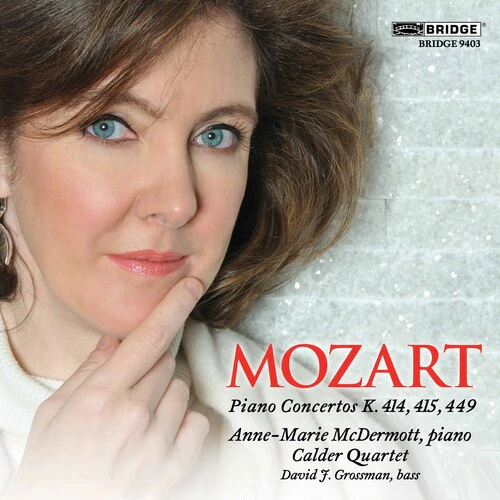
Mozart: Piano Concertos K 414, 415, 449 (Chamber Version). Anne-Marie McDermott, Calder Quartet
MOZART Piano Concertos Nos. 12–14 (arr. unknown) • Anne-Marie McDermott (pn); Calder Qrt; David J. Grossman (db) • BRIDGE 9403 (75:54)
From Wikipedia, regarding Concertos No. 11-13: “arrangements exist for them for piano plus string quartet that lose little,” with no indication if those arrangements are by Mozart or not. Nothing is said in the liner notes about these or the string quintet reduction of Concerto No. 14. Yet a review of a similar recording, made by pianist Jean-Phillippe Collard for EMI in 1988 at allmusic.com, indicates that the arangements are Mozart’s own, “his justification for doing them was that if he didn’t, someone else would.” To ears used to a full orchestral accompaniment, the sound is a little strange at first—we keep waiting for orchestral tuttis that never arrive—but the bottom line is whether or not the performances are musically convincing and valid, and for me they are, particularly since Anne-Marie McDermott, one of the truly great American pianists of our time, seems to be using a lean-sounding if modern piano (possibly a Baldwin of the type favored by Glenn Gould?), and these lean, crisp sonorities play well against the string quartet (and quintet in the case of No. 14).
The concertos nos. 12 and 13 (presented on the CD in reverse order) are not among Mozart’s most profound compositions in this genre, but rather fall into the category of music that the cynical composer described to his father in a letter: “These concertos (Nos. 11–13) are a happy medium between what is too easy and too difficult; they are very brilliant, pleasing to the ear, and natural without being vapid….In order to win applause one must write stuff which is so inane that a coachman could sing it, or so unintelligible that it pleases precisely because no reasonable man can understand it.” (This quote, again, from Wikipedia.)
McDermott, producing an appropriately light yet well-inflected sound throughout most of each concerto, really lets herself go in the first-movement cadenzas, and it is here that she separates herself from the more delicate, almost prissy Mozart interpreters on record. Not that she attacks the keyboard as if the music were by Beethoven (though she certainly has the power to do so), but because she understands that the nature of these cadenzas was to stand out and assert center stage, however briefly.
As Mozart indicated, concertos 12 and 13 aren’t exactly profound music. Despite some nicely subtle passages (he never wrote anything that did not have such sections within them), they tend to be lightweight works, designed, as he so aptly put it, “to please” without unduly challenging the average listener’s mind. Yet when the music does turn profound, as it does (quite dramatically so) in the Andante of No. 12, McDermott and the Calder Quartet are up to the challenge. Here, their playing includes a great deal of coloration in addition to the subtlest of modifications within the beats, producing an exquisite musical flow.
The Concerto No. 14 inhabits an entirely different musical world. This is richer, deeper, more mature Mozart, the music alternating in mood between “prettiness” (you’ve got to please the public!) and darker, more penetrating depths, and oddly enough this also applies to the first-movement cadenza. Mozart wisely adds a double bass to the proceedings here; it is necessary to counterbalance the thematic material and its development with a richer texture. This performance alone is worth the price of the CD: it is worthy of the music in every way. Note, particularly, Mozart’s subtle yet dramatic use of descending chromatics and his equally impressive use of what one might call grace notes played as part of the overall structure.
This is an excellent album of its type, although your willingness to acquire it will naturally depend on how many other versions you have of these concertos and whether or not you’d like to have them in chamber music arrangements. Recommended nevertheless.
FANFARE: Lynn René Bayley
MOZART Piano Concertos Nos. 12–14 (arr. unknown) • Anne-Marie McDermott (pn); Calder Qrt; David J. Grossman (db) • BRIDGE 9403 (75:54)
From Wikipedia, regarding Concertos No. 11-13: “arrangements exist for them for piano plus string quartet that lose little,” with no indication if those arrangements are by Mozart or not. Nothing is said in the liner notes about these or the string quintet reduction of Concerto No. 14. Yet a review of a similar recording, made by pianist Jean-Phillippe Collard for EMI in 1988 at allmusic.com, indicates that the arangements are Mozart’s own, “his justification for doing them was that if he didn’t, someone else would.” To ears used to a full orchestral accompaniment, the sound is a little strange at first—we keep waiting for orchestral tuttis that never arrive—but the bottom line is whether or not the performances are musically convincing and valid, and for me they are, particularly since Anne-Marie McDermott, one of the truly great American pianists of our time, seems to be using a lean-sounding if modern piano (possibly a Baldwin of the type favored by Glenn Gould?), and these lean, crisp sonorities play well against the string quartet (and quintet in the case of No. 14).
The concertos nos. 12 and 13 (presented on the CD in reverse order) are not among Mozart’s most profound compositions in this genre, but rather fall into the category of music that the cynical composer described to his father in a letter: “These concertos (Nos. 11–13) are a happy medium between what is too easy and too difficult; they are very brilliant, pleasing to the ear, and natural without being vapid….In order to win applause one must write stuff which is so inane that a coachman could sing it, or so unintelligible that it pleases precisely because no reasonable man can understand it.” (This quote, again, from Wikipedia.)
McDermott, producing an appropriately light yet well-inflected sound throughout most of each concerto, really lets herself go in the first-movement cadenzas, and it is here that she separates herself from the more delicate, almost prissy Mozart interpreters on record. Not that she attacks the keyboard as if the music were by Beethoven (though she certainly has the power to do so), but because she understands that the nature of these cadenzas was to stand out and assert center stage, however briefly.
As Mozart indicated, concertos 12 and 13 aren’t exactly profound music. Despite some nicely subtle passages (he never wrote anything that did not have such sections within them), they tend to be lightweight works, designed, as he so aptly put it, “to please” without unduly challenging the average listener’s mind. Yet when the music does turn profound, as it does (quite dramatically so) in the Andante of No. 12, McDermott and the Calder Quartet are up to the challenge. Here, their playing includes a great deal of coloration in addition to the subtlest of modifications within the beats, producing an exquisite musical flow.
The Concerto No. 14 inhabits an entirely different musical world. This is richer, deeper, more mature Mozart, the music alternating in mood between “prettiness” (you’ve got to please the public!) and darker, more penetrating depths, and oddly enough this also applies to the first-movement cadenza. Mozart wisely adds a double bass to the proceedings here; it is necessary to counterbalance the thematic material and its development with a richer texture. This performance alone is worth the price of the CD: it is worthy of the music in every way. Note, particularly, Mozart’s subtle yet dramatic use of descending chromatics and his equally impressive use of what one might call grace notes played as part of the overall structure.
This is an excellent album of its type, although your willingness to acquire it will naturally depend on how many other versions you have of these concertos and whether or not you’d like to have them in chamber music arrangements. Recommended nevertheless.
FANFARE: Lynn René Bayley
$5.25
Original: $14.99
-65%Mozart: Piano Concertos K 414, 415, 449 (Chamber Version). Anne-Marie McDermott, Calder Quartet—
$14.99
$5.25Description
MOZART Piano Concertos Nos. 12–14 (arr. unknown) • Anne-Marie McDermott (pn); Calder Qrt; David J. Grossman (db) • BRIDGE 9403 (75:54)
From Wikipedia, regarding Concertos No. 11-13: “arrangements exist for them for piano plus string quartet that lose little,” with no indication if those arrangements are by Mozart or not. Nothing is said in the liner notes about these or the string quintet reduction of Concerto No. 14. Yet a review of a similar recording, made by pianist Jean-Phillippe Collard for EMI in 1988 at allmusic.com, indicates that the arangements are Mozart’s own, “his justification for doing them was that if he didn’t, someone else would.” To ears used to a full orchestral accompaniment, the sound is a little strange at first—we keep waiting for orchestral tuttis that never arrive—but the bottom line is whether or not the performances are musically convincing and valid, and for me they are, particularly since Anne-Marie McDermott, one of the truly great American pianists of our time, seems to be using a lean-sounding if modern piano (possibly a Baldwin of the type favored by Glenn Gould?), and these lean, crisp sonorities play well against the string quartet (and quintet in the case of No. 14).
The concertos nos. 12 and 13 (presented on the CD in reverse order) are not among Mozart’s most profound compositions in this genre, but rather fall into the category of music that the cynical composer described to his father in a letter: “These concertos (Nos. 11–13) are a happy medium between what is too easy and too difficult; they are very brilliant, pleasing to the ear, and natural without being vapid….In order to win applause one must write stuff which is so inane that a coachman could sing it, or so unintelligible that it pleases precisely because no reasonable man can understand it.” (This quote, again, from Wikipedia.)
McDermott, producing an appropriately light yet well-inflected sound throughout most of each concerto, really lets herself go in the first-movement cadenzas, and it is here that she separates herself from the more delicate, almost prissy Mozart interpreters on record. Not that she attacks the keyboard as if the music were by Beethoven (though she certainly has the power to do so), but because she understands that the nature of these cadenzas was to stand out and assert center stage, however briefly.
As Mozart indicated, concertos 12 and 13 aren’t exactly profound music. Despite some nicely subtle passages (he never wrote anything that did not have such sections within them), they tend to be lightweight works, designed, as he so aptly put it, “to please” without unduly challenging the average listener’s mind. Yet when the music does turn profound, as it does (quite dramatically so) in the Andante of No. 12, McDermott and the Calder Quartet are up to the challenge. Here, their playing includes a great deal of coloration in addition to the subtlest of modifications within the beats, producing an exquisite musical flow.
The Concerto No. 14 inhabits an entirely different musical world. This is richer, deeper, more mature Mozart, the music alternating in mood between “prettiness” (you’ve got to please the public!) and darker, more penetrating depths, and oddly enough this also applies to the first-movement cadenza. Mozart wisely adds a double bass to the proceedings here; it is necessary to counterbalance the thematic material and its development with a richer texture. This performance alone is worth the price of the CD: it is worthy of the music in every way. Note, particularly, Mozart’s subtle yet dramatic use of descending chromatics and his equally impressive use of what one might call grace notes played as part of the overall structure.
This is an excellent album of its type, although your willingness to acquire it will naturally depend on how many other versions you have of these concertos and whether or not you’d like to have them in chamber music arrangements. Recommended nevertheless.
FANFARE: Lynn René Bayley