🎉 Up to 70% Off Selected ItemsShop Sale

1 / 2
Mozart/Grieg: Sonatas For Piano Duet / Dena Piano Duo
MOZART (Arr. Grieg) Piano Sonatas: in C, K 545; in F, K 533; in G, K 283; in c, K 457 • Dena Pn Duo • 2-L 40 (Hybrid multichannel SACD: 73:10)
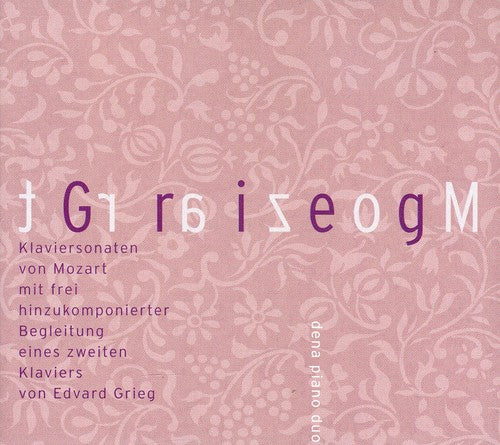
Why would anyone, even Edvard Grieg—not the greatest composer by a long shot, but a great musical figure and one who revered Mozart—arrange any Mozart piano sonatas—even the powerful K 457 and the forward-looking K 533—for two pianos? My wariness of arrangements other than those by the composer leads me to ask again, why? Well, if you’ve never tried it (or never heard it), don’t knock it. Keep an open mind! But before I listened, I read. The notes in the accompanying booklet describe what Grieg did. (In English, the small, red font against a purple background is an abominable choice for reading; in German, the white font against the same background is eminently readable, but my German is now a distant memory.) Grieg’s “arrangements” are actually adaptations, or more precisely, augmentations. In each sonata, Grieg retained Mozart’s score as the primo and composed a secundo to add a more contemporary style to the music. Now this is certainly a novel approach to “arranging,” and it may be the first example of crossover. It is akin to the current theatrical practice of presenting Shakespeare in contemporary guise, such as Julius Caesar in Fascist uniforms or The Taming of the Shrew on motorcycles (both courtesy of noted stage director Michael Kahn or those directors he fosters), a practice that I deplore. Then I listened. What I heard were four Mozart sonatas that were as fully recognizable as their originals, but with fuller bass lines, with extra and more complex harmonization, and with significantly non-Mozartian embellishments.
In the early K 283, much more Grieg is discernable in the latter two movements than in the first movement. K 545, Mozart’s easy-to-play and most popular sonata, can be described as complexified simplicity. The power of the first movement of K 457 is greatly weakened by Grieg’s defocusing secundo augmentation. The second movement of K 457 fares even worse, sounding like a mixture of ballroom dance-music with piano noodling by a “stylist.” Grieg’s defocusing secundo augmentation relaxes the tension in the final movement, eventually enervating the normally powerful coda. Most interesting is the first movement of K 533, which is stylistically very open to Grieg’s secundo augmentation. In the K 533 second movement, in a-b-a form, Mozart already achieves Grieg’s contemporary style in part b without Grieg’s intervention. By contemporizing part a, Grieg distracts from the listener’s amazement at the shocking progressions and harmonies that Mozart introduces in part b. But this provides the opportunity in part b for Grieg to really let loose, building interestingly on Mozart’s already impressionistic base. The final movement of K 533 shows the strongest Grieg influence on this disc, masking the movement’s Mozartian delicacy—one could call it, with successive puns, the “MoztGrieg” and the least “Griegzart.”
The Dena Piano Duo (Tina Margareta Nilssen, piano 1, and Heide Görtz, piano 2) are excellent pianists, and the sound quality is also excellent. Nilssen plays the primo (Mozart) part, and Görtz plays the secundo (Grieg) part. I recommend this CD to Grieg scholars and, strictly as a curiosity, to anyone else, but not as an addition to anyone’s Mozart collection.
FANFARE: Burton Rothleder
This is a hybrid Super Audio CD playable on both regular and Super Audio CD players.
MOZART (Arr. Grieg) Piano Sonatas: in C, K 545; in F, K 533; in G, K 283; in c, K 457 • Dena Pn Duo • 2-L 40 (Hybrid multichannel SACD: 73:10)
Why would anyone, even Edvard Grieg—not the greatest composer by a long shot, but a great musical figure and one who revered Mozart—arrange any Mozart piano sonatas—even the powerful K 457 and the forward-looking K 533—for two pianos? My wariness of arrangements other than those by the composer leads me to ask again, why? Well, if you’ve never tried it (or never heard it), don’t knock it. Keep an open mind! But before I listened, I read. The notes in the accompanying booklet describe what Grieg did. (In English, the small, red font against a purple background is an abominable choice for reading; in German, the white font against the same background is eminently readable, but my German is now a distant memory.) Grieg’s “arrangements” are actually adaptations, or more precisely, augmentations. In each sonata, Grieg retained Mozart’s score as the primo and composed a secundo to add a more contemporary style to the music. Now this is certainly a novel approach to “arranging,” and it may be the first example of crossover. It is akin to the current theatrical practice of presenting Shakespeare in contemporary guise, such as Julius Caesar in Fascist uniforms or The Taming of the Shrew on motorcycles (both courtesy of noted stage director Michael Kahn or those directors he fosters), a practice that I deplore. Then I listened. What I heard were four Mozart sonatas that were as fully recognizable as their originals, but with fuller bass lines, with extra and more complex harmonization, and with significantly non-Mozartian embellishments.
In the early K 283, much more Grieg is discernable in the latter two movements than in the first movement. K 545, Mozart’s easy-to-play and most popular sonata, can be described as complexified simplicity. The power of the first movement of K 457 is greatly weakened by Grieg’s defocusing secundo augmentation. The second movement of K 457 fares even worse, sounding like a mixture of ballroom dance-music with piano noodling by a “stylist.” Grieg’s defocusing secundo augmentation relaxes the tension in the final movement, eventually enervating the normally powerful coda. Most interesting is the first movement of K 533, which is stylistically very open to Grieg’s secundo augmentation. In the K 533 second movement, in a-b-a form, Mozart already achieves Grieg’s contemporary style in part b without Grieg’s intervention. By contemporizing part a, Grieg distracts from the listener’s amazement at the shocking progressions and harmonies that Mozart introduces in part b. But this provides the opportunity in part b for Grieg to really let loose, building interestingly on Mozart’s already impressionistic base. The final movement of K 533 shows the strongest Grieg influence on this disc, masking the movement’s Mozartian delicacy—one could call it, with successive puns, the “MoztGrieg” and the least “Griegzart.”
The Dena Piano Duo (Tina Margareta Nilssen, piano 1, and Heide Görtz, piano 2) are excellent pianists, and the sound quality is also excellent. Nilssen plays the primo (Mozart) part, and Görtz plays the secundo (Grieg) part. I recommend this CD to Grieg scholars and, strictly as a curiosity, to anyone else, but not as an addition to anyone’s Mozart collection.
FANFARE: Burton Rothleder
This is a hybrid Super Audio CD playable on both regular and Super Audio CD players.
$18.99
Mozart/Grieg: Sonatas For Piano Duet / Dena Piano Duo—
$18.99
Description
MOZART (Arr. Grieg) Piano Sonatas: in C, K 545; in F, K 533; in G, K 283; in c, K 457 • Dena Pn Duo • 2-L 40 (Hybrid multichannel SACD: 73:10)
Why would anyone, even Edvard Grieg—not the greatest composer by a long shot, but a great musical figure and one who revered Mozart—arrange any Mozart piano sonatas—even the powerful K 457 and the forward-looking K 533—for two pianos? My wariness of arrangements other than those by the composer leads me to ask again, why? Well, if you’ve never tried it (or never heard it), don’t knock it. Keep an open mind! But before I listened, I read. The notes in the accompanying booklet describe what Grieg did. (In English, the small, red font against a purple background is an abominable choice for reading; in German, the white font against the same background is eminently readable, but my German is now a distant memory.) Grieg’s “arrangements” are actually adaptations, or more precisely, augmentations. In each sonata, Grieg retained Mozart’s score as the primo and composed a secundo to add a more contemporary style to the music. Now this is certainly a novel approach to “arranging,” and it may be the first example of crossover. It is akin to the current theatrical practice of presenting Shakespeare in contemporary guise, such as Julius Caesar in Fascist uniforms or The Taming of the Shrew on motorcycles (both courtesy of noted stage director Michael Kahn or those directors he fosters), a practice that I deplore. Then I listened. What I heard were four Mozart sonatas that were as fully recognizable as their originals, but with fuller bass lines, with extra and more complex harmonization, and with significantly non-Mozartian embellishments.
In the early K 283, much more Grieg is discernable in the latter two movements than in the first movement. K 545, Mozart’s easy-to-play and most popular sonata, can be described as complexified simplicity. The power of the first movement of K 457 is greatly weakened by Grieg’s defocusing secundo augmentation. The second movement of K 457 fares even worse, sounding like a mixture of ballroom dance-music with piano noodling by a “stylist.” Grieg’s defocusing secundo augmentation relaxes the tension in the final movement, eventually enervating the normally powerful coda. Most interesting is the first movement of K 533, which is stylistically very open to Grieg’s secundo augmentation. In the K 533 second movement, in a-b-a form, Mozart already achieves Grieg’s contemporary style in part b without Grieg’s intervention. By contemporizing part a, Grieg distracts from the listener’s amazement at the shocking progressions and harmonies that Mozart introduces in part b. But this provides the opportunity in part b for Grieg to really let loose, building interestingly on Mozart’s already impressionistic base. The final movement of K 533 shows the strongest Grieg influence on this disc, masking the movement’s Mozartian delicacy—one could call it, with successive puns, the “MoztGrieg” and the least “Griegzart.”
The Dena Piano Duo (Tina Margareta Nilssen, piano 1, and Heide Görtz, piano 2) are excellent pianists, and the sound quality is also excellent. Nilssen plays the primo (Mozart) part, and Görtz plays the secundo (Grieg) part. I recommend this CD to Grieg scholars and, strictly as a curiosity, to anyone else, but not as an addition to anyone’s Mozart collection.
FANFARE: Burton Rothleder
This is a hybrid Super Audio CD playable on both regular and Super Audio CD players.