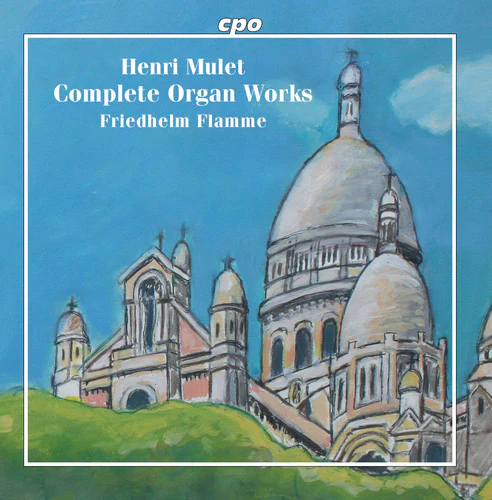
Mulet: Complete Organ Works / Friedhelm Flamme
Henri Mulet was born in the immediate vicinity of the Sacré-Coeur Basilica in 1878 and studied organ with Charles-Marie Widor and Louis Vierne at the Paris Conservatory. Vierne ranked his student with the “most brilliant of musical personalities” and described him as “an outstanding virtuoso and a very fine improviser.” From 1923 to 1931 Mulet was a professor at the Schola Cantorum in Paris; Camille-Saint-Saëns was one of his colleagues, and Gabriel Fauré merits mention as one of his first students. Mulet’s oeuvre focused first and foremost on the organ, and the Esquisses byzantines composed from 1914 to 1919 and published in 1920 has continued to be his most frequently performed collection of pieces. While the rhythms and meters in most of his pieces – the “quadrature of the compositional structure” castigated by Richard Wagner – were rather conventional, the harmonies negotiating between Debussy, Wagner, and Vierne are very appealing.
Henri Mulet was born in the immediate vicinity of the Sacré-Coeur Basilica in 1878 and studied organ with Charles-Marie Widor and Louis Vierne at the Paris Conservatory. Vierne ranked his student with the “most brilliant of musical personalities” and described him as “an outstanding virtuoso and a very fine improviser.” From 1923 to 1931 Mulet was a professor at the Schola Cantorum in Paris; Camille-Saint-Saëns was one of his colleagues, and Gabriel Fauré merits mention as one of his first students. Mulet’s oeuvre focused first and foremost on the organ, and the Esquisses byzantines composed from 1914 to 1919 and published in 1920 has continued to be his most frequently performed collection of pieces. While the rhythms and meters in most of his pieces – the “quadrature of the compositional structure” castigated by Richard Wagner – were rather conventional, the harmonies negotiating between Debussy, Wagner, and Vierne are very appealing.
Original: $25.99
-65%$25.99
$9.10Description
Henri Mulet was born in the immediate vicinity of the Sacré-Coeur Basilica in 1878 and studied organ with Charles-Marie Widor and Louis Vierne at the Paris Conservatory. Vierne ranked his student with the “most brilliant of musical personalities” and described him as “an outstanding virtuoso and a very fine improviser.” From 1923 to 1931 Mulet was a professor at the Schola Cantorum in Paris; Camille-Saint-Saëns was one of his colleagues, and Gabriel Fauré merits mention as one of his first students. Mulet’s oeuvre focused first and foremost on the organ, and the Esquisses byzantines composed from 1914 to 1919 and published in 1920 has continued to be his most frequently performed collection of pieces. While the rhythms and meters in most of his pieces – the “quadrature of the compositional structure” castigated by Richard Wagner – were rather conventional, the harmonies negotiating between Debussy, Wagner, and Vierne are very appealing.