🎉 Up to 70% Off Selected ItemsShop Sale

1 / 2
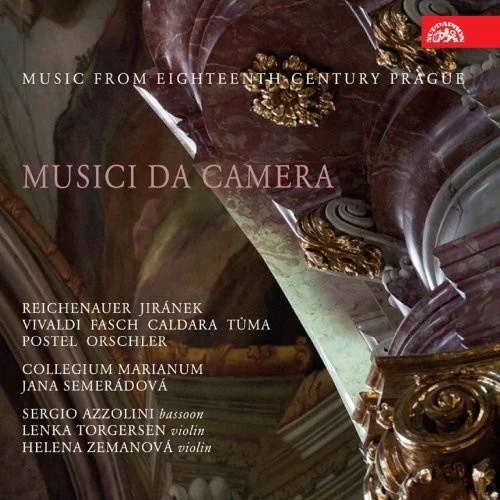
Musica Da Camera: Music From Eighteenth Century Prague
MUSIC FROM 18TH-CENTURY PRAGUE • Jana Semerádová (fl, cond); Sergio Azzolini (bsn); Lenka Torgersen (vn); Helena Zemanova (vn); Collegium Marianum (period instruments) • SUPRAPHON 4112 (2 CDs: 112:31)
REICHENAUER Quartet in g for Violin, Cello, Bassoon, and Continuo, Rk 18. Trio Sonata in B? for Violin, Cello, and Continuo, Rk 20. FASCH Quartet in D for Flute, Violin, Bassoon, and Continuo, WV N:D1. Concerto in C for Flute, Violin, Bassoon, and Continuo, WV L:C3. Concerto in D for 2 Flutes, Strings, and Continuo, WV L:D9. JIRÁNEK Trio Sonata in B? for 2 Violins and Continuo, Jk 27. POSTEL Trio Sonata in A for 2 Violins and Continuo. ORSCHLER Trio in f for Two Violins and Continuo. VIVALDI Trio in g for Violin, Lute, and Continuo, RV 85. T?MA Partita in C for Flute and Continuo. CALDARA Sonata in A for Violin and Continuo
Let me begin with what usually comes at the end of a review, the recommendation. Without reservation, this is enthusiastically recommended to all lovers of music from the very late Baroque and very early Classical periods. Now you can skip the rest and run right to your computer to order this set.
I wanted to get that out of the way first before dealing with some of the inconsistencies in the titling of these works. But first let me credit the album booklet’s credits page for naming every member of the Collegium Marianum ensemble and cross-referencing each player with each work in which he or she is a participant.Next, let it be noted that of the 11 works on these two CDs, six are world premiere recordings, the two by Reinchenauer and those by Jiránek, Postel, Orschler, and T?ma.
Now for the inconsistencies. To begin with, the inclusion of works by Vivaldi and Caldara on a disc titled “18th-Century Music from Prague” is a bit of a stretch. Their music may have been known in the Bohemian capital, but it’s speculation on the part of note author Václav Kapsa as to whether either composer ever set foot in Prague; and even if they did, the works by which they’re represented on these discs were certainly not written there, nor, to my knowledge, does either of them have Czech ancestry in his blood. But who cares? Vivaldi and Caldara are always welcome guests.
The other inconsistencies have to do with the formal nomenclature used to classify some of these works. There’s no problem with the pieces designated “trio sonata” by Reichenauer, Jiránek, Postel, Orschler, and Vivaldi, all of which feature two melody instruments plus continuo. This was the common configuration for trio sonatas in the 18th century, and in what was fairly standard, if not de riguer baroque practice, a fourth low bass bowed string or plucked instrument was used to reinforce the keyboard’s bass line.
The current performances present us with an interesting and satisfying approach to this practice. In the Jiránek and Reichenauer trios, the keyboard instrument used is a harpsichord and, appropriately, it’s reinforced by a theorbo in one case and a baroque guitar in another. In the Postel trio, the keyboard instrument is an organ, for which reinforcement is probably not necessary, and so none is added. But in the Orschler trio, in which the organ is also used, a baroque guitar is added. Finally, in the Vivaldi trio for violin and lute, no keyboard instrument is used at all; instead, the theorbo alone fulfills the continuo function. So, in each of these pieces, the sound of the continuo is varied by the use of a different keyboard instrument (or no keyboard instrument in the case of the Vivaldi) in combination with a different reinforcing bass instrument (or none in the case of the Postel). Not only does this add an extra element of color, but it also suggests a connection with baroque performance practice, for I suspect that musicians came together to play these pieces with whatever instruments were available at the moment.
Figuring out the formal classifications of some of these other pieces is trickier. For example, we have two works designated “quartet” in which there are now three main melody instruments plus continuo. We don’t usually think of a quartet as being a piece like a trio sonata where a keyboard or low bass plucked instrument plays a continuo role, yet that’s what we have in Reicnenauer’s Quartet in G Minor for Violin, Cello, Bassoon, and Continuo and in Fasch’s Quartet in D Major for Flute, Violin, Bassoon, and Continuo. In both cases, the continuo instrument used is theorbo or baroque guitar.
Even more unusual to us in its terminology is Fasch’s Concerto in C for Flute, Violin, Bassoon, and Continuo. We know, of course, that baroque concertos almost invariably relied on a keyboard instrument to underpin the ensemble, but at the heart of the concerto concept was a single soloist or a small group of soloists contrasted against a larger instrumental body. Here we have a work called a concerto, but essentially it’s no different from the quartets discussed above. The answer to this head-scratcher is provided by the same composer whose above-cited concerto on disc 1 raised the question, for Fasch provides us on disc 2 with his Concerto in D Major for Two Flutes, Strings, and Continuo, which, with its body of multiple strings, comports more closely with what we think of as a true concerto.
The simple fact is that all of these pieces date from around the midway point in the 18th century at a time when the Baroque was transitioning to the Classical, when composers were experimenting with various instrumental combinations, and when terms used for musical forms were in a state of flux. It’s entirely reasonable to assume that works designated “quartet” by Reichenauer and Fasch sowed the seeds for what would shortly become a formalized quartet—i.e., four instruments unsupported by continuo.
Vivaldi, of course, but even Fasch, Caldara, and Reichenauer are names familiar to most listeners with more than a superficial exposure to music of the Baroque period, and they all flourished around the same time as Bach and Handel. But Franti?ek Jiránek (1698–1778), Christian Gottlieb Postel (1697–1730), Johann Georg Orschler (1697–1767/70), and Franti?ek Ignác Antonin T?ma (1704–1774) are apt to be less known or not known at all, and in two cases, Jiránek and T?ma, they lived well into the full flowering of the Classical period. There’s nothing in the music of these two later composers, however—at least in what there is of it on these CDs—to suggest that either of them had encountered Haydn. In terms of style, Jiránek’s trio sonata sounds the most modern, suggesting that he had some knowledge of C. P. E. Bach. But you would rightly identify the rest of the pieces in this collection as examples of late-Baroque style, influenced, it sounds to me, mainly by the Dresden school of Johann Georg Pisendel.
The above is not a criticism, it’s merely an observation based on my hearing of these pieces. The performances by this Prague-based ensemble are riveting. Composed of what appears to be 16 players, the Collegium Marianum is one of the best period-instrument groups I’ve recently encountered. Jana Semerádová has honed the ensemble to a high degree of technical perfection, and she both plays in and leads spirited, communicative, and moving performances in a program of music that will keep you listening and captivated for the almost two hours of this very strongly recommended two-disc set.
FANFARE: Jerry Dubins
MUSIC FROM 18TH-CENTURY PRAGUE • Jana Semerádová (fl, cond); Sergio Azzolini (bsn); Lenka Torgersen (vn); Helena Zemanova (vn); Collegium Marianum (period instruments) • SUPRAPHON 4112 (2 CDs: 112:31)
REICHENAUER Quartet in g for Violin, Cello, Bassoon, and Continuo, Rk 18. Trio Sonata in B? for Violin, Cello, and Continuo, Rk 20. FASCH Quartet in D for Flute, Violin, Bassoon, and Continuo, WV N:D1. Concerto in C for Flute, Violin, Bassoon, and Continuo, WV L:C3. Concerto in D for 2 Flutes, Strings, and Continuo, WV L:D9. JIRÁNEK Trio Sonata in B? for 2 Violins and Continuo, Jk 27. POSTEL Trio Sonata in A for 2 Violins and Continuo. ORSCHLER Trio in f for Two Violins and Continuo. VIVALDI Trio in g for Violin, Lute, and Continuo, RV 85. T?MA Partita in C for Flute and Continuo. CALDARA Sonata in A for Violin and Continuo
Let me begin with what usually comes at the end of a review, the recommendation. Without reservation, this is enthusiastically recommended to all lovers of music from the very late Baroque and very early Classical periods. Now you can skip the rest and run right to your computer to order this set.
I wanted to get that out of the way first before dealing with some of the inconsistencies in the titling of these works. But first let me credit the album booklet’s credits page for naming every member of the Collegium Marianum ensemble and cross-referencing each player with each work in which he or she is a participant.Next, let it be noted that of the 11 works on these two CDs, six are world premiere recordings, the two by Reinchenauer and those by Jiránek, Postel, Orschler, and T?ma.
Now for the inconsistencies. To begin with, the inclusion of works by Vivaldi and Caldara on a disc titled “18th-Century Music from Prague” is a bit of a stretch. Their music may have been known in the Bohemian capital, but it’s speculation on the part of note author Václav Kapsa as to whether either composer ever set foot in Prague; and even if they did, the works by which they’re represented on these discs were certainly not written there, nor, to my knowledge, does either of them have Czech ancestry in his blood. But who cares? Vivaldi and Caldara are always welcome guests.
The other inconsistencies have to do with the formal nomenclature used to classify some of these works. There’s no problem with the pieces designated “trio sonata” by Reichenauer, Jiránek, Postel, Orschler, and Vivaldi, all of which feature two melody instruments plus continuo. This was the common configuration for trio sonatas in the 18th century, and in what was fairly standard, if not de riguer baroque practice, a fourth low bass bowed string or plucked instrument was used to reinforce the keyboard’s bass line.
The current performances present us with an interesting and satisfying approach to this practice. In the Jiránek and Reichenauer trios, the keyboard instrument used is a harpsichord and, appropriately, it’s reinforced by a theorbo in one case and a baroque guitar in another. In the Postel trio, the keyboard instrument is an organ, for which reinforcement is probably not necessary, and so none is added. But in the Orschler trio, in which the organ is also used, a baroque guitar is added. Finally, in the Vivaldi trio for violin and lute, no keyboard instrument is used at all; instead, the theorbo alone fulfills the continuo function. So, in each of these pieces, the sound of the continuo is varied by the use of a different keyboard instrument (or no keyboard instrument in the case of the Vivaldi) in combination with a different reinforcing bass instrument (or none in the case of the Postel). Not only does this add an extra element of color, but it also suggests a connection with baroque performance practice, for I suspect that musicians came together to play these pieces with whatever instruments were available at the moment.
Figuring out the formal classifications of some of these other pieces is trickier. For example, we have two works designated “quartet” in which there are now three main melody instruments plus continuo. We don’t usually think of a quartet as being a piece like a trio sonata where a keyboard or low bass plucked instrument plays a continuo role, yet that’s what we have in Reicnenauer’s Quartet in G Minor for Violin, Cello, Bassoon, and Continuo and in Fasch’s Quartet in D Major for Flute, Violin, Bassoon, and Continuo. In both cases, the continuo instrument used is theorbo or baroque guitar.
Even more unusual to us in its terminology is Fasch’s Concerto in C for Flute, Violin, Bassoon, and Continuo. We know, of course, that baroque concertos almost invariably relied on a keyboard instrument to underpin the ensemble, but at the heart of the concerto concept was a single soloist or a small group of soloists contrasted against a larger instrumental body. Here we have a work called a concerto, but essentially it’s no different from the quartets discussed above. The answer to this head-scratcher is provided by the same composer whose above-cited concerto on disc 1 raised the question, for Fasch provides us on disc 2 with his Concerto in D Major for Two Flutes, Strings, and Continuo, which, with its body of multiple strings, comports more closely with what we think of as a true concerto.
The simple fact is that all of these pieces date from around the midway point in the 18th century at a time when the Baroque was transitioning to the Classical, when composers were experimenting with various instrumental combinations, and when terms used for musical forms were in a state of flux. It’s entirely reasonable to assume that works designated “quartet” by Reichenauer and Fasch sowed the seeds for what would shortly become a formalized quartet—i.e., four instruments unsupported by continuo.
Vivaldi, of course, but even Fasch, Caldara, and Reichenauer are names familiar to most listeners with more than a superficial exposure to music of the Baroque period, and they all flourished around the same time as Bach and Handel. But Franti?ek Jiránek (1698–1778), Christian Gottlieb Postel (1697–1730), Johann Georg Orschler (1697–1767/70), and Franti?ek Ignác Antonin T?ma (1704–1774) are apt to be less known or not known at all, and in two cases, Jiránek and T?ma, they lived well into the full flowering of the Classical period. There’s nothing in the music of these two later composers, however—at least in what there is of it on these CDs—to suggest that either of them had encountered Haydn. In terms of style, Jiránek’s trio sonata sounds the most modern, suggesting that he had some knowledge of C. P. E. Bach. But you would rightly identify the rest of the pieces in this collection as examples of late-Baroque style, influenced, it sounds to me, mainly by the Dresden school of Johann Georg Pisendel.
The above is not a criticism, it’s merely an observation based on my hearing of these pieces. The performances by this Prague-based ensemble are riveting. Composed of what appears to be 16 players, the Collegium Marianum is one of the best period-instrument groups I’ve recently encountered. Jana Semerádová has honed the ensemble to a high degree of technical perfection, and she both plays in and leads spirited, communicative, and moving performances in a program of music that will keep you listening and captivated for the almost two hours of this very strongly recommended two-disc set.
FANFARE: Jerry Dubins
$35.99
Musica Da Camera: Music From Eighteenth Century Prague—
$35.99
Description
MUSIC FROM 18TH-CENTURY PRAGUE • Jana Semerádová (fl, cond); Sergio Azzolini (bsn); Lenka Torgersen (vn); Helena Zemanova (vn); Collegium Marianum (period instruments) • SUPRAPHON 4112 (2 CDs: 112:31)
REICHENAUER Quartet in g for Violin, Cello, Bassoon, and Continuo, Rk 18. Trio Sonata in B? for Violin, Cello, and Continuo, Rk 20. FASCH Quartet in D for Flute, Violin, Bassoon, and Continuo, WV N:D1. Concerto in C for Flute, Violin, Bassoon, and Continuo, WV L:C3. Concerto in D for 2 Flutes, Strings, and Continuo, WV L:D9. JIRÁNEK Trio Sonata in B? for 2 Violins and Continuo, Jk 27. POSTEL Trio Sonata in A for 2 Violins and Continuo. ORSCHLER Trio in f for Two Violins and Continuo. VIVALDI Trio in g for Violin, Lute, and Continuo, RV 85. T?MA Partita in C for Flute and Continuo. CALDARA Sonata in A for Violin and Continuo
Let me begin with what usually comes at the end of a review, the recommendation. Without reservation, this is enthusiastically recommended to all lovers of music from the very late Baroque and very early Classical periods. Now you can skip the rest and run right to your computer to order this set.
I wanted to get that out of the way first before dealing with some of the inconsistencies in the titling of these works. But first let me credit the album booklet’s credits page for naming every member of the Collegium Marianum ensemble and cross-referencing each player with each work in which he or she is a participant.Next, let it be noted that of the 11 works on these two CDs, six are world premiere recordings, the two by Reinchenauer and those by Jiránek, Postel, Orschler, and T?ma.
Now for the inconsistencies. To begin with, the inclusion of works by Vivaldi and Caldara on a disc titled “18th-Century Music from Prague” is a bit of a stretch. Their music may have been known in the Bohemian capital, but it’s speculation on the part of note author Václav Kapsa as to whether either composer ever set foot in Prague; and even if they did, the works by which they’re represented on these discs were certainly not written there, nor, to my knowledge, does either of them have Czech ancestry in his blood. But who cares? Vivaldi and Caldara are always welcome guests.
The other inconsistencies have to do with the formal nomenclature used to classify some of these works. There’s no problem with the pieces designated “trio sonata” by Reichenauer, Jiránek, Postel, Orschler, and Vivaldi, all of which feature two melody instruments plus continuo. This was the common configuration for trio sonatas in the 18th century, and in what was fairly standard, if not de riguer baroque practice, a fourth low bass bowed string or plucked instrument was used to reinforce the keyboard’s bass line.
The current performances present us with an interesting and satisfying approach to this practice. In the Jiránek and Reichenauer trios, the keyboard instrument used is a harpsichord and, appropriately, it’s reinforced by a theorbo in one case and a baroque guitar in another. In the Postel trio, the keyboard instrument is an organ, for which reinforcement is probably not necessary, and so none is added. But in the Orschler trio, in which the organ is also used, a baroque guitar is added. Finally, in the Vivaldi trio for violin and lute, no keyboard instrument is used at all; instead, the theorbo alone fulfills the continuo function. So, in each of these pieces, the sound of the continuo is varied by the use of a different keyboard instrument (or no keyboard instrument in the case of the Vivaldi) in combination with a different reinforcing bass instrument (or none in the case of the Postel). Not only does this add an extra element of color, but it also suggests a connection with baroque performance practice, for I suspect that musicians came together to play these pieces with whatever instruments were available at the moment.
Figuring out the formal classifications of some of these other pieces is trickier. For example, we have two works designated “quartet” in which there are now three main melody instruments plus continuo. We don’t usually think of a quartet as being a piece like a trio sonata where a keyboard or low bass plucked instrument plays a continuo role, yet that’s what we have in Reicnenauer’s Quartet in G Minor for Violin, Cello, Bassoon, and Continuo and in Fasch’s Quartet in D Major for Flute, Violin, Bassoon, and Continuo. In both cases, the continuo instrument used is theorbo or baroque guitar.
Even more unusual to us in its terminology is Fasch’s Concerto in C for Flute, Violin, Bassoon, and Continuo. We know, of course, that baroque concertos almost invariably relied on a keyboard instrument to underpin the ensemble, but at the heart of the concerto concept was a single soloist or a small group of soloists contrasted against a larger instrumental body. Here we have a work called a concerto, but essentially it’s no different from the quartets discussed above. The answer to this head-scratcher is provided by the same composer whose above-cited concerto on disc 1 raised the question, for Fasch provides us on disc 2 with his Concerto in D Major for Two Flutes, Strings, and Continuo, which, with its body of multiple strings, comports more closely with what we think of as a true concerto.
The simple fact is that all of these pieces date from around the midway point in the 18th century at a time when the Baroque was transitioning to the Classical, when composers were experimenting with various instrumental combinations, and when terms used for musical forms were in a state of flux. It’s entirely reasonable to assume that works designated “quartet” by Reichenauer and Fasch sowed the seeds for what would shortly become a formalized quartet—i.e., four instruments unsupported by continuo.
Vivaldi, of course, but even Fasch, Caldara, and Reichenauer are names familiar to most listeners with more than a superficial exposure to music of the Baroque period, and they all flourished around the same time as Bach and Handel. But Franti?ek Jiránek (1698–1778), Christian Gottlieb Postel (1697–1730), Johann Georg Orschler (1697–1767/70), and Franti?ek Ignác Antonin T?ma (1704–1774) are apt to be less known or not known at all, and in two cases, Jiránek and T?ma, they lived well into the full flowering of the Classical period. There’s nothing in the music of these two later composers, however—at least in what there is of it on these CDs—to suggest that either of them had encountered Haydn. In terms of style, Jiránek’s trio sonata sounds the most modern, suggesting that he had some knowledge of C. P. E. Bach. But you would rightly identify the rest of the pieces in this collection as examples of late-Baroque style, influenced, it sounds to me, mainly by the Dresden school of Johann Georg Pisendel.
The above is not a criticism, it’s merely an observation based on my hearing of these pieces. The performances by this Prague-based ensemble are riveting. Composed of what appears to be 16 players, the Collegium Marianum is one of the best period-instrument groups I’ve recently encountered. Jana Semerádová has honed the ensemble to a high degree of technical perfection, and she both plays in and leads spirited, communicative, and moving performances in a program of music that will keep you listening and captivated for the almost two hours of this very strongly recommended two-disc set.
FANFARE: Jerry Dubins