🎉 Up to 70% Off Selected ItemsShop Sale

1 / 2
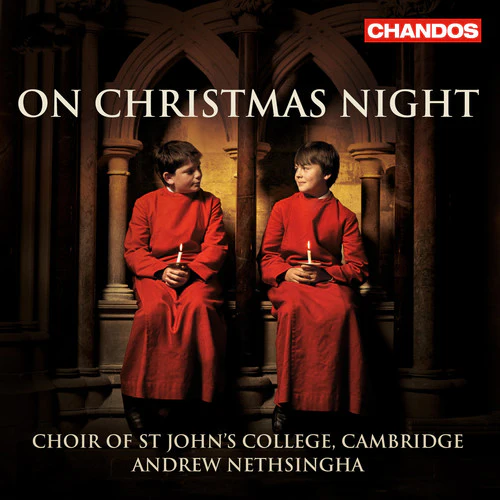
On Christmas Night / Nethsingha, Choir of St. John's
This excellent and most enjoyable disc will be a high quality Christmas present for a musical friend - or to give to yourself!
It’s four years now since Andrew Nethsingha moved from Gloucester Cathedral, where he had been a distinguished Director of Music, to St. John’s College, where as part of his training he had once been the Organ Scholar, under George Guest. Having established himself securely with the college’s choir he’s begun recording with them for Chandos and the partnership has already produced some impressive results. These include a very fine Howells collection, an equally good mixed recital of church music and a disc of music by Lassus, which I haven’t heard but which impressed my colleague, Gavin Dixon. Their latest offering is of music for Advent and Christmas; in every respect it maintains the high standards set by their previous releases.
Before commenting on the music, can I commend Chandos for the quality of the booklet? This label is always strong on documentation but there must be a temptation for record companies to economise a little on such releases - “it’s only carols”. In fact, Chandos provide all the texts and, best of all, a really useful and thorough essay by Martin Ennis, which includes a separate and interesting paragraph on every one of the twenty-four items on the programme. The essay, in fact, is a model of its kind and the best I can recall seeing for a release of seasonal music.
The programme has been very carefully chosen and includes a welcome mix of the familiar, the unfamiliar and the familiar in slightly less-than-familiar guise. Into this latter category would come items such as the exuberant and effective arrangement by Philip Marshall, the former organist of Lincoln Cathedral, of I saw three ships. The version of Ding! dong! merrily on high would also fall into the exuberant, indeed flamboyant, category. It was made by the Music Director of the Mormon Tabernacle Choir and requires two organists. The organ features strongly - and most effectively - in Stephen Jackson’s arrangement of Noël nouvelet. Indeed, the organ writing is a key element in giving the setting its pronounced French flavour. It’s good to see Andrew Nethsingha give a bow to one of his predecessors at St. John’s, Christopher Robinson. Instead of the usual - and excellent - Willcocks descant to Hark! the herald angels sing we hear Robinson’s descant and a jolly good one it is!
Moving to the unfamiliar elements in the programme we find Christopher Robinson there too. I’d not heard before his setting of Make we joy - a text more famously set by Walton. I like this Robinson setting very much indeed; it’s buoyant and strongly rhythmic. Also new to me was Michael Finnissy’s Telling. Written in 2008, this is a setting for unaccompanied choir of an anonymous sixteenth century text. Martin Ennis draws attention, rightly, to the “refined harmonic sensibility” of the piece. I think it’s a beautiful composition and, in an intelligent piece of programme ordering, we find that Kenneth Leighton’s fine Coventry Carol, which comes next in the running order, complements the Finnissy nicely. Mention should also be made of Matthew Martin’s Adam lay ybounden. This is very different from some other settings - one thinks of Boris Ord’s celebrated setting, for starters. Martin’s piece is slow and reflective and it’s good to have another slant on this well-known text. I also liked the item by James Burton, perhaps best known as Director of the Oxford Schola Cantorum. His Balulalow eschews trebles - the altos take the top line - giving an interesting, darker texture. Some of the harmonies are quite close and I think it’s a lovely piece.
And so to the familiar seasonal items. It’s right to include them to give the programme balance. Nethsingha and his singers pay these pieces - and their listeners - the important compliment of taking as much care over them as they have done over the less conventional fare. Harold Darke’s classic piece is given a lovely performance and lovely too is the choir’s account of Philip Ledger’s sympathetic arrangement of Silent Night - good planning, too, to place this immediately after his equally good arrangement of the Sussex Carol. Ledger’s predecessor at King’s College, Sir David Willcocks, is represented by his justly popular Tomorrow shall be my dancing day. O little town of Bethlehem, mainstay of innumerable carol services, makes an equally welcome appearance. It wouldn’t be a Christmas programme without John Rutter. When you hear his lovely What sweeter music, which, as Martin Ennis justly observes, contains “one of his most winning melodies”, you realise just why for so many people Rutter has become synonymous with Christmas music. The present performance is first class, with every little detail of Rutter’s music nicely observed.
The singing on this disc is very fine indeed. Solos are well taken and the choir as a group blends extremely well and sings with excellent tone and great clarity. Several of the pieces are accompanied by organ and the college’s Senior Organ Scholar, John Challenger, does a marvellous job. I relished especially his splendid contributions - very different from each other in character - to the Jackson and Mathias pieces.
It only remains to say that the Chandos sound is up to the label’s usual exalted standard - I listened to this hybrid SACD as a conventional CD. This most enjoyable disc will be a high quality Christmas present for a musical friend - or to give to yourself!
-- John Quinn, MusicWeb International
It’s four years now since Andrew Nethsingha moved from Gloucester Cathedral, where he had been a distinguished Director of Music, to St. John’s College, where as part of his training he had once been the Organ Scholar, under George Guest. Having established himself securely with the college’s choir he’s begun recording with them for Chandos and the partnership has already produced some impressive results. These include a very fine Howells collection, an equally good mixed recital of church music and a disc of music by Lassus, which I haven’t heard but which impressed my colleague, Gavin Dixon. Their latest offering is of music for Advent and Christmas; in every respect it maintains the high standards set by their previous releases.
Before commenting on the music, can I commend Chandos for the quality of the booklet? This label is always strong on documentation but there must be a temptation for record companies to economise a little on such releases - “it’s only carols”. In fact, Chandos provide all the texts and, best of all, a really useful and thorough essay by Martin Ennis, which includes a separate and interesting paragraph on every one of the twenty-four items on the programme. The essay, in fact, is a model of its kind and the best I can recall seeing for a release of seasonal music.
The programme has been very carefully chosen and includes a welcome mix of the familiar, the unfamiliar and the familiar in slightly less-than-familiar guise. Into this latter category would come items such as the exuberant and effective arrangement by Philip Marshall, the former organist of Lincoln Cathedral, of I saw three ships. The version of Ding! dong! merrily on high would also fall into the exuberant, indeed flamboyant, category. It was made by the Music Director of the Mormon Tabernacle Choir and requires two organists. The organ features strongly - and most effectively - in Stephen Jackson’s arrangement of Noël nouvelet. Indeed, the organ writing is a key element in giving the setting its pronounced French flavour. It’s good to see Andrew Nethsingha give a bow to one of his predecessors at St. John’s, Christopher Robinson. Instead of the usual - and excellent - Willcocks descant to Hark! the herald angels sing we hear Robinson’s descant and a jolly good one it is!
Moving to the unfamiliar elements in the programme we find Christopher Robinson there too. I’d not heard before his setting of Make we joy - a text more famously set by Walton. I like this Robinson setting very much indeed; it’s buoyant and strongly rhythmic. Also new to me was Michael Finnissy’s Telling. Written in 2008, this is a setting for unaccompanied choir of an anonymous sixteenth century text. Martin Ennis draws attention, rightly, to the “refined harmonic sensibility” of the piece. I think it’s a beautiful composition and, in an intelligent piece of programme ordering, we find that Kenneth Leighton’s fine Coventry Carol, which comes next in the running order, complements the Finnissy nicely. Mention should also be made of Matthew Martin’s Adam lay ybounden. This is very different from some other settings - one thinks of Boris Ord’s celebrated setting, for starters. Martin’s piece is slow and reflective and it’s good to have another slant on this well-known text. I also liked the item by James Burton, perhaps best known as Director of the Oxford Schola Cantorum. His Balulalow eschews trebles - the altos take the top line - giving an interesting, darker texture. Some of the harmonies are quite close and I think it’s a lovely piece.
And so to the familiar seasonal items. It’s right to include them to give the programme balance. Nethsingha and his singers pay these pieces - and their listeners - the important compliment of taking as much care over them as they have done over the less conventional fare. Harold Darke’s classic piece is given a lovely performance and lovely too is the choir’s account of Philip Ledger’s sympathetic arrangement of Silent Night - good planning, too, to place this immediately after his equally good arrangement of the Sussex Carol. Ledger’s predecessor at King’s College, Sir David Willcocks, is represented by his justly popular Tomorrow shall be my dancing day. O little town of Bethlehem, mainstay of innumerable carol services, makes an equally welcome appearance. It wouldn’t be a Christmas programme without John Rutter. When you hear his lovely What sweeter music, which, as Martin Ennis justly observes, contains “one of his most winning melodies”, you realise just why for so many people Rutter has become synonymous with Christmas music. The present performance is first class, with every little detail of Rutter’s music nicely observed.
The singing on this disc is very fine indeed. Solos are well taken and the choir as a group blends extremely well and sings with excellent tone and great clarity. Several of the pieces are accompanied by organ and the college’s Senior Organ Scholar, John Challenger, does a marvellous job. I relished especially his splendid contributions - very different from each other in character - to the Jackson and Mathias pieces.
It only remains to say that the Chandos sound is up to the label’s usual exalted standard - I listened to this hybrid SACD as a conventional CD. This most enjoyable disc will be a high quality Christmas present for a musical friend - or to give to yourself!
-- John Quinn, MusicWeb International
This excellent and most enjoyable disc will be a high quality Christmas present for a musical friend - or to give to yourself!
It’s four years now since Andrew Nethsingha moved from Gloucester Cathedral, where he had been a distinguished Director of Music, to St. John’s College, where as part of his training he had once been the Organ Scholar, under George Guest. Having established himself securely with the college’s choir he’s begun recording with them for Chandos and the partnership has already produced some impressive results. These include a very fine Howells collection, an equally good mixed recital of church music and a disc of music by Lassus, which I haven’t heard but which impressed my colleague, Gavin Dixon. Their latest offering is of music for Advent and Christmas; in every respect it maintains the high standards set by their previous releases.
Before commenting on the music, can I commend Chandos for the quality of the booklet? This label is always strong on documentation but there must be a temptation for record companies to economise a little on such releases - “it’s only carols”. In fact, Chandos provide all the texts and, best of all, a really useful and thorough essay by Martin Ennis, which includes a separate and interesting paragraph on every one of the twenty-four items on the programme. The essay, in fact, is a model of its kind and the best I can recall seeing for a release of seasonal music.
The programme has been very carefully chosen and includes a welcome mix of the familiar, the unfamiliar and the familiar in slightly less-than-familiar guise. Into this latter category would come items such as the exuberant and effective arrangement by Philip Marshall, the former organist of Lincoln Cathedral, of I saw three ships. The version of Ding! dong! merrily on high would also fall into the exuberant, indeed flamboyant, category. It was made by the Music Director of the Mormon Tabernacle Choir and requires two organists. The organ features strongly - and most effectively - in Stephen Jackson’s arrangement of Noël nouvelet. Indeed, the organ writing is a key element in giving the setting its pronounced French flavour. It’s good to see Andrew Nethsingha give a bow to one of his predecessors at St. John’s, Christopher Robinson. Instead of the usual - and excellent - Willcocks descant to Hark! the herald angels sing we hear Robinson’s descant and a jolly good one it is!
Moving to the unfamiliar elements in the programme we find Christopher Robinson there too. I’d not heard before his setting of Make we joy - a text more famously set by Walton. I like this Robinson setting very much indeed; it’s buoyant and strongly rhythmic. Also new to me was Michael Finnissy’s Telling. Written in 2008, this is a setting for unaccompanied choir of an anonymous sixteenth century text. Martin Ennis draws attention, rightly, to the “refined harmonic sensibility” of the piece. I think it’s a beautiful composition and, in an intelligent piece of programme ordering, we find that Kenneth Leighton’s fine Coventry Carol, which comes next in the running order, complements the Finnissy nicely. Mention should also be made of Matthew Martin’s Adam lay ybounden. This is very different from some other settings - one thinks of Boris Ord’s celebrated setting, for starters. Martin’s piece is slow and reflective and it’s good to have another slant on this well-known text. I also liked the item by James Burton, perhaps best known as Director of the Oxford Schola Cantorum. His Balulalow eschews trebles - the altos take the top line - giving an interesting, darker texture. Some of the harmonies are quite close and I think it’s a lovely piece.
And so to the familiar seasonal items. It’s right to include them to give the programme balance. Nethsingha and his singers pay these pieces - and their listeners - the important compliment of taking as much care over them as they have done over the less conventional fare. Harold Darke’s classic piece is given a lovely performance and lovely too is the choir’s account of Philip Ledger’s sympathetic arrangement of Silent Night - good planning, too, to place this immediately after his equally good arrangement of the Sussex Carol. Ledger’s predecessor at King’s College, Sir David Willcocks, is represented by his justly popular Tomorrow shall be my dancing day. O little town of Bethlehem, mainstay of innumerable carol services, makes an equally welcome appearance. It wouldn’t be a Christmas programme without John Rutter. When you hear his lovely What sweeter music, which, as Martin Ennis justly observes, contains “one of his most winning melodies”, you realise just why for so many people Rutter has become synonymous with Christmas music. The present performance is first class, with every little detail of Rutter’s music nicely observed.
The singing on this disc is very fine indeed. Solos are well taken and the choir as a group blends extremely well and sings with excellent tone and great clarity. Several of the pieces are accompanied by organ and the college’s Senior Organ Scholar, John Challenger, does a marvellous job. I relished especially his splendid contributions - very different from each other in character - to the Jackson and Mathias pieces.
It only remains to say that the Chandos sound is up to the label’s usual exalted standard - I listened to this hybrid SACD as a conventional CD. This most enjoyable disc will be a high quality Christmas present for a musical friend - or to give to yourself!
-- John Quinn, MusicWeb International
It’s four years now since Andrew Nethsingha moved from Gloucester Cathedral, where he had been a distinguished Director of Music, to St. John’s College, where as part of his training he had once been the Organ Scholar, under George Guest. Having established himself securely with the college’s choir he’s begun recording with them for Chandos and the partnership has already produced some impressive results. These include a very fine Howells collection, an equally good mixed recital of church music and a disc of music by Lassus, which I haven’t heard but which impressed my colleague, Gavin Dixon. Their latest offering is of music for Advent and Christmas; in every respect it maintains the high standards set by their previous releases.
Before commenting on the music, can I commend Chandos for the quality of the booklet? This label is always strong on documentation but there must be a temptation for record companies to economise a little on such releases - “it’s only carols”. In fact, Chandos provide all the texts and, best of all, a really useful and thorough essay by Martin Ennis, which includes a separate and interesting paragraph on every one of the twenty-four items on the programme. The essay, in fact, is a model of its kind and the best I can recall seeing for a release of seasonal music.
The programme has been very carefully chosen and includes a welcome mix of the familiar, the unfamiliar and the familiar in slightly less-than-familiar guise. Into this latter category would come items such as the exuberant and effective arrangement by Philip Marshall, the former organist of Lincoln Cathedral, of I saw three ships. The version of Ding! dong! merrily on high would also fall into the exuberant, indeed flamboyant, category. It was made by the Music Director of the Mormon Tabernacle Choir and requires two organists. The organ features strongly - and most effectively - in Stephen Jackson’s arrangement of Noël nouvelet. Indeed, the organ writing is a key element in giving the setting its pronounced French flavour. It’s good to see Andrew Nethsingha give a bow to one of his predecessors at St. John’s, Christopher Robinson. Instead of the usual - and excellent - Willcocks descant to Hark! the herald angels sing we hear Robinson’s descant and a jolly good one it is!
Moving to the unfamiliar elements in the programme we find Christopher Robinson there too. I’d not heard before his setting of Make we joy - a text more famously set by Walton. I like this Robinson setting very much indeed; it’s buoyant and strongly rhythmic. Also new to me was Michael Finnissy’s Telling. Written in 2008, this is a setting for unaccompanied choir of an anonymous sixteenth century text. Martin Ennis draws attention, rightly, to the “refined harmonic sensibility” of the piece. I think it’s a beautiful composition and, in an intelligent piece of programme ordering, we find that Kenneth Leighton’s fine Coventry Carol, which comes next in the running order, complements the Finnissy nicely. Mention should also be made of Matthew Martin’s Adam lay ybounden. This is very different from some other settings - one thinks of Boris Ord’s celebrated setting, for starters. Martin’s piece is slow and reflective and it’s good to have another slant on this well-known text. I also liked the item by James Burton, perhaps best known as Director of the Oxford Schola Cantorum. His Balulalow eschews trebles - the altos take the top line - giving an interesting, darker texture. Some of the harmonies are quite close and I think it’s a lovely piece.
And so to the familiar seasonal items. It’s right to include them to give the programme balance. Nethsingha and his singers pay these pieces - and their listeners - the important compliment of taking as much care over them as they have done over the less conventional fare. Harold Darke’s classic piece is given a lovely performance and lovely too is the choir’s account of Philip Ledger’s sympathetic arrangement of Silent Night - good planning, too, to place this immediately after his equally good arrangement of the Sussex Carol. Ledger’s predecessor at King’s College, Sir David Willcocks, is represented by his justly popular Tomorrow shall be my dancing day. O little town of Bethlehem, mainstay of innumerable carol services, makes an equally welcome appearance. It wouldn’t be a Christmas programme without John Rutter. When you hear his lovely What sweeter music, which, as Martin Ennis justly observes, contains “one of his most winning melodies”, you realise just why for so many people Rutter has become synonymous with Christmas music. The present performance is first class, with every little detail of Rutter’s music nicely observed.
The singing on this disc is very fine indeed. Solos are well taken and the choir as a group blends extremely well and sings with excellent tone and great clarity. Several of the pieces are accompanied by organ and the college’s Senior Organ Scholar, John Challenger, does a marvellous job. I relished especially his splendid contributions - very different from each other in character - to the Jackson and Mathias pieces.
It only remains to say that the Chandos sound is up to the label’s usual exalted standard - I listened to this hybrid SACD as a conventional CD. This most enjoyable disc will be a high quality Christmas present for a musical friend - or to give to yourself!
-- John Quinn, MusicWeb International
$16.99
On Christmas Night / Nethsingha, Choir of St. John's—
$16.99
Description
This excellent and most enjoyable disc will be a high quality Christmas present for a musical friend - or to give to yourself!
It’s four years now since Andrew Nethsingha moved from Gloucester Cathedral, where he had been a distinguished Director of Music, to St. John’s College, where as part of his training he had once been the Organ Scholar, under George Guest. Having established himself securely with the college’s choir he’s begun recording with them for Chandos and the partnership has already produced some impressive results. These include a very fine Howells collection, an equally good mixed recital of church music and a disc of music by Lassus, which I haven’t heard but which impressed my colleague, Gavin Dixon. Their latest offering is of music for Advent and Christmas; in every respect it maintains the high standards set by their previous releases.
Before commenting on the music, can I commend Chandos for the quality of the booklet? This label is always strong on documentation but there must be a temptation for record companies to economise a little on such releases - “it’s only carols”. In fact, Chandos provide all the texts and, best of all, a really useful and thorough essay by Martin Ennis, which includes a separate and interesting paragraph on every one of the twenty-four items on the programme. The essay, in fact, is a model of its kind and the best I can recall seeing for a release of seasonal music.
The programme has been very carefully chosen and includes a welcome mix of the familiar, the unfamiliar and the familiar in slightly less-than-familiar guise. Into this latter category would come items such as the exuberant and effective arrangement by Philip Marshall, the former organist of Lincoln Cathedral, of I saw three ships. The version of Ding! dong! merrily on high would also fall into the exuberant, indeed flamboyant, category. It was made by the Music Director of the Mormon Tabernacle Choir and requires two organists. The organ features strongly - and most effectively - in Stephen Jackson’s arrangement of Noël nouvelet. Indeed, the organ writing is a key element in giving the setting its pronounced French flavour. It’s good to see Andrew Nethsingha give a bow to one of his predecessors at St. John’s, Christopher Robinson. Instead of the usual - and excellent - Willcocks descant to Hark! the herald angels sing we hear Robinson’s descant and a jolly good one it is!
Moving to the unfamiliar elements in the programme we find Christopher Robinson there too. I’d not heard before his setting of Make we joy - a text more famously set by Walton. I like this Robinson setting very much indeed; it’s buoyant and strongly rhythmic. Also new to me was Michael Finnissy’s Telling. Written in 2008, this is a setting for unaccompanied choir of an anonymous sixteenth century text. Martin Ennis draws attention, rightly, to the “refined harmonic sensibility” of the piece. I think it’s a beautiful composition and, in an intelligent piece of programme ordering, we find that Kenneth Leighton’s fine Coventry Carol, which comes next in the running order, complements the Finnissy nicely. Mention should also be made of Matthew Martin’s Adam lay ybounden. This is very different from some other settings - one thinks of Boris Ord’s celebrated setting, for starters. Martin’s piece is slow and reflective and it’s good to have another slant on this well-known text. I also liked the item by James Burton, perhaps best known as Director of the Oxford Schola Cantorum. His Balulalow eschews trebles - the altos take the top line - giving an interesting, darker texture. Some of the harmonies are quite close and I think it’s a lovely piece.
And so to the familiar seasonal items. It’s right to include them to give the programme balance. Nethsingha and his singers pay these pieces - and their listeners - the important compliment of taking as much care over them as they have done over the less conventional fare. Harold Darke’s classic piece is given a lovely performance and lovely too is the choir’s account of Philip Ledger’s sympathetic arrangement of Silent Night - good planning, too, to place this immediately after his equally good arrangement of the Sussex Carol. Ledger’s predecessor at King’s College, Sir David Willcocks, is represented by his justly popular Tomorrow shall be my dancing day. O little town of Bethlehem, mainstay of innumerable carol services, makes an equally welcome appearance. It wouldn’t be a Christmas programme without John Rutter. When you hear his lovely What sweeter music, which, as Martin Ennis justly observes, contains “one of his most winning melodies”, you realise just why for so many people Rutter has become synonymous with Christmas music. The present performance is first class, with every little detail of Rutter’s music nicely observed.
The singing on this disc is very fine indeed. Solos are well taken and the choir as a group blends extremely well and sings with excellent tone and great clarity. Several of the pieces are accompanied by organ and the college’s Senior Organ Scholar, John Challenger, does a marvellous job. I relished especially his splendid contributions - very different from each other in character - to the Jackson and Mathias pieces.
It only remains to say that the Chandos sound is up to the label’s usual exalted standard - I listened to this hybrid SACD as a conventional CD. This most enjoyable disc will be a high quality Christmas present for a musical friend - or to give to yourself!
-- John Quinn, MusicWeb International
It’s four years now since Andrew Nethsingha moved from Gloucester Cathedral, where he had been a distinguished Director of Music, to St. John’s College, where as part of his training he had once been the Organ Scholar, under George Guest. Having established himself securely with the college’s choir he’s begun recording with them for Chandos and the partnership has already produced some impressive results. These include a very fine Howells collection, an equally good mixed recital of church music and a disc of music by Lassus, which I haven’t heard but which impressed my colleague, Gavin Dixon. Their latest offering is of music for Advent and Christmas; in every respect it maintains the high standards set by their previous releases.
Before commenting on the music, can I commend Chandos for the quality of the booklet? This label is always strong on documentation but there must be a temptation for record companies to economise a little on such releases - “it’s only carols”. In fact, Chandos provide all the texts and, best of all, a really useful and thorough essay by Martin Ennis, which includes a separate and interesting paragraph on every one of the twenty-four items on the programme. The essay, in fact, is a model of its kind and the best I can recall seeing for a release of seasonal music.
The programme has been very carefully chosen and includes a welcome mix of the familiar, the unfamiliar and the familiar in slightly less-than-familiar guise. Into this latter category would come items such as the exuberant and effective arrangement by Philip Marshall, the former organist of Lincoln Cathedral, of I saw three ships. The version of Ding! dong! merrily on high would also fall into the exuberant, indeed flamboyant, category. It was made by the Music Director of the Mormon Tabernacle Choir and requires two organists. The organ features strongly - and most effectively - in Stephen Jackson’s arrangement of Noël nouvelet. Indeed, the organ writing is a key element in giving the setting its pronounced French flavour. It’s good to see Andrew Nethsingha give a bow to one of his predecessors at St. John’s, Christopher Robinson. Instead of the usual - and excellent - Willcocks descant to Hark! the herald angels sing we hear Robinson’s descant and a jolly good one it is!
Moving to the unfamiliar elements in the programme we find Christopher Robinson there too. I’d not heard before his setting of Make we joy - a text more famously set by Walton. I like this Robinson setting very much indeed; it’s buoyant and strongly rhythmic. Also new to me was Michael Finnissy’s Telling. Written in 2008, this is a setting for unaccompanied choir of an anonymous sixteenth century text. Martin Ennis draws attention, rightly, to the “refined harmonic sensibility” of the piece. I think it’s a beautiful composition and, in an intelligent piece of programme ordering, we find that Kenneth Leighton’s fine Coventry Carol, which comes next in the running order, complements the Finnissy nicely. Mention should also be made of Matthew Martin’s Adam lay ybounden. This is very different from some other settings - one thinks of Boris Ord’s celebrated setting, for starters. Martin’s piece is slow and reflective and it’s good to have another slant on this well-known text. I also liked the item by James Burton, perhaps best known as Director of the Oxford Schola Cantorum. His Balulalow eschews trebles - the altos take the top line - giving an interesting, darker texture. Some of the harmonies are quite close and I think it’s a lovely piece.
And so to the familiar seasonal items. It’s right to include them to give the programme balance. Nethsingha and his singers pay these pieces - and their listeners - the important compliment of taking as much care over them as they have done over the less conventional fare. Harold Darke’s classic piece is given a lovely performance and lovely too is the choir’s account of Philip Ledger’s sympathetic arrangement of Silent Night - good planning, too, to place this immediately after his equally good arrangement of the Sussex Carol. Ledger’s predecessor at King’s College, Sir David Willcocks, is represented by his justly popular Tomorrow shall be my dancing day. O little town of Bethlehem, mainstay of innumerable carol services, makes an equally welcome appearance. It wouldn’t be a Christmas programme without John Rutter. When you hear his lovely What sweeter music, which, as Martin Ennis justly observes, contains “one of his most winning melodies”, you realise just why for so many people Rutter has become synonymous with Christmas music. The present performance is first class, with every little detail of Rutter’s music nicely observed.
The singing on this disc is very fine indeed. Solos are well taken and the choir as a group blends extremely well and sings with excellent tone and great clarity. Several of the pieces are accompanied by organ and the college’s Senior Organ Scholar, John Challenger, does a marvellous job. I relished especially his splendid contributions - very different from each other in character - to the Jackson and Mathias pieces.
It only remains to say that the Chandos sound is up to the label’s usual exalted standard - I listened to this hybrid SACD as a conventional CD. This most enjoyable disc will be a high quality Christmas present for a musical friend - or to give to yourself!
-- John Quinn, MusicWeb International