🎉 Up to 70% Off Selected ItemsShop Sale

1 / 2
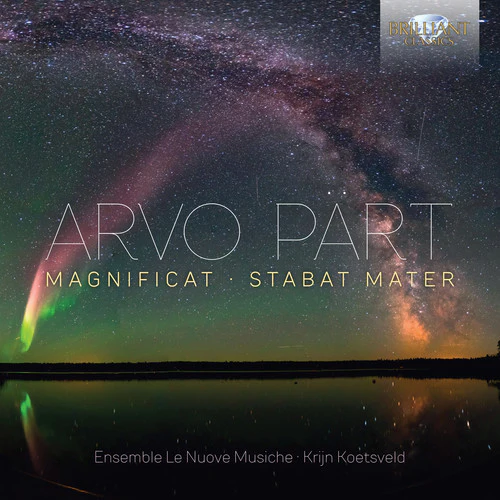
Part: Magnificat & Stabat Mater / Koetsveld, Le Nuove Musiche
Under its founder-director Krijn Koetsveld, Le Nuove Musiche has won international acclaim for its complete recording of Monteverdi’s madrigals, a project over a decade in the making and which has recently been released complete for the first time by Brilliant Classics. Now the ensemble turns its attention to a modern master of concerted vocal writing, Arvo Pärt. The idioms of the two composers could hardly be more different: Monteverdi’s madrigals so rich and elaborate, speaking of earthly love and pain, while Pärt evokes a world of stillness and calm. As Koetsveld remarks in his booklet introduction, his music seems so simple. Only a few notes, repeated harmonies, often extremely quiet tempo, declamation on a note or chord. No complex patterns, with many surprisingly dissonant harmonies or highly complex vocalizations. Where does that intriguing, intoxicating atmosphere come from which many cherish and enrapture? In the Magnificat of 1989 Pärt draped the text in a free declamatory style, on a note, or a dissonance or a simple harmonic world He expresses the Marian hymn softly, almost timidly, as if the defining vision of the text is of Mary, quietly rejoicing at the news that she carries within her the son of God. The Nunc dimittis was composed separately, 12 years later, but its unhurried unfolding of the Song of Simeon complements the Magnificat perfectly. The Seven Magnificat Antiphons (1988, 1991) and the Stabat mater (1985) both employ fewer notes in the service of a more austere soundworld, one which may cast the listener back to the vast spaces of a medieval cathedral and the daily offices held therein. For 25 minutes the Stabat mater dwells hauntingly within the Aeolian mode as if in musical imitation of Mary, quietly lamenting her son at the foot of the Cross. Both of them exercise an immense power upon any receptive listener, and this new recording is sure to capture the imagination of Pärt’s many followers worldwide.
-----
REVIEW:
There are plenty of first-rate recordings of these works available, particularly the Magnificat and Nunc dimittis, but who’s going to complain about a new one that delivers a slightly different perspective–that is, one created by a minimal vocal ensemble (eight voices), well-tailored to Pärt’s famously minimal scoring? The voices are (happily) very well-matched, and their favorable blend and balance often leads you to forget how many (or few) of them there are. You just enjoy the sound—both for its fullness and textural clarity, as well as for the special quality that comes from a handful rather than a roomful of compatible voices resonating.
While the Magnificat, Nunc dimittis, and Maria antiphons are all finely sung, the Stabat Mater—heard less frequently, probably due to its uncommon scoring for three voices and three strings—is the highlight, showing in luminous detail the beauty of particular voices—soprano Wendy Roobol, alto Hugo Naessens, and tenor Falco van Loon (great names, all!)—as well as the three singers’ exceptional technical and interpretive mastery. I was not familiar with this ensemble, Le Nuove Musiche, before, and its earlier claim to fame is a 12-disc set of Monteverdi madrigals. All available clues suggest that this is a Netherlands-based group, but good luck trying to find out much at the ensemble’s website: strewn with an odd and unhelpful mix of (mostly) Dutch and (occasional) English, its contents are certain to leave most sincerely inquisitive browsers frustrated and still uninformed. There is virtually no information about the group—other than a composite of individual head-shot photos—in the disc’s liner notes.
Oh well. The music and the singing are very good, and give no reason to disappoint either the newcomer or the experienced Pärt listener, even if there’s nothing here in the performances of the Magnificat, Nunc dimittis, and antiphons that elevates them beyond the existing reference versions. If you happen to be new to Pärt’s music you will find a substantial commentary on various works in our reviews archive, from which an excerpt, describing some of the music’s unique characteristics, concludes this review:
“The bias toward minor thirds in both melodic and harmonic contexts, the pervasive use of antiphonal choral effects, the chord inversions that give a sense of suspended time, the slow-moving harmonic changes unbound by traditional metrical or temporal constraints–all of these in some way define Pärt’s post-1976 music. But ultimately, the proof is in receptive, un-analytical listening, and no matter how many times you hear Pärt’s works, each time you’re somehow carried beyond an expected esthetic experience to a more spiritual place–whether you want to be or not.”
– ClassicsToday (David Vernier)
-----
REVIEW:
There are plenty of first-rate recordings of these works available, particularly the Magnificat and Nunc dimittis, but who’s going to complain about a new one that delivers a slightly different perspective–that is, one created by a minimal vocal ensemble (eight voices), well-tailored to Pärt’s famously minimal scoring? The voices are (happily) very well-matched, and their favorable blend and balance often leads you to forget how many (or few) of them there are. You just enjoy the sound—both for its fullness and textural clarity, as well as for the special quality that comes from a handful rather than a roomful of compatible voices resonating.
While the Magnificat, Nunc dimittis, and Maria antiphons are all finely sung, the Stabat Mater—heard less frequently, probably due to its uncommon scoring for three voices and three strings—is the highlight, showing in luminous detail the beauty of particular voices—soprano Wendy Roobol, alto Hugo Naessens, and tenor Falco van Loon (great names, all!)—as well as the three singers’ exceptional technical and interpretive mastery. I was not familiar with this ensemble, Le Nuove Musiche, before, and its earlier claim to fame is a 12-disc set of Monteverdi madrigals. All available clues suggest that this is a Netherlands-based group, but good luck trying to find out much at the ensemble’s website: strewn with an odd and unhelpful mix of (mostly) Dutch and (occasional) English, its contents are certain to leave most sincerely inquisitive browsers frustrated and still uninformed. There is virtually no information about the group—other than a composite of individual head-shot photos—in the disc’s liner notes.
Oh well. The music and the singing are very good, and give no reason to disappoint either the newcomer or the experienced Pärt listener, even if there’s nothing here in the performances of the Magnificat, Nunc dimittis, and antiphons that elevates them beyond the existing reference versions. If you happen to be new to Pärt’s music you will find a substantial commentary on various works in our reviews archive, from which an excerpt, describing some of the music’s unique characteristics, concludes this review:
“The bias toward minor thirds in both melodic and harmonic contexts, the pervasive use of antiphonal choral effects, the chord inversions that give a sense of suspended time, the slow-moving harmonic changes unbound by traditional metrical or temporal constraints–all of these in some way define Pärt’s post-1976 music. But ultimately, the proof is in receptive, un-analytical listening, and no matter how many times you hear Pärt’s works, each time you’re somehow carried beyond an expected esthetic experience to a more spiritual place–whether you want to be or not.”
– ClassicsToday (David Vernier)
Under its founder-director Krijn Koetsveld, Le Nuove Musiche has won international acclaim for its complete recording of Monteverdi’s madrigals, a project over a decade in the making and which has recently been released complete for the first time by Brilliant Classics. Now the ensemble turns its attention to a modern master of concerted vocal writing, Arvo Pärt. The idioms of the two composers could hardly be more different: Monteverdi’s madrigals so rich and elaborate, speaking of earthly love and pain, while Pärt evokes a world of stillness and calm. As Koetsveld remarks in his booklet introduction, his music seems so simple. Only a few notes, repeated harmonies, often extremely quiet tempo, declamation on a note or chord. No complex patterns, with many surprisingly dissonant harmonies or highly complex vocalizations. Where does that intriguing, intoxicating atmosphere come from which many cherish and enrapture? In the Magnificat of 1989 Pärt draped the text in a free declamatory style, on a note, or a dissonance or a simple harmonic world He expresses the Marian hymn softly, almost timidly, as if the defining vision of the text is of Mary, quietly rejoicing at the news that she carries within her the son of God. The Nunc dimittis was composed separately, 12 years later, but its unhurried unfolding of the Song of Simeon complements the Magnificat perfectly. The Seven Magnificat Antiphons (1988, 1991) and the Stabat mater (1985) both employ fewer notes in the service of a more austere soundworld, one which may cast the listener back to the vast spaces of a medieval cathedral and the daily offices held therein. For 25 minutes the Stabat mater dwells hauntingly within the Aeolian mode as if in musical imitation of Mary, quietly lamenting her son at the foot of the Cross. Both of them exercise an immense power upon any receptive listener, and this new recording is sure to capture the imagination of Pärt’s many followers worldwide.
-----
REVIEW:
There are plenty of first-rate recordings of these works available, particularly the Magnificat and Nunc dimittis, but who’s going to complain about a new one that delivers a slightly different perspective–that is, one created by a minimal vocal ensemble (eight voices), well-tailored to Pärt’s famously minimal scoring? The voices are (happily) very well-matched, and their favorable blend and balance often leads you to forget how many (or few) of them there are. You just enjoy the sound—both for its fullness and textural clarity, as well as for the special quality that comes from a handful rather than a roomful of compatible voices resonating.
While the Magnificat, Nunc dimittis, and Maria antiphons are all finely sung, the Stabat Mater—heard less frequently, probably due to its uncommon scoring for three voices and three strings—is the highlight, showing in luminous detail the beauty of particular voices—soprano Wendy Roobol, alto Hugo Naessens, and tenor Falco van Loon (great names, all!)—as well as the three singers’ exceptional technical and interpretive mastery. I was not familiar with this ensemble, Le Nuove Musiche, before, and its earlier claim to fame is a 12-disc set of Monteverdi madrigals. All available clues suggest that this is a Netherlands-based group, but good luck trying to find out much at the ensemble’s website: strewn with an odd and unhelpful mix of (mostly) Dutch and (occasional) English, its contents are certain to leave most sincerely inquisitive browsers frustrated and still uninformed. There is virtually no information about the group—other than a composite of individual head-shot photos—in the disc’s liner notes.
Oh well. The music and the singing are very good, and give no reason to disappoint either the newcomer or the experienced Pärt listener, even if there’s nothing here in the performances of the Magnificat, Nunc dimittis, and antiphons that elevates them beyond the existing reference versions. If you happen to be new to Pärt’s music you will find a substantial commentary on various works in our reviews archive, from which an excerpt, describing some of the music’s unique characteristics, concludes this review:
“The bias toward minor thirds in both melodic and harmonic contexts, the pervasive use of antiphonal choral effects, the chord inversions that give a sense of suspended time, the slow-moving harmonic changes unbound by traditional metrical or temporal constraints–all of these in some way define Pärt’s post-1976 music. But ultimately, the proof is in receptive, un-analytical listening, and no matter how many times you hear Pärt’s works, each time you’re somehow carried beyond an expected esthetic experience to a more spiritual place–whether you want to be or not.”
– ClassicsToday (David Vernier)
-----
REVIEW:
There are plenty of first-rate recordings of these works available, particularly the Magnificat and Nunc dimittis, but who’s going to complain about a new one that delivers a slightly different perspective–that is, one created by a minimal vocal ensemble (eight voices), well-tailored to Pärt’s famously minimal scoring? The voices are (happily) very well-matched, and their favorable blend and balance often leads you to forget how many (or few) of them there are. You just enjoy the sound—both for its fullness and textural clarity, as well as for the special quality that comes from a handful rather than a roomful of compatible voices resonating.
While the Magnificat, Nunc dimittis, and Maria antiphons are all finely sung, the Stabat Mater—heard less frequently, probably due to its uncommon scoring for three voices and three strings—is the highlight, showing in luminous detail the beauty of particular voices—soprano Wendy Roobol, alto Hugo Naessens, and tenor Falco van Loon (great names, all!)—as well as the three singers’ exceptional technical and interpretive mastery. I was not familiar with this ensemble, Le Nuove Musiche, before, and its earlier claim to fame is a 12-disc set of Monteverdi madrigals. All available clues suggest that this is a Netherlands-based group, but good luck trying to find out much at the ensemble’s website: strewn with an odd and unhelpful mix of (mostly) Dutch and (occasional) English, its contents are certain to leave most sincerely inquisitive browsers frustrated and still uninformed. There is virtually no information about the group—other than a composite of individual head-shot photos—in the disc’s liner notes.
Oh well. The music and the singing are very good, and give no reason to disappoint either the newcomer or the experienced Pärt listener, even if there’s nothing here in the performances of the Magnificat, Nunc dimittis, and antiphons that elevates them beyond the existing reference versions. If you happen to be new to Pärt’s music you will find a substantial commentary on various works in our reviews archive, from which an excerpt, describing some of the music’s unique characteristics, concludes this review:
“The bias toward minor thirds in both melodic and harmonic contexts, the pervasive use of antiphonal choral effects, the chord inversions that give a sense of suspended time, the slow-moving harmonic changes unbound by traditional metrical or temporal constraints–all of these in some way define Pärt’s post-1976 music. But ultimately, the proof is in receptive, un-analytical listening, and no matter how many times you hear Pärt’s works, each time you’re somehow carried beyond an expected esthetic experience to a more spiritual place–whether you want to be or not.”
– ClassicsToday (David Vernier)
$6.30
Original: $17.99
-65%Part: Magnificat & Stabat Mater / Koetsveld, Le Nuove Musiche—
$17.99
$6.30Description
Under its founder-director Krijn Koetsveld, Le Nuove Musiche has won international acclaim for its complete recording of Monteverdi’s madrigals, a project over a decade in the making and which has recently been released complete for the first time by Brilliant Classics. Now the ensemble turns its attention to a modern master of concerted vocal writing, Arvo Pärt. The idioms of the two composers could hardly be more different: Monteverdi’s madrigals so rich and elaborate, speaking of earthly love and pain, while Pärt evokes a world of stillness and calm. As Koetsveld remarks in his booklet introduction, his music seems so simple. Only a few notes, repeated harmonies, often extremely quiet tempo, declamation on a note or chord. No complex patterns, with many surprisingly dissonant harmonies or highly complex vocalizations. Where does that intriguing, intoxicating atmosphere come from which many cherish and enrapture? In the Magnificat of 1989 Pärt draped the text in a free declamatory style, on a note, or a dissonance or a simple harmonic world He expresses the Marian hymn softly, almost timidly, as if the defining vision of the text is of Mary, quietly rejoicing at the news that she carries within her the son of God. The Nunc dimittis was composed separately, 12 years later, but its unhurried unfolding of the Song of Simeon complements the Magnificat perfectly. The Seven Magnificat Antiphons (1988, 1991) and the Stabat mater (1985) both employ fewer notes in the service of a more austere soundworld, one which may cast the listener back to the vast spaces of a medieval cathedral and the daily offices held therein. For 25 minutes the Stabat mater dwells hauntingly within the Aeolian mode as if in musical imitation of Mary, quietly lamenting her son at the foot of the Cross. Both of them exercise an immense power upon any receptive listener, and this new recording is sure to capture the imagination of Pärt’s many followers worldwide.
-----
REVIEW:
There are plenty of first-rate recordings of these works available, particularly the Magnificat and Nunc dimittis, but who’s going to complain about a new one that delivers a slightly different perspective–that is, one created by a minimal vocal ensemble (eight voices), well-tailored to Pärt’s famously minimal scoring? The voices are (happily) very well-matched, and their favorable blend and balance often leads you to forget how many (or few) of them there are. You just enjoy the sound—both for its fullness and textural clarity, as well as for the special quality that comes from a handful rather than a roomful of compatible voices resonating.
While the Magnificat, Nunc dimittis, and Maria antiphons are all finely sung, the Stabat Mater—heard less frequently, probably due to its uncommon scoring for three voices and three strings—is the highlight, showing in luminous detail the beauty of particular voices—soprano Wendy Roobol, alto Hugo Naessens, and tenor Falco van Loon (great names, all!)—as well as the three singers’ exceptional technical and interpretive mastery. I was not familiar with this ensemble, Le Nuove Musiche, before, and its earlier claim to fame is a 12-disc set of Monteverdi madrigals. All available clues suggest that this is a Netherlands-based group, but good luck trying to find out much at the ensemble’s website: strewn with an odd and unhelpful mix of (mostly) Dutch and (occasional) English, its contents are certain to leave most sincerely inquisitive browsers frustrated and still uninformed. There is virtually no information about the group—other than a composite of individual head-shot photos—in the disc’s liner notes.
Oh well. The music and the singing are very good, and give no reason to disappoint either the newcomer or the experienced Pärt listener, even if there’s nothing here in the performances of the Magnificat, Nunc dimittis, and antiphons that elevates them beyond the existing reference versions. If you happen to be new to Pärt’s music you will find a substantial commentary on various works in our reviews archive, from which an excerpt, describing some of the music’s unique characteristics, concludes this review:
“The bias toward minor thirds in both melodic and harmonic contexts, the pervasive use of antiphonal choral effects, the chord inversions that give a sense of suspended time, the slow-moving harmonic changes unbound by traditional metrical or temporal constraints–all of these in some way define Pärt’s post-1976 music. But ultimately, the proof is in receptive, un-analytical listening, and no matter how many times you hear Pärt’s works, each time you’re somehow carried beyond an expected esthetic experience to a more spiritual place–whether you want to be or not.”
– ClassicsToday (David Vernier)
-----
REVIEW:
There are plenty of first-rate recordings of these works available, particularly the Magnificat and Nunc dimittis, but who’s going to complain about a new one that delivers a slightly different perspective–that is, one created by a minimal vocal ensemble (eight voices), well-tailored to Pärt’s famously minimal scoring? The voices are (happily) very well-matched, and their favorable blend and balance often leads you to forget how many (or few) of them there are. You just enjoy the sound—both for its fullness and textural clarity, as well as for the special quality that comes from a handful rather than a roomful of compatible voices resonating.
While the Magnificat, Nunc dimittis, and Maria antiphons are all finely sung, the Stabat Mater—heard less frequently, probably due to its uncommon scoring for three voices and three strings—is the highlight, showing in luminous detail the beauty of particular voices—soprano Wendy Roobol, alto Hugo Naessens, and tenor Falco van Loon (great names, all!)—as well as the three singers’ exceptional technical and interpretive mastery. I was not familiar with this ensemble, Le Nuove Musiche, before, and its earlier claim to fame is a 12-disc set of Monteverdi madrigals. All available clues suggest that this is a Netherlands-based group, but good luck trying to find out much at the ensemble’s website: strewn with an odd and unhelpful mix of (mostly) Dutch and (occasional) English, its contents are certain to leave most sincerely inquisitive browsers frustrated and still uninformed. There is virtually no information about the group—other than a composite of individual head-shot photos—in the disc’s liner notes.
Oh well. The music and the singing are very good, and give no reason to disappoint either the newcomer or the experienced Pärt listener, even if there’s nothing here in the performances of the Magnificat, Nunc dimittis, and antiphons that elevates them beyond the existing reference versions. If you happen to be new to Pärt’s music you will find a substantial commentary on various works in our reviews archive, from which an excerpt, describing some of the music’s unique characteristics, concludes this review:
“The bias toward minor thirds in both melodic and harmonic contexts, the pervasive use of antiphonal choral effects, the chord inversions that give a sense of suspended time, the slow-moving harmonic changes unbound by traditional metrical or temporal constraints–all of these in some way define Pärt’s post-1976 music. But ultimately, the proof is in receptive, un-analytical listening, and no matter how many times you hear Pärt’s works, each time you’re somehow carried beyond an expected esthetic experience to a more spiritual place–whether you want to be or not.”
– ClassicsToday (David Vernier)