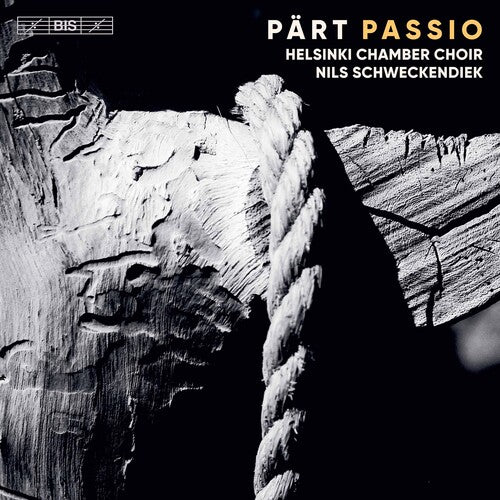
Pärt: Passio / Schweckendiek, Helsinki Chamber Choir
Composed in 1982, Arvo Pärt’s Passio has retained its place as one of the foremost works of sacred music of the late 20th century. It has been called a minimalist masterpiece, and is a seminal work in the composer’s oeuvre – the culmination of his so-called tintinnabuli style, and the first in a line of large-scale choral works on religious themes. Passion settings have a long history, with polyphonic settings for choral performance beginning in the 15th century and continuing up until the high baroque and the monumental works by Johann Sebastian Bach. In his Passion, Pärt looks back to an older tradition, however – the medieval one of a single voice chanting the text. As a result, the narrative – chapters 18 and 19 of the Gospel of St. John – becomes the basis for sustained spiritual contemplation rather than the drama of Bach’s Passions. Another important distinction from earlier Passion settings is Pärt’s treatment of the Evangelist, who narrates the story. Rather than a single voice, he employs a quartet: soprano, alto, tenor and bass, accompanied by an ensemble of four instruments. The only other instrument used in the work is the organ, again in contrast to the larger instrumental forces of the Bach Passions. This contemplative work is here performed by the Helsinki Chamber Choir under Nils Schweckendiek.
REVIEW:
Arvo Pärt's Passio (1982), also known as the St. John Passion, is sometimes grouped with the large pieces of the time in which Pärt developed his tintinnabuli technique. The technique is present in the work, but Passio is unlike anything else Pärt ever wrote. The Passio has rarely been recorded, and that's reason enough to welcome this reading by the Helsinki Chamber Choir. More reason is provided by the performers, who offer expressive interpretations with a fine sense of the functions of the many pauses in the music. This performance diverges somewhat from the stark version by Paul Hillier and the Hilliard Ensemble some years ago, and BIS' sound, from a Helsinki church, is warmer than that of ECM on the Hillier version, allowing in some ambient noise such as organ machinery. This is an extraordinary performance of an underrated work by one of the major composers of our time.
-- AllMusic.com (James Manheim)
Composed in 1982, Arvo Pärt’s Passio has retained its place as one of the foremost works of sacred music of the late 20th century. It has been called a minimalist masterpiece, and is a seminal work in the composer’s oeuvre – the culmination of his so-called tintinnabuli style, and the first in a line of large-scale choral works on religious themes. Passion settings have a long history, with polyphonic settings for choral performance beginning in the 15th century and continuing up until the high baroque and the monumental works by Johann Sebastian Bach. In his Passion, Pärt looks back to an older tradition, however – the medieval one of a single voice chanting the text. As a result, the narrative – chapters 18 and 19 of the Gospel of St. John – becomes the basis for sustained spiritual contemplation rather than the drama of Bach’s Passions. Another important distinction from earlier Passion settings is Pärt’s treatment of the Evangelist, who narrates the story. Rather than a single voice, he employs a quartet: soprano, alto, tenor and bass, accompanied by an ensemble of four instruments. The only other instrument used in the work is the organ, again in contrast to the larger instrumental forces of the Bach Passions. This contemplative work is here performed by the Helsinki Chamber Choir under Nils Schweckendiek.
REVIEW:
Arvo Pärt's Passio (1982), also known as the St. John Passion, is sometimes grouped with the large pieces of the time in which Pärt developed his tintinnabuli technique. The technique is present in the work, but Passio is unlike anything else Pärt ever wrote. The Passio has rarely been recorded, and that's reason enough to welcome this reading by the Helsinki Chamber Choir. More reason is provided by the performers, who offer expressive interpretations with a fine sense of the functions of the many pauses in the music. This performance diverges somewhat from the stark version by Paul Hillier and the Hilliard Ensemble some years ago, and BIS' sound, from a Helsinki church, is warmer than that of ECM on the Hillier version, allowing in some ambient noise such as organ machinery. This is an extraordinary performance of an underrated work by one of the major composers of our time.
-- AllMusic.com (James Manheim)
Original: $15.99
-65%$15.99
$5.60Description
Composed in 1982, Arvo Pärt’s Passio has retained its place as one of the foremost works of sacred music of the late 20th century. It has been called a minimalist masterpiece, and is a seminal work in the composer’s oeuvre – the culmination of his so-called tintinnabuli style, and the first in a line of large-scale choral works on religious themes. Passion settings have a long history, with polyphonic settings for choral performance beginning in the 15th century and continuing up until the high baroque and the monumental works by Johann Sebastian Bach. In his Passion, Pärt looks back to an older tradition, however – the medieval one of a single voice chanting the text. As a result, the narrative – chapters 18 and 19 of the Gospel of St. John – becomes the basis for sustained spiritual contemplation rather than the drama of Bach’s Passions. Another important distinction from earlier Passion settings is Pärt’s treatment of the Evangelist, who narrates the story. Rather than a single voice, he employs a quartet: soprano, alto, tenor and bass, accompanied by an ensemble of four instruments. The only other instrument used in the work is the organ, again in contrast to the larger instrumental forces of the Bach Passions. This contemplative work is here performed by the Helsinki Chamber Choir under Nils Schweckendiek.
REVIEW:
Arvo Pärt's Passio (1982), also known as the St. John Passion, is sometimes grouped with the large pieces of the time in which Pärt developed his tintinnabuli technique. The technique is present in the work, but Passio is unlike anything else Pärt ever wrote. The Passio has rarely been recorded, and that's reason enough to welcome this reading by the Helsinki Chamber Choir. More reason is provided by the performers, who offer expressive interpretations with a fine sense of the functions of the many pauses in the music. This performance diverges somewhat from the stark version by Paul Hillier and the Hilliard Ensemble some years ago, and BIS' sound, from a Helsinki church, is warmer than that of ECM on the Hillier version, allowing in some ambient noise such as organ machinery. This is an extraordinary performance of an underrated work by one of the major composers of our time.
-- AllMusic.com (James Manheim)