🎉 Up to 70% Off Selected ItemsShop Sale

1 / 2
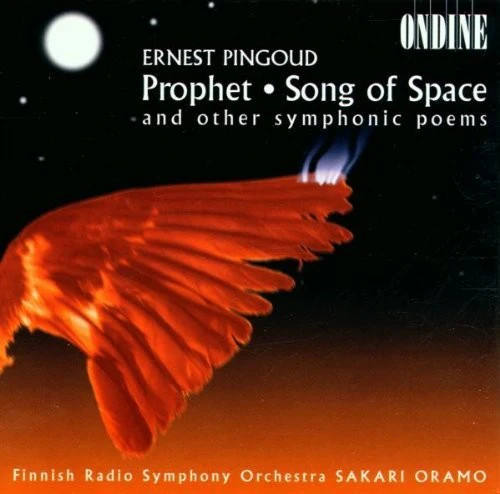
Pingoud: Symphonic Poems / Oramo, Finnish RSO
Ernest Pingoud (1887-1942) is one of those names one encounters in footnotes, or in the more comprehensive musical dictionaries. The Gramophone Database contains no entry for him other than this worthy new disc, and I am not aware of any previous recordings of his music, even from Finland (to where he emigrated from Russia in 1918). In his day, he was considered one of Finland’s leading modernists, with Vaino Rautio and Aarre Merikanto, so consequently had to endure sustained indifference. He eventually threw himself under a train.
His style as exhibited in these five tone-poems (only Fetich, 1917, and Le chant de l’espace – “The song of space”, 1931-8 – really live up to the “symphonic poem” billing; the others are too small in scale) is frankly not particularly distinctive, and can be summed up as a mish-mash of Strauss and Scriabin orchestrated by Prokofiev. Resonances of other composers abound, not least of Russian contemporaries but also Finns such as Melartin in Le prophete (1921) and Fetich, and early Sibelius in Flambeaux eteints (“Extinguished torches”, 1919). Fetich is by some way the best of them, skittish and excitable by turns but compelling overall, unlike Le chant de l’espace which is overblown and structurally flaccid. Le prophete, Chantecler (1919) and the rather engaging Flambeaux eteints lie variously in between. Sakari Oramo produces exemplary performances, faithfully recorded. One for the specialists.
-- Gramophone [2/1998]
His style as exhibited in these five tone-poems (only Fetich, 1917, and Le chant de l’espace – “The song of space”, 1931-8 – really live up to the “symphonic poem” billing; the others are too small in scale) is frankly not particularly distinctive, and can be summed up as a mish-mash of Strauss and Scriabin orchestrated by Prokofiev. Resonances of other composers abound, not least of Russian contemporaries but also Finns such as Melartin in Le prophete (1921) and Fetich, and early Sibelius in Flambeaux eteints (“Extinguished torches”, 1919). Fetich is by some way the best of them, skittish and excitable by turns but compelling overall, unlike Le chant de l’espace which is overblown and structurally flaccid. Le prophete, Chantecler (1919) and the rather engaging Flambeaux eteints lie variously in between. Sakari Oramo produces exemplary performances, faithfully recorded. One for the specialists.
-- Gramophone [2/1998]
Ernest Pingoud (1887-1942) is one of those names one encounters in footnotes, or in the more comprehensive musical dictionaries. The Gramophone Database contains no entry for him other than this worthy new disc, and I am not aware of any previous recordings of his music, even from Finland (to where he emigrated from Russia in 1918). In his day, he was considered one of Finland’s leading modernists, with Vaino Rautio and Aarre Merikanto, so consequently had to endure sustained indifference. He eventually threw himself under a train.
His style as exhibited in these five tone-poems (only Fetich, 1917, and Le chant de l’espace – “The song of space”, 1931-8 – really live up to the “symphonic poem” billing; the others are too small in scale) is frankly not particularly distinctive, and can be summed up as a mish-mash of Strauss and Scriabin orchestrated by Prokofiev. Resonances of other composers abound, not least of Russian contemporaries but also Finns such as Melartin in Le prophete (1921) and Fetich, and early Sibelius in Flambeaux eteints (“Extinguished torches”, 1919). Fetich is by some way the best of them, skittish and excitable by turns but compelling overall, unlike Le chant de l’espace which is overblown and structurally flaccid. Le prophete, Chantecler (1919) and the rather engaging Flambeaux eteints lie variously in between. Sakari Oramo produces exemplary performances, faithfully recorded. One for the specialists.
-- Gramophone [2/1998]
His style as exhibited in these five tone-poems (only Fetich, 1917, and Le chant de l’espace – “The song of space”, 1931-8 – really live up to the “symphonic poem” billing; the others are too small in scale) is frankly not particularly distinctive, and can be summed up as a mish-mash of Strauss and Scriabin orchestrated by Prokofiev. Resonances of other composers abound, not least of Russian contemporaries but also Finns such as Melartin in Le prophete (1921) and Fetich, and early Sibelius in Flambeaux eteints (“Extinguished torches”, 1919). Fetich is by some way the best of them, skittish and excitable by turns but compelling overall, unlike Le chant de l’espace which is overblown and structurally flaccid. Le prophete, Chantecler (1919) and the rather engaging Flambeaux eteints lie variously in between. Sakari Oramo produces exemplary performances, faithfully recorded. One for the specialists.
-- Gramophone [2/1998]
$14.99
Pingoud: Symphonic Poems / Oramo, Finnish RSO—
$14.99
Description
Ernest Pingoud (1887-1942) is one of those names one encounters in footnotes, or in the more comprehensive musical dictionaries. The Gramophone Database contains no entry for him other than this worthy new disc, and I am not aware of any previous recordings of his music, even from Finland (to where he emigrated from Russia in 1918). In his day, he was considered one of Finland’s leading modernists, with Vaino Rautio and Aarre Merikanto, so consequently had to endure sustained indifference. He eventually threw himself under a train.
His style as exhibited in these five tone-poems (only Fetich, 1917, and Le chant de l’espace – “The song of space”, 1931-8 – really live up to the “symphonic poem” billing; the others are too small in scale) is frankly not particularly distinctive, and can be summed up as a mish-mash of Strauss and Scriabin orchestrated by Prokofiev. Resonances of other composers abound, not least of Russian contemporaries but also Finns such as Melartin in Le prophete (1921) and Fetich, and early Sibelius in Flambeaux eteints (“Extinguished torches”, 1919). Fetich is by some way the best of them, skittish and excitable by turns but compelling overall, unlike Le chant de l’espace which is overblown and structurally flaccid. Le prophete, Chantecler (1919) and the rather engaging Flambeaux eteints lie variously in between. Sakari Oramo produces exemplary performances, faithfully recorded. One for the specialists.
-- Gramophone [2/1998]
His style as exhibited in these five tone-poems (only Fetich, 1917, and Le chant de l’espace – “The song of space”, 1931-8 – really live up to the “symphonic poem” billing; the others are too small in scale) is frankly not particularly distinctive, and can be summed up as a mish-mash of Strauss and Scriabin orchestrated by Prokofiev. Resonances of other composers abound, not least of Russian contemporaries but also Finns such as Melartin in Le prophete (1921) and Fetich, and early Sibelius in Flambeaux eteints (“Extinguished torches”, 1919). Fetich is by some way the best of them, skittish and excitable by turns but compelling overall, unlike Le chant de l’espace which is overblown and structurally flaccid. Le prophete, Chantecler (1919) and the rather engaging Flambeaux eteints lie variously in between. Sakari Oramo produces exemplary performances, faithfully recorded. One for the specialists.
-- Gramophone [2/1998]