🎉 Up to 70% Off Selected ItemsShop Sale

1 / 2
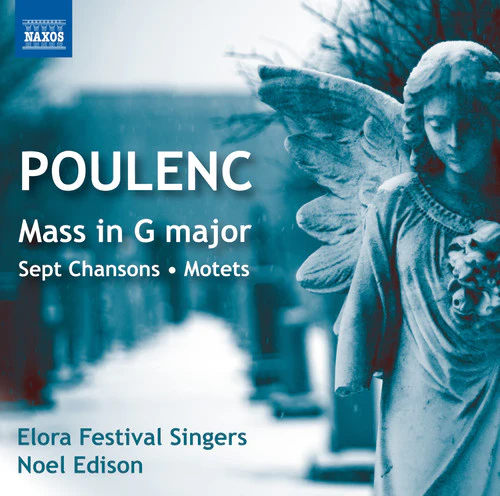
Poulenc: Mass in G Major… / Elora Festival Singers

One thing choirs who’ve sung Francis Poulenc’s choral works know is that he wasn’t concerned about making it easy for singers. Yet, unlike some other composers of the last (and current) century, neither was he creating difficult music just because he could. Instead, there is no similar choral repertoire by any other composer that more satisfyingly rewards the effort it takes–including a commitment of a certain level of vocal/technical skill and artistic savvy–to perform it accurately and stylishly–the rewards to the singer realized in the sheer sensual pleasure and excitement of being “inside” Poulenc’s incredible sound-world; and for the listener, you could say the same, just that the perspective is different.
There is no choir, nor will you find a recording, that does such full justice to these great a cappella works, each chanson, motet, or Mass movement a miniature yet significant and unique masterpiece. It’s difficult to choose specific performance highlights–there are so many moments perfectly demonstrative of some or other virtuosic technical feat or lovely, breathtaking, or otherwise moving expressive musical effect, that the list would amount to citations of nearly every part of every piece. However, for sheer virtuosity, you won’t be disappointed if you begin with the Mass–the Sanctus and Benedictus are perfect examples of how these singers manage ensemble balances even in the widest-spaced textures or thorniest harmonic passages.
Although these characteristics are consistent throughout all the performances, in Tenebrae factae sunt and Tristis est anima mea (from the Quatre motets pour le temps de pénitence) we experience the choir’s extraordinary command of ensemble balance, dynamic control, nuances of phrasing, rhythmic precision, spot-on intonation, ideal resonance in harmonies–everything combines to create the resplendent choral sound that defines these works.
Where there is word-painting–and there are numerous instances–we “get it”; where all-important soft singing is required, the choir delivers while always maintaining intonation and ensemble balance; where the texts are in French (the Sept Chansons), we hear beautifully enunciated, expertly sung French; the bell-like sounds at the end of Par une nuit nouvelle are exquisitely executed, as are the vibrant jazz harmonies of Tous les droits, the scurrying opening lines of Marie, and those treacherous wide-open voicings at the beginning and end of Luire (sung perfectly tuned, producing a hair-raising resonance). Not to take anything away from the rest of the choir, it’s important to give special mention to those sublime sopranos, who have so many passages and individual notes that are high and very exposed, and who sing them with extraordinary confidence, clarity, and accuracy, while always mindful of the lower voices.
Most popular among Poulenc’s choral works are surely the Christmas motets, especially the oft recorded O magnum–and here the Elora singers deliver it with a completely natural, easy flow from phrase to phrase; repeated statements (iacentem) are given emphasis without dynamic exaggeration; overall, there is a gentleness of expression coupled with an exceptional sense of devotion to the music. And devotion to the music is the key to the success of this entire program, whether conveying the joy, the sadness, or more reflective, prayerful moods and moments. Noel Edison and his singers have made perhaps their finest recording to date, a reference for choirs who follow and for listeners who want an important and enduring addition to their choral music library.
The production and sound, overseen by Bonnie Silver and Norbert Kraft in the choir’s home venue–St John’s Church, Elora, Ontario–capitalizes on the church’s excellent choral acoustics (which somehow, in different ways, are excellent no matter whether the church is empty or full of people). Thoughtful, informative notes by Dominic Wells cap this essential release.
-- David Vernier, ClassicsToday.com
One thing choirs who’ve sung Francis Poulenc’s choral works know is that he wasn’t concerned about making it easy for singers. Yet, unlike some other composers of the last (and current) century, neither was he creating difficult music just because he could. Instead, there is no similar choral repertoire by any other composer that more satisfyingly rewards the effort it takes–including a commitment of a certain level of vocal/technical skill and artistic savvy–to perform it accurately and stylishly–the rewards to the singer realized in the sheer sensual pleasure and excitement of being “inside” Poulenc’s incredible sound-world; and for the listener, you could say the same, just that the perspective is different.
There is no choir, nor will you find a recording, that does such full justice to these great a cappella works, each chanson, motet, or Mass movement a miniature yet significant and unique masterpiece. It’s difficult to choose specific performance highlights–there are so many moments perfectly demonstrative of some or other virtuosic technical feat or lovely, breathtaking, or otherwise moving expressive musical effect, that the list would amount to citations of nearly every part of every piece. However, for sheer virtuosity, you won’t be disappointed if you begin with the Mass–the Sanctus and Benedictus are perfect examples of how these singers manage ensemble balances even in the widest-spaced textures or thorniest harmonic passages.
Although these characteristics are consistent throughout all the performances, in Tenebrae factae sunt and Tristis est anima mea (from the Quatre motets pour le temps de pénitence) we experience the choir’s extraordinary command of ensemble balance, dynamic control, nuances of phrasing, rhythmic precision, spot-on intonation, ideal resonance in harmonies–everything combines to create the resplendent choral sound that defines these works.
Where there is word-painting–and there are numerous instances–we “get it”; where all-important soft singing is required, the choir delivers while always maintaining intonation and ensemble balance; where the texts are in French (the Sept Chansons), we hear beautifully enunciated, expertly sung French; the bell-like sounds at the end of Par une nuit nouvelle are exquisitely executed, as are the vibrant jazz harmonies of Tous les droits, the scurrying opening lines of Marie, and those treacherous wide-open voicings at the beginning and end of Luire (sung perfectly tuned, producing a hair-raising resonance). Not to take anything away from the rest of the choir, it’s important to give special mention to those sublime sopranos, who have so many passages and individual notes that are high and very exposed, and who sing them with extraordinary confidence, clarity, and accuracy, while always mindful of the lower voices.
Most popular among Poulenc’s choral works are surely the Christmas motets, especially the oft recorded O magnum–and here the Elora singers deliver it with a completely natural, easy flow from phrase to phrase; repeated statements (iacentem) are given emphasis without dynamic exaggeration; overall, there is a gentleness of expression coupled with an exceptional sense of devotion to the music. And devotion to the music is the key to the success of this entire program, whether conveying the joy, the sadness, or more reflective, prayerful moods and moments. Noel Edison and his singers have made perhaps their finest recording to date, a reference for choirs who follow and for listeners who want an important and enduring addition to their choral music library.
The production and sound, overseen by Bonnie Silver and Norbert Kraft in the choir’s home venue–St John’s Church, Elora, Ontario–capitalizes on the church’s excellent choral acoustics (which somehow, in different ways, are excellent no matter whether the church is empty or full of people). Thoughtful, informative notes by Dominic Wells cap this essential release.
-- David Vernier, ClassicsToday.com
$3.50
Original: $9.99
-65%Poulenc: Mass in G Major… / Elora Festival Singers—
$9.99
$3.50Description
One thing choirs who’ve sung Francis Poulenc’s choral works know is that he wasn’t concerned about making it easy for singers. Yet, unlike some other composers of the last (and current) century, neither was he creating difficult music just because he could. Instead, there is no similar choral repertoire by any other composer that more satisfyingly rewards the effort it takes–including a commitment of a certain level of vocal/technical skill and artistic savvy–to perform it accurately and stylishly–the rewards to the singer realized in the sheer sensual pleasure and excitement of being “inside” Poulenc’s incredible sound-world; and for the listener, you could say the same, just that the perspective is different.
There is no choir, nor will you find a recording, that does such full justice to these great a cappella works, each chanson, motet, or Mass movement a miniature yet significant and unique masterpiece. It’s difficult to choose specific performance highlights–there are so many moments perfectly demonstrative of some or other virtuosic technical feat or lovely, breathtaking, or otherwise moving expressive musical effect, that the list would amount to citations of nearly every part of every piece. However, for sheer virtuosity, you won’t be disappointed if you begin with the Mass–the Sanctus and Benedictus are perfect examples of how these singers manage ensemble balances even in the widest-spaced textures or thorniest harmonic passages.
Although these characteristics are consistent throughout all the performances, in Tenebrae factae sunt and Tristis est anima mea (from the Quatre motets pour le temps de pénitence) we experience the choir’s extraordinary command of ensemble balance, dynamic control, nuances of phrasing, rhythmic precision, spot-on intonation, ideal resonance in harmonies–everything combines to create the resplendent choral sound that defines these works.
Where there is word-painting–and there are numerous instances–we “get it”; where all-important soft singing is required, the choir delivers while always maintaining intonation and ensemble balance; where the texts are in French (the Sept Chansons), we hear beautifully enunciated, expertly sung French; the bell-like sounds at the end of Par une nuit nouvelle are exquisitely executed, as are the vibrant jazz harmonies of Tous les droits, the scurrying opening lines of Marie, and those treacherous wide-open voicings at the beginning and end of Luire (sung perfectly tuned, producing a hair-raising resonance). Not to take anything away from the rest of the choir, it’s important to give special mention to those sublime sopranos, who have so many passages and individual notes that are high and very exposed, and who sing them with extraordinary confidence, clarity, and accuracy, while always mindful of the lower voices.
Most popular among Poulenc’s choral works are surely the Christmas motets, especially the oft recorded O magnum–and here the Elora singers deliver it with a completely natural, easy flow from phrase to phrase; repeated statements (iacentem) are given emphasis without dynamic exaggeration; overall, there is a gentleness of expression coupled with an exceptional sense of devotion to the music. And devotion to the music is the key to the success of this entire program, whether conveying the joy, the sadness, or more reflective, prayerful moods and moments. Noel Edison and his singers have made perhaps their finest recording to date, a reference for choirs who follow and for listeners who want an important and enduring addition to their choral music library.
The production and sound, overseen by Bonnie Silver and Norbert Kraft in the choir’s home venue–St John’s Church, Elora, Ontario–capitalizes on the church’s excellent choral acoustics (which somehow, in different ways, are excellent no matter whether the church is empty or full of people). Thoughtful, informative notes by Dominic Wells cap this essential release.
-- David Vernier, ClassicsToday.com