🎉 Up to 70% Off Selected ItemsShop Sale

1 / 2
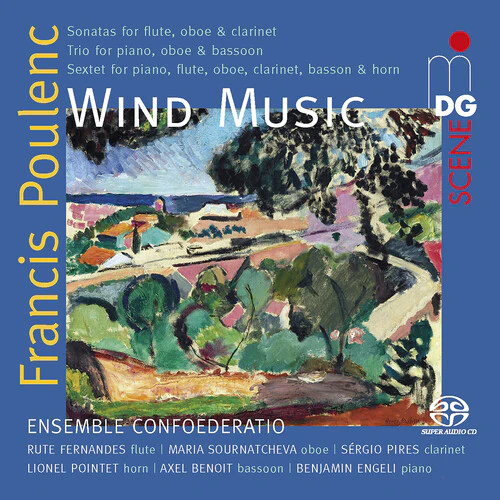
Poulenc: Wind Music / Ensemble Confoederatio
On the occasion of the 120th anniversary of the composer’s birth, six internationally acclaimed soloists are now presenting chamber music by Francis Poulenc, and what these young musicians, all of them active in Switzerland, charm onto the stage, grips us from the very first measure.
The incomparable combination of breathtaking virtuosity and playful lightness as well as songlike melos and deep emotion long ago qualified this anti-Romantic rebel of the 1920s as a modern classic. Already the opening Sextet for Piano and Wind Quintet emancipates itself from the chains of convention. Not a one of the movements designed in classical form adheres to a fixed metrical pattern. Shifts of meter and tempo again and again relax the structure. The resultant extremely entertaining impression pervades the entire program, from the early Trio for Piano, Oboe, and Bassoon to the later Duo Sonatas. Poulenc’s preference for wind instruments may perhaps be explained by his French origins and his predilection for song – since it is not without reason that he ranks as one of the most important song composers of the twentieth century. Even without texts his chamber music is highly expressive and dynamic.
This brand-new Super Audio album offers high-resolution sound and three-dimensional imaging, transports audiences deep into the music, and makes us forget the highest degree of technical difficulty involved in the scores. A disc for mirthful entertainment on the very highest level!
-----
REVIEW:
The Ensemble Confoederatio players evidently have fun in the Sextet. Bassoonist Axel Benoit phrases nicely in the first-movement bridge which heralds the slow section. There isn’t quite the sense of Gallic humour summoned up by Rogé and friends, but it’s a close call. Portuguese flautist Rute Fernandes plays her sonata suavely, especially the jocular finale. Maria Sournatcheva captures the tragic introspection of the Oboe Sonata well. Sérgio Pires delivers a rollicking Clarinet Sonata, fuller and rounder in tone than Michel Portal's. Overall, individual performances stand up well and this disc should provide a lot of pleasurable listening.
– Gramophone
The incomparable combination of breathtaking virtuosity and playful lightness as well as songlike melos and deep emotion long ago qualified this anti-Romantic rebel of the 1920s as a modern classic. Already the opening Sextet for Piano and Wind Quintet emancipates itself from the chains of convention. Not a one of the movements designed in classical form adheres to a fixed metrical pattern. Shifts of meter and tempo again and again relax the structure. The resultant extremely entertaining impression pervades the entire program, from the early Trio for Piano, Oboe, and Bassoon to the later Duo Sonatas. Poulenc’s preference for wind instruments may perhaps be explained by his French origins and his predilection for song – since it is not without reason that he ranks as one of the most important song composers of the twentieth century. Even without texts his chamber music is highly expressive and dynamic.
This brand-new Super Audio album offers high-resolution sound and three-dimensional imaging, transports audiences deep into the music, and makes us forget the highest degree of technical difficulty involved in the scores. A disc for mirthful entertainment on the very highest level!
-----
REVIEW:
The Ensemble Confoederatio players evidently have fun in the Sextet. Bassoonist Axel Benoit phrases nicely in the first-movement bridge which heralds the slow section. There isn’t quite the sense of Gallic humour summoned up by Rogé and friends, but it’s a close call. Portuguese flautist Rute Fernandes plays her sonata suavely, especially the jocular finale. Maria Sournatcheva captures the tragic introspection of the Oboe Sonata well. Sérgio Pires delivers a rollicking Clarinet Sonata, fuller and rounder in tone than Michel Portal's. Overall, individual performances stand up well and this disc should provide a lot of pleasurable listening.
– Gramophone
On the occasion of the 120th anniversary of the composer’s birth, six internationally acclaimed soloists are now presenting chamber music by Francis Poulenc, and what these young musicians, all of them active in Switzerland, charm onto the stage, grips us from the very first measure.
The incomparable combination of breathtaking virtuosity and playful lightness as well as songlike melos and deep emotion long ago qualified this anti-Romantic rebel of the 1920s as a modern classic. Already the opening Sextet for Piano and Wind Quintet emancipates itself from the chains of convention. Not a one of the movements designed in classical form adheres to a fixed metrical pattern. Shifts of meter and tempo again and again relax the structure. The resultant extremely entertaining impression pervades the entire program, from the early Trio for Piano, Oboe, and Bassoon to the later Duo Sonatas. Poulenc’s preference for wind instruments may perhaps be explained by his French origins and his predilection for song – since it is not without reason that he ranks as one of the most important song composers of the twentieth century. Even without texts his chamber music is highly expressive and dynamic.
This brand-new Super Audio album offers high-resolution sound and three-dimensional imaging, transports audiences deep into the music, and makes us forget the highest degree of technical difficulty involved in the scores. A disc for mirthful entertainment on the very highest level!
-----
REVIEW:
The Ensemble Confoederatio players evidently have fun in the Sextet. Bassoonist Axel Benoit phrases nicely in the first-movement bridge which heralds the slow section. There isn’t quite the sense of Gallic humour summoned up by Rogé and friends, but it’s a close call. Portuguese flautist Rute Fernandes plays her sonata suavely, especially the jocular finale. Maria Sournatcheva captures the tragic introspection of the Oboe Sonata well. Sérgio Pires delivers a rollicking Clarinet Sonata, fuller and rounder in tone than Michel Portal's. Overall, individual performances stand up well and this disc should provide a lot of pleasurable listening.
– Gramophone
The incomparable combination of breathtaking virtuosity and playful lightness as well as songlike melos and deep emotion long ago qualified this anti-Romantic rebel of the 1920s as a modern classic. Already the opening Sextet for Piano and Wind Quintet emancipates itself from the chains of convention. Not a one of the movements designed in classical form adheres to a fixed metrical pattern. Shifts of meter and tempo again and again relax the structure. The resultant extremely entertaining impression pervades the entire program, from the early Trio for Piano, Oboe, and Bassoon to the later Duo Sonatas. Poulenc’s preference for wind instruments may perhaps be explained by his French origins and his predilection for song – since it is not without reason that he ranks as one of the most important song composers of the twentieth century. Even without texts his chamber music is highly expressive and dynamic.
This brand-new Super Audio album offers high-resolution sound and three-dimensional imaging, transports audiences deep into the music, and makes us forget the highest degree of technical difficulty involved in the scores. A disc for mirthful entertainment on the very highest level!
-----
REVIEW:
The Ensemble Confoederatio players evidently have fun in the Sextet. Bassoonist Axel Benoit phrases nicely in the first-movement bridge which heralds the slow section. There isn’t quite the sense of Gallic humour summoned up by Rogé and friends, but it’s a close call. Portuguese flautist Rute Fernandes plays her sonata suavely, especially the jocular finale. Maria Sournatcheva captures the tragic introspection of the Oboe Sonata well. Sérgio Pires delivers a rollicking Clarinet Sonata, fuller and rounder in tone than Michel Portal's. Overall, individual performances stand up well and this disc should provide a lot of pleasurable listening.
– Gramophone
$8.75
Original: $24.99
-65%Poulenc: Wind Music / Ensemble Confoederatio—
$24.99
$8.75Description
On the occasion of the 120th anniversary of the composer’s birth, six internationally acclaimed soloists are now presenting chamber music by Francis Poulenc, and what these young musicians, all of them active in Switzerland, charm onto the stage, grips us from the very first measure.
The incomparable combination of breathtaking virtuosity and playful lightness as well as songlike melos and deep emotion long ago qualified this anti-Romantic rebel of the 1920s as a modern classic. Already the opening Sextet for Piano and Wind Quintet emancipates itself from the chains of convention. Not a one of the movements designed in classical form adheres to a fixed metrical pattern. Shifts of meter and tempo again and again relax the structure. The resultant extremely entertaining impression pervades the entire program, from the early Trio for Piano, Oboe, and Bassoon to the later Duo Sonatas. Poulenc’s preference for wind instruments may perhaps be explained by his French origins and his predilection for song – since it is not without reason that he ranks as one of the most important song composers of the twentieth century. Even without texts his chamber music is highly expressive and dynamic.
This brand-new Super Audio album offers high-resolution sound and three-dimensional imaging, transports audiences deep into the music, and makes us forget the highest degree of technical difficulty involved in the scores. A disc for mirthful entertainment on the very highest level!
-----
REVIEW:
The Ensemble Confoederatio players evidently have fun in the Sextet. Bassoonist Axel Benoit phrases nicely in the first-movement bridge which heralds the slow section. There isn’t quite the sense of Gallic humour summoned up by Rogé and friends, but it’s a close call. Portuguese flautist Rute Fernandes plays her sonata suavely, especially the jocular finale. Maria Sournatcheva captures the tragic introspection of the Oboe Sonata well. Sérgio Pires delivers a rollicking Clarinet Sonata, fuller and rounder in tone than Michel Portal's. Overall, individual performances stand up well and this disc should provide a lot of pleasurable listening.
– Gramophone
The incomparable combination of breathtaking virtuosity and playful lightness as well as songlike melos and deep emotion long ago qualified this anti-Romantic rebel of the 1920s as a modern classic. Already the opening Sextet for Piano and Wind Quintet emancipates itself from the chains of convention. Not a one of the movements designed in classical form adheres to a fixed metrical pattern. Shifts of meter and tempo again and again relax the structure. The resultant extremely entertaining impression pervades the entire program, from the early Trio for Piano, Oboe, and Bassoon to the later Duo Sonatas. Poulenc’s preference for wind instruments may perhaps be explained by his French origins and his predilection for song – since it is not without reason that he ranks as one of the most important song composers of the twentieth century. Even without texts his chamber music is highly expressive and dynamic.
This brand-new Super Audio album offers high-resolution sound and three-dimensional imaging, transports audiences deep into the music, and makes us forget the highest degree of technical difficulty involved in the scores. A disc for mirthful entertainment on the very highest level!
-----
REVIEW:
The Ensemble Confoederatio players evidently have fun in the Sextet. Bassoonist Axel Benoit phrases nicely in the first-movement bridge which heralds the slow section. There isn’t quite the sense of Gallic humour summoned up by Rogé and friends, but it’s a close call. Portuguese flautist Rute Fernandes plays her sonata suavely, especially the jocular finale. Maria Sournatcheva captures the tragic introspection of the Oboe Sonata well. Sérgio Pires delivers a rollicking Clarinet Sonata, fuller and rounder in tone than Michel Portal's. Overall, individual performances stand up well and this disc should provide a lot of pleasurable listening.
– Gramophone