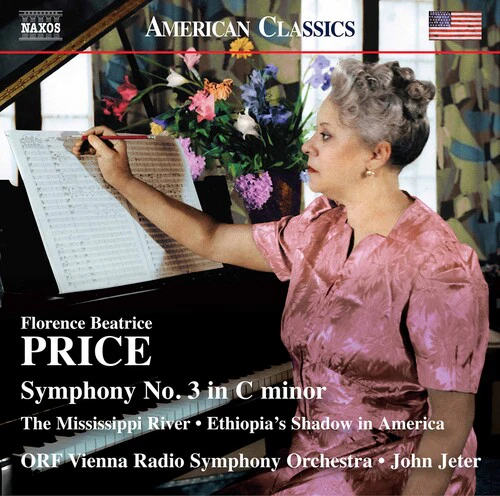
Price: Symphony No. 3 - The Mississippi River - Ethiopia's Shadow in America / Jeter, ORF VRSO
Naxos continues its exploration of Florence Price’s unjustly neglected orchestral works with this latest album, which includes Symphony No. 3. The ORF Vienna Radio Symphony Orchestra is conducted by Price advocate, John Jeter, who received widespread praise for his album of Symphonies Nos. 1 and 4 (8.559827), released in January 2019.
REVIEW:
Florence Price’s Symphony No. 3 (1940) may be her finest. Written in four well-proportioned movements, it begins with music of high seriousness—a slow introduction that sounds like the Adagio of Bruckner’s Seventh meets the Blues—and never looks back. The ensuring Andante is extremely beautiful, and in place of the usual scherzo Price gives us her customary “Juba,” a dance-like fantasy full of captivating sonorities, sultry melodies, and gently offbeat rhythms. As in the Fourth Symphony, Price calls the finale the actual Scherzo, offering her own imaginative slant on traditional symphonic form. It’s worth pointing out that as a graguate (with honors) from the New England Conservatory, Price was about as well trained as any American composer of her day, and entirely apart from the music’s characteristically personal expressive elements, her technical sophistication as a writer for the orchestra really shows. This is good stuff.
The Mississippi River, sometimes called a “suite,” is actually a tone poem containing nearly half an hour of continuous music. Price quotes American folk tunes and Negro spirituals (Get Along Little Doggies, Deep River, etc) as the river wends its way from north to south, but what impresses most is how well sustained the musical argument is, and how effectively this lengthy and colorful piece cheats the clock. Really, there’s no excuse for this music not being programmed regularly in American orchestra concerts. Finally, Ethiopia’s Shadow in America is a brief triptych tracing the arrival of the Black man to American as a slave, his resignation and faith, and finally, hopefully, his ultimate assimilation into American society in a fusion of African and “acquired impulses.” The work offers a useful commentary on the role of the individual in society in these racially polarized times.
John Jeter has already turned in very good performances of Price’s First and Fourth Symphonies with his own orchestra in Arkansas, but these recordings with the full-time ORF Vienna Radio Symphony Orchestra are both better played and better recorded. Price was an important and worthy voice in American classical music, quite apart from the challenges she faced as an African-American woman. Getting to know her is a genuine treat.
-- ClassicsToday.com (David Hurwitz)
Naxos continues its exploration of Florence Price’s unjustly neglected orchestral works with this latest album, which includes Symphony No. 3. The ORF Vienna Radio Symphony Orchestra is conducted by Price advocate, John Jeter, who received widespread praise for his album of Symphonies Nos. 1 and 4 (8.559827), released in January 2019.
REVIEW:
Florence Price’s Symphony No. 3 (1940) may be her finest. Written in four well-proportioned movements, it begins with music of high seriousness—a slow introduction that sounds like the Adagio of Bruckner’s Seventh meets the Blues—and never looks back. The ensuring Andante is extremely beautiful, and in place of the usual scherzo Price gives us her customary “Juba,” a dance-like fantasy full of captivating sonorities, sultry melodies, and gently offbeat rhythms. As in the Fourth Symphony, Price calls the finale the actual Scherzo, offering her own imaginative slant on traditional symphonic form. It’s worth pointing out that as a graguate (with honors) from the New England Conservatory, Price was about as well trained as any American composer of her day, and entirely apart from the music’s characteristically personal expressive elements, her technical sophistication as a writer for the orchestra really shows. This is good stuff.
The Mississippi River, sometimes called a “suite,” is actually a tone poem containing nearly half an hour of continuous music. Price quotes American folk tunes and Negro spirituals (Get Along Little Doggies, Deep River, etc) as the river wends its way from north to south, but what impresses most is how well sustained the musical argument is, and how effectively this lengthy and colorful piece cheats the clock. Really, there’s no excuse for this music not being programmed regularly in American orchestra concerts. Finally, Ethiopia’s Shadow in America is a brief triptych tracing the arrival of the Black man to American as a slave, his resignation and faith, and finally, hopefully, his ultimate assimilation into American society in a fusion of African and “acquired impulses.” The work offers a useful commentary on the role of the individual in society in these racially polarized times.
John Jeter has already turned in very good performances of Price’s First and Fourth Symphonies with his own orchestra in Arkansas, but these recordings with the full-time ORF Vienna Radio Symphony Orchestra are both better played and better recorded. Price was an important and worthy voice in American classical music, quite apart from the challenges she faced as an African-American woman. Getting to know her is a genuine treat.
-- ClassicsToday.com (David Hurwitz)
Original: $19.99
-65%$19.99
$7.00Description
Naxos continues its exploration of Florence Price’s unjustly neglected orchestral works with this latest album, which includes Symphony No. 3. The ORF Vienna Radio Symphony Orchestra is conducted by Price advocate, John Jeter, who received widespread praise for his album of Symphonies Nos. 1 and 4 (8.559827), released in January 2019.
REVIEW:
Florence Price’s Symphony No. 3 (1940) may be her finest. Written in four well-proportioned movements, it begins with music of high seriousness—a slow introduction that sounds like the Adagio of Bruckner’s Seventh meets the Blues—and never looks back. The ensuring Andante is extremely beautiful, and in place of the usual scherzo Price gives us her customary “Juba,” a dance-like fantasy full of captivating sonorities, sultry melodies, and gently offbeat rhythms. As in the Fourth Symphony, Price calls the finale the actual Scherzo, offering her own imaginative slant on traditional symphonic form. It’s worth pointing out that as a graguate (with honors) from the New England Conservatory, Price was about as well trained as any American composer of her day, and entirely apart from the music’s characteristically personal expressive elements, her technical sophistication as a writer for the orchestra really shows. This is good stuff.
The Mississippi River, sometimes called a “suite,” is actually a tone poem containing nearly half an hour of continuous music. Price quotes American folk tunes and Negro spirituals (Get Along Little Doggies, Deep River, etc) as the river wends its way from north to south, but what impresses most is how well sustained the musical argument is, and how effectively this lengthy and colorful piece cheats the clock. Really, there’s no excuse for this music not being programmed regularly in American orchestra concerts. Finally, Ethiopia’s Shadow in America is a brief triptych tracing the arrival of the Black man to American as a slave, his resignation and faith, and finally, hopefully, his ultimate assimilation into American society in a fusion of African and “acquired impulses.” The work offers a useful commentary on the role of the individual in society in these racially polarized times.
John Jeter has already turned in very good performances of Price’s First and Fourth Symphonies with his own orchestra in Arkansas, but these recordings with the full-time ORF Vienna Radio Symphony Orchestra are both better played and better recorded. Price was an important and worthy voice in American classical music, quite apart from the challenges she faced as an African-American woman. Getting to know her is a genuine treat.
-- ClassicsToday.com (David Hurwitz)