🎉 Up to 70% Off Selected ItemsShop Sale

1 / 2
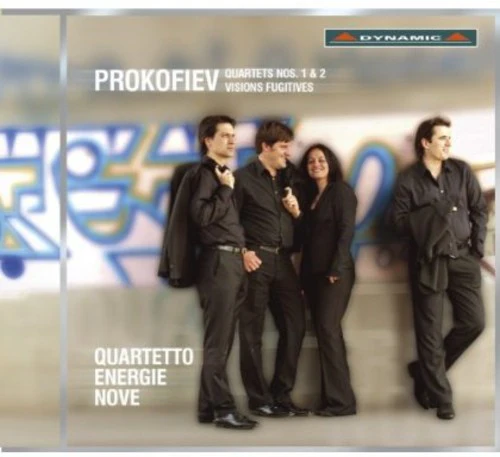
Prokofiev: Quartets No 1 & 2, Visions Fugitives / Quartetto Energie Nova
PROKOFIEV String Quartets: No. 1 in b; No. 2 in F. Visions fugitives (arr. S. Samsonov) • Energie Nove Qrt • DYNAMIC 726 (69:31)
The Italian label Dynamic seems to be re-energizing itself (pun intended) with a roster of new and unfamiliar artists. First it was a recording of Bach’s French Suites with a harpsichordist new to Fanfare , Alessandra Artifoni, reviewed elsewhere in this issue; and now we have a similarly unfamiliar string quartet ensemble billing itself Quartetto Energie Nove, which, like Artifoni, has neither an official website nor any other recordings I could find. The ensemble’s rep agency, Suavis Artists, does however, have a bio-blurb about the group, and I stumbled upon a YouTube entry of a complete performance by the ensemble of Beethoven’s “Harp” Quartet, op. 74, which sounds very promising. Energie Nove’s makeup is international—Russian, German, and Italian—but all four musicians play on neutral territory, being members of Switzerland’s Orchestra della Svizzera Italiano. Familiar names, such as Salvatore Accardo, Tibor Varga, Franco Gulli, and Valentin Berlinsky (long-time cellist of the Borodin Quartet), figure prominently in Energie Nove’s training.
To repeat what I’ve said many times before, we are blessed to be living in a golden age of string playing, and the Quartetto Energie Nove is but yet another manifestation of our blessings. Most performances of Prokofiev’s First String Quartet start off with an appropriately jaunty stride of cockeyed optimism. But Energie Nove’s players spring forth, jack-in-the-box like, with a mischievous alacrity. Their first movement timing, 6:39, leaves the St. Petersburg Quartet (on Delos), at 7:43, in the dust. They’re even faster than the Emerson Quartet at 7:05 and the Chilingrian Quartet (on Chandos) at 7: 01.
In the Andante , the timings are reversed, with Energie Nove being slightly slower and more probing than any of the above-cited three versions, while in the last movement—the one Prokofiev himself arranged for string orchestra—Energie Nove’s timing is very close to the others, but its playing is sharper edged. The effect, to recall the previous pun, is to energize the music in a way I’ve not heard it played before. Admittedly, I’ve not heard the recent version by the Pavel Haas Quartet on Supraphon, which was very highly rated by Boyd Pomeroy in 33:6 and Want Listed by Bart Verhaeghe in 34:2.
Prokofiev was close to 40 when he wrote his first of only two string quartets in 1930. The work was commissioned by the Library of Congress, where it was first performed the following year. The composer’s Second Quartet, in F Major, was written a decade later and under very different circumstances. By 1941, Prokofiev was back in Moscow, but not for long. When the Nazis invaded the Soviet Union, he, along with several other artists the government deemed “high value” assets, was whisked away to the safety of Nalchik, a town some 900 miles south of Moscow. It was here that the composer was asked (ordered, would be more accurate) to write a string quartet based on the Karbadino-Balkar folk tunes and rhythms of the indigenous tribal peoples of this North Caucasus region.
One would think that having to produce a work on-demand like that would not motivate a composer to his best efforts, but Prokofiev became quite intrigued by the native folk music he’d been directed to incorporate into his new quartet, and he ended up composing a very attractive and, in some ways, more emotionally stirring score than that of his First Quartet. Again, Energie Nove plays with consummate technical authority and real feeling for the music’s folk idioms.
Prokofiev’s Visions fugitives , 20 short pieces the composer wrote for piano between 1915 and 1917, performed here in an arrangement for string quartet by Sergei Samsonov, is perhaps a bit of an odd choice as a complement to the two string quartets, but the sad fact (our loss) is that Prokofiev didn’t really compose much chamber music. These two string quartets, a Quintet for mixed winds and strings, a couple of sonatas for violin and piano, a Sonata for cello and piano, a Sonata for two violins, and a Sextet, better known as Overture on Hebrew Themes , are about the extent of it, unless one counts a few miscellaneous pieces for violin and piano and for cello and piano. Though the Visions fugitives string quartet arrangement is not in Prokofiev’s hand, it makes more sense to me as a disc filler than does the Emerson Quartet’s choice of the two-violin sonata—the identical program offered by the Pavel Haas Quartet—or the St. Petersburg Quartet’s choice of a not very appealing 1985 string quartet by Georgian composer Zurab Nadarejshvili. And Energie Nove’s choice is certainly preferable to the Chilingrian Quartet’s filler on Chandos, which is nothing, a 43-minute disc I’m now retiring from my collection.
I’m hoping to hear a lot more from Quartetto Energie Nove in the future. Meanwhile, this new Prokofiev offering is strongly recommended.
FANFARE: Jerry Dubins
PROKOFIEV String Quartets: No. 1 in b; No. 2 in F. Visions fugitives (arr. S. Samsonov) • Energie Nove Qrt • DYNAMIC 726 (69:31)
The Italian label Dynamic seems to be re-energizing itself (pun intended) with a roster of new and unfamiliar artists. First it was a recording of Bach’s French Suites with a harpsichordist new to Fanfare , Alessandra Artifoni, reviewed elsewhere in this issue; and now we have a similarly unfamiliar string quartet ensemble billing itself Quartetto Energie Nove, which, like Artifoni, has neither an official website nor any other recordings I could find. The ensemble’s rep agency, Suavis Artists, does however, have a bio-blurb about the group, and I stumbled upon a YouTube entry of a complete performance by the ensemble of Beethoven’s “Harp” Quartet, op. 74, which sounds very promising. Energie Nove’s makeup is international—Russian, German, and Italian—but all four musicians play on neutral territory, being members of Switzerland’s Orchestra della Svizzera Italiano. Familiar names, such as Salvatore Accardo, Tibor Varga, Franco Gulli, and Valentin Berlinsky (long-time cellist of the Borodin Quartet), figure prominently in Energie Nove’s training.
To repeat what I’ve said many times before, we are blessed to be living in a golden age of string playing, and the Quartetto Energie Nove is but yet another manifestation of our blessings. Most performances of Prokofiev’s First String Quartet start off with an appropriately jaunty stride of cockeyed optimism. But Energie Nove’s players spring forth, jack-in-the-box like, with a mischievous alacrity. Their first movement timing, 6:39, leaves the St. Petersburg Quartet (on Delos), at 7:43, in the dust. They’re even faster than the Emerson Quartet at 7:05 and the Chilingrian Quartet (on Chandos) at 7: 01.
In the Andante , the timings are reversed, with Energie Nove being slightly slower and more probing than any of the above-cited three versions, while in the last movement—the one Prokofiev himself arranged for string orchestra—Energie Nove’s timing is very close to the others, but its playing is sharper edged. The effect, to recall the previous pun, is to energize the music in a way I’ve not heard it played before. Admittedly, I’ve not heard the recent version by the Pavel Haas Quartet on Supraphon, which was very highly rated by Boyd Pomeroy in 33:6 and Want Listed by Bart Verhaeghe in 34:2.
Prokofiev was close to 40 when he wrote his first of only two string quartets in 1930. The work was commissioned by the Library of Congress, where it was first performed the following year. The composer’s Second Quartet, in F Major, was written a decade later and under very different circumstances. By 1941, Prokofiev was back in Moscow, but not for long. When the Nazis invaded the Soviet Union, he, along with several other artists the government deemed “high value” assets, was whisked away to the safety of Nalchik, a town some 900 miles south of Moscow. It was here that the composer was asked (ordered, would be more accurate) to write a string quartet based on the Karbadino-Balkar folk tunes and rhythms of the indigenous tribal peoples of this North Caucasus region.
One would think that having to produce a work on-demand like that would not motivate a composer to his best efforts, but Prokofiev became quite intrigued by the native folk music he’d been directed to incorporate into his new quartet, and he ended up composing a very attractive and, in some ways, more emotionally stirring score than that of his First Quartet. Again, Energie Nove plays with consummate technical authority and real feeling for the music’s folk idioms.
Prokofiev’s Visions fugitives , 20 short pieces the composer wrote for piano between 1915 and 1917, performed here in an arrangement for string quartet by Sergei Samsonov, is perhaps a bit of an odd choice as a complement to the two string quartets, but the sad fact (our loss) is that Prokofiev didn’t really compose much chamber music. These two string quartets, a Quintet for mixed winds and strings, a couple of sonatas for violin and piano, a Sonata for cello and piano, a Sonata for two violins, and a Sextet, better known as Overture on Hebrew Themes , are about the extent of it, unless one counts a few miscellaneous pieces for violin and piano and for cello and piano. Though the Visions fugitives string quartet arrangement is not in Prokofiev’s hand, it makes more sense to me as a disc filler than does the Emerson Quartet’s choice of the two-violin sonata—the identical program offered by the Pavel Haas Quartet—or the St. Petersburg Quartet’s choice of a not very appealing 1985 string quartet by Georgian composer Zurab Nadarejshvili. And Energie Nove’s choice is certainly preferable to the Chilingrian Quartet’s filler on Chandos, which is nothing, a 43-minute disc I’m now retiring from my collection.
I’m hoping to hear a lot more from Quartetto Energie Nove in the future. Meanwhile, this new Prokofiev offering is strongly recommended.
FANFARE: Jerry Dubins
$6.65
Original: $18.99
-65%Prokofiev: Quartets No 1 & 2, Visions Fugitives / Quartetto Energie Nova—
$18.99
$6.65Description
PROKOFIEV String Quartets: No. 1 in b; No. 2 in F. Visions fugitives (arr. S. Samsonov) • Energie Nove Qrt • DYNAMIC 726 (69:31)
The Italian label Dynamic seems to be re-energizing itself (pun intended) with a roster of new and unfamiliar artists. First it was a recording of Bach’s French Suites with a harpsichordist new to Fanfare , Alessandra Artifoni, reviewed elsewhere in this issue; and now we have a similarly unfamiliar string quartet ensemble billing itself Quartetto Energie Nove, which, like Artifoni, has neither an official website nor any other recordings I could find. The ensemble’s rep agency, Suavis Artists, does however, have a bio-blurb about the group, and I stumbled upon a YouTube entry of a complete performance by the ensemble of Beethoven’s “Harp” Quartet, op. 74, which sounds very promising. Energie Nove’s makeup is international—Russian, German, and Italian—but all four musicians play on neutral territory, being members of Switzerland’s Orchestra della Svizzera Italiano. Familiar names, such as Salvatore Accardo, Tibor Varga, Franco Gulli, and Valentin Berlinsky (long-time cellist of the Borodin Quartet), figure prominently in Energie Nove’s training.
To repeat what I’ve said many times before, we are blessed to be living in a golden age of string playing, and the Quartetto Energie Nove is but yet another manifestation of our blessings. Most performances of Prokofiev’s First String Quartet start off with an appropriately jaunty stride of cockeyed optimism. But Energie Nove’s players spring forth, jack-in-the-box like, with a mischievous alacrity. Their first movement timing, 6:39, leaves the St. Petersburg Quartet (on Delos), at 7:43, in the dust. They’re even faster than the Emerson Quartet at 7:05 and the Chilingrian Quartet (on Chandos) at 7: 01.
In the Andante , the timings are reversed, with Energie Nove being slightly slower and more probing than any of the above-cited three versions, while in the last movement—the one Prokofiev himself arranged for string orchestra—Energie Nove’s timing is very close to the others, but its playing is sharper edged. The effect, to recall the previous pun, is to energize the music in a way I’ve not heard it played before. Admittedly, I’ve not heard the recent version by the Pavel Haas Quartet on Supraphon, which was very highly rated by Boyd Pomeroy in 33:6 and Want Listed by Bart Verhaeghe in 34:2.
Prokofiev was close to 40 when he wrote his first of only two string quartets in 1930. The work was commissioned by the Library of Congress, where it was first performed the following year. The composer’s Second Quartet, in F Major, was written a decade later and under very different circumstances. By 1941, Prokofiev was back in Moscow, but not for long. When the Nazis invaded the Soviet Union, he, along with several other artists the government deemed “high value” assets, was whisked away to the safety of Nalchik, a town some 900 miles south of Moscow. It was here that the composer was asked (ordered, would be more accurate) to write a string quartet based on the Karbadino-Balkar folk tunes and rhythms of the indigenous tribal peoples of this North Caucasus region.
One would think that having to produce a work on-demand like that would not motivate a composer to his best efforts, but Prokofiev became quite intrigued by the native folk music he’d been directed to incorporate into his new quartet, and he ended up composing a very attractive and, in some ways, more emotionally stirring score than that of his First Quartet. Again, Energie Nove plays with consummate technical authority and real feeling for the music’s folk idioms.
Prokofiev’s Visions fugitives , 20 short pieces the composer wrote for piano between 1915 and 1917, performed here in an arrangement for string quartet by Sergei Samsonov, is perhaps a bit of an odd choice as a complement to the two string quartets, but the sad fact (our loss) is that Prokofiev didn’t really compose much chamber music. These two string quartets, a Quintet for mixed winds and strings, a couple of sonatas for violin and piano, a Sonata for cello and piano, a Sonata for two violins, and a Sextet, better known as Overture on Hebrew Themes , are about the extent of it, unless one counts a few miscellaneous pieces for violin and piano and for cello and piano. Though the Visions fugitives string quartet arrangement is not in Prokofiev’s hand, it makes more sense to me as a disc filler than does the Emerson Quartet’s choice of the two-violin sonata—the identical program offered by the Pavel Haas Quartet—or the St. Petersburg Quartet’s choice of a not very appealing 1985 string quartet by Georgian composer Zurab Nadarejshvili. And Energie Nove’s choice is certainly preferable to the Chilingrian Quartet’s filler on Chandos, which is nothing, a 43-minute disc I’m now retiring from my collection.
I’m hoping to hear a lot more from Quartetto Energie Nove in the future. Meanwhile, this new Prokofiev offering is strongly recommended.
FANFARE: Jerry Dubins