🎉 Up to 70% Off Selected ItemsShop Sale

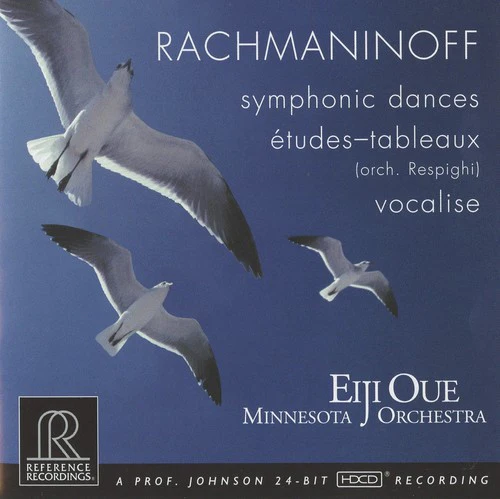
Rachmaninoff: Symphonic Dances, Etudes-tableaux, Etc / Oue
First, you need to play this recording at a higher than normal level because it's got a very realistic dynamic range--which means that the opening's soft string chirpings won't register fully at a low level. But then, watch out (I said it's a realistic dynamic range): when the orchestra rips, you'll be abruptly transported to Minneapolis' Orchestra Hall. Okay, so what's all this state of the art 24-bit digital technology bringing to us? Namely one of the best Rachmaninov Symphonic Dances on disc! The playing by the Minnesota Orchestra is simply stupendous: tremendously unified ensemble, immaculate balances that let you hear all the important lines, and a palpable sense of enjoyment from the players (those trumpets rule!).
Eiji Oue sets an ideal tempo for the first movement and employs perfectly timed rubato in its lyrical central section. The second movement flags a bit, lacking the snarling sexuality of Jansons with the St. Petersburg Philharmonic, which remains the most gripping performance of recent years; but with the finale Oue gears up again for a blockbuster reading of tremendous excitement and bracing virtuosity. And yes, he lets the final tam-tam stroke reverberate uninterrupted, as (confusingly) indicated in the score.
A gently passionate performance of the ubiquitous Vocalise functions as an interlude (with serenely singing strings) before the Études-tableaux, where Oue again exploits his orchestra's radiant sonorities to fully flesh out Respighi's brilliant orchestrations of these mysterious, sensuous, and evocative pieces. Reference's recording renders all the music's color, irony, and drama in true high fidelity. An excellent conclusion to an excellent disc, one you are wholeheartedly urged to investigate.
--Victor Carr Jr., ClassicsToday.com
Eiji Oue sets an ideal tempo for the first movement and employs perfectly timed rubato in its lyrical central section. The second movement flags a bit, lacking the snarling sexuality of Jansons with the St. Petersburg Philharmonic, which remains the most gripping performance of recent years; but with the finale Oue gears up again for a blockbuster reading of tremendous excitement and bracing virtuosity. And yes, he lets the final tam-tam stroke reverberate uninterrupted, as (confusingly) indicated in the score.
A gently passionate performance of the ubiquitous Vocalise functions as an interlude (with serenely singing strings) before the Études-tableaux, where Oue again exploits his orchestra's radiant sonorities to fully flesh out Respighi's brilliant orchestrations of these mysterious, sensuous, and evocative pieces. Reference's recording renders all the music's color, irony, and drama in true high fidelity. An excellent conclusion to an excellent disc, one you are wholeheartedly urged to investigate.
--Victor Carr Jr., ClassicsToday.com
First, you need to play this recording at a higher than normal level because it's got a very realistic dynamic range--which means that the opening's soft string chirpings won't register fully at a low level. But then, watch out (I said it's a realistic dynamic range): when the orchestra rips, you'll be abruptly transported to Minneapolis' Orchestra Hall. Okay, so what's all this state of the art 24-bit digital technology bringing to us? Namely one of the best Rachmaninov Symphonic Dances on disc! The playing by the Minnesota Orchestra is simply stupendous: tremendously unified ensemble, immaculate balances that let you hear all the important lines, and a palpable sense of enjoyment from the players (those trumpets rule!).
Eiji Oue sets an ideal tempo for the first movement and employs perfectly timed rubato in its lyrical central section. The second movement flags a bit, lacking the snarling sexuality of Jansons with the St. Petersburg Philharmonic, which remains the most gripping performance of recent years; but with the finale Oue gears up again for a blockbuster reading of tremendous excitement and bracing virtuosity. And yes, he lets the final tam-tam stroke reverberate uninterrupted, as (confusingly) indicated in the score.
A gently passionate performance of the ubiquitous Vocalise functions as an interlude (with serenely singing strings) before the Études-tableaux, where Oue again exploits his orchestra's radiant sonorities to fully flesh out Respighi's brilliant orchestrations of these mysterious, sensuous, and evocative pieces. Reference's recording renders all the music's color, irony, and drama in true high fidelity. An excellent conclusion to an excellent disc, one you are wholeheartedly urged to investigate.
--Victor Carr Jr., ClassicsToday.com
Eiji Oue sets an ideal tempo for the first movement and employs perfectly timed rubato in its lyrical central section. The second movement flags a bit, lacking the snarling sexuality of Jansons with the St. Petersburg Philharmonic, which remains the most gripping performance of recent years; but with the finale Oue gears up again for a blockbuster reading of tremendous excitement and bracing virtuosity. And yes, he lets the final tam-tam stroke reverberate uninterrupted, as (confusingly) indicated in the score.
A gently passionate performance of the ubiquitous Vocalise functions as an interlude (with serenely singing strings) before the Études-tableaux, where Oue again exploits his orchestra's radiant sonorities to fully flesh out Respighi's brilliant orchestrations of these mysterious, sensuous, and evocative pieces. Reference's recording renders all the music's color, irony, and drama in true high fidelity. An excellent conclusion to an excellent disc, one you are wholeheartedly urged to investigate.
--Victor Carr Jr., ClassicsToday.com
$18.99
Rachmaninoff: Symphonic Dances, Etudes-tableaux, Etc / Oue—
$18.99
Description
First, you need to play this recording at a higher than normal level because it's got a very realistic dynamic range--which means that the opening's soft string chirpings won't register fully at a low level. But then, watch out (I said it's a realistic dynamic range): when the orchestra rips, you'll be abruptly transported to Minneapolis' Orchestra Hall. Okay, so what's all this state of the art 24-bit digital technology bringing to us? Namely one of the best Rachmaninov Symphonic Dances on disc! The playing by the Minnesota Orchestra is simply stupendous: tremendously unified ensemble, immaculate balances that let you hear all the important lines, and a palpable sense of enjoyment from the players (those trumpets rule!).
Eiji Oue sets an ideal tempo for the first movement and employs perfectly timed rubato in its lyrical central section. The second movement flags a bit, lacking the snarling sexuality of Jansons with the St. Petersburg Philharmonic, which remains the most gripping performance of recent years; but with the finale Oue gears up again for a blockbuster reading of tremendous excitement and bracing virtuosity. And yes, he lets the final tam-tam stroke reverberate uninterrupted, as (confusingly) indicated in the score.
A gently passionate performance of the ubiquitous Vocalise functions as an interlude (with serenely singing strings) before the Études-tableaux, where Oue again exploits his orchestra's radiant sonorities to fully flesh out Respighi's brilliant orchestrations of these mysterious, sensuous, and evocative pieces. Reference's recording renders all the music's color, irony, and drama in true high fidelity. An excellent conclusion to an excellent disc, one you are wholeheartedly urged to investigate.
--Victor Carr Jr., ClassicsToday.com
Eiji Oue sets an ideal tempo for the first movement and employs perfectly timed rubato in its lyrical central section. The second movement flags a bit, lacking the snarling sexuality of Jansons with the St. Petersburg Philharmonic, which remains the most gripping performance of recent years; but with the finale Oue gears up again for a blockbuster reading of tremendous excitement and bracing virtuosity. And yes, he lets the final tam-tam stroke reverberate uninterrupted, as (confusingly) indicated in the score.
A gently passionate performance of the ubiquitous Vocalise functions as an interlude (with serenely singing strings) before the Études-tableaux, where Oue again exploits his orchestra's radiant sonorities to fully flesh out Respighi's brilliant orchestrations of these mysterious, sensuous, and evocative pieces. Reference's recording renders all the music's color, irony, and drama in true high fidelity. An excellent conclusion to an excellent disc, one you are wholeheartedly urged to investigate.
--Victor Carr Jr., ClassicsToday.com