🎉 Up to 70% Off Selected ItemsShop Sale

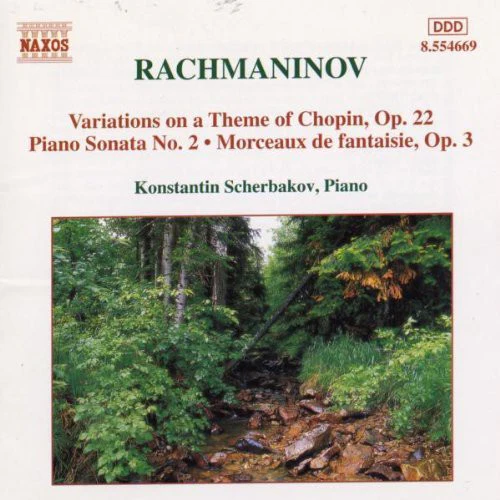
Rachmaninov: Piano Sonata No 2, Etc / Konstantin Scherbakov
Rachmaninov’s Chopin Variations is a relative rarity on disc and a work that has never caught on in the concert hall. Here is a performance that makes you wonder why. More clearly than in Berezovsky’s (incomplete) recording (Teldec), more compellingly than even Howard Shelley (Hyperion), Scherbakov illustrates how the Variations, touchingly dedicated to Leschetizky, come from the same golden vein of inspiration that followed the Second Piano Concerto, even reusing some of its figurations and modulations (listen to Vars 3 and 8). Contrast the limpid lyricism of the brief Var. 17, one of the composer’s greatest melodies, with the bravura finale (Scherbakov chooses the alternative presto coda to end the cycle): this is great Rachmaninov playing with an eye for detail and lucid phrasing as much as for atmosphere and colour.
The five Op. 3 pieces are notable for the beautiful tonal quality of the playing (this and the recording throughout are first class). I’ve heard more cohesive takes on the Prelude, the second of the set (Hofmann, for example, and the composer himself), and the opening ‘Élégie’ has a slightly indulgent tempo, but Scherbakov’s individuality and character carry the day.
In the Sonata he manages to combine drama, breathtaking articulation and clarity of texture (usually one disappears at the expense of the other in this work). While it does not claim the pent-up, nerve-jangling thrill of Horowitz’s famous account, and despite a slight loss of tension in the final pages, Scherbakov’s must rank as a front runner among modern recordings.
-- Jeremy Nicholas, BBC Music
The five Op. 3 pieces are notable for the beautiful tonal quality of the playing (this and the recording throughout are first class). I’ve heard more cohesive takes on the Prelude, the second of the set (Hofmann, for example, and the composer himself), and the opening ‘Élégie’ has a slightly indulgent tempo, but Scherbakov’s individuality and character carry the day.
In the Sonata he manages to combine drama, breathtaking articulation and clarity of texture (usually one disappears at the expense of the other in this work). While it does not claim the pent-up, nerve-jangling thrill of Horowitz’s famous account, and despite a slight loss of tension in the final pages, Scherbakov’s must rank as a front runner among modern recordings.
-- Jeremy Nicholas, BBC Music
Rachmaninov’s Chopin Variations is a relative rarity on disc and a work that has never caught on in the concert hall. Here is a performance that makes you wonder why. More clearly than in Berezovsky’s (incomplete) recording (Teldec), more compellingly than even Howard Shelley (Hyperion), Scherbakov illustrates how the Variations, touchingly dedicated to Leschetizky, come from the same golden vein of inspiration that followed the Second Piano Concerto, even reusing some of its figurations and modulations (listen to Vars 3 and 8). Contrast the limpid lyricism of the brief Var. 17, one of the composer’s greatest melodies, with the bravura finale (Scherbakov chooses the alternative presto coda to end the cycle): this is great Rachmaninov playing with an eye for detail and lucid phrasing as much as for atmosphere and colour.
The five Op. 3 pieces are notable for the beautiful tonal quality of the playing (this and the recording throughout are first class). I’ve heard more cohesive takes on the Prelude, the second of the set (Hofmann, for example, and the composer himself), and the opening ‘Élégie’ has a slightly indulgent tempo, but Scherbakov’s individuality and character carry the day.
In the Sonata he manages to combine drama, breathtaking articulation and clarity of texture (usually one disappears at the expense of the other in this work). While it does not claim the pent-up, nerve-jangling thrill of Horowitz’s famous account, and despite a slight loss of tension in the final pages, Scherbakov’s must rank as a front runner among modern recordings.
-- Jeremy Nicholas, BBC Music
The five Op. 3 pieces are notable for the beautiful tonal quality of the playing (this and the recording throughout are first class). I’ve heard more cohesive takes on the Prelude, the second of the set (Hofmann, for example, and the composer himself), and the opening ‘Élégie’ has a slightly indulgent tempo, but Scherbakov’s individuality and character carry the day.
In the Sonata he manages to combine drama, breathtaking articulation and clarity of texture (usually one disappears at the expense of the other in this work). While it does not claim the pent-up, nerve-jangling thrill of Horowitz’s famous account, and despite a slight loss of tension in the final pages, Scherbakov’s must rank as a front runner among modern recordings.
-- Jeremy Nicholas, BBC Music
$19.99
Rachmaninov: Piano Sonata No 2, Etc / Konstantin Scherbakov—
$19.99
Description
Rachmaninov’s Chopin Variations is a relative rarity on disc and a work that has never caught on in the concert hall. Here is a performance that makes you wonder why. More clearly than in Berezovsky’s (incomplete) recording (Teldec), more compellingly than even Howard Shelley (Hyperion), Scherbakov illustrates how the Variations, touchingly dedicated to Leschetizky, come from the same golden vein of inspiration that followed the Second Piano Concerto, even reusing some of its figurations and modulations (listen to Vars 3 and 8). Contrast the limpid lyricism of the brief Var. 17, one of the composer’s greatest melodies, with the bravura finale (Scherbakov chooses the alternative presto coda to end the cycle): this is great Rachmaninov playing with an eye for detail and lucid phrasing as much as for atmosphere and colour.
The five Op. 3 pieces are notable for the beautiful tonal quality of the playing (this and the recording throughout are first class). I’ve heard more cohesive takes on the Prelude, the second of the set (Hofmann, for example, and the composer himself), and the opening ‘Élégie’ has a slightly indulgent tempo, but Scherbakov’s individuality and character carry the day.
In the Sonata he manages to combine drama, breathtaking articulation and clarity of texture (usually one disappears at the expense of the other in this work). While it does not claim the pent-up, nerve-jangling thrill of Horowitz’s famous account, and despite a slight loss of tension in the final pages, Scherbakov’s must rank as a front runner among modern recordings.
-- Jeremy Nicholas, BBC Music
The five Op. 3 pieces are notable for the beautiful tonal quality of the playing (this and the recording throughout are first class). I’ve heard more cohesive takes on the Prelude, the second of the set (Hofmann, for example, and the composer himself), and the opening ‘Élégie’ has a slightly indulgent tempo, but Scherbakov’s individuality and character carry the day.
In the Sonata he manages to combine drama, breathtaking articulation and clarity of texture (usually one disappears at the expense of the other in this work). While it does not claim the pent-up, nerve-jangling thrill of Horowitz’s famous account, and despite a slight loss of tension in the final pages, Scherbakov’s must rank as a front runner among modern recordings.
-- Jeremy Nicholas, BBC Music