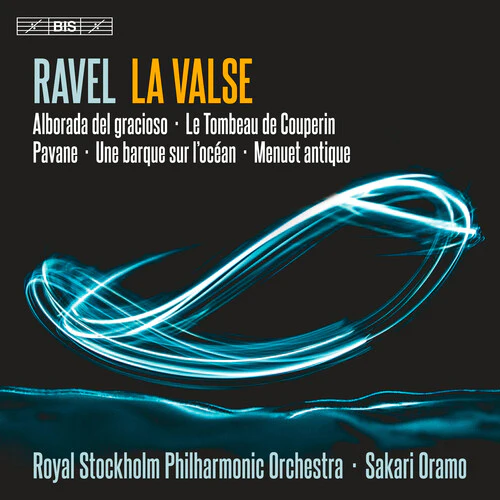
Ravel: La Valse / Oramo, Royal Stockholm Philharmonic Orchestra
Maurice Ravel composed many works which stand as classics for both solo piano and for orchestra. On this disc, all except one work were first conceived for piano, which raises the question how it is possible to transfer such pianistic music to the orchestra without making it sound like a mere ‘colorized’ version. Ravel’s orchestral writing was the result of a long apprenticeship and careful study. Although his skills as an orchestrator are much admired today, his ability to coax new sounds out of the orchestra wasn't always appreciated in his own time, however – in 1907 the critic Pierre Lalo complained that ‘in Ravel’s orchestra, no instrument retains its natural sound…’!
Among the works performed here by Sakari Oramo and the Royal Stockholm Philharmonic Orchestra are some of Ravel’s earliest compositions, including the much-loved Pavane pour une infante défunte, but the album closes with a later work: La Valse, written in 1920 as one of only four works by Ravel originally conceived for orchestra. The idea of composing a tribute to Johann Strauss had pursued Ravel since 1906, but it took a commission from Sergei Diaghilev of the Ballets Russes for him to return to the project. When Diaghilev found it unsuited for ballet, Ravel gave it the subtitle ‘choreographic poem’. It was premiered in concert in 1920 and enjoyed immediate success.
REVIEW:
The ostensible title of this disc is “La Valse,” which is actually the least interesting performance on it. Oramo delivers a quick, lithe and lean interpretation of a work that ought to sound like a decadent, high cholesterol indulgence that explodes in a giant orchestral aneurism at the end. Here, he leaves the music no room to increase in urgency through the apocalyptic closing pages, although the playing is excellent and the sonics, as usual, first class. No, the real treat here is Le Tombeau de Couperin, here given with the two movements of the piano original that Ravel left off the orchestral version (Fugue and Toccata) very idiomatically arranged by Kenneth Hesketh. I particularly like Oramo’s decision not to take the opening too quickly, so that we get to savor the melody as well as Ravel’s gorgeous harmonies. It’s a splendid performance all around.
After Le Tombeau, the highlight of the program must be Une barque sur l’océan, still something of a rarity (even the score used to be hard to find), and I suppose a work that seems to fail next to Debussy’s La mer. The truth is that it’s a totally different beast, mostly dark and mysterious, and that’s just how Oramo plays it. The remaining works are mostly good. The inevitable Pavane for a Dead Princess and the Minuet antique are unkillable, but Alborada del gracioso needs more swagger towards the end. Why doesn’t Oramo give the trombones a chance to inject a little healthy vulgarity into the concluding bars? Of course, it’s not as if we’re short of worthy alternatives in most of this music, but the excellence (and novelty) of Le Tombeau and Une barque make this release impossible to dismiss.
-- ClassicsToday.com (David Hurwitz)
Maurice Ravel composed many works which stand as classics for both solo piano and for orchestra. On this disc, all except one work were first conceived for piano, which raises the question how it is possible to transfer such pianistic music to the orchestra without making it sound like a mere ‘colorized’ version. Ravel’s orchestral writing was the result of a long apprenticeship and careful study. Although his skills as an orchestrator are much admired today, his ability to coax new sounds out of the orchestra wasn't always appreciated in his own time, however – in 1907 the critic Pierre Lalo complained that ‘in Ravel’s orchestra, no instrument retains its natural sound…’!
Among the works performed here by Sakari Oramo and the Royal Stockholm Philharmonic Orchestra are some of Ravel’s earliest compositions, including the much-loved Pavane pour une infante défunte, but the album closes with a later work: La Valse, written in 1920 as one of only four works by Ravel originally conceived for orchestra. The idea of composing a tribute to Johann Strauss had pursued Ravel since 1906, but it took a commission from Sergei Diaghilev of the Ballets Russes for him to return to the project. When Diaghilev found it unsuited for ballet, Ravel gave it the subtitle ‘choreographic poem’. It was premiered in concert in 1920 and enjoyed immediate success.
REVIEW:
The ostensible title of this disc is “La Valse,” which is actually the least interesting performance on it. Oramo delivers a quick, lithe and lean interpretation of a work that ought to sound like a decadent, high cholesterol indulgence that explodes in a giant orchestral aneurism at the end. Here, he leaves the music no room to increase in urgency through the apocalyptic closing pages, although the playing is excellent and the sonics, as usual, first class. No, the real treat here is Le Tombeau de Couperin, here given with the two movements of the piano original that Ravel left off the orchestral version (Fugue and Toccata) very idiomatically arranged by Kenneth Hesketh. I particularly like Oramo’s decision not to take the opening too quickly, so that we get to savor the melody as well as Ravel’s gorgeous harmonies. It’s a splendid performance all around.
After Le Tombeau, the highlight of the program must be Une barque sur l’océan, still something of a rarity (even the score used to be hard to find), and I suppose a work that seems to fail next to Debussy’s La mer. The truth is that it’s a totally different beast, mostly dark and mysterious, and that’s just how Oramo plays it. The remaining works are mostly good. The inevitable Pavane for a Dead Princess and the Minuet antique are unkillable, but Alborada del gracioso needs more swagger towards the end. Why doesn’t Oramo give the trombones a chance to inject a little healthy vulgarity into the concluding bars? Of course, it’s not as if we’re short of worthy alternatives in most of this music, but the excellence (and novelty) of Le Tombeau and Une barque make this release impossible to dismiss.
-- ClassicsToday.com (David Hurwitz)
Description
Maurice Ravel composed many works which stand as classics for both solo piano and for orchestra. On this disc, all except one work were first conceived for piano, which raises the question how it is possible to transfer such pianistic music to the orchestra without making it sound like a mere ‘colorized’ version. Ravel’s orchestral writing was the result of a long apprenticeship and careful study. Although his skills as an orchestrator are much admired today, his ability to coax new sounds out of the orchestra wasn't always appreciated in his own time, however – in 1907 the critic Pierre Lalo complained that ‘in Ravel’s orchestra, no instrument retains its natural sound…’!
Among the works performed here by Sakari Oramo and the Royal Stockholm Philharmonic Orchestra are some of Ravel’s earliest compositions, including the much-loved Pavane pour une infante défunte, but the album closes with a later work: La Valse, written in 1920 as one of only four works by Ravel originally conceived for orchestra. The idea of composing a tribute to Johann Strauss had pursued Ravel since 1906, but it took a commission from Sergei Diaghilev of the Ballets Russes for him to return to the project. When Diaghilev found it unsuited for ballet, Ravel gave it the subtitle ‘choreographic poem’. It was premiered in concert in 1920 and enjoyed immediate success.
REVIEW:
The ostensible title of this disc is “La Valse,” which is actually the least interesting performance on it. Oramo delivers a quick, lithe and lean interpretation of a work that ought to sound like a decadent, high cholesterol indulgence that explodes in a giant orchestral aneurism at the end. Here, he leaves the music no room to increase in urgency through the apocalyptic closing pages, although the playing is excellent and the sonics, as usual, first class. No, the real treat here is Le Tombeau de Couperin, here given with the two movements of the piano original that Ravel left off the orchestral version (Fugue and Toccata) very idiomatically arranged by Kenneth Hesketh. I particularly like Oramo’s decision not to take the opening too quickly, so that we get to savor the melody as well as Ravel’s gorgeous harmonies. It’s a splendid performance all around.
After Le Tombeau, the highlight of the program must be Une barque sur l’océan, still something of a rarity (even the score used to be hard to find), and I suppose a work that seems to fail next to Debussy’s La mer. The truth is that it’s a totally different beast, mostly dark and mysterious, and that’s just how Oramo plays it. The remaining works are mostly good. The inevitable Pavane for a Dead Princess and the Minuet antique are unkillable, but Alborada del gracioso needs more swagger towards the end. Why doesn’t Oramo give the trombones a chance to inject a little healthy vulgarity into the concluding bars? Of course, it’s not as if we’re short of worthy alternatives in most of this music, but the excellence (and novelty) of Le Tombeau and Une barque make this release impossible to dismiss.
-- ClassicsToday.com (David Hurwitz)