🎉 Up to 70% Off Selected ItemsShop Sale

1 / 2
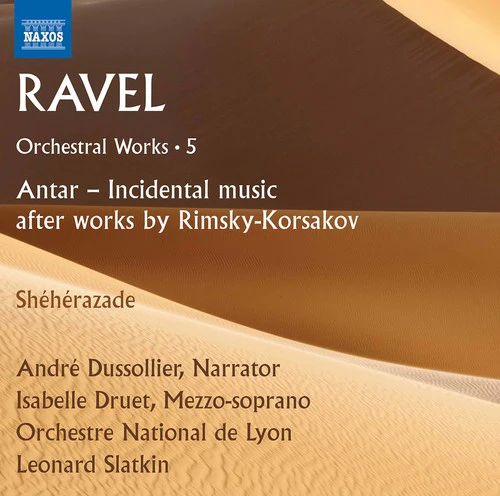
Ravel: Orchestral Works, Vol. 5 / Slatkin, Orchestre National de Lyon
Listen to the Naxos Podcast to learn more about this release
Now here’s a novelty that fans of Ravel and Rimsky-Korsakov will want to hear. In 1910, the story of Antar reached the stage in Paris as a play, with incidental music by Ravel arranged out of Rimsky’s eponymous symphony/tone poem (with a bit of Mlada thrown in for good measure). There is very little original music by Ravel–just a couple of minutes in all–but the arrangements involve some telling reorchestration and the creation of numerous short interludes. The cinematic conclusion (sound clip) sums things up nicely. All told, you get almost the complete original work: the first three movements, plus a good bit of the finale, albeit in a different order.
Unfortunately, for this premiere recording a long, pretentious, self-consciously “poetic” narration has been added, with words by Amin Maalouf. His main musical distinction lies in the fact that he has furnished several opera librettos for Kaija Saariaho, as if that’s a recommendation. My annoyance grew with every word. I mean, the only reason anyone wants to hear this piece is to find out what Ravel did with Rimsky’s original. Why put narrator André Dussolier in what sounds like an empty aircraft hangar and superimpose his histrionic reading of the text on top of the music? You’ll get through it, but it was a bad decision.
That said, Slatkin’s conducting is excellent, as it almost always is when he’s interpreting Russian music, and the sonics are very good when the narrator isn’t narrating. The coupling is a fine performance of Shéhérazade. Isabelle Druet’s voice is, arguably, a bit too small for the work, but she only sounds strained at the climax of Asie. Otherwise, she sings with intelligence, excellent diction, and characterful attention to the text. A sometimes frustrating release, then, but a collector’s item all the same.
– ClassicsToday (David Hurwitz)
Now here’s a novelty that fans of Ravel and Rimsky-Korsakov will want to hear. In 1910, the story of Antar reached the stage in Paris as a play, with incidental music by Ravel arranged out of Rimsky’s eponymous symphony/tone poem (with a bit of Mlada thrown in for good measure). There is very little original music by Ravel–just a couple of minutes in all–but the arrangements involve some telling reorchestration and the creation of numerous short interludes. The cinematic conclusion (sound clip) sums things up nicely. All told, you get almost the complete original work: the first three movements, plus a good bit of the finale, albeit in a different order.
Unfortunately, for this premiere recording a long, pretentious, self-consciously “poetic” narration has been added, with words by Amin Maalouf. His main musical distinction lies in the fact that he has furnished several opera librettos for Kaija Saariaho, as if that’s a recommendation. My annoyance grew with every word. I mean, the only reason anyone wants to hear this piece is to find out what Ravel did with Rimsky’s original. Why put narrator André Dussolier in what sounds like an empty aircraft hangar and superimpose his histrionic reading of the text on top of the music? You’ll get through it, but it was a bad decision.
That said, Slatkin’s conducting is excellent, as it almost always is when he’s interpreting Russian music, and the sonics are very good when the narrator isn’t narrating. The coupling is a fine performance of Shéhérazade. Isabelle Druet’s voice is, arguably, a bit too small for the work, but she only sounds strained at the climax of Asie. Otherwise, she sings with intelligence, excellent diction, and characterful attention to the text. A sometimes frustrating release, then, but a collector’s item all the same.
– ClassicsToday (David Hurwitz)
Listen to the Naxos Podcast to learn more about this release
Now here’s a novelty that fans of Ravel and Rimsky-Korsakov will want to hear. In 1910, the story of Antar reached the stage in Paris as a play, with incidental music by Ravel arranged out of Rimsky’s eponymous symphony/tone poem (with a bit of Mlada thrown in for good measure). There is very little original music by Ravel–just a couple of minutes in all–but the arrangements involve some telling reorchestration and the creation of numerous short interludes. The cinematic conclusion (sound clip) sums things up nicely. All told, you get almost the complete original work: the first three movements, plus a good bit of the finale, albeit in a different order.
Unfortunately, for this premiere recording a long, pretentious, self-consciously “poetic” narration has been added, with words by Amin Maalouf. His main musical distinction lies in the fact that he has furnished several opera librettos for Kaija Saariaho, as if that’s a recommendation. My annoyance grew with every word. I mean, the only reason anyone wants to hear this piece is to find out what Ravel did with Rimsky’s original. Why put narrator André Dussolier in what sounds like an empty aircraft hangar and superimpose his histrionic reading of the text on top of the music? You’ll get through it, but it was a bad decision.
That said, Slatkin’s conducting is excellent, as it almost always is when he’s interpreting Russian music, and the sonics are very good when the narrator isn’t narrating. The coupling is a fine performance of Shéhérazade. Isabelle Druet’s voice is, arguably, a bit too small for the work, but she only sounds strained at the climax of Asie. Otherwise, she sings with intelligence, excellent diction, and characterful attention to the text. A sometimes frustrating release, then, but a collector’s item all the same.
– ClassicsToday (David Hurwitz)
Now here’s a novelty that fans of Ravel and Rimsky-Korsakov will want to hear. In 1910, the story of Antar reached the stage in Paris as a play, with incidental music by Ravel arranged out of Rimsky’s eponymous symphony/tone poem (with a bit of Mlada thrown in for good measure). There is very little original music by Ravel–just a couple of minutes in all–but the arrangements involve some telling reorchestration and the creation of numerous short interludes. The cinematic conclusion (sound clip) sums things up nicely. All told, you get almost the complete original work: the first three movements, plus a good bit of the finale, albeit in a different order.
Unfortunately, for this premiere recording a long, pretentious, self-consciously “poetic” narration has been added, with words by Amin Maalouf. His main musical distinction lies in the fact that he has furnished several opera librettos for Kaija Saariaho, as if that’s a recommendation. My annoyance grew with every word. I mean, the only reason anyone wants to hear this piece is to find out what Ravel did with Rimsky’s original. Why put narrator André Dussolier in what sounds like an empty aircraft hangar and superimpose his histrionic reading of the text on top of the music? You’ll get through it, but it was a bad decision.
That said, Slatkin’s conducting is excellent, as it almost always is when he’s interpreting Russian music, and the sonics are very good when the narrator isn’t narrating. The coupling is a fine performance of Shéhérazade. Isabelle Druet’s voice is, arguably, a bit too small for the work, but she only sounds strained at the climax of Asie. Otherwise, she sings with intelligence, excellent diction, and characterful attention to the text. A sometimes frustrating release, then, but a collector’s item all the same.
– ClassicsToday (David Hurwitz)
$3.50
Original: $9.99
-65%Ravel: Orchestral Works, Vol. 5 / Slatkin, Orchestre National de Lyon—
$9.99
$3.50Description
Listen to the Naxos Podcast to learn more about this release
Now here’s a novelty that fans of Ravel and Rimsky-Korsakov will want to hear. In 1910, the story of Antar reached the stage in Paris as a play, with incidental music by Ravel arranged out of Rimsky’s eponymous symphony/tone poem (with a bit of Mlada thrown in for good measure). There is very little original music by Ravel–just a couple of minutes in all–but the arrangements involve some telling reorchestration and the creation of numerous short interludes. The cinematic conclusion (sound clip) sums things up nicely. All told, you get almost the complete original work: the first three movements, plus a good bit of the finale, albeit in a different order.
Unfortunately, for this premiere recording a long, pretentious, self-consciously “poetic” narration has been added, with words by Amin Maalouf. His main musical distinction lies in the fact that he has furnished several opera librettos for Kaija Saariaho, as if that’s a recommendation. My annoyance grew with every word. I mean, the only reason anyone wants to hear this piece is to find out what Ravel did with Rimsky’s original. Why put narrator André Dussolier in what sounds like an empty aircraft hangar and superimpose his histrionic reading of the text on top of the music? You’ll get through it, but it was a bad decision.
That said, Slatkin’s conducting is excellent, as it almost always is when he’s interpreting Russian music, and the sonics are very good when the narrator isn’t narrating. The coupling is a fine performance of Shéhérazade. Isabelle Druet’s voice is, arguably, a bit too small for the work, but she only sounds strained at the climax of Asie. Otherwise, she sings with intelligence, excellent diction, and characterful attention to the text. A sometimes frustrating release, then, but a collector’s item all the same.
– ClassicsToday (David Hurwitz)
Now here’s a novelty that fans of Ravel and Rimsky-Korsakov will want to hear. In 1910, the story of Antar reached the stage in Paris as a play, with incidental music by Ravel arranged out of Rimsky’s eponymous symphony/tone poem (with a bit of Mlada thrown in for good measure). There is very little original music by Ravel–just a couple of minutes in all–but the arrangements involve some telling reorchestration and the creation of numerous short interludes. The cinematic conclusion (sound clip) sums things up nicely. All told, you get almost the complete original work: the first three movements, plus a good bit of the finale, albeit in a different order.
Unfortunately, for this premiere recording a long, pretentious, self-consciously “poetic” narration has been added, with words by Amin Maalouf. His main musical distinction lies in the fact that he has furnished several opera librettos for Kaija Saariaho, as if that’s a recommendation. My annoyance grew with every word. I mean, the only reason anyone wants to hear this piece is to find out what Ravel did with Rimsky’s original. Why put narrator André Dussolier in what sounds like an empty aircraft hangar and superimpose his histrionic reading of the text on top of the music? You’ll get through it, but it was a bad decision.
That said, Slatkin’s conducting is excellent, as it almost always is when he’s interpreting Russian music, and the sonics are very good when the narrator isn’t narrating. The coupling is a fine performance of Shéhérazade. Isabelle Druet’s voice is, arguably, a bit too small for the work, but she only sounds strained at the climax of Asie. Otherwise, she sings with intelligence, excellent diction, and characterful attention to the text. A sometimes frustrating release, then, but a collector’s item all the same.
– ClassicsToday (David Hurwitz)