🎉 Up to 70% Off Selected ItemsShop Sale

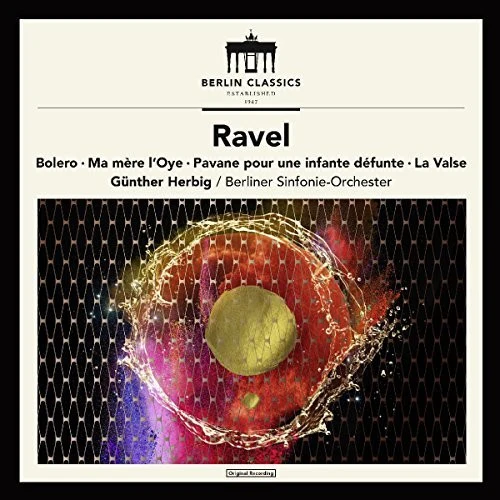
RAVEL: SYMPHONIC WORKS
Günther Herbig knew the Berlin Symphony Orchestra well, even before being made Principal Conductor in 1977 of what is now the Konzerthaus orchestra. He had deputized in that post from 1966 to 1972. Solo flautist Richard Waage, an orchestra member from 1961 to 2002, also valued the work ethic of his Principal Conductor – notably when it came to the execution of solo parts. “With Herbig things were ‘more open’, when you had worked your way into a certain context, than with other conductors. He allowed you more freedom.” On one occasion when he had the opportunity to see Herbig’s conducting score, he was impressed by how every harmonic step was marked, so that the score bore traces of a musicological analysis. Solo flautist Richard Waage, an orchestra member from 1961 to 2002, also valued the work ethic of his Principal Conductor – notably when it came to the execution of solo parts. “With Herbig things were ‘more open’, when you had worked your way into a certain context, than with other conductors. He allowed you more freedom. You could offer more as an individual. I liked that a lot.” On one occasion when he had the opportunity to see Herbig’s conducting score, he was impressed by how every harmonic step was marked, so that the score bore traces of a musicological analysis. “This was the mathematical impulse” characteristic, he judged, of Herbig’s way of working. This architectural, formally structured approach to the music fitted well with the recording technique of those days, which did not allow breakdown into such small steps as today. Arches of tension thus sound more plausible, because there are fewer pieces to put together. “When you have long takes, of course that makes it all more organic,” concludes Richard Waage. It will surely have been these working conditions and the conductor’s specific style that made it possible, even in such an unpretentious piece as the Pavane, “to bring out the character of mourning”, which so moved Jürgen Kögel and other participants. This recording contains Ravel’s symphonic works La Valse, Ma Mère l'Oye, Pavane pour une infante défunte and last but not least the famous Bolero.
Günther Herbig knew the Berlin Symphony Orchestra well, even before being made Principal Conductor in 1977 of what is now the Konzerthaus orchestra. He had deputized in that post from 1966 to 1972. Solo flautist Richard Waage, an orchestra member from 1961 to 2002, also valued the work ethic of his Principal Conductor – notably when it came to the execution of solo parts. “With Herbig things were ‘more open’, when you had worked your way into a certain context, than with other conductors. He allowed you more freedom.” On one occasion when he had the opportunity to see Herbig’s conducting score, he was impressed by how every harmonic step was marked, so that the score bore traces of a musicological analysis. Solo flautist Richard Waage, an orchestra member from 1961 to 2002, also valued the work ethic of his Principal Conductor – notably when it came to the execution of solo parts. “With Herbig things were ‘more open’, when you had worked your way into a certain context, than with other conductors. He allowed you more freedom. You could offer more as an individual. I liked that a lot.” On one occasion when he had the opportunity to see Herbig’s conducting score, he was impressed by how every harmonic step was marked, so that the score bore traces of a musicological analysis. “This was the mathematical impulse” characteristic, he judged, of Herbig’s way of working. This architectural, formally structured approach to the music fitted well with the recording technique of those days, which did not allow breakdown into such small steps as today. Arches of tension thus sound more plausible, because there are fewer pieces to put together. “When you have long takes, of course that makes it all more organic,” concludes Richard Waage. It will surely have been these working conditions and the conductor’s specific style that made it possible, even in such an unpretentious piece as the Pavane, “to bring out the character of mourning”, which so moved Jürgen Kögel and other participants. This recording contains Ravel’s symphonic works La Valse, Ma Mère l'Oye, Pavane pour une infante défunte and last but not least the famous Bolero.
$5.95
Original: $16.99
-65%RAVEL: SYMPHONIC WORKS—
$16.99
$5.95Description
Günther Herbig knew the Berlin Symphony Orchestra well, even before being made Principal Conductor in 1977 of what is now the Konzerthaus orchestra. He had deputized in that post from 1966 to 1972. Solo flautist Richard Waage, an orchestra member from 1961 to 2002, also valued the work ethic of his Principal Conductor – notably when it came to the execution of solo parts. “With Herbig things were ‘more open’, when you had worked your way into a certain context, than with other conductors. He allowed you more freedom.” On one occasion when he had the opportunity to see Herbig’s conducting score, he was impressed by how every harmonic step was marked, so that the score bore traces of a musicological analysis. Solo flautist Richard Waage, an orchestra member from 1961 to 2002, also valued the work ethic of his Principal Conductor – notably when it came to the execution of solo parts. “With Herbig things were ‘more open’, when you had worked your way into a certain context, than with other conductors. He allowed you more freedom. You could offer more as an individual. I liked that a lot.” On one occasion when he had the opportunity to see Herbig’s conducting score, he was impressed by how every harmonic step was marked, so that the score bore traces of a musicological analysis. “This was the mathematical impulse” characteristic, he judged, of Herbig’s way of working. This architectural, formally structured approach to the music fitted well with the recording technique of those days, which did not allow breakdown into such small steps as today. Arches of tension thus sound more plausible, because there are fewer pieces to put together. “When you have long takes, of course that makes it all more organic,” concludes Richard Waage. It will surely have been these working conditions and the conductor’s specific style that made it possible, even in such an unpretentious piece as the Pavane, “to bring out the character of mourning”, which so moved Jürgen Kögel and other participants. This recording contains Ravel’s symphonic works La Valse, Ma Mère l'Oye, Pavane pour une infante défunte and last but not least the famous Bolero.