🎉 Up to 70% Off Selected ItemsShop Sale

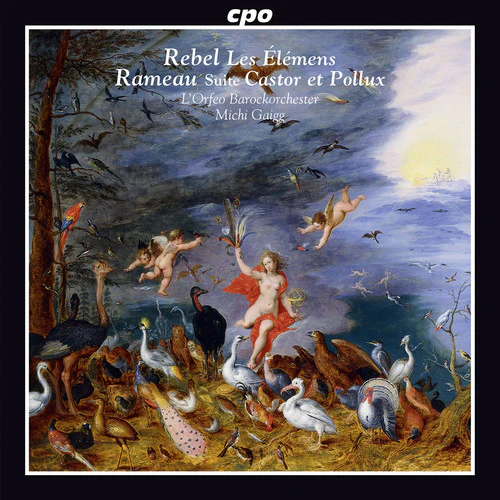
Rebel: Les Elemens Suite; Rameau: Castor et Pollux Suite / Gaigg, L'Orfeo Baroque Orchestra

In 1737 at age 71, after more than four decades serving in numerous positions as a Court violinist, orchestra director, and part-time composer, Jean-Féry Rebel composed his profoundly unique ballet-suite Les élémens (the elements). In his description of the opening movement (included in the notes to Musica Antiqua Köln’s 1995 DG Archiv recording of the work) director/violinist Reinhard Goebel offers a telling assessment as to just how unique, if not important Rebel’s achievement was: “He [Rebel] discarded all formal fetters: neither concerto nor overture, neither sonata nor sinfonia, his ‘Le cahos’ [chaos] is the first free orchestral composition in the history of music, more tone-poem than programme music.”
Indeed, it’s doubtful that anyone new to or even familiar with this remarkable work won’t be shocked (and shocked again) by Rebel’s intention, as he states in his preface to Les élémens, to “dare to undertake to link the idea of the confusion of the elements with that of confusion in harmony”…to depict “Chaos itself, this confusion which reigned between the Elements [earth, air, fire, and water] before the instant when, subject to invariable laws, they took their prescribed place in the order of nature.” Imagine, as Catherine Cessac puts it in her insightful notes to Les Musiciens du Louvre’s 1993 Erato recording, “…a daring ‘cluster’ involving the simultaneous attack of every note in the D minor harmonic scale…”. Of course, by now you realize my point: Rebel’s Les élémens must truly be heard to be believed.
This recent 2014 CPO release featuring L’Orfeo Barockorchester directed by Michi Gaigg was originally issued on Capriccio’s Phoenix Edition in 2008. It’s an excellent performance (that brooding diminuendo and lengthy pause between the initial sustained “cluster” and the remainder of the first movement rivals Musica Antiqua Köln’s intensity) and sometimes quirky, as when the ensemble plays up the wide array of rhythmic and dynamic contrasts for dramatic effect. The tempos by and large are quicker than most, with the exception of the seventh-movement Tambourins where, like The Academy of Ancient Music (L’Oiseau-Lyre), the ensemble favors a more measured pace before gradually gaining momentum near the end. All in all, this is a beautiful and at times spectacular offering.
Rameau’s Castor et Pollux suite also receives an exemplary performance, in some respects bettering my reference recording by Frans Brüggen and the Orchestra of the 18th Century (Philips). Gaigg has better instincts in shaping the suite as a whole, as well as an ability to better draw out instrumental texture and detail (compare their renderings of “Troisième air pour les athlétes” and the “Premier passepied pour les ombres heureuses”, for instance). This makes a nice, fitting choice to conclude the program.
The sound is remarkably good with excellent transparency in the woodwinds, strings, and percussion. Given Les élémens’ relative obscurity, there have been a few wonderful recordings (including a chamber version by the Palladian Ensemble that David Hurwitz favorably reviewed here). The one not to be missed, however, remains the previously mentioned Academy of Ancient Music performance directed by the late period-instrument visionary Christopher Hogwood. It was recorded in 1980, and every performance since that one is still very much indebted to Hogwood’s ground-breaking undertaking. Kudos to CPO for reissuing this worthy successor. Highly recommended.
-- John Greene, ClassicsToday.com
In 1737 at age 71, after more than four decades serving in numerous positions as a Court violinist, orchestra director, and part-time composer, Jean-Féry Rebel composed his profoundly unique ballet-suite Les élémens (the elements). In his description of the opening movement (included in the notes to Musica Antiqua Köln’s 1995 DG Archiv recording of the work) director/violinist Reinhard Goebel offers a telling assessment as to just how unique, if not important Rebel’s achievement was: “He [Rebel] discarded all formal fetters: neither concerto nor overture, neither sonata nor sinfonia, his ‘Le cahos’ [chaos] is the first free orchestral composition in the history of music, more tone-poem than programme music.”
Indeed, it’s doubtful that anyone new to or even familiar with this remarkable work won’t be shocked (and shocked again) by Rebel’s intention, as he states in his preface to Les élémens, to “dare to undertake to link the idea of the confusion of the elements with that of confusion in harmony”…to depict “Chaos itself, this confusion which reigned between the Elements [earth, air, fire, and water] before the instant when, subject to invariable laws, they took their prescribed place in the order of nature.” Imagine, as Catherine Cessac puts it in her insightful notes to Les Musiciens du Louvre’s 1993 Erato recording, “…a daring ‘cluster’ involving the simultaneous attack of every note in the D minor harmonic scale…”. Of course, by now you realize my point: Rebel’s Les élémens must truly be heard to be believed.
This recent 2014 CPO release featuring L’Orfeo Barockorchester directed by Michi Gaigg was originally issued on Capriccio’s Phoenix Edition in 2008. It’s an excellent performance (that brooding diminuendo and lengthy pause between the initial sustained “cluster” and the remainder of the first movement rivals Musica Antiqua Köln’s intensity) and sometimes quirky, as when the ensemble plays up the wide array of rhythmic and dynamic contrasts for dramatic effect. The tempos by and large are quicker than most, with the exception of the seventh-movement Tambourins where, like The Academy of Ancient Music (L’Oiseau-Lyre), the ensemble favors a more measured pace before gradually gaining momentum near the end. All in all, this is a beautiful and at times spectacular offering.
Rameau’s Castor et Pollux suite also receives an exemplary performance, in some respects bettering my reference recording by Frans Brüggen and the Orchestra of the 18th Century (Philips). Gaigg has better instincts in shaping the suite as a whole, as well as an ability to better draw out instrumental texture and detail (compare their renderings of “Troisième air pour les athlétes” and the “Premier passepied pour les ombres heureuses”, for instance). This makes a nice, fitting choice to conclude the program.
The sound is remarkably good with excellent transparency in the woodwinds, strings, and percussion. Given Les élémens’ relative obscurity, there have been a few wonderful recordings (including a chamber version by the Palladian Ensemble that David Hurwitz favorably reviewed here). The one not to be missed, however, remains the previously mentioned Academy of Ancient Music performance directed by the late period-instrument visionary Christopher Hogwood. It was recorded in 1980, and every performance since that one is still very much indebted to Hogwood’s ground-breaking undertaking. Kudos to CPO for reissuing this worthy successor. Highly recommended.
-- John Greene, ClassicsToday.com
$13.99
Rebel: Les Elemens Suite; Rameau: Castor et Pollux Suite / Gaigg, L'Orfeo Baroque Orchestra—
$13.99
Description
In 1737 at age 71, after more than four decades serving in numerous positions as a Court violinist, orchestra director, and part-time composer, Jean-Féry Rebel composed his profoundly unique ballet-suite Les élémens (the elements). In his description of the opening movement (included in the notes to Musica Antiqua Köln’s 1995 DG Archiv recording of the work) director/violinist Reinhard Goebel offers a telling assessment as to just how unique, if not important Rebel’s achievement was: “He [Rebel] discarded all formal fetters: neither concerto nor overture, neither sonata nor sinfonia, his ‘Le cahos’ [chaos] is the first free orchestral composition in the history of music, more tone-poem than programme music.”
Indeed, it’s doubtful that anyone new to or even familiar with this remarkable work won’t be shocked (and shocked again) by Rebel’s intention, as he states in his preface to Les élémens, to “dare to undertake to link the idea of the confusion of the elements with that of confusion in harmony”…to depict “Chaos itself, this confusion which reigned between the Elements [earth, air, fire, and water] before the instant when, subject to invariable laws, they took their prescribed place in the order of nature.” Imagine, as Catherine Cessac puts it in her insightful notes to Les Musiciens du Louvre’s 1993 Erato recording, “…a daring ‘cluster’ involving the simultaneous attack of every note in the D minor harmonic scale…”. Of course, by now you realize my point: Rebel’s Les élémens must truly be heard to be believed.
This recent 2014 CPO release featuring L’Orfeo Barockorchester directed by Michi Gaigg was originally issued on Capriccio’s Phoenix Edition in 2008. It’s an excellent performance (that brooding diminuendo and lengthy pause between the initial sustained “cluster” and the remainder of the first movement rivals Musica Antiqua Köln’s intensity) and sometimes quirky, as when the ensemble plays up the wide array of rhythmic and dynamic contrasts for dramatic effect. The tempos by and large are quicker than most, with the exception of the seventh-movement Tambourins where, like The Academy of Ancient Music (L’Oiseau-Lyre), the ensemble favors a more measured pace before gradually gaining momentum near the end. All in all, this is a beautiful and at times spectacular offering.
Rameau’s Castor et Pollux suite also receives an exemplary performance, in some respects bettering my reference recording by Frans Brüggen and the Orchestra of the 18th Century (Philips). Gaigg has better instincts in shaping the suite as a whole, as well as an ability to better draw out instrumental texture and detail (compare their renderings of “Troisième air pour les athlétes” and the “Premier passepied pour les ombres heureuses”, for instance). This makes a nice, fitting choice to conclude the program.
The sound is remarkably good with excellent transparency in the woodwinds, strings, and percussion. Given Les élémens’ relative obscurity, there have been a few wonderful recordings (including a chamber version by the Palladian Ensemble that David Hurwitz favorably reviewed here). The one not to be missed, however, remains the previously mentioned Academy of Ancient Music performance directed by the late period-instrument visionary Christopher Hogwood. It was recorded in 1980, and every performance since that one is still very much indebted to Hogwood’s ground-breaking undertaking. Kudos to CPO for reissuing this worthy successor. Highly recommended.
-- John Greene, ClassicsToday.com