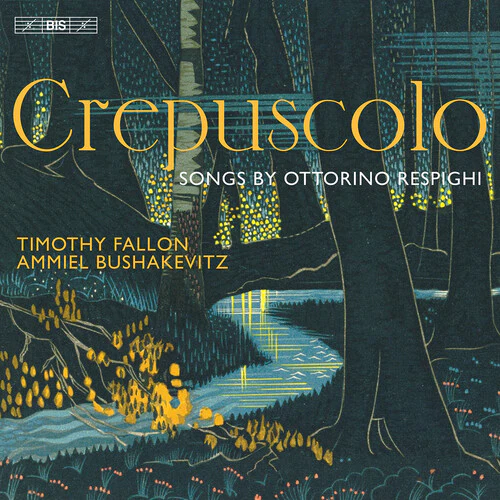
Respighi: Crepuscolo - Songs / Fallon, Bushakev
:"Crepuscolo" is the final song in Ottorino Respighi’s song cycle Deità silvane (‘woodland deities’), but as an album title it also stands for the twilight during the interwar years of everything that Respighi represented, as various trends such as atonality, spiky neoclassicism, and Italian futurism flourished. In reaction to these developments, Respighi in 1932 famously signed a manifesto calling for music with a ‘human content’ – in other words, a continuation of Romanticism. His songs certainly live up to this: as Elsa Respighi, the composer’s wife, once said, it was to his songs that he ‘entrusts his heart’s hidden secrets, when he lets his soul sing freely.’ From L’ultima ebbrezza, composed when Respighi was only 17 years old, to the Four Scottish Songs from 1924, the songs recorded here attest to the variety of his musical interests, influences and styles, and are at turns lyrically operatic, expressionist, impressionist or symbolist. Respighi’s love of the Renaissance is also manifest in the Cinque canti all’antica, settings of poets including Boccaccio.
Timothy Fallon and Ammiel Bushakevitz have previously released a Liszt recital described as ‘superb’ in Gramophone. They have now devised a varied program which takes in three complete groups as well as a selection of individual songs, including Respighi’s most popular songs (Nebbie, Stornellatrice) as well as less well known ones.
REVIEWS:
With every new exposure to Respighi’s vocal music – whether opera or song – I find that his much better-known orchestral works fade in significance, especially with this new cross section of the composer’s songs...this newcomer makes a great case for a single-disc collection thanks to a smart sense of musical variety in the sequencing plus the passionate, elegant performances by lyric tenor Timothy Fallon and his longtime collaborator, pianist Ammiel Bushakevitz.
Fallon is no newcomer...but maintains a youthful sensibility that takes the poems at face value, never looking outside of them, aided by a warm, Italianate tone that lends itself to the musical simplicity of the Scottish folk songs as well as the operatic histrionics of ‘Stornellatrice’ (‘Balladeer’)...Bushakevitz’s sonority and sense of comprehension suggest the lilac-scented, silk-upholstered parlours seen in Luchino Visconti movies, but make such a good case for the more distilled piano versions that, at least for the moment, you wouldn’t want to hear the music any other way.
-- Gramophone
:"Crepuscolo" is the final song in Ottorino Respighi’s song cycle Deità silvane (‘woodland deities’), but as an album title it also stands for the twilight during the interwar years of everything that Respighi represented, as various trends such as atonality, spiky neoclassicism, and Italian futurism flourished. In reaction to these developments, Respighi in 1932 famously signed a manifesto calling for music with a ‘human content’ – in other words, a continuation of Romanticism. His songs certainly live up to this: as Elsa Respighi, the composer’s wife, once said, it was to his songs that he ‘entrusts his heart’s hidden secrets, when he lets his soul sing freely.’ From L’ultima ebbrezza, composed when Respighi was only 17 years old, to the Four Scottish Songs from 1924, the songs recorded here attest to the variety of his musical interests, influences and styles, and are at turns lyrically operatic, expressionist, impressionist or symbolist. Respighi’s love of the Renaissance is also manifest in the Cinque canti all’antica, settings of poets including Boccaccio.
Timothy Fallon and Ammiel Bushakevitz have previously released a Liszt recital described as ‘superb’ in Gramophone. They have now devised a varied program which takes in three complete groups as well as a selection of individual songs, including Respighi’s most popular songs (Nebbie, Stornellatrice) as well as less well known ones.
REVIEWS:
With every new exposure to Respighi’s vocal music – whether opera or song – I find that his much better-known orchestral works fade in significance, especially with this new cross section of the composer’s songs...this newcomer makes a great case for a single-disc collection thanks to a smart sense of musical variety in the sequencing plus the passionate, elegant performances by lyric tenor Timothy Fallon and his longtime collaborator, pianist Ammiel Bushakevitz.
Fallon is no newcomer...but maintains a youthful sensibility that takes the poems at face value, never looking outside of them, aided by a warm, Italianate tone that lends itself to the musical simplicity of the Scottish folk songs as well as the operatic histrionics of ‘Stornellatrice’ (‘Balladeer’)...Bushakevitz’s sonority and sense of comprehension suggest the lilac-scented, silk-upholstered parlours seen in Luchino Visconti movies, but make such a good case for the more distilled piano versions that, at least for the moment, you wouldn’t want to hear the music any other way.
-- Gramophone
Original: $10.99
-65%$10.99
$3.85Description
:"Crepuscolo" is the final song in Ottorino Respighi’s song cycle Deità silvane (‘woodland deities’), but as an album title it also stands for the twilight during the interwar years of everything that Respighi represented, as various trends such as atonality, spiky neoclassicism, and Italian futurism flourished. In reaction to these developments, Respighi in 1932 famously signed a manifesto calling for music with a ‘human content’ – in other words, a continuation of Romanticism. His songs certainly live up to this: as Elsa Respighi, the composer’s wife, once said, it was to his songs that he ‘entrusts his heart’s hidden secrets, when he lets his soul sing freely.’ From L’ultima ebbrezza, composed when Respighi was only 17 years old, to the Four Scottish Songs from 1924, the songs recorded here attest to the variety of his musical interests, influences and styles, and are at turns lyrically operatic, expressionist, impressionist or symbolist. Respighi’s love of the Renaissance is also manifest in the Cinque canti all’antica, settings of poets including Boccaccio.
Timothy Fallon and Ammiel Bushakevitz have previously released a Liszt recital described as ‘superb’ in Gramophone. They have now devised a varied program which takes in three complete groups as well as a selection of individual songs, including Respighi’s most popular songs (Nebbie, Stornellatrice) as well as less well known ones.
REVIEWS:
With every new exposure to Respighi’s vocal music – whether opera or song – I find that his much better-known orchestral works fade in significance, especially with this new cross section of the composer’s songs...this newcomer makes a great case for a single-disc collection thanks to a smart sense of musical variety in the sequencing plus the passionate, elegant performances by lyric tenor Timothy Fallon and his longtime collaborator, pianist Ammiel Bushakevitz.
Fallon is no newcomer...but maintains a youthful sensibility that takes the poems at face value, never looking outside of them, aided by a warm, Italianate tone that lends itself to the musical simplicity of the Scottish folk songs as well as the operatic histrionics of ‘Stornellatrice’ (‘Balladeer’)...Bushakevitz’s sonority and sense of comprehension suggest the lilac-scented, silk-upholstered parlours seen in Luchino Visconti movies, but make such a good case for the more distilled piano versions that, at least for the moment, you wouldn’t want to hear the music any other way.
-- Gramophone