🎉 Up to 70% Off Selected ItemsShop Sale

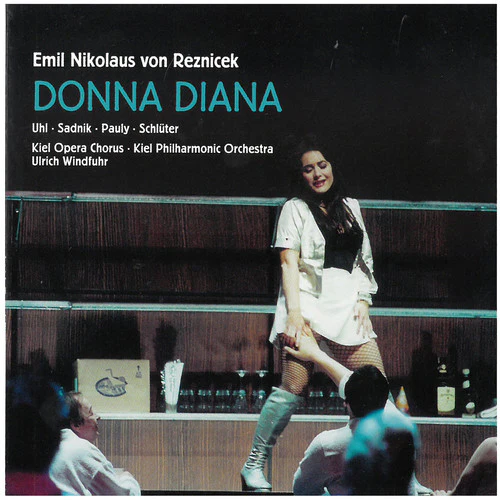
Reznicek: Donna Diana / Windfuhr, Et Al
As I felt when I encountered and reviewed Reznicek's Ritter Blaubart (type Q6627 in Search Reviews), this all-but-hidden composer has a great deal to offer. The overture to Donna Diana is well-known and absolutely charming; Ritter Blaubart surprised me with its darkness and atmospheric gloom. What else does this composer have up his sleeve? Well, hearing the beautifully crafted and well-scored opera that follows its famous overture, a listener can only be amazed. Alternating between the tone of a witty operetta and a grand work in the Wagnerian mold (but with clearly emotive arias and duets that would not be out of place in Italian opera), this story of Donna Diana (daughter of Don Diego) and Don Cesar (a prince), who refuse to acknowledge their mutual love out of sheer arrogance, unfolds with wit, a distinctly Spanish flavor, complex ensembles, plenty of tunes, and never a dull moment. This seems like great theater (it is set against the background of a tournament in Barcelona)--a comic opera whose inhabitants, despite being "types", react the way people react, sometimes howling with rage, sometimes looking gently inward.
Perin--a wonderful role for high baritone--is a wise-fool figure, Don Cesar's friend, who gives advice, puts the play in action, and is more-or-less omnipresent. About a half-hour before the opera's close (the whole work is just short of two hours long) he lets us know that he'd also like a lady friend for himself. He's a delightfully three-dimensional character, and Simon Pauly sings him with remarkable "face" and engaging tone. His duet with Don Cesar near the beginning of the show is splendid, and both he and tenor Roman Sadnik paint indelible portraits of themselves right then and there. The duet, which is grand and grandly orchestrated, ending with a blazing high-C from Sadnik against a slightly too-loud orchestra, sets the tone for the work's forward propulsion and great energy. They and the other players sing off the text brilliantly, and while there are few beautiful voices to be heard, each is distinctive and is used with great theatricality. This live performance really moves.
There are three other pairs of lovers: Don Louis and Donna Laura, Don Gaston and Donna Fenisa, and a surprise in the very sharp Floretta, Diana's foster-sister, who turns out to be just right for Perin. Including Don Diego, then, there are nine characters, and Reznicek writes for them all individually and in ensemble, and always with specificity. The vaguely goofy tone that tends to be present in the comic operas of the earlier Italian composers is entirely missing here, and to very good effect.
The entire cast, well-rehearsed and utterly committed, does itself proud. In addition to Sadnik and Pauly, most impressive is Manuela Uhl as Donna Diana. She captures the girl's haughtiness, while in asides she exhibits a softer side. And as pure singing, she shines as well: in recent recordings of Alfano's Cyrano de Bergerac and Strauss' Die Liebe der Danae she has moments of rawness, but here she seems more frequently at home, and her Moorish Romanza in Act 2 is lovely. Max Wittges has just the commanding bass for Don Diego and mezzo Anne-Carolyn Schlüter presents a self-contained portrait of the standing-back-from-the-crowd Floretta. The rest of the cast, chorus, and Kiel Orchestra--the latter with a brass section any orchestra would be proud of--are polished and should be pleased with their fine work. The sound is excellent despite the intermittent tendency of conductor Ulrich Windfuhr to throw the balance toward the orchestra. It wouldn't surprise me if this recording (and the earlier one of Ritter Blaubart) began a Reznicek rediscovery. Seeing either opera live must be a real treat. [2/8/2005]
--Robert Levine, ClassicsToday.com
Perin--a wonderful role for high baritone--is a wise-fool figure, Don Cesar's friend, who gives advice, puts the play in action, and is more-or-less omnipresent. About a half-hour before the opera's close (the whole work is just short of two hours long) he lets us know that he'd also like a lady friend for himself. He's a delightfully three-dimensional character, and Simon Pauly sings him with remarkable "face" and engaging tone. His duet with Don Cesar near the beginning of the show is splendid, and both he and tenor Roman Sadnik paint indelible portraits of themselves right then and there. The duet, which is grand and grandly orchestrated, ending with a blazing high-C from Sadnik against a slightly too-loud orchestra, sets the tone for the work's forward propulsion and great energy. They and the other players sing off the text brilliantly, and while there are few beautiful voices to be heard, each is distinctive and is used with great theatricality. This live performance really moves.
There are three other pairs of lovers: Don Louis and Donna Laura, Don Gaston and Donna Fenisa, and a surprise in the very sharp Floretta, Diana's foster-sister, who turns out to be just right for Perin. Including Don Diego, then, there are nine characters, and Reznicek writes for them all individually and in ensemble, and always with specificity. The vaguely goofy tone that tends to be present in the comic operas of the earlier Italian composers is entirely missing here, and to very good effect.
The entire cast, well-rehearsed and utterly committed, does itself proud. In addition to Sadnik and Pauly, most impressive is Manuela Uhl as Donna Diana. She captures the girl's haughtiness, while in asides she exhibits a softer side. And as pure singing, she shines as well: in recent recordings of Alfano's Cyrano de Bergerac and Strauss' Die Liebe der Danae she has moments of rawness, but here she seems more frequently at home, and her Moorish Romanza in Act 2 is lovely. Max Wittges has just the commanding bass for Don Diego and mezzo Anne-Carolyn Schlüter presents a self-contained portrait of the standing-back-from-the-crowd Floretta. The rest of the cast, chorus, and Kiel Orchestra--the latter with a brass section any orchestra would be proud of--are polished and should be pleased with their fine work. The sound is excellent despite the intermittent tendency of conductor Ulrich Windfuhr to throw the balance toward the orchestra. It wouldn't surprise me if this recording (and the earlier one of Ritter Blaubart) began a Reznicek rediscovery. Seeing either opera live must be a real treat. [2/8/2005]
--Robert Levine, ClassicsToday.com
As I felt when I encountered and reviewed Reznicek's Ritter Blaubart (type Q6627 in Search Reviews), this all-but-hidden composer has a great deal to offer. The overture to Donna Diana is well-known and absolutely charming; Ritter Blaubart surprised me with its darkness and atmospheric gloom. What else does this composer have up his sleeve? Well, hearing the beautifully crafted and well-scored opera that follows its famous overture, a listener can only be amazed. Alternating between the tone of a witty operetta and a grand work in the Wagnerian mold (but with clearly emotive arias and duets that would not be out of place in Italian opera), this story of Donna Diana (daughter of Don Diego) and Don Cesar (a prince), who refuse to acknowledge their mutual love out of sheer arrogance, unfolds with wit, a distinctly Spanish flavor, complex ensembles, plenty of tunes, and never a dull moment. This seems like great theater (it is set against the background of a tournament in Barcelona)--a comic opera whose inhabitants, despite being "types", react the way people react, sometimes howling with rage, sometimes looking gently inward.
Perin--a wonderful role for high baritone--is a wise-fool figure, Don Cesar's friend, who gives advice, puts the play in action, and is more-or-less omnipresent. About a half-hour before the opera's close (the whole work is just short of two hours long) he lets us know that he'd also like a lady friend for himself. He's a delightfully three-dimensional character, and Simon Pauly sings him with remarkable "face" and engaging tone. His duet with Don Cesar near the beginning of the show is splendid, and both he and tenor Roman Sadnik paint indelible portraits of themselves right then and there. The duet, which is grand and grandly orchestrated, ending with a blazing high-C from Sadnik against a slightly too-loud orchestra, sets the tone for the work's forward propulsion and great energy. They and the other players sing off the text brilliantly, and while there are few beautiful voices to be heard, each is distinctive and is used with great theatricality. This live performance really moves.
There are three other pairs of lovers: Don Louis and Donna Laura, Don Gaston and Donna Fenisa, and a surprise in the very sharp Floretta, Diana's foster-sister, who turns out to be just right for Perin. Including Don Diego, then, there are nine characters, and Reznicek writes for them all individually and in ensemble, and always with specificity. The vaguely goofy tone that tends to be present in the comic operas of the earlier Italian composers is entirely missing here, and to very good effect.
The entire cast, well-rehearsed and utterly committed, does itself proud. In addition to Sadnik and Pauly, most impressive is Manuela Uhl as Donna Diana. She captures the girl's haughtiness, while in asides she exhibits a softer side. And as pure singing, she shines as well: in recent recordings of Alfano's Cyrano de Bergerac and Strauss' Die Liebe der Danae she has moments of rawness, but here she seems more frequently at home, and her Moorish Romanza in Act 2 is lovely. Max Wittges has just the commanding bass for Don Diego and mezzo Anne-Carolyn Schlüter presents a self-contained portrait of the standing-back-from-the-crowd Floretta. The rest of the cast, chorus, and Kiel Orchestra--the latter with a brass section any orchestra would be proud of--are polished and should be pleased with their fine work. The sound is excellent despite the intermittent tendency of conductor Ulrich Windfuhr to throw the balance toward the orchestra. It wouldn't surprise me if this recording (and the earlier one of Ritter Blaubart) began a Reznicek rediscovery. Seeing either opera live must be a real treat. [2/8/2005]
--Robert Levine, ClassicsToday.com
Perin--a wonderful role for high baritone--is a wise-fool figure, Don Cesar's friend, who gives advice, puts the play in action, and is more-or-less omnipresent. About a half-hour before the opera's close (the whole work is just short of two hours long) he lets us know that he'd also like a lady friend for himself. He's a delightfully three-dimensional character, and Simon Pauly sings him with remarkable "face" and engaging tone. His duet with Don Cesar near the beginning of the show is splendid, and both he and tenor Roman Sadnik paint indelible portraits of themselves right then and there. The duet, which is grand and grandly orchestrated, ending with a blazing high-C from Sadnik against a slightly too-loud orchestra, sets the tone for the work's forward propulsion and great energy. They and the other players sing off the text brilliantly, and while there are few beautiful voices to be heard, each is distinctive and is used with great theatricality. This live performance really moves.
There are three other pairs of lovers: Don Louis and Donna Laura, Don Gaston and Donna Fenisa, and a surprise in the very sharp Floretta, Diana's foster-sister, who turns out to be just right for Perin. Including Don Diego, then, there are nine characters, and Reznicek writes for them all individually and in ensemble, and always with specificity. The vaguely goofy tone that tends to be present in the comic operas of the earlier Italian composers is entirely missing here, and to very good effect.
The entire cast, well-rehearsed and utterly committed, does itself proud. In addition to Sadnik and Pauly, most impressive is Manuela Uhl as Donna Diana. She captures the girl's haughtiness, while in asides she exhibits a softer side. And as pure singing, she shines as well: in recent recordings of Alfano's Cyrano de Bergerac and Strauss' Die Liebe der Danae she has moments of rawness, but here she seems more frequently at home, and her Moorish Romanza in Act 2 is lovely. Max Wittges has just the commanding bass for Don Diego and mezzo Anne-Carolyn Schlüter presents a self-contained portrait of the standing-back-from-the-crowd Floretta. The rest of the cast, chorus, and Kiel Orchestra--the latter with a brass section any orchestra would be proud of--are polished and should be pleased with their fine work. The sound is excellent despite the intermittent tendency of conductor Ulrich Windfuhr to throw the balance toward the orchestra. It wouldn't surprise me if this recording (and the earlier one of Ritter Blaubart) began a Reznicek rediscovery. Seeing either opera live must be a real treat. [2/8/2005]
--Robert Levine, ClassicsToday.com
$12.95
Original: $36.99
-65%Reznicek: Donna Diana / Windfuhr, Et Al—
$36.99
$12.95Description
As I felt when I encountered and reviewed Reznicek's Ritter Blaubart (type Q6627 in Search Reviews), this all-but-hidden composer has a great deal to offer. The overture to Donna Diana is well-known and absolutely charming; Ritter Blaubart surprised me with its darkness and atmospheric gloom. What else does this composer have up his sleeve? Well, hearing the beautifully crafted and well-scored opera that follows its famous overture, a listener can only be amazed. Alternating between the tone of a witty operetta and a grand work in the Wagnerian mold (but with clearly emotive arias and duets that would not be out of place in Italian opera), this story of Donna Diana (daughter of Don Diego) and Don Cesar (a prince), who refuse to acknowledge their mutual love out of sheer arrogance, unfolds with wit, a distinctly Spanish flavor, complex ensembles, plenty of tunes, and never a dull moment. This seems like great theater (it is set against the background of a tournament in Barcelona)--a comic opera whose inhabitants, despite being "types", react the way people react, sometimes howling with rage, sometimes looking gently inward.
Perin--a wonderful role for high baritone--is a wise-fool figure, Don Cesar's friend, who gives advice, puts the play in action, and is more-or-less omnipresent. About a half-hour before the opera's close (the whole work is just short of two hours long) he lets us know that he'd also like a lady friend for himself. He's a delightfully three-dimensional character, and Simon Pauly sings him with remarkable "face" and engaging tone. His duet with Don Cesar near the beginning of the show is splendid, and both he and tenor Roman Sadnik paint indelible portraits of themselves right then and there. The duet, which is grand and grandly orchestrated, ending with a blazing high-C from Sadnik against a slightly too-loud orchestra, sets the tone for the work's forward propulsion and great energy. They and the other players sing off the text brilliantly, and while there are few beautiful voices to be heard, each is distinctive and is used with great theatricality. This live performance really moves.
There are three other pairs of lovers: Don Louis and Donna Laura, Don Gaston and Donna Fenisa, and a surprise in the very sharp Floretta, Diana's foster-sister, who turns out to be just right for Perin. Including Don Diego, then, there are nine characters, and Reznicek writes for them all individually and in ensemble, and always with specificity. The vaguely goofy tone that tends to be present in the comic operas of the earlier Italian composers is entirely missing here, and to very good effect.
The entire cast, well-rehearsed and utterly committed, does itself proud. In addition to Sadnik and Pauly, most impressive is Manuela Uhl as Donna Diana. She captures the girl's haughtiness, while in asides she exhibits a softer side. And as pure singing, she shines as well: in recent recordings of Alfano's Cyrano de Bergerac and Strauss' Die Liebe der Danae she has moments of rawness, but here she seems more frequently at home, and her Moorish Romanza in Act 2 is lovely. Max Wittges has just the commanding bass for Don Diego and mezzo Anne-Carolyn Schlüter presents a self-contained portrait of the standing-back-from-the-crowd Floretta. The rest of the cast, chorus, and Kiel Orchestra--the latter with a brass section any orchestra would be proud of--are polished and should be pleased with their fine work. The sound is excellent despite the intermittent tendency of conductor Ulrich Windfuhr to throw the balance toward the orchestra. It wouldn't surprise me if this recording (and the earlier one of Ritter Blaubart) began a Reznicek rediscovery. Seeing either opera live must be a real treat. [2/8/2005]
--Robert Levine, ClassicsToday.com
Perin--a wonderful role for high baritone--is a wise-fool figure, Don Cesar's friend, who gives advice, puts the play in action, and is more-or-less omnipresent. About a half-hour before the opera's close (the whole work is just short of two hours long) he lets us know that he'd also like a lady friend for himself. He's a delightfully three-dimensional character, and Simon Pauly sings him with remarkable "face" and engaging tone. His duet with Don Cesar near the beginning of the show is splendid, and both he and tenor Roman Sadnik paint indelible portraits of themselves right then and there. The duet, which is grand and grandly orchestrated, ending with a blazing high-C from Sadnik against a slightly too-loud orchestra, sets the tone for the work's forward propulsion and great energy. They and the other players sing off the text brilliantly, and while there are few beautiful voices to be heard, each is distinctive and is used with great theatricality. This live performance really moves.
There are three other pairs of lovers: Don Louis and Donna Laura, Don Gaston and Donna Fenisa, and a surprise in the very sharp Floretta, Diana's foster-sister, who turns out to be just right for Perin. Including Don Diego, then, there are nine characters, and Reznicek writes for them all individually and in ensemble, and always with specificity. The vaguely goofy tone that tends to be present in the comic operas of the earlier Italian composers is entirely missing here, and to very good effect.
The entire cast, well-rehearsed and utterly committed, does itself proud. In addition to Sadnik and Pauly, most impressive is Manuela Uhl as Donna Diana. She captures the girl's haughtiness, while in asides she exhibits a softer side. And as pure singing, she shines as well: in recent recordings of Alfano's Cyrano de Bergerac and Strauss' Die Liebe der Danae she has moments of rawness, but here she seems more frequently at home, and her Moorish Romanza in Act 2 is lovely. Max Wittges has just the commanding bass for Don Diego and mezzo Anne-Carolyn Schlüter presents a self-contained portrait of the standing-back-from-the-crowd Floretta. The rest of the cast, chorus, and Kiel Orchestra--the latter with a brass section any orchestra would be proud of--are polished and should be pleased with their fine work. The sound is excellent despite the intermittent tendency of conductor Ulrich Windfuhr to throw the balance toward the orchestra. It wouldn't surprise me if this recording (and the earlier one of Ritter Blaubart) began a Reznicek rediscovery. Seeing either opera live must be a real treat. [2/8/2005]
--Robert Levine, ClassicsToday.com