🎉 Up to 70% Off Selected ItemsShop Sale

1 / 2
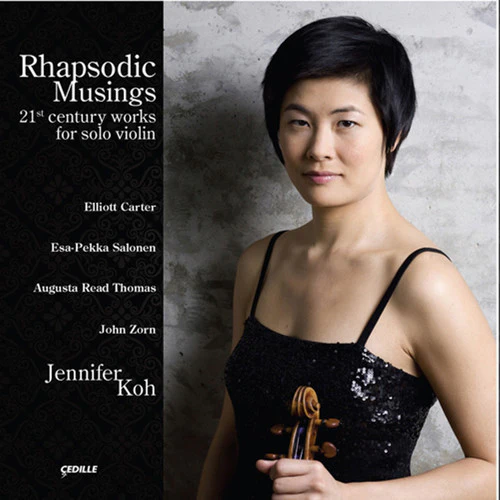
Rhapsodic Musings / Jennifer Koh
RHAPSODIC MUSINGS • Jennifer Koh (vn) • ÇEDILLE 113 (52:00)
SALONEN Lachen Verlernt. CARTER Four Lauds. THOMAS Pulsar. ZORN Goetia
& A video by Tal Rosner
Rumor has it that there’s a big chunk of the classical music listening public that is afraid of contemporary music. When it’s played with the passion and conviction that violinist Jennifer Koh generates on behalf of these three 21st-century scores (not excluding Elliott Carter’s Four Lauds , which were composed between 1984 and 2000), the skeptics have nothing to fear. She displays impeccable technique and a flawless tonal range regardless of their degree of difficulty, and more important, uncovers the lyrical impulse at the music’s core.
Even so, I think the disc’s title, borrowed from Carter, understates the nature of the music somewhat. None of these works quite suit the state of absorption in thought or dreamy abstraction that my dictionary applies to musing, though rhapsodic they may be. True, Augusta Read Thomas’s Pulsar does resolve its dramatic thrusts, swoops, and soaring with a meditative conclusion. And Carter’s Four Lauds —“Statement—Remembering Aaron” (Copland), “Riconoscenza per Goffredo Petrassi,” “Rhapsodic Musings,” and “Fantasy”—maintain recognizable classical proportions amid their flamboyant gestures. Esa-Pekka Salonen’s Lachen Verlernt takes its title from a line in Albert Giraud’s sequence of poems, Pierrot Lunaire (in Otto Hartleben’s German translation from the original French, “Mein Lachen/Hab ich verlernt!”—I have unlearned [or forgotten] all my laughter!). The music, however, owes nothing to Schoenberg as it accelerates, chaconne-like, from an introductory lament to a fantasia of impulsive double-stops and sizzling twists of phrase. (Tal Rosner’s accompanying CD-ROM video of geometric and graphically altered imagery choreographed to Lachen Verlernt is a pleasant but extraneous bonus.)
The eight movements of John Zorn’s Goetia provide—perhaps predictably, given his participation in free jazz, thrash rock, and other extravagant musical genres—the most aggressive events and make the most treacherous technical demands on the violinist. The title is derived from the Greek word for sorcery, and relates to the Middle Ages practice of conjuring demons through elaborate spells and numerological systems. In this case, Zorn has devised a sequence of 277 pitches that remain the same in each movement, but whose character changes according to shifts in phrasing, tempo, dynamics, and attack. But, as program booklet annotator Paul Griffiths suggests, the bristling pizzicatos, slashing multi-stops, and moto perpetuo passages, for all their “demonic” intensity, may simply remind us of how the fiddle has long been identified as the devil’s own instrument.
Jennifer Koh is a hell of a violinist (sorry, couldn’t resist), and this is a most impressive recital.
FANFARE: Art Lange
RHAPSODIC MUSINGS • Jennifer Koh (vn) • ÇEDILLE 113 (52:00)
SALONEN Lachen Verlernt. CARTER Four Lauds. THOMAS Pulsar. ZORN Goetia
& A video by Tal Rosner
Rumor has it that there’s a big chunk of the classical music listening public that is afraid of contemporary music. When it’s played with the passion and conviction that violinist Jennifer Koh generates on behalf of these three 21st-century scores (not excluding Elliott Carter’s Four Lauds , which were composed between 1984 and 2000), the skeptics have nothing to fear. She displays impeccable technique and a flawless tonal range regardless of their degree of difficulty, and more important, uncovers the lyrical impulse at the music’s core.
Even so, I think the disc’s title, borrowed from Carter, understates the nature of the music somewhat. None of these works quite suit the state of absorption in thought or dreamy abstraction that my dictionary applies to musing, though rhapsodic they may be. True, Augusta Read Thomas’s Pulsar does resolve its dramatic thrusts, swoops, and soaring with a meditative conclusion. And Carter’s Four Lauds —“Statement—Remembering Aaron” (Copland), “Riconoscenza per Goffredo Petrassi,” “Rhapsodic Musings,” and “Fantasy”—maintain recognizable classical proportions amid their flamboyant gestures. Esa-Pekka Salonen’s Lachen Verlernt takes its title from a line in Albert Giraud’s sequence of poems, Pierrot Lunaire (in Otto Hartleben’s German translation from the original French, “Mein Lachen/Hab ich verlernt!”—I have unlearned [or forgotten] all my laughter!). The music, however, owes nothing to Schoenberg as it accelerates, chaconne-like, from an introductory lament to a fantasia of impulsive double-stops and sizzling twists of phrase. (Tal Rosner’s accompanying CD-ROM video of geometric and graphically altered imagery choreographed to Lachen Verlernt is a pleasant but extraneous bonus.)
The eight movements of John Zorn’s Goetia provide—perhaps predictably, given his participation in free jazz, thrash rock, and other extravagant musical genres—the most aggressive events and make the most treacherous technical demands on the violinist. The title is derived from the Greek word for sorcery, and relates to the Middle Ages practice of conjuring demons through elaborate spells and numerological systems. In this case, Zorn has devised a sequence of 277 pitches that remain the same in each movement, but whose character changes according to shifts in phrasing, tempo, dynamics, and attack. But, as program booklet annotator Paul Griffiths suggests, the bristling pizzicatos, slashing multi-stops, and moto perpetuo passages, for all their “demonic” intensity, may simply remind us of how the fiddle has long been identified as the devil’s own instrument.
Jennifer Koh is a hell of a violinist (sorry, couldn’t resist), and this is a most impressive recital.
FANFARE: Art Lange
$7.00
Original: $19.99
-65%Rhapsodic Musings / Jennifer Koh—
$19.99
$7.00Description
RHAPSODIC MUSINGS • Jennifer Koh (vn) • ÇEDILLE 113 (52:00)
SALONEN Lachen Verlernt. CARTER Four Lauds. THOMAS Pulsar. ZORN Goetia
& A video by Tal Rosner
Rumor has it that there’s a big chunk of the classical music listening public that is afraid of contemporary music. When it’s played with the passion and conviction that violinist Jennifer Koh generates on behalf of these three 21st-century scores (not excluding Elliott Carter’s Four Lauds , which were composed between 1984 and 2000), the skeptics have nothing to fear. She displays impeccable technique and a flawless tonal range regardless of their degree of difficulty, and more important, uncovers the lyrical impulse at the music’s core.
Even so, I think the disc’s title, borrowed from Carter, understates the nature of the music somewhat. None of these works quite suit the state of absorption in thought or dreamy abstraction that my dictionary applies to musing, though rhapsodic they may be. True, Augusta Read Thomas’s Pulsar does resolve its dramatic thrusts, swoops, and soaring with a meditative conclusion. And Carter’s Four Lauds —“Statement—Remembering Aaron” (Copland), “Riconoscenza per Goffredo Petrassi,” “Rhapsodic Musings,” and “Fantasy”—maintain recognizable classical proportions amid their flamboyant gestures. Esa-Pekka Salonen’s Lachen Verlernt takes its title from a line in Albert Giraud’s sequence of poems, Pierrot Lunaire (in Otto Hartleben’s German translation from the original French, “Mein Lachen/Hab ich verlernt!”—I have unlearned [or forgotten] all my laughter!). The music, however, owes nothing to Schoenberg as it accelerates, chaconne-like, from an introductory lament to a fantasia of impulsive double-stops and sizzling twists of phrase. (Tal Rosner’s accompanying CD-ROM video of geometric and graphically altered imagery choreographed to Lachen Verlernt is a pleasant but extraneous bonus.)
The eight movements of John Zorn’s Goetia provide—perhaps predictably, given his participation in free jazz, thrash rock, and other extravagant musical genres—the most aggressive events and make the most treacherous technical demands on the violinist. The title is derived from the Greek word for sorcery, and relates to the Middle Ages practice of conjuring demons through elaborate spells and numerological systems. In this case, Zorn has devised a sequence of 277 pitches that remain the same in each movement, but whose character changes according to shifts in phrasing, tempo, dynamics, and attack. But, as program booklet annotator Paul Griffiths suggests, the bristling pizzicatos, slashing multi-stops, and moto perpetuo passages, for all their “demonic” intensity, may simply remind us of how the fiddle has long been identified as the devil’s own instrument.
Jennifer Koh is a hell of a violinist (sorry, couldn’t resist), and this is a most impressive recital.
FANFARE: Art Lange