🎉 Up to 70% Off Selected ItemsShop Sale

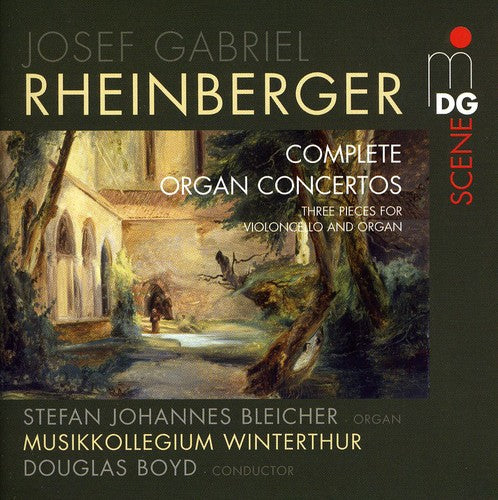
Rheinberger: Complete Organ Concertos / Stefan Johannes Bleicher
RHEINBERGER Organ Concertos: No. 1 in F; No. 2 in g. 3 Pieces for Cello and Organ • Stefan Johannes Bleicher (org); Douglas Boyd, cond; Musikkollegium Winterthur; Cäcilia Chmel (vc) • MDG 1643 (SACD: 57:58)
Josef Rheinberger (1839–1901) is frequently named alongside Max Bruch, Karl Goldmark, Robert Fuchs, and Carl Reinecke when mention is made of late 19th- to early 20th-century German Romantic composers who cultivated an essentially conservative style influenced by the Mendelssohn-Schumann-Brahms-Joachim axis. Budding composers from abroad, including America, flocked to Germany to study under these men and to have bestowed upon them the mantle of a proper German pedigree. In Leipzig, Reinecke could claim Grieg, Sinding, Svendsen, Janá?ek, and Weingartner among his students; while in Munich, Rheinberger could name Humperdinck, Parker, Chadwick, Wolf-Ferrari, Thuille, and Furtwängler among those he instructed.
Rheinberger’s instrument was the organ, a fact that’s hard to ignore based on his vast output in which the organ plays a dominant role. Yet, in his entire voluminous catalog—the solo organ pieces alone occupy 12 CDs—the two concertos on this disc are the only concerted works I’m aware of that he wrote for organ and orchestra. The mind leaps immediately to the similar compositions by Rheinberger’s French contemporaries Widor and Guilmant, but the reality is that Rheinberger’s concertos are in a more classical mold and of a thematic content somewhat similar to the chorale-like melodic and harmonic manner of Saint-Saëns. Oddly, as well, there are not a few passages that seem to anticipate the sort of ceremonial hubbub and pageantry one hears in Elgar’s soon-to-be pomp and circumstance mode. Rheinberger’s concertos, however, predate the earliest of Elgar’s coronation marches by 17 and seven years, respectively.
The Concerto No. 1, dated 1884, two years before Saint-Saëns’s brilliant “Organ” Symphony, is modestly orchestrated for three horns (or two horns and bassoon) and strings, with the organ filling in for the absent winds. Scoring in the Concerto No. 2 of 10 years later isn’t much augmented, but to the earlier ensemble Rheinberger adds two trumpets and timpani, so that the organ must still furnish the sonorities that would ordinarily be supplied by flutes, oboes, and clarinets. If the Second Concerto finds its voice somewhere between Saint-Saëns and Elgar, the First Concerto reaches a bit further back, perhaps to Mendelssohn and Schumann.
These are not hard works to like. They’re tuneful, spirited, and engaging enough that one doesn’t miss the fuller symphonic approach that Saint-Saëns took to the orchestra or the more variegated splashes of color Widor and Guilmant drew from their Cavaillé-Coll and French organs.
There are two or three more recordings of these works available than I find reviewed in the Fanfare Archive. In 23:6, John Bauman covered a Classico release featuring organist Ulrik Spang-Hansen with the Chamber Philharmonic of Bohemia led by Douglas Bostock; while in 28:5, James Reel readdressed a Capriccio recording that had originally been reviewed in 16:2 and was recycled in SACD format with the rear channels presumably artificially processed. That disc featured organist Andreas Juffinger with Harmut Haenchen conducting the Berlin RSO. Not reviewed, as far as I can tell, are recordings by Ulrich Meldau with Daniel Schweizer presiding over the Zurich Symphony Orchestra on the Motette label, and a more recent Naxos version by organist Paul Skevington with Timothy Rowe leading the Amadeus Chamber Ensemble. Of these several editions, the only one I have for comparison purposes is the Juffinger in its “enhanced” SACD incarnation.
The Capriccio booklet has nothing to say about the organ, though the recording was made in Berlin’s Jesus-Christus-Kirche, so I assume the instrument to be of German, Swiss, or Dutch pedigree, but for the concertos the new MDG recording is to be preferred. Newly recorded in February 2010, the disc is in true surround format. Full-page specifications are given on Winterthur’s historic Stadrkirche organ built by E. F. Walcker in 1887–88 and restored in 1980–84 by the Swiss firm currently doing business as Kuhn Organ Builders, Ltd. And MDG’s Bleiche and Boyd are considerably more animated than Capriccio’s Juffinger and Haenchen in every movement of both concertos, delivering performances that are crisply articulated and in which the organ and orchestra are beautifully integrated.
MDG’s bonus is three pieces— Abendlied, Pastorale, and Elegie —Rheinberger transcribed for cello and organ from a set of six pieces he’d originally written for violin and organ at the dual requests of church organist Johann Georg Herzog and the composer’s publisher, August Robert Froberg. Adagio meditation-type pieces for a solo string instrument accompanied by organ were rarities, if indeed they existed at all at the time. Rheinberger’s contributions are exactly what you would expect—the musical equivalent of votive candles flickering in the transepts. Cellist Cäcilia Chmel plays prayerfully enough, but the angels remain frozen in their friezes, unmoved by Rheinberger’s entreaties.
Definitely recommended for enjoyable, if not great, music, fine performances, and superb recording. I will not, however, be throwing away my Juffinger and Haenchen on Capriccio for the simple reason that it includes Rheinberger’s Suite for Violin and Organ, op. 166, a lovely neobaroquish affair that echoes with distant strains of Bach, Handel, and Corelli, and is a more substantial and preferable alternative to the three cello pieces on the current disc.
FANFARE: Jerry Dubins
RHEINBERGER Organ Concertos: No. 1 in F; No. 2 in g. 3 Pieces for Cello and Organ • Stefan Johannes Bleicher (org); Douglas Boyd, cond; Musikkollegium Winterthur; Cäcilia Chmel (vc) • MDG 1643 (SACD: 57:58)
Josef Rheinberger (1839–1901) is frequently named alongside Max Bruch, Karl Goldmark, Robert Fuchs, and Carl Reinecke when mention is made of late 19th- to early 20th-century German Romantic composers who cultivated an essentially conservative style influenced by the Mendelssohn-Schumann-Brahms-Joachim axis. Budding composers from abroad, including America, flocked to Germany to study under these men and to have bestowed upon them the mantle of a proper German pedigree. In Leipzig, Reinecke could claim Grieg, Sinding, Svendsen, Janá?ek, and Weingartner among his students; while in Munich, Rheinberger could name Humperdinck, Parker, Chadwick, Wolf-Ferrari, Thuille, and Furtwängler among those he instructed.
Rheinberger’s instrument was the organ, a fact that’s hard to ignore based on his vast output in which the organ plays a dominant role. Yet, in his entire voluminous catalog—the solo organ pieces alone occupy 12 CDs—the two concertos on this disc are the only concerted works I’m aware of that he wrote for organ and orchestra. The mind leaps immediately to the similar compositions by Rheinberger’s French contemporaries Widor and Guilmant, but the reality is that Rheinberger’s concertos are in a more classical mold and of a thematic content somewhat similar to the chorale-like melodic and harmonic manner of Saint-Saëns. Oddly, as well, there are not a few passages that seem to anticipate the sort of ceremonial hubbub and pageantry one hears in Elgar’s soon-to-be pomp and circumstance mode. Rheinberger’s concertos, however, predate the earliest of Elgar’s coronation marches by 17 and seven years, respectively.
The Concerto No. 1, dated 1884, two years before Saint-Saëns’s brilliant “Organ” Symphony, is modestly orchestrated for three horns (or two horns and bassoon) and strings, with the organ filling in for the absent winds. Scoring in the Concerto No. 2 of 10 years later isn’t much augmented, but to the earlier ensemble Rheinberger adds two trumpets and timpani, so that the organ must still furnish the sonorities that would ordinarily be supplied by flutes, oboes, and clarinets. If the Second Concerto finds its voice somewhere between Saint-Saëns and Elgar, the First Concerto reaches a bit further back, perhaps to Mendelssohn and Schumann.
These are not hard works to like. They’re tuneful, spirited, and engaging enough that one doesn’t miss the fuller symphonic approach that Saint-Saëns took to the orchestra or the more variegated splashes of color Widor and Guilmant drew from their Cavaillé-Coll and French organs.
There are two or three more recordings of these works available than I find reviewed in the Fanfare Archive. In 23:6, John Bauman covered a Classico release featuring organist Ulrik Spang-Hansen with the Chamber Philharmonic of Bohemia led by Douglas Bostock; while in 28:5, James Reel readdressed a Capriccio recording that had originally been reviewed in 16:2 and was recycled in SACD format with the rear channels presumably artificially processed. That disc featured organist Andreas Juffinger with Harmut Haenchen conducting the Berlin RSO. Not reviewed, as far as I can tell, are recordings by Ulrich Meldau with Daniel Schweizer presiding over the Zurich Symphony Orchestra on the Motette label, and a more recent Naxos version by organist Paul Skevington with Timothy Rowe leading the Amadeus Chamber Ensemble. Of these several editions, the only one I have for comparison purposes is the Juffinger in its “enhanced” SACD incarnation.
The Capriccio booklet has nothing to say about the organ, though the recording was made in Berlin’s Jesus-Christus-Kirche, so I assume the instrument to be of German, Swiss, or Dutch pedigree, but for the concertos the new MDG recording is to be preferred. Newly recorded in February 2010, the disc is in true surround format. Full-page specifications are given on Winterthur’s historic Stadrkirche organ built by E. F. Walcker in 1887–88 and restored in 1980–84 by the Swiss firm currently doing business as Kuhn Organ Builders, Ltd. And MDG’s Bleiche and Boyd are considerably more animated than Capriccio’s Juffinger and Haenchen in every movement of both concertos, delivering performances that are crisply articulated and in which the organ and orchestra are beautifully integrated.
MDG’s bonus is three pieces— Abendlied, Pastorale, and Elegie —Rheinberger transcribed for cello and organ from a set of six pieces he’d originally written for violin and organ at the dual requests of church organist Johann Georg Herzog and the composer’s publisher, August Robert Froberg. Adagio meditation-type pieces for a solo string instrument accompanied by organ were rarities, if indeed they existed at all at the time. Rheinberger’s contributions are exactly what you would expect—the musical equivalent of votive candles flickering in the transepts. Cellist Cäcilia Chmel plays prayerfully enough, but the angels remain frozen in their friezes, unmoved by Rheinberger’s entreaties.
Definitely recommended for enjoyable, if not great, music, fine performances, and superb recording. I will not, however, be throwing away my Juffinger and Haenchen on Capriccio for the simple reason that it includes Rheinberger’s Suite for Violin and Organ, op. 166, a lovely neobaroquish affair that echoes with distant strains of Bach, Handel, and Corelli, and is a more substantial and preferable alternative to the three cello pieces on the current disc.
FANFARE: Jerry Dubins
$8.75
Original: $24.99
-65%Rheinberger: Complete Organ Concertos / Stefan Johannes Bleicher—
$24.99
$8.75Description
RHEINBERGER Organ Concertos: No. 1 in F; No. 2 in g. 3 Pieces for Cello and Organ • Stefan Johannes Bleicher (org); Douglas Boyd, cond; Musikkollegium Winterthur; Cäcilia Chmel (vc) • MDG 1643 (SACD: 57:58)
Josef Rheinberger (1839–1901) is frequently named alongside Max Bruch, Karl Goldmark, Robert Fuchs, and Carl Reinecke when mention is made of late 19th- to early 20th-century German Romantic composers who cultivated an essentially conservative style influenced by the Mendelssohn-Schumann-Brahms-Joachim axis. Budding composers from abroad, including America, flocked to Germany to study under these men and to have bestowed upon them the mantle of a proper German pedigree. In Leipzig, Reinecke could claim Grieg, Sinding, Svendsen, Janá?ek, and Weingartner among his students; while in Munich, Rheinberger could name Humperdinck, Parker, Chadwick, Wolf-Ferrari, Thuille, and Furtwängler among those he instructed.
Rheinberger’s instrument was the organ, a fact that’s hard to ignore based on his vast output in which the organ plays a dominant role. Yet, in his entire voluminous catalog—the solo organ pieces alone occupy 12 CDs—the two concertos on this disc are the only concerted works I’m aware of that he wrote for organ and orchestra. The mind leaps immediately to the similar compositions by Rheinberger’s French contemporaries Widor and Guilmant, but the reality is that Rheinberger’s concertos are in a more classical mold and of a thematic content somewhat similar to the chorale-like melodic and harmonic manner of Saint-Saëns. Oddly, as well, there are not a few passages that seem to anticipate the sort of ceremonial hubbub and pageantry one hears in Elgar’s soon-to-be pomp and circumstance mode. Rheinberger’s concertos, however, predate the earliest of Elgar’s coronation marches by 17 and seven years, respectively.
The Concerto No. 1, dated 1884, two years before Saint-Saëns’s brilliant “Organ” Symphony, is modestly orchestrated for three horns (or two horns and bassoon) and strings, with the organ filling in for the absent winds. Scoring in the Concerto No. 2 of 10 years later isn’t much augmented, but to the earlier ensemble Rheinberger adds two trumpets and timpani, so that the organ must still furnish the sonorities that would ordinarily be supplied by flutes, oboes, and clarinets. If the Second Concerto finds its voice somewhere between Saint-Saëns and Elgar, the First Concerto reaches a bit further back, perhaps to Mendelssohn and Schumann.
These are not hard works to like. They’re tuneful, spirited, and engaging enough that one doesn’t miss the fuller symphonic approach that Saint-Saëns took to the orchestra or the more variegated splashes of color Widor and Guilmant drew from their Cavaillé-Coll and French organs.
There are two or three more recordings of these works available than I find reviewed in the Fanfare Archive. In 23:6, John Bauman covered a Classico release featuring organist Ulrik Spang-Hansen with the Chamber Philharmonic of Bohemia led by Douglas Bostock; while in 28:5, James Reel readdressed a Capriccio recording that had originally been reviewed in 16:2 and was recycled in SACD format with the rear channels presumably artificially processed. That disc featured organist Andreas Juffinger with Harmut Haenchen conducting the Berlin RSO. Not reviewed, as far as I can tell, are recordings by Ulrich Meldau with Daniel Schweizer presiding over the Zurich Symphony Orchestra on the Motette label, and a more recent Naxos version by organist Paul Skevington with Timothy Rowe leading the Amadeus Chamber Ensemble. Of these several editions, the only one I have for comparison purposes is the Juffinger in its “enhanced” SACD incarnation.
The Capriccio booklet has nothing to say about the organ, though the recording was made in Berlin’s Jesus-Christus-Kirche, so I assume the instrument to be of German, Swiss, or Dutch pedigree, but for the concertos the new MDG recording is to be preferred. Newly recorded in February 2010, the disc is in true surround format. Full-page specifications are given on Winterthur’s historic Stadrkirche organ built by E. F. Walcker in 1887–88 and restored in 1980–84 by the Swiss firm currently doing business as Kuhn Organ Builders, Ltd. And MDG’s Bleiche and Boyd are considerably more animated than Capriccio’s Juffinger and Haenchen in every movement of both concertos, delivering performances that are crisply articulated and in which the organ and orchestra are beautifully integrated.
MDG’s bonus is three pieces— Abendlied, Pastorale, and Elegie —Rheinberger transcribed for cello and organ from a set of six pieces he’d originally written for violin and organ at the dual requests of church organist Johann Georg Herzog and the composer’s publisher, August Robert Froberg. Adagio meditation-type pieces for a solo string instrument accompanied by organ were rarities, if indeed they existed at all at the time. Rheinberger’s contributions are exactly what you would expect—the musical equivalent of votive candles flickering in the transepts. Cellist Cäcilia Chmel plays prayerfully enough, but the angels remain frozen in their friezes, unmoved by Rheinberger’s entreaties.
Definitely recommended for enjoyable, if not great, music, fine performances, and superb recording. I will not, however, be throwing away my Juffinger and Haenchen on Capriccio for the simple reason that it includes Rheinberger’s Suite for Violin and Organ, op. 166, a lovely neobaroquish affair that echoes with distant strains of Bach, Handel, and Corelli, and is a more substantial and preferable alternative to the three cello pieces on the current disc.
FANFARE: Jerry Dubins