🎉 Up to 70% Off Selected ItemsShop Sale

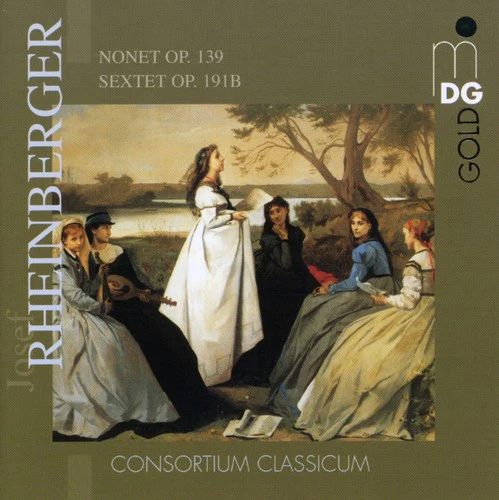
Rheinberger: Nonet, Sextet / Consortium Classicum
This is a disc I could listen to again and again and again. Heck, I probably will—excuse me while I hit the back button on my CD player!
RHEINBERGER Sextet, op.191b. Nonet, op. 139 • Consortium Classicum • MDG 301 1453 (68:22)
This was my very first exposure to the music of Josef Gabriel Rheinberger (1839–1901), a composer who, I confess, I had never even heard of before. Born in Lichtenstein, he was apparently a great organist and the composer of several marvelous organ sonatas as well as a doctor of philosophy. Perhaps the extraordinarily high quality of the performances has something to do with it, but I found this music utterly charming, relaxed, and beautiful, much in the vein of the Schubert Octet or the Brahms Serenades. Like those works, there is nothing startling or innovative about this music melodically or harmonically. It is echt -German Romanticism in all its glory. Yet the warm autumnal colors and relaxed, flowing rhythmic contours of the works held me in thrall from the very first note of the Sextet to the very last note of the Nonet.
I attribute much of my being charmed to the extraordinarily warm playing of oboist Gernot Schmalfuss (in the Sextet) and Pavel Sokolov (in the Nonet), hornist Jan Schroeder, and especially pianist Stefan Irmer, whose consistently light, airy tone and flowing sense of rhythm kept things moving without ever sounding aggressive. Nevertheless, Rheinberger’s music put me in mind of a leisurely stroll through the countryside, in which one’s ramblings are occasionally interrupted by a sight or a thought that shifts one’s reality sideways for a few diverting moments. In a world of gushy, overproduced “relaxing classics,” this is genuinely music of relaxation, but it works not because of its soft contours but because, despite its leisurely quality, it continually engages the mind. His feeling for rhythm is uncannily natural, his occasional emphasis on secondary themes in the foreground creative yet playful. And how this music sings ! The only other composer whose works have had such an arresting effect on me is the vastly underrated York Bowen.
Unlike other music in this genre (Schubert’s and Mendelssohn’s, of course, excepted), Rheinberger is not intent on making or proving a point. He is not trying to convince us that he really is a Great Composer. He just reveals the workings of his mind in music that is tonal and romantic, but also fresh, vital and wholly delightful. Analysis of these sorts of pieces rather withers in the face of the extreme aesthetic pleasures they bring, much as an analysis of Leo Delibes or Paul Dukas rather dissipates in the extraordinary charm of their music. It has been said that Rheinberger’s wife and former pupil, Franziska von Hoffnaass, had a significant influence on his compositional style. I am inclined to believe this; these two works, at least, seem as much feminine in their outlook as they do masculine.
As the disc went on, I rather felt that the sonics were also partly to credit for the music’s impact. For those reactionaries who love to claim that music in the days of vinyl sounded fuller, warmer, more realistic, I commend you to a careful listen of MDG’s sonics. Recorded in 2006 at the Fürstliche Reitbahn Bad Arolsen by engineer Holger Schlegel, there is all the fullness of a real-time concert hall. Everything is clearly articulated, despite the group’s wonderful penchant for ensemble blend, yet absolutely nothing sounds artificial. The only older recordings I can compare these to are the magnificent New York Woodwind Quintet discs of the late 1950s and early 1960s on Everest’s 35-mm recording film. If you liked the sound of those records—and what true musician didn’t, as they were best-sellers among professionals—you will absolutely fall in love with MDG’s sonics. This is a disc I could listen to again and again and again. Heck, I probably will—excuse me while I hit the back button on my CD player!
FANFARE: Lynn René Bayley
RHEINBERGER Sextet, op.191b. Nonet, op. 139 • Consortium Classicum • MDG 301 1453 (68:22)
This was my very first exposure to the music of Josef Gabriel Rheinberger (1839–1901), a composer who, I confess, I had never even heard of before. Born in Lichtenstein, he was apparently a great organist and the composer of several marvelous organ sonatas as well as a doctor of philosophy. Perhaps the extraordinarily high quality of the performances has something to do with it, but I found this music utterly charming, relaxed, and beautiful, much in the vein of the Schubert Octet or the Brahms Serenades. Like those works, there is nothing startling or innovative about this music melodically or harmonically. It is echt -German Romanticism in all its glory. Yet the warm autumnal colors and relaxed, flowing rhythmic contours of the works held me in thrall from the very first note of the Sextet to the very last note of the Nonet.
I attribute much of my being charmed to the extraordinarily warm playing of oboist Gernot Schmalfuss (in the Sextet) and Pavel Sokolov (in the Nonet), hornist Jan Schroeder, and especially pianist Stefan Irmer, whose consistently light, airy tone and flowing sense of rhythm kept things moving without ever sounding aggressive. Nevertheless, Rheinberger’s music put me in mind of a leisurely stroll through the countryside, in which one’s ramblings are occasionally interrupted by a sight or a thought that shifts one’s reality sideways for a few diverting moments. In a world of gushy, overproduced “relaxing classics,” this is genuinely music of relaxation, but it works not because of its soft contours but because, despite its leisurely quality, it continually engages the mind. His feeling for rhythm is uncannily natural, his occasional emphasis on secondary themes in the foreground creative yet playful. And how this music sings ! The only other composer whose works have had such an arresting effect on me is the vastly underrated York Bowen.
Unlike other music in this genre (Schubert’s and Mendelssohn’s, of course, excepted), Rheinberger is not intent on making or proving a point. He is not trying to convince us that he really is a Great Composer. He just reveals the workings of his mind in music that is tonal and romantic, but also fresh, vital and wholly delightful. Analysis of these sorts of pieces rather withers in the face of the extreme aesthetic pleasures they bring, much as an analysis of Leo Delibes or Paul Dukas rather dissipates in the extraordinary charm of their music. It has been said that Rheinberger’s wife and former pupil, Franziska von Hoffnaass, had a significant influence on his compositional style. I am inclined to believe this; these two works, at least, seem as much feminine in their outlook as they do masculine.
As the disc went on, I rather felt that the sonics were also partly to credit for the music’s impact. For those reactionaries who love to claim that music in the days of vinyl sounded fuller, warmer, more realistic, I commend you to a careful listen of MDG’s sonics. Recorded in 2006 at the Fürstliche Reitbahn Bad Arolsen by engineer Holger Schlegel, there is all the fullness of a real-time concert hall. Everything is clearly articulated, despite the group’s wonderful penchant for ensemble blend, yet absolutely nothing sounds artificial. The only older recordings I can compare these to are the magnificent New York Woodwind Quintet discs of the late 1950s and early 1960s on Everest’s 35-mm recording film. If you liked the sound of those records—and what true musician didn’t, as they were best-sellers among professionals—you will absolutely fall in love with MDG’s sonics. This is a disc I could listen to again and again and again. Heck, I probably will—excuse me while I hit the back button on my CD player!
FANFARE: Lynn René Bayley
This is a disc I could listen to again and again and again. Heck, I probably will—excuse me while I hit the back button on my CD player!
RHEINBERGER Sextet, op.191b. Nonet, op. 139 • Consortium Classicum • MDG 301 1453 (68:22)
This was my very first exposure to the music of Josef Gabriel Rheinberger (1839–1901), a composer who, I confess, I had never even heard of before. Born in Lichtenstein, he was apparently a great organist and the composer of several marvelous organ sonatas as well as a doctor of philosophy. Perhaps the extraordinarily high quality of the performances has something to do with it, but I found this music utterly charming, relaxed, and beautiful, much in the vein of the Schubert Octet or the Brahms Serenades. Like those works, there is nothing startling or innovative about this music melodically or harmonically. It is echt -German Romanticism in all its glory. Yet the warm autumnal colors and relaxed, flowing rhythmic contours of the works held me in thrall from the very first note of the Sextet to the very last note of the Nonet.
I attribute much of my being charmed to the extraordinarily warm playing of oboist Gernot Schmalfuss (in the Sextet) and Pavel Sokolov (in the Nonet), hornist Jan Schroeder, and especially pianist Stefan Irmer, whose consistently light, airy tone and flowing sense of rhythm kept things moving without ever sounding aggressive. Nevertheless, Rheinberger’s music put me in mind of a leisurely stroll through the countryside, in which one’s ramblings are occasionally interrupted by a sight or a thought that shifts one’s reality sideways for a few diverting moments. In a world of gushy, overproduced “relaxing classics,” this is genuinely music of relaxation, but it works not because of its soft contours but because, despite its leisurely quality, it continually engages the mind. His feeling for rhythm is uncannily natural, his occasional emphasis on secondary themes in the foreground creative yet playful. And how this music sings ! The only other composer whose works have had such an arresting effect on me is the vastly underrated York Bowen.
Unlike other music in this genre (Schubert’s and Mendelssohn’s, of course, excepted), Rheinberger is not intent on making or proving a point. He is not trying to convince us that he really is a Great Composer. He just reveals the workings of his mind in music that is tonal and romantic, but also fresh, vital and wholly delightful. Analysis of these sorts of pieces rather withers in the face of the extreme aesthetic pleasures they bring, much as an analysis of Leo Delibes or Paul Dukas rather dissipates in the extraordinary charm of their music. It has been said that Rheinberger’s wife and former pupil, Franziska von Hoffnaass, had a significant influence on his compositional style. I am inclined to believe this; these two works, at least, seem as much feminine in their outlook as they do masculine.
As the disc went on, I rather felt that the sonics were also partly to credit for the music’s impact. For those reactionaries who love to claim that music in the days of vinyl sounded fuller, warmer, more realistic, I commend you to a careful listen of MDG’s sonics. Recorded in 2006 at the Fürstliche Reitbahn Bad Arolsen by engineer Holger Schlegel, there is all the fullness of a real-time concert hall. Everything is clearly articulated, despite the group’s wonderful penchant for ensemble blend, yet absolutely nothing sounds artificial. The only older recordings I can compare these to are the magnificent New York Woodwind Quintet discs of the late 1950s and early 1960s on Everest’s 35-mm recording film. If you liked the sound of those records—and what true musician didn’t, as they were best-sellers among professionals—you will absolutely fall in love with MDG’s sonics. This is a disc I could listen to again and again and again. Heck, I probably will—excuse me while I hit the back button on my CD player!
FANFARE: Lynn René Bayley
RHEINBERGER Sextet, op.191b. Nonet, op. 139 • Consortium Classicum • MDG 301 1453 (68:22)
This was my very first exposure to the music of Josef Gabriel Rheinberger (1839–1901), a composer who, I confess, I had never even heard of before. Born in Lichtenstein, he was apparently a great organist and the composer of several marvelous organ sonatas as well as a doctor of philosophy. Perhaps the extraordinarily high quality of the performances has something to do with it, but I found this music utterly charming, relaxed, and beautiful, much in the vein of the Schubert Octet or the Brahms Serenades. Like those works, there is nothing startling or innovative about this music melodically or harmonically. It is echt -German Romanticism in all its glory. Yet the warm autumnal colors and relaxed, flowing rhythmic contours of the works held me in thrall from the very first note of the Sextet to the very last note of the Nonet.
I attribute much of my being charmed to the extraordinarily warm playing of oboist Gernot Schmalfuss (in the Sextet) and Pavel Sokolov (in the Nonet), hornist Jan Schroeder, and especially pianist Stefan Irmer, whose consistently light, airy tone and flowing sense of rhythm kept things moving without ever sounding aggressive. Nevertheless, Rheinberger’s music put me in mind of a leisurely stroll through the countryside, in which one’s ramblings are occasionally interrupted by a sight or a thought that shifts one’s reality sideways for a few diverting moments. In a world of gushy, overproduced “relaxing classics,” this is genuinely music of relaxation, but it works not because of its soft contours but because, despite its leisurely quality, it continually engages the mind. His feeling for rhythm is uncannily natural, his occasional emphasis on secondary themes in the foreground creative yet playful. And how this music sings ! The only other composer whose works have had such an arresting effect on me is the vastly underrated York Bowen.
Unlike other music in this genre (Schubert’s and Mendelssohn’s, of course, excepted), Rheinberger is not intent on making or proving a point. He is not trying to convince us that he really is a Great Composer. He just reveals the workings of his mind in music that is tonal and romantic, but also fresh, vital and wholly delightful. Analysis of these sorts of pieces rather withers in the face of the extreme aesthetic pleasures they bring, much as an analysis of Leo Delibes or Paul Dukas rather dissipates in the extraordinary charm of their music. It has been said that Rheinberger’s wife and former pupil, Franziska von Hoffnaass, had a significant influence on his compositional style. I am inclined to believe this; these two works, at least, seem as much feminine in their outlook as they do masculine.
As the disc went on, I rather felt that the sonics were also partly to credit for the music’s impact. For those reactionaries who love to claim that music in the days of vinyl sounded fuller, warmer, more realistic, I commend you to a careful listen of MDG’s sonics. Recorded in 2006 at the Fürstliche Reitbahn Bad Arolsen by engineer Holger Schlegel, there is all the fullness of a real-time concert hall. Everything is clearly articulated, despite the group’s wonderful penchant for ensemble blend, yet absolutely nothing sounds artificial. The only older recordings I can compare these to are the magnificent New York Woodwind Quintet discs of the late 1950s and early 1960s on Everest’s 35-mm recording film. If you liked the sound of those records—and what true musician didn’t, as they were best-sellers among professionals—you will absolutely fall in love with MDG’s sonics. This is a disc I could listen to again and again and again. Heck, I probably will—excuse me while I hit the back button on my CD player!
FANFARE: Lynn René Bayley
$23.99
Rheinberger: Nonet, Sextet / Consortium Classicum—
$23.99
Description
This is a disc I could listen to again and again and again. Heck, I probably will—excuse me while I hit the back button on my CD player!
RHEINBERGER Sextet, op.191b. Nonet, op. 139 • Consortium Classicum • MDG 301 1453 (68:22)
This was my very first exposure to the music of Josef Gabriel Rheinberger (1839–1901), a composer who, I confess, I had never even heard of before. Born in Lichtenstein, he was apparently a great organist and the composer of several marvelous organ sonatas as well as a doctor of philosophy. Perhaps the extraordinarily high quality of the performances has something to do with it, but I found this music utterly charming, relaxed, and beautiful, much in the vein of the Schubert Octet or the Brahms Serenades. Like those works, there is nothing startling or innovative about this music melodically or harmonically. It is echt -German Romanticism in all its glory. Yet the warm autumnal colors and relaxed, flowing rhythmic contours of the works held me in thrall from the very first note of the Sextet to the very last note of the Nonet.
I attribute much of my being charmed to the extraordinarily warm playing of oboist Gernot Schmalfuss (in the Sextet) and Pavel Sokolov (in the Nonet), hornist Jan Schroeder, and especially pianist Stefan Irmer, whose consistently light, airy tone and flowing sense of rhythm kept things moving without ever sounding aggressive. Nevertheless, Rheinberger’s music put me in mind of a leisurely stroll through the countryside, in which one’s ramblings are occasionally interrupted by a sight or a thought that shifts one’s reality sideways for a few diverting moments. In a world of gushy, overproduced “relaxing classics,” this is genuinely music of relaxation, but it works not because of its soft contours but because, despite its leisurely quality, it continually engages the mind. His feeling for rhythm is uncannily natural, his occasional emphasis on secondary themes in the foreground creative yet playful. And how this music sings ! The only other composer whose works have had such an arresting effect on me is the vastly underrated York Bowen.
Unlike other music in this genre (Schubert’s and Mendelssohn’s, of course, excepted), Rheinberger is not intent on making or proving a point. He is not trying to convince us that he really is a Great Composer. He just reveals the workings of his mind in music that is tonal and romantic, but also fresh, vital and wholly delightful. Analysis of these sorts of pieces rather withers in the face of the extreme aesthetic pleasures they bring, much as an analysis of Leo Delibes or Paul Dukas rather dissipates in the extraordinary charm of their music. It has been said that Rheinberger’s wife and former pupil, Franziska von Hoffnaass, had a significant influence on his compositional style. I am inclined to believe this; these two works, at least, seem as much feminine in their outlook as they do masculine.
As the disc went on, I rather felt that the sonics were also partly to credit for the music’s impact. For those reactionaries who love to claim that music in the days of vinyl sounded fuller, warmer, more realistic, I commend you to a careful listen of MDG’s sonics. Recorded in 2006 at the Fürstliche Reitbahn Bad Arolsen by engineer Holger Schlegel, there is all the fullness of a real-time concert hall. Everything is clearly articulated, despite the group’s wonderful penchant for ensemble blend, yet absolutely nothing sounds artificial. The only older recordings I can compare these to are the magnificent New York Woodwind Quintet discs of the late 1950s and early 1960s on Everest’s 35-mm recording film. If you liked the sound of those records—and what true musician didn’t, as they were best-sellers among professionals—you will absolutely fall in love with MDG’s sonics. This is a disc I could listen to again and again and again. Heck, I probably will—excuse me while I hit the back button on my CD player!
FANFARE: Lynn René Bayley
RHEINBERGER Sextet, op.191b. Nonet, op. 139 • Consortium Classicum • MDG 301 1453 (68:22)
This was my very first exposure to the music of Josef Gabriel Rheinberger (1839–1901), a composer who, I confess, I had never even heard of before. Born in Lichtenstein, he was apparently a great organist and the composer of several marvelous organ sonatas as well as a doctor of philosophy. Perhaps the extraordinarily high quality of the performances has something to do with it, but I found this music utterly charming, relaxed, and beautiful, much in the vein of the Schubert Octet or the Brahms Serenades. Like those works, there is nothing startling or innovative about this music melodically or harmonically. It is echt -German Romanticism in all its glory. Yet the warm autumnal colors and relaxed, flowing rhythmic contours of the works held me in thrall from the very first note of the Sextet to the very last note of the Nonet.
I attribute much of my being charmed to the extraordinarily warm playing of oboist Gernot Schmalfuss (in the Sextet) and Pavel Sokolov (in the Nonet), hornist Jan Schroeder, and especially pianist Stefan Irmer, whose consistently light, airy tone and flowing sense of rhythm kept things moving without ever sounding aggressive. Nevertheless, Rheinberger’s music put me in mind of a leisurely stroll through the countryside, in which one’s ramblings are occasionally interrupted by a sight or a thought that shifts one’s reality sideways for a few diverting moments. In a world of gushy, overproduced “relaxing classics,” this is genuinely music of relaxation, but it works not because of its soft contours but because, despite its leisurely quality, it continually engages the mind. His feeling for rhythm is uncannily natural, his occasional emphasis on secondary themes in the foreground creative yet playful. And how this music sings ! The only other composer whose works have had such an arresting effect on me is the vastly underrated York Bowen.
Unlike other music in this genre (Schubert’s and Mendelssohn’s, of course, excepted), Rheinberger is not intent on making or proving a point. He is not trying to convince us that he really is a Great Composer. He just reveals the workings of his mind in music that is tonal and romantic, but also fresh, vital and wholly delightful. Analysis of these sorts of pieces rather withers in the face of the extreme aesthetic pleasures they bring, much as an analysis of Leo Delibes or Paul Dukas rather dissipates in the extraordinary charm of their music. It has been said that Rheinberger’s wife and former pupil, Franziska von Hoffnaass, had a significant influence on his compositional style. I am inclined to believe this; these two works, at least, seem as much feminine in their outlook as they do masculine.
As the disc went on, I rather felt that the sonics were also partly to credit for the music’s impact. For those reactionaries who love to claim that music in the days of vinyl sounded fuller, warmer, more realistic, I commend you to a careful listen of MDG’s sonics. Recorded in 2006 at the Fürstliche Reitbahn Bad Arolsen by engineer Holger Schlegel, there is all the fullness of a real-time concert hall. Everything is clearly articulated, despite the group’s wonderful penchant for ensemble blend, yet absolutely nothing sounds artificial. The only older recordings I can compare these to are the magnificent New York Woodwind Quintet discs of the late 1950s and early 1960s on Everest’s 35-mm recording film. If you liked the sound of those records—and what true musician didn’t, as they were best-sellers among professionals—you will absolutely fall in love with MDG’s sonics. This is a disc I could listen to again and again and again. Heck, I probably will—excuse me while I hit the back button on my CD player!
FANFARE: Lynn René Bayley