🎉 Up to 70% Off Selected ItemsShop Sale

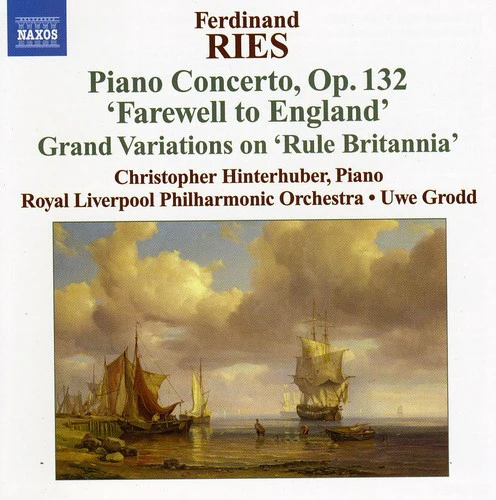
Ries: Piano Concertos Vol 3 / Hinterhuber, Grodd, Royal Liverpool PO
RIES Piano Concerto in A, “Farewell Concert for England.” Grand Variations on “Rule Britannia.” Introduction et Variations brillantes • Christopher Hinterhuber (pn); Uwe Grodd, cond; Royal Liverpool PO • NAXOS 8.570440 (66:02)
Ferdinand Ries has been receiving lots of attention on record and in these pages of late. Fanfare ’s own Susan Kagan has been working her way through the composer’s piano sonatas for Naxos, and this is the label’s third volume of his concerted works for piano and orchestra, numbering eight concertos and two sets of variations, the latter of which are included on the present disc. My reaction to the sonatas in a 32:3 review—not to Susan’s playing of them—was lukewarm, leading me to conclude that while “good, solid musical ideas aplenty fly by, one senses that something more significant would be made of them by a composer of a more gifted muse; but in Ries’s hands tuition never quite seems to achieve fruition.”
Ries’s chamber works, with which I am admittedly more familiar, and these works for piano and orchestra, however, tell a rather different story. Perhaps the mother of Ries’s invention was the necessity of mass appeal. Writing to accommodate the tastes of the less musically sophisticated middle-class audiences that were increasingly finding the means to attend public concerts required a different approach. I hate the term “dumbing-down,” but we see it even in Beethoven, whose solo piano sonatas and string quartets, which were aimed at a smaller, more musically cultivated and elite audience, were more experimental and listener challenging than his concertos and symphonies, although here, too, he pushed the envelope. Likewise, Ries’s concerted works are immediately engaging, melodically and harmonically fluent, and filled with wonderfully imaginative and memorable turns of phrase.
The grand orchestral tuttis clearly take Beethoven as their model, but the piano-writing is something else. In the A-Minor Concerto there is an exquisite prefiguring of Chopin and Mendelssohn, with its arabesques and filigree anchoring and sustaining the pivotal notes that constitute the melodic arc. This is gorgeous stuff that you will never tire of listening to. All three works on this disc date from Ries’s London period, the concerto—the seventh in order of publication and obvious from its title—was written in London in 1823 and marks the end of the composer’s period in England. The Introduction and Variations brillantes bears a higher opus number than the concerto only because it wasn’t published until later. This and the Grand Variations on “Rule Britannia” show Ries to be a thorough master of the variations style and technique.
At present, there is little to no competition on CD in this repertoire, so Christopher Hinterhuber pretty much has the field to himself—all the more reason then to rejoice at his lively and beautifully turned performances. Uwe Grodd and the Royal Liverpool band accompany and complement him admirably. If you add to the equation over an hour’s worth of really enjoyable music, excellent playing, an outstanding recording, and Naxos’s budget price, you have a gold star winner.
FANFARE: Jerry Dubins
RIES Piano Concerto in A, “Farewell Concert for England.” Grand Variations on “Rule Britannia.” Introduction et Variations brillantes • Christopher Hinterhuber (pn); Uwe Grodd, cond; Royal Liverpool PO • NAXOS 8.570440 (66:02)
Ferdinand Ries has been receiving lots of attention on record and in these pages of late. Fanfare ’s own Susan Kagan has been working her way through the composer’s piano sonatas for Naxos, and this is the label’s third volume of his concerted works for piano and orchestra, numbering eight concertos and two sets of variations, the latter of which are included on the present disc. My reaction to the sonatas in a 32:3 review—not to Susan’s playing of them—was lukewarm, leading me to conclude that while “good, solid musical ideas aplenty fly by, one senses that something more significant would be made of them by a composer of a more gifted muse; but in Ries’s hands tuition never quite seems to achieve fruition.”
Ries’s chamber works, with which I am admittedly more familiar, and these works for piano and orchestra, however, tell a rather different story. Perhaps the mother of Ries’s invention was the necessity of mass appeal. Writing to accommodate the tastes of the less musically sophisticated middle-class audiences that were increasingly finding the means to attend public concerts required a different approach. I hate the term “dumbing-down,” but we see it even in Beethoven, whose solo piano sonatas and string quartets, which were aimed at a smaller, more musically cultivated and elite audience, were more experimental and listener challenging than his concertos and symphonies, although here, too, he pushed the envelope. Likewise, Ries’s concerted works are immediately engaging, melodically and harmonically fluent, and filled with wonderfully imaginative and memorable turns of phrase.
The grand orchestral tuttis clearly take Beethoven as their model, but the piano-writing is something else. In the A-Minor Concerto there is an exquisite prefiguring of Chopin and Mendelssohn, with its arabesques and filigree anchoring and sustaining the pivotal notes that constitute the melodic arc. This is gorgeous stuff that you will never tire of listening to. All three works on this disc date from Ries’s London period, the concerto—the seventh in order of publication and obvious from its title—was written in London in 1823 and marks the end of the composer’s period in England. The Introduction and Variations brillantes bears a higher opus number than the concerto only because it wasn’t published until later. This and the Grand Variations on “Rule Britannia” show Ries to be a thorough master of the variations style and technique.
At present, there is little to no competition on CD in this repertoire, so Christopher Hinterhuber pretty much has the field to himself—all the more reason then to rejoice at his lively and beautifully turned performances. Uwe Grodd and the Royal Liverpool band accompany and complement him admirably. If you add to the equation over an hour’s worth of really enjoyable music, excellent playing, an outstanding recording, and Naxos’s budget price, you have a gold star winner.
FANFARE: Jerry Dubins
$19.99
Ries: Piano Concertos Vol 3 / Hinterhuber, Grodd, Royal Liverpool PO—
$19.99
Description
RIES Piano Concerto in A, “Farewell Concert for England.” Grand Variations on “Rule Britannia.” Introduction et Variations brillantes • Christopher Hinterhuber (pn); Uwe Grodd, cond; Royal Liverpool PO • NAXOS 8.570440 (66:02)
Ferdinand Ries has been receiving lots of attention on record and in these pages of late. Fanfare ’s own Susan Kagan has been working her way through the composer’s piano sonatas for Naxos, and this is the label’s third volume of his concerted works for piano and orchestra, numbering eight concertos and two sets of variations, the latter of which are included on the present disc. My reaction to the sonatas in a 32:3 review—not to Susan’s playing of them—was lukewarm, leading me to conclude that while “good, solid musical ideas aplenty fly by, one senses that something more significant would be made of them by a composer of a more gifted muse; but in Ries’s hands tuition never quite seems to achieve fruition.”
Ries’s chamber works, with which I am admittedly more familiar, and these works for piano and orchestra, however, tell a rather different story. Perhaps the mother of Ries’s invention was the necessity of mass appeal. Writing to accommodate the tastes of the less musically sophisticated middle-class audiences that were increasingly finding the means to attend public concerts required a different approach. I hate the term “dumbing-down,” but we see it even in Beethoven, whose solo piano sonatas and string quartets, which were aimed at a smaller, more musically cultivated and elite audience, were more experimental and listener challenging than his concertos and symphonies, although here, too, he pushed the envelope. Likewise, Ries’s concerted works are immediately engaging, melodically and harmonically fluent, and filled with wonderfully imaginative and memorable turns of phrase.
The grand orchestral tuttis clearly take Beethoven as their model, but the piano-writing is something else. In the A-Minor Concerto there is an exquisite prefiguring of Chopin and Mendelssohn, with its arabesques and filigree anchoring and sustaining the pivotal notes that constitute the melodic arc. This is gorgeous stuff that you will never tire of listening to. All three works on this disc date from Ries’s London period, the concerto—the seventh in order of publication and obvious from its title—was written in London in 1823 and marks the end of the composer’s period in England. The Introduction and Variations brillantes bears a higher opus number than the concerto only because it wasn’t published until later. This and the Grand Variations on “Rule Britannia” show Ries to be a thorough master of the variations style and technique.
At present, there is little to no competition on CD in this repertoire, so Christopher Hinterhuber pretty much has the field to himself—all the more reason then to rejoice at his lively and beautifully turned performances. Uwe Grodd and the Royal Liverpool band accompany and complement him admirably. If you add to the equation over an hour’s worth of really enjoyable music, excellent playing, an outstanding recording, and Naxos’s budget price, you have a gold star winner.
FANFARE: Jerry Dubins