🎉 Up to 70% Off Selected ItemsShop Sale

1 / 2
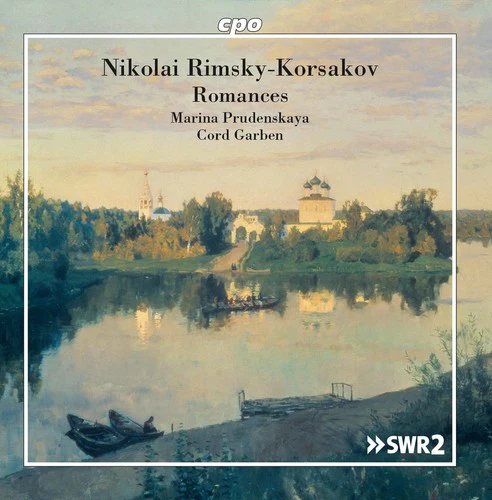
Rimsky-Korsakov: Romances / Prudenskaya, Garben
Over the years I and several other reviewers on this site have been bemoaning the failure of Melodiya, when reissuing their recordings of rare Russian material, to provide texts, translations or indeed adequate booklet notes of any meaningful description for their releases – a damaging omission which does little to make more accessible the excellent recordings themselves. In this selection of Rimsky-Korsakov melodies, CPO have gone to the opposite extreme. Not only do we get the full texts complete with translations, but we also are vouchsafed a lengthy essay from CPO stalwart Eckhardt van den Hoogen discoursing on the composer himself, his psychological background, his attempts to establish himself as a pedagogue, and many other peripheral issues while managing almost entirely to avoid any discussion of the music itself as featured on this disc. Now, I fully appreciate the efforts that CPO put into their booklet notes, which do indeed in many issues offer valuable insights into the music and the composers themselves. However, the turgid prose style of Professor van den Hoogen (which often seems to totally defeat Susan Marie Praeder’s attempts at English translation), are perhaps best regarded in the light of the provision of unintentional amusement. In a final footnote, the booklet essay of eight pages (in small type) notes: “The fact that the Firebird hymn is heard in the Night will be mentioned here for the sake of curiosity and registered completely free from all speculation.” If it is not the intention of the author to discuss the matter, why mention it at all? Earlier in his essay the writer attempts to turn the received opinion of the last century on its head by describing Mussorgsky in the following terms: “Ilya Repin’s famous portrait really tells us everything we need to know about the last years of this original sloth’s life: from his dishevelled hair and watery eyes to the red bulb of a nose shining like a sad lighthouse out of the rolling hills of his face.” Is this really “everything we need to know” about a composer whose output of songs has not only comprehensively outdistanced Rimsky-Korsakov’s in reputation but is also by some considerable margin the most often performed body of vocal works coming from Russia during the nineteenth century?
Still, one has to concede that Professor van den Hoogen always gives good value for money, and he clearly values Rimsky-Korsakov’s output of songs highly. And the performances here do much to justify his enthusiasm. Maria Prudenskaya has spent most of the last ten years working in German opera houses and specialising in Wagner and Verdi, and she fully comprehends the dramatic demands that high romantic music demands of its singers. She was a superbly responsive mezzo soloist in a live Bavarian Radio recording of Verdi’s Requiem under Mariss Jansons a couple of years ago, which I reviewed enthusiastically for this site. Her Waltraute in the 2016 Bayreuth Ring was a towering highlight in an admittedly generally execrable production, and her absolute steadiness of tonal production and gleaming higher register are a real pleasure to hear – not a suspicion of Slavonic wobble here. She also displays a plentiful employment of reflective half-tone, as well as an unexpected (and beautifully floated) upper range in the oriental-sounding Op.2/2 (track 30). Her accompanist Cord Garben is a stalwart contributor to many recitals of song, and as always he relishes the challenge of unfamiliar repertoire. Rimsky-Korsakov was not himself a pianist, and his writing for the instrument was condemned during his lifetime as unidiomatic; but he always gets the effects that he wants to convey. The recording was made some three years before the aforementioned Verdi Requiem – it is not clear why it has waited so long for release – and the recorded sound is fine, even if a little more reverberation might have been welcome.
The disc assembles a whole collection of ‘romances’ identified solely by opus numbers on the CD box, and by transliterated Russian titles at the front of the booklet. They vary in length from just under a minute to a maximum of four minutes; there are thirty individual items here. As might be expected they are all highly proficient settings, generally reflective rather than dramatic, and all have an immediate melodic appeal. Rimsky’s choice of poetic texts is admirable, with Tolstoy, Lermontov, Pushkin and Heine (in Russian translation) featured. They are not assembled in order of composition, which robs the listener of a chance to hear how the composer’s style developed over the years; but Rimsky’s opus numbers are often misleading, with earlier pieces subjected to later revision – it is a pity that the extensive booklet note did not find room to explore this development, including indeed references to songs not actually included on this disc! There are moments which occasion surprise: the clear echo of Beethoven’s Moonlight Sonata in Op.39/1 (track 5), for example, is an unusual reference to non-Russian material. The treatment of the theme quoted by Stravinsky in The Firebird at the outset of Op.8/2 (track 23) is totally different from that of Rimsky’s pupil.
The songs are generally grouped by the poet whose verses are set, although Rimsky does not seem to make any real stylistic discrimination between his lyrics. Most will I suspect be totally unfamiliar to listeners, although some may have crossed the hearer’s path in miscellaneous recitals of Russian song. But since titles (let alone translations) may differ between one recording and another, there seems to be little point in itemising them here.
So far as I can see this is the only current available single disc devoted entirely to the composer’s output in the field, although Brilliant Classics do have a three-disc compendium of his ‘complete songs’ although there appear to be some individual items omitted (77 songs are included out of some 80 apparently given in published editions), and they are distributed between a whole raft of different singers and pianists. This set suffers also from the fact that no sung texts or translations were provided, even in its original issue on Chant du Monde in 1993. Rimsky-Korsakov enthusiasts will obviously have to own the ‘complete’ set; but for lesser mortals this CD, with its judicious selection complete with transliterated text and translations into both German and English, will be more readily approachable. The music itself will certainly prove enjoyable.
– MusicWeb International (Paul Corfield Godfrey)
Still, one has to concede that Professor van den Hoogen always gives good value for money, and he clearly values Rimsky-Korsakov’s output of songs highly. And the performances here do much to justify his enthusiasm. Maria Prudenskaya has spent most of the last ten years working in German opera houses and specialising in Wagner and Verdi, and she fully comprehends the dramatic demands that high romantic music demands of its singers. She was a superbly responsive mezzo soloist in a live Bavarian Radio recording of Verdi’s Requiem under Mariss Jansons a couple of years ago, which I reviewed enthusiastically for this site. Her Waltraute in the 2016 Bayreuth Ring was a towering highlight in an admittedly generally execrable production, and her absolute steadiness of tonal production and gleaming higher register are a real pleasure to hear – not a suspicion of Slavonic wobble here. She also displays a plentiful employment of reflective half-tone, as well as an unexpected (and beautifully floated) upper range in the oriental-sounding Op.2/2 (track 30). Her accompanist Cord Garben is a stalwart contributor to many recitals of song, and as always he relishes the challenge of unfamiliar repertoire. Rimsky-Korsakov was not himself a pianist, and his writing for the instrument was condemned during his lifetime as unidiomatic; but he always gets the effects that he wants to convey. The recording was made some three years before the aforementioned Verdi Requiem – it is not clear why it has waited so long for release – and the recorded sound is fine, even if a little more reverberation might have been welcome.
The disc assembles a whole collection of ‘romances’ identified solely by opus numbers on the CD box, and by transliterated Russian titles at the front of the booklet. They vary in length from just under a minute to a maximum of four minutes; there are thirty individual items here. As might be expected they are all highly proficient settings, generally reflective rather than dramatic, and all have an immediate melodic appeal. Rimsky’s choice of poetic texts is admirable, with Tolstoy, Lermontov, Pushkin and Heine (in Russian translation) featured. They are not assembled in order of composition, which robs the listener of a chance to hear how the composer’s style developed over the years; but Rimsky’s opus numbers are often misleading, with earlier pieces subjected to later revision – it is a pity that the extensive booklet note did not find room to explore this development, including indeed references to songs not actually included on this disc! There are moments which occasion surprise: the clear echo of Beethoven’s Moonlight Sonata in Op.39/1 (track 5), for example, is an unusual reference to non-Russian material. The treatment of the theme quoted by Stravinsky in The Firebird at the outset of Op.8/2 (track 23) is totally different from that of Rimsky’s pupil.
The songs are generally grouped by the poet whose verses are set, although Rimsky does not seem to make any real stylistic discrimination between his lyrics. Most will I suspect be totally unfamiliar to listeners, although some may have crossed the hearer’s path in miscellaneous recitals of Russian song. But since titles (let alone translations) may differ between one recording and another, there seems to be little point in itemising them here.
So far as I can see this is the only current available single disc devoted entirely to the composer’s output in the field, although Brilliant Classics do have a three-disc compendium of his ‘complete songs’ although there appear to be some individual items omitted (77 songs are included out of some 80 apparently given in published editions), and they are distributed between a whole raft of different singers and pianists. This set suffers also from the fact that no sung texts or translations were provided, even in its original issue on Chant du Monde in 1993. Rimsky-Korsakov enthusiasts will obviously have to own the ‘complete’ set; but for lesser mortals this CD, with its judicious selection complete with transliterated text and translations into both German and English, will be more readily approachable. The music itself will certainly prove enjoyable.
– MusicWeb International (Paul Corfield Godfrey)
Over the years I and several other reviewers on this site have been bemoaning the failure of Melodiya, when reissuing their recordings of rare Russian material, to provide texts, translations or indeed adequate booklet notes of any meaningful description for their releases – a damaging omission which does little to make more accessible the excellent recordings themselves. In this selection of Rimsky-Korsakov melodies, CPO have gone to the opposite extreme. Not only do we get the full texts complete with translations, but we also are vouchsafed a lengthy essay from CPO stalwart Eckhardt van den Hoogen discoursing on the composer himself, his psychological background, his attempts to establish himself as a pedagogue, and many other peripheral issues while managing almost entirely to avoid any discussion of the music itself as featured on this disc. Now, I fully appreciate the efforts that CPO put into their booklet notes, which do indeed in many issues offer valuable insights into the music and the composers themselves. However, the turgid prose style of Professor van den Hoogen (which often seems to totally defeat Susan Marie Praeder’s attempts at English translation), are perhaps best regarded in the light of the provision of unintentional amusement. In a final footnote, the booklet essay of eight pages (in small type) notes: “The fact that the Firebird hymn is heard in the Night will be mentioned here for the sake of curiosity and registered completely free from all speculation.” If it is not the intention of the author to discuss the matter, why mention it at all? Earlier in his essay the writer attempts to turn the received opinion of the last century on its head by describing Mussorgsky in the following terms: “Ilya Repin’s famous portrait really tells us everything we need to know about the last years of this original sloth’s life: from his dishevelled hair and watery eyes to the red bulb of a nose shining like a sad lighthouse out of the rolling hills of his face.” Is this really “everything we need to know” about a composer whose output of songs has not only comprehensively outdistanced Rimsky-Korsakov’s in reputation but is also by some considerable margin the most often performed body of vocal works coming from Russia during the nineteenth century?
Still, one has to concede that Professor van den Hoogen always gives good value for money, and he clearly values Rimsky-Korsakov’s output of songs highly. And the performances here do much to justify his enthusiasm. Maria Prudenskaya has spent most of the last ten years working in German opera houses and specialising in Wagner and Verdi, and she fully comprehends the dramatic demands that high romantic music demands of its singers. She was a superbly responsive mezzo soloist in a live Bavarian Radio recording of Verdi’s Requiem under Mariss Jansons a couple of years ago, which I reviewed enthusiastically for this site. Her Waltraute in the 2016 Bayreuth Ring was a towering highlight in an admittedly generally execrable production, and her absolute steadiness of tonal production and gleaming higher register are a real pleasure to hear – not a suspicion of Slavonic wobble here. She also displays a plentiful employment of reflective half-tone, as well as an unexpected (and beautifully floated) upper range in the oriental-sounding Op.2/2 (track 30). Her accompanist Cord Garben is a stalwart contributor to many recitals of song, and as always he relishes the challenge of unfamiliar repertoire. Rimsky-Korsakov was not himself a pianist, and his writing for the instrument was condemned during his lifetime as unidiomatic; but he always gets the effects that he wants to convey. The recording was made some three years before the aforementioned Verdi Requiem – it is not clear why it has waited so long for release – and the recorded sound is fine, even if a little more reverberation might have been welcome.
The disc assembles a whole collection of ‘romances’ identified solely by opus numbers on the CD box, and by transliterated Russian titles at the front of the booklet. They vary in length from just under a minute to a maximum of four minutes; there are thirty individual items here. As might be expected they are all highly proficient settings, generally reflective rather than dramatic, and all have an immediate melodic appeal. Rimsky’s choice of poetic texts is admirable, with Tolstoy, Lermontov, Pushkin and Heine (in Russian translation) featured. They are not assembled in order of composition, which robs the listener of a chance to hear how the composer’s style developed over the years; but Rimsky’s opus numbers are often misleading, with earlier pieces subjected to later revision – it is a pity that the extensive booklet note did not find room to explore this development, including indeed references to songs not actually included on this disc! There are moments which occasion surprise: the clear echo of Beethoven’s Moonlight Sonata in Op.39/1 (track 5), for example, is an unusual reference to non-Russian material. The treatment of the theme quoted by Stravinsky in The Firebird at the outset of Op.8/2 (track 23) is totally different from that of Rimsky’s pupil.
The songs are generally grouped by the poet whose verses are set, although Rimsky does not seem to make any real stylistic discrimination between his lyrics. Most will I suspect be totally unfamiliar to listeners, although some may have crossed the hearer’s path in miscellaneous recitals of Russian song. But since titles (let alone translations) may differ between one recording and another, there seems to be little point in itemising them here.
So far as I can see this is the only current available single disc devoted entirely to the composer’s output in the field, although Brilliant Classics do have a three-disc compendium of his ‘complete songs’ although there appear to be some individual items omitted (77 songs are included out of some 80 apparently given in published editions), and they are distributed between a whole raft of different singers and pianists. This set suffers also from the fact that no sung texts or translations were provided, even in its original issue on Chant du Monde in 1993. Rimsky-Korsakov enthusiasts will obviously have to own the ‘complete’ set; but for lesser mortals this CD, with its judicious selection complete with transliterated text and translations into both German and English, will be more readily approachable. The music itself will certainly prove enjoyable.
– MusicWeb International (Paul Corfield Godfrey)
Still, one has to concede that Professor van den Hoogen always gives good value for money, and he clearly values Rimsky-Korsakov’s output of songs highly. And the performances here do much to justify his enthusiasm. Maria Prudenskaya has spent most of the last ten years working in German opera houses and specialising in Wagner and Verdi, and she fully comprehends the dramatic demands that high romantic music demands of its singers. She was a superbly responsive mezzo soloist in a live Bavarian Radio recording of Verdi’s Requiem under Mariss Jansons a couple of years ago, which I reviewed enthusiastically for this site. Her Waltraute in the 2016 Bayreuth Ring was a towering highlight in an admittedly generally execrable production, and her absolute steadiness of tonal production and gleaming higher register are a real pleasure to hear – not a suspicion of Slavonic wobble here. She also displays a plentiful employment of reflective half-tone, as well as an unexpected (and beautifully floated) upper range in the oriental-sounding Op.2/2 (track 30). Her accompanist Cord Garben is a stalwart contributor to many recitals of song, and as always he relishes the challenge of unfamiliar repertoire. Rimsky-Korsakov was not himself a pianist, and his writing for the instrument was condemned during his lifetime as unidiomatic; but he always gets the effects that he wants to convey. The recording was made some three years before the aforementioned Verdi Requiem – it is not clear why it has waited so long for release – and the recorded sound is fine, even if a little more reverberation might have been welcome.
The disc assembles a whole collection of ‘romances’ identified solely by opus numbers on the CD box, and by transliterated Russian titles at the front of the booklet. They vary in length from just under a minute to a maximum of four minutes; there are thirty individual items here. As might be expected they are all highly proficient settings, generally reflective rather than dramatic, and all have an immediate melodic appeal. Rimsky’s choice of poetic texts is admirable, with Tolstoy, Lermontov, Pushkin and Heine (in Russian translation) featured. They are not assembled in order of composition, which robs the listener of a chance to hear how the composer’s style developed over the years; but Rimsky’s opus numbers are often misleading, with earlier pieces subjected to later revision – it is a pity that the extensive booklet note did not find room to explore this development, including indeed references to songs not actually included on this disc! There are moments which occasion surprise: the clear echo of Beethoven’s Moonlight Sonata in Op.39/1 (track 5), for example, is an unusual reference to non-Russian material. The treatment of the theme quoted by Stravinsky in The Firebird at the outset of Op.8/2 (track 23) is totally different from that of Rimsky’s pupil.
The songs are generally grouped by the poet whose verses are set, although Rimsky does not seem to make any real stylistic discrimination between his lyrics. Most will I suspect be totally unfamiliar to listeners, although some may have crossed the hearer’s path in miscellaneous recitals of Russian song. But since titles (let alone translations) may differ between one recording and another, there seems to be little point in itemising them here.
So far as I can see this is the only current available single disc devoted entirely to the composer’s output in the field, although Brilliant Classics do have a three-disc compendium of his ‘complete songs’ although there appear to be some individual items omitted (77 songs are included out of some 80 apparently given in published editions), and they are distributed between a whole raft of different singers and pianists. This set suffers also from the fact that no sung texts or translations were provided, even in its original issue on Chant du Monde in 1993. Rimsky-Korsakov enthusiasts will obviously have to own the ‘complete’ set; but for lesser mortals this CD, with its judicious selection complete with transliterated text and translations into both German and English, will be more readily approachable. The music itself will certainly prove enjoyable.
– MusicWeb International (Paul Corfield Godfrey)
$4.90
Original: $13.99
-65%Rimsky-Korsakov: Romances / Prudenskaya, Garben—
$13.99
$4.90Description
Over the years I and several other reviewers on this site have been bemoaning the failure of Melodiya, when reissuing their recordings of rare Russian material, to provide texts, translations or indeed adequate booklet notes of any meaningful description for their releases – a damaging omission which does little to make more accessible the excellent recordings themselves. In this selection of Rimsky-Korsakov melodies, CPO have gone to the opposite extreme. Not only do we get the full texts complete with translations, but we also are vouchsafed a lengthy essay from CPO stalwart Eckhardt van den Hoogen discoursing on the composer himself, his psychological background, his attempts to establish himself as a pedagogue, and many other peripheral issues while managing almost entirely to avoid any discussion of the music itself as featured on this disc. Now, I fully appreciate the efforts that CPO put into their booklet notes, which do indeed in many issues offer valuable insights into the music and the composers themselves. However, the turgid prose style of Professor van den Hoogen (which often seems to totally defeat Susan Marie Praeder’s attempts at English translation), are perhaps best regarded in the light of the provision of unintentional amusement. In a final footnote, the booklet essay of eight pages (in small type) notes: “The fact that the Firebird hymn is heard in the Night will be mentioned here for the sake of curiosity and registered completely free from all speculation.” If it is not the intention of the author to discuss the matter, why mention it at all? Earlier in his essay the writer attempts to turn the received opinion of the last century on its head by describing Mussorgsky in the following terms: “Ilya Repin’s famous portrait really tells us everything we need to know about the last years of this original sloth’s life: from his dishevelled hair and watery eyes to the red bulb of a nose shining like a sad lighthouse out of the rolling hills of his face.” Is this really “everything we need to know” about a composer whose output of songs has not only comprehensively outdistanced Rimsky-Korsakov’s in reputation but is also by some considerable margin the most often performed body of vocal works coming from Russia during the nineteenth century?
Still, one has to concede that Professor van den Hoogen always gives good value for money, and he clearly values Rimsky-Korsakov’s output of songs highly. And the performances here do much to justify his enthusiasm. Maria Prudenskaya has spent most of the last ten years working in German opera houses and specialising in Wagner and Verdi, and she fully comprehends the dramatic demands that high romantic music demands of its singers. She was a superbly responsive mezzo soloist in a live Bavarian Radio recording of Verdi’s Requiem under Mariss Jansons a couple of years ago, which I reviewed enthusiastically for this site. Her Waltraute in the 2016 Bayreuth Ring was a towering highlight in an admittedly generally execrable production, and her absolute steadiness of tonal production and gleaming higher register are a real pleasure to hear – not a suspicion of Slavonic wobble here. She also displays a plentiful employment of reflective half-tone, as well as an unexpected (and beautifully floated) upper range in the oriental-sounding Op.2/2 (track 30). Her accompanist Cord Garben is a stalwart contributor to many recitals of song, and as always he relishes the challenge of unfamiliar repertoire. Rimsky-Korsakov was not himself a pianist, and his writing for the instrument was condemned during his lifetime as unidiomatic; but he always gets the effects that he wants to convey. The recording was made some three years before the aforementioned Verdi Requiem – it is not clear why it has waited so long for release – and the recorded sound is fine, even if a little more reverberation might have been welcome.
The disc assembles a whole collection of ‘romances’ identified solely by opus numbers on the CD box, and by transliterated Russian titles at the front of the booklet. They vary in length from just under a minute to a maximum of four minutes; there are thirty individual items here. As might be expected they are all highly proficient settings, generally reflective rather than dramatic, and all have an immediate melodic appeal. Rimsky’s choice of poetic texts is admirable, with Tolstoy, Lermontov, Pushkin and Heine (in Russian translation) featured. They are not assembled in order of composition, which robs the listener of a chance to hear how the composer’s style developed over the years; but Rimsky’s opus numbers are often misleading, with earlier pieces subjected to later revision – it is a pity that the extensive booklet note did not find room to explore this development, including indeed references to songs not actually included on this disc! There are moments which occasion surprise: the clear echo of Beethoven’s Moonlight Sonata in Op.39/1 (track 5), for example, is an unusual reference to non-Russian material. The treatment of the theme quoted by Stravinsky in The Firebird at the outset of Op.8/2 (track 23) is totally different from that of Rimsky’s pupil.
The songs are generally grouped by the poet whose verses are set, although Rimsky does not seem to make any real stylistic discrimination between his lyrics. Most will I suspect be totally unfamiliar to listeners, although some may have crossed the hearer’s path in miscellaneous recitals of Russian song. But since titles (let alone translations) may differ between one recording and another, there seems to be little point in itemising them here.
So far as I can see this is the only current available single disc devoted entirely to the composer’s output in the field, although Brilliant Classics do have a three-disc compendium of his ‘complete songs’ although there appear to be some individual items omitted (77 songs are included out of some 80 apparently given in published editions), and they are distributed between a whole raft of different singers and pianists. This set suffers also from the fact that no sung texts or translations were provided, even in its original issue on Chant du Monde in 1993. Rimsky-Korsakov enthusiasts will obviously have to own the ‘complete’ set; but for lesser mortals this CD, with its judicious selection complete with transliterated text and translations into both German and English, will be more readily approachable. The music itself will certainly prove enjoyable.
– MusicWeb International (Paul Corfield Godfrey)
Still, one has to concede that Professor van den Hoogen always gives good value for money, and he clearly values Rimsky-Korsakov’s output of songs highly. And the performances here do much to justify his enthusiasm. Maria Prudenskaya has spent most of the last ten years working in German opera houses and specialising in Wagner and Verdi, and she fully comprehends the dramatic demands that high romantic music demands of its singers. She was a superbly responsive mezzo soloist in a live Bavarian Radio recording of Verdi’s Requiem under Mariss Jansons a couple of years ago, which I reviewed enthusiastically for this site. Her Waltraute in the 2016 Bayreuth Ring was a towering highlight in an admittedly generally execrable production, and her absolute steadiness of tonal production and gleaming higher register are a real pleasure to hear – not a suspicion of Slavonic wobble here. She also displays a plentiful employment of reflective half-tone, as well as an unexpected (and beautifully floated) upper range in the oriental-sounding Op.2/2 (track 30). Her accompanist Cord Garben is a stalwart contributor to many recitals of song, and as always he relishes the challenge of unfamiliar repertoire. Rimsky-Korsakov was not himself a pianist, and his writing for the instrument was condemned during his lifetime as unidiomatic; but he always gets the effects that he wants to convey. The recording was made some three years before the aforementioned Verdi Requiem – it is not clear why it has waited so long for release – and the recorded sound is fine, even if a little more reverberation might have been welcome.
The disc assembles a whole collection of ‘romances’ identified solely by opus numbers on the CD box, and by transliterated Russian titles at the front of the booklet. They vary in length from just under a minute to a maximum of four minutes; there are thirty individual items here. As might be expected they are all highly proficient settings, generally reflective rather than dramatic, and all have an immediate melodic appeal. Rimsky’s choice of poetic texts is admirable, with Tolstoy, Lermontov, Pushkin and Heine (in Russian translation) featured. They are not assembled in order of composition, which robs the listener of a chance to hear how the composer’s style developed over the years; but Rimsky’s opus numbers are often misleading, with earlier pieces subjected to later revision – it is a pity that the extensive booklet note did not find room to explore this development, including indeed references to songs not actually included on this disc! There are moments which occasion surprise: the clear echo of Beethoven’s Moonlight Sonata in Op.39/1 (track 5), for example, is an unusual reference to non-Russian material. The treatment of the theme quoted by Stravinsky in The Firebird at the outset of Op.8/2 (track 23) is totally different from that of Rimsky’s pupil.
The songs are generally grouped by the poet whose verses are set, although Rimsky does not seem to make any real stylistic discrimination between his lyrics. Most will I suspect be totally unfamiliar to listeners, although some may have crossed the hearer’s path in miscellaneous recitals of Russian song. But since titles (let alone translations) may differ between one recording and another, there seems to be little point in itemising them here.
So far as I can see this is the only current available single disc devoted entirely to the composer’s output in the field, although Brilliant Classics do have a three-disc compendium of his ‘complete songs’ although there appear to be some individual items omitted (77 songs are included out of some 80 apparently given in published editions), and they are distributed between a whole raft of different singers and pianists. This set suffers also from the fact that no sung texts or translations were provided, even in its original issue on Chant du Monde in 1993. Rimsky-Korsakov enthusiasts will obviously have to own the ‘complete’ set; but for lesser mortals this CD, with its judicious selection complete with transliterated text and translations into both German and English, will be more readily approachable. The music itself will certainly prove enjoyable.
– MusicWeb International (Paul Corfield Godfrey)