🎉 Up to 70% Off Selected ItemsShop Sale

1 / 2
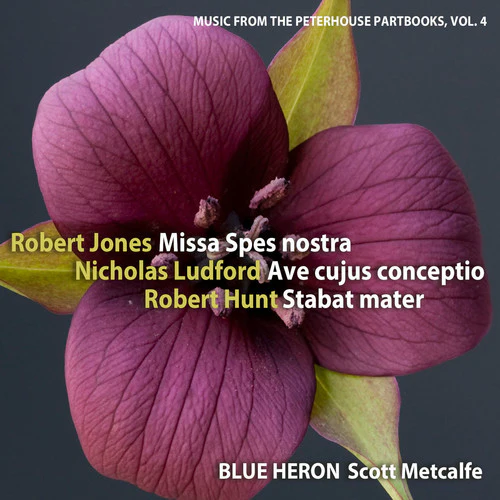
Jones: Missa Spes Nostra - Ludford: Ave Cujus Conceptio - Hunt: Stabat Mater
At their most fanatical, the radicalized Reformists of England’s Church sought to purify the Church of everything worldly—and for our purposes, that included music set to Latin texts or requiring professional performance. It didn’t need a mass uprising to achieve this cleansing, this destruction. Merely a few small gangs of determined individuals in a time and place when the rule of law was in abeyance was probably sufficient, though the appointment of several influential Puritans to high office certainly didn’t help matters. Much music is known to have been lost, though a justified level of fear encouraged forethought in a few instances. It wasn’t until 1926 that a servant at Peterhouse revealed a hidden cupboard behind the Perne library’s paneling, for instance, where three Caroline partbooks were hidden.
Still, some of the partbooks have gone missing over time; and given that a set, one voice to a part, is required for performance, any loss has proven sufficient to silence so much fine Tudor polyphony. The Henrician Peterhouse group—Peterhouse MSS 40, 41, 31 and 32, a total of 72 works, 39 of which are unica—furnish a sad example of this. Of its five partbooks, the tenor is missing, as well as several leaves removed at some point from the treble. Various scholars long asserted that the kind of florid style frequently found in these books was no longer being composed in the later years of Henry’s rule, and paid no attention to the partbooks because they were little known and their contents unperformable. It is thanks to musicologist Nick Sandon, who has supplied the tenor part (and when necessary, the treble), that we have a working edition of those compositions that can’t be found elsewhere.
This fourth volume of the series once again features a work by Nicholas Ludford (c. 1490–1557). He is easily the best-known composer on the disc, which, given that he was almost entirely unknown until the last half century, says much about England’s musical discontinuity. (As well as the importance of Peterhouse’s Henrician partbooks; for a fair amount of what they include isn’t unica by well-known composers, but by those who lived, worked, died, and were completely forgotten.) Though his Ave cujus conceptio is not the centerpiece of the album as the Missa Regnum mundi (Blue Heron 1003) and Missa Inclina cor meum (Blue Heron 1004) were of theirs, it is a brightly buoyant work without shadows, launching lengthy melismatic phrases like so many streamers.
The central work on the program is the Missa Spes nostra of Robert Jones (fl. 1520–1535). His is a cantus firmus Mass, and as was the custom in England at the time, there is no pre-composed, polyphonic Kyrie. (Blue Heron supplies a plainchant one from the Sarum use sung, as was this Mass, on Trinity Sunday.) Metcalfe points out in his excellent liner notes that Jones “plays with the idea of alternation between major and minor harmonizations of the third scale degree” throughout the Mass. This, along with some simpler homophonic statements among the wealth of imitation, gives it at times an almost folk-like quality, though upon other occasions Jones relishes the passing dissonances his juxtapositions invite. Sandon notes in his doctoral dissertation that Jones can be unpredictable, and that he “sometimes writes very neat motivically generated counterpoint, but at other times he can be quirky and wayward.” This Mass is a highly individualized work, and amply repays repeated listening.
The final composer on the program, Robert Hunt, is so obscure that he hasn’t even been further identified yet. Only two pieces of his survive, both in the Peterhouse partbooks: an Ave Maria mater dei, and the Stabat mater dolorosa heard here. It is the only work on the disc missing both its tenor and treble parts, which Sandon has supplied. In a manner that recalls the spiritual exercises of St. Ignatius of Loyola, it invites the listener to partake in the successive emotions experienced at the foot of the Cross by Mary, and manages this brilliantly in a very free, intensely emotive fashion. It should be required listening of anyone who feels that imitative counterpoint can’t be expressive.
It is also a superb example of what Scott Metcalfe has achieved with Blue Heron: an ensemble that yields to none for intonation, blend, and clarity, yet also utilizes both overall and part-related dynamics as an expressive device in a way most other professional choirs of its quality do not. Metcalfe is alive to the lyricism that was a remarked-upon feature of 15th-century English music, and the beauty of Blue Heron’s phrasing displays this everywhere on this disc. That the choir isn’t better known is no doubt a result in part of its rarified repertoire, but also Metcalfe’s desire to retain control over all aspects of his recordings. So you won’t find Blue Heron on such labels as Hyperion or Harmonia Mundi, but you will find that the excellent engineering on this album provides a close, rich sound with just enough reverberation to give body to the voices.
Complete texts and translations are included. Really, the entire series to date is worth the purchase. And if you want to sample some of Blue Heron’s recordings, as well as buy them, the place to go is blueheronchoir.org. Strongly recommended.
Still, some of the partbooks have gone missing over time; and given that a set, one voice to a part, is required for performance, any loss has proven sufficient to silence so much fine Tudor polyphony. The Henrician Peterhouse group—Peterhouse MSS 40, 41, 31 and 32, a total of 72 works, 39 of which are unica—furnish a sad example of this. Of its five partbooks, the tenor is missing, as well as several leaves removed at some point from the treble. Various scholars long asserted that the kind of florid style frequently found in these books was no longer being composed in the later years of Henry’s rule, and paid no attention to the partbooks because they were little known and their contents unperformable. It is thanks to musicologist Nick Sandon, who has supplied the tenor part (and when necessary, the treble), that we have a working edition of those compositions that can’t be found elsewhere.
This fourth volume of the series once again features a work by Nicholas Ludford (c. 1490–1557). He is easily the best-known composer on the disc, which, given that he was almost entirely unknown until the last half century, says much about England’s musical discontinuity. (As well as the importance of Peterhouse’s Henrician partbooks; for a fair amount of what they include isn’t unica by well-known composers, but by those who lived, worked, died, and were completely forgotten.) Though his Ave cujus conceptio is not the centerpiece of the album as the Missa Regnum mundi (Blue Heron 1003) and Missa Inclina cor meum (Blue Heron 1004) were of theirs, it is a brightly buoyant work without shadows, launching lengthy melismatic phrases like so many streamers.
The central work on the program is the Missa Spes nostra of Robert Jones (fl. 1520–1535). His is a cantus firmus Mass, and as was the custom in England at the time, there is no pre-composed, polyphonic Kyrie. (Blue Heron supplies a plainchant one from the Sarum use sung, as was this Mass, on Trinity Sunday.) Metcalfe points out in his excellent liner notes that Jones “plays with the idea of alternation between major and minor harmonizations of the third scale degree” throughout the Mass. This, along with some simpler homophonic statements among the wealth of imitation, gives it at times an almost folk-like quality, though upon other occasions Jones relishes the passing dissonances his juxtapositions invite. Sandon notes in his doctoral dissertation that Jones can be unpredictable, and that he “sometimes writes very neat motivically generated counterpoint, but at other times he can be quirky and wayward.” This Mass is a highly individualized work, and amply repays repeated listening.
The final composer on the program, Robert Hunt, is so obscure that he hasn’t even been further identified yet. Only two pieces of his survive, both in the Peterhouse partbooks: an Ave Maria mater dei, and the Stabat mater dolorosa heard here. It is the only work on the disc missing both its tenor and treble parts, which Sandon has supplied. In a manner that recalls the spiritual exercises of St. Ignatius of Loyola, it invites the listener to partake in the successive emotions experienced at the foot of the Cross by Mary, and manages this brilliantly in a very free, intensely emotive fashion. It should be required listening of anyone who feels that imitative counterpoint can’t be expressive.
It is also a superb example of what Scott Metcalfe has achieved with Blue Heron: an ensemble that yields to none for intonation, blend, and clarity, yet also utilizes both overall and part-related dynamics as an expressive device in a way most other professional choirs of its quality do not. Metcalfe is alive to the lyricism that was a remarked-upon feature of 15th-century English music, and the beauty of Blue Heron’s phrasing displays this everywhere on this disc. That the choir isn’t better known is no doubt a result in part of its rarified repertoire, but also Metcalfe’s desire to retain control over all aspects of his recordings. So you won’t find Blue Heron on such labels as Hyperion or Harmonia Mundi, but you will find that the excellent engineering on this album provides a close, rich sound with just enough reverberation to give body to the voices.
Complete texts and translations are included. Really, the entire series to date is worth the purchase. And if you want to sample some of Blue Heron’s recordings, as well as buy them, the place to go is blueheronchoir.org. Strongly recommended.
At their most fanatical, the radicalized Reformists of England’s Church sought to purify the Church of everything worldly—and for our purposes, that included music set to Latin texts or requiring professional performance. It didn’t need a mass uprising to achieve this cleansing, this destruction. Merely a few small gangs of determined individuals in a time and place when the rule of law was in abeyance was probably sufficient, though the appointment of several influential Puritans to high office certainly didn’t help matters. Much music is known to have been lost, though a justified level of fear encouraged forethought in a few instances. It wasn’t until 1926 that a servant at Peterhouse revealed a hidden cupboard behind the Perne library’s paneling, for instance, where three Caroline partbooks were hidden.
Still, some of the partbooks have gone missing over time; and given that a set, one voice to a part, is required for performance, any loss has proven sufficient to silence so much fine Tudor polyphony. The Henrician Peterhouse group—Peterhouse MSS 40, 41, 31 and 32, a total of 72 works, 39 of which are unica—furnish a sad example of this. Of its five partbooks, the tenor is missing, as well as several leaves removed at some point from the treble. Various scholars long asserted that the kind of florid style frequently found in these books was no longer being composed in the later years of Henry’s rule, and paid no attention to the partbooks because they were little known and their contents unperformable. It is thanks to musicologist Nick Sandon, who has supplied the tenor part (and when necessary, the treble), that we have a working edition of those compositions that can’t be found elsewhere.
This fourth volume of the series once again features a work by Nicholas Ludford (c. 1490–1557). He is easily the best-known composer on the disc, which, given that he was almost entirely unknown until the last half century, says much about England’s musical discontinuity. (As well as the importance of Peterhouse’s Henrician partbooks; for a fair amount of what they include isn’t unica by well-known composers, but by those who lived, worked, died, and were completely forgotten.) Though his Ave cujus conceptio is not the centerpiece of the album as the Missa Regnum mundi (Blue Heron 1003) and Missa Inclina cor meum (Blue Heron 1004) were of theirs, it is a brightly buoyant work without shadows, launching lengthy melismatic phrases like so many streamers.
The central work on the program is the Missa Spes nostra of Robert Jones (fl. 1520–1535). His is a cantus firmus Mass, and as was the custom in England at the time, there is no pre-composed, polyphonic Kyrie. (Blue Heron supplies a plainchant one from the Sarum use sung, as was this Mass, on Trinity Sunday.) Metcalfe points out in his excellent liner notes that Jones “plays with the idea of alternation between major and minor harmonizations of the third scale degree” throughout the Mass. This, along with some simpler homophonic statements among the wealth of imitation, gives it at times an almost folk-like quality, though upon other occasions Jones relishes the passing dissonances his juxtapositions invite. Sandon notes in his doctoral dissertation that Jones can be unpredictable, and that he “sometimes writes very neat motivically generated counterpoint, but at other times he can be quirky and wayward.” This Mass is a highly individualized work, and amply repays repeated listening.
The final composer on the program, Robert Hunt, is so obscure that he hasn’t even been further identified yet. Only two pieces of his survive, both in the Peterhouse partbooks: an Ave Maria mater dei, and the Stabat mater dolorosa heard here. It is the only work on the disc missing both its tenor and treble parts, which Sandon has supplied. In a manner that recalls the spiritual exercises of St. Ignatius of Loyola, it invites the listener to partake in the successive emotions experienced at the foot of the Cross by Mary, and manages this brilliantly in a very free, intensely emotive fashion. It should be required listening of anyone who feels that imitative counterpoint can’t be expressive.
It is also a superb example of what Scott Metcalfe has achieved with Blue Heron: an ensemble that yields to none for intonation, blend, and clarity, yet also utilizes both overall and part-related dynamics as an expressive device in a way most other professional choirs of its quality do not. Metcalfe is alive to the lyricism that was a remarked-upon feature of 15th-century English music, and the beauty of Blue Heron’s phrasing displays this everywhere on this disc. That the choir isn’t better known is no doubt a result in part of its rarified repertoire, but also Metcalfe’s desire to retain control over all aspects of his recordings. So you won’t find Blue Heron on such labels as Hyperion or Harmonia Mundi, but you will find that the excellent engineering on this album provides a close, rich sound with just enough reverberation to give body to the voices.
Complete texts and translations are included. Really, the entire series to date is worth the purchase. And if you want to sample some of Blue Heron’s recordings, as well as buy them, the place to go is blueheronchoir.org. Strongly recommended.
Still, some of the partbooks have gone missing over time; and given that a set, one voice to a part, is required for performance, any loss has proven sufficient to silence so much fine Tudor polyphony. The Henrician Peterhouse group—Peterhouse MSS 40, 41, 31 and 32, a total of 72 works, 39 of which are unica—furnish a sad example of this. Of its five partbooks, the tenor is missing, as well as several leaves removed at some point from the treble. Various scholars long asserted that the kind of florid style frequently found in these books was no longer being composed in the later years of Henry’s rule, and paid no attention to the partbooks because they were little known and their contents unperformable. It is thanks to musicologist Nick Sandon, who has supplied the tenor part (and when necessary, the treble), that we have a working edition of those compositions that can’t be found elsewhere.
This fourth volume of the series once again features a work by Nicholas Ludford (c. 1490–1557). He is easily the best-known composer on the disc, which, given that he was almost entirely unknown until the last half century, says much about England’s musical discontinuity. (As well as the importance of Peterhouse’s Henrician partbooks; for a fair amount of what they include isn’t unica by well-known composers, but by those who lived, worked, died, and were completely forgotten.) Though his Ave cujus conceptio is not the centerpiece of the album as the Missa Regnum mundi (Blue Heron 1003) and Missa Inclina cor meum (Blue Heron 1004) were of theirs, it is a brightly buoyant work without shadows, launching lengthy melismatic phrases like so many streamers.
The central work on the program is the Missa Spes nostra of Robert Jones (fl. 1520–1535). His is a cantus firmus Mass, and as was the custom in England at the time, there is no pre-composed, polyphonic Kyrie. (Blue Heron supplies a plainchant one from the Sarum use sung, as was this Mass, on Trinity Sunday.) Metcalfe points out in his excellent liner notes that Jones “plays with the idea of alternation between major and minor harmonizations of the third scale degree” throughout the Mass. This, along with some simpler homophonic statements among the wealth of imitation, gives it at times an almost folk-like quality, though upon other occasions Jones relishes the passing dissonances his juxtapositions invite. Sandon notes in his doctoral dissertation that Jones can be unpredictable, and that he “sometimes writes very neat motivically generated counterpoint, but at other times he can be quirky and wayward.” This Mass is a highly individualized work, and amply repays repeated listening.
The final composer on the program, Robert Hunt, is so obscure that he hasn’t even been further identified yet. Only two pieces of his survive, both in the Peterhouse partbooks: an Ave Maria mater dei, and the Stabat mater dolorosa heard here. It is the only work on the disc missing both its tenor and treble parts, which Sandon has supplied. In a manner that recalls the spiritual exercises of St. Ignatius of Loyola, it invites the listener to partake in the successive emotions experienced at the foot of the Cross by Mary, and manages this brilliantly in a very free, intensely emotive fashion. It should be required listening of anyone who feels that imitative counterpoint can’t be expressive.
It is also a superb example of what Scott Metcalfe has achieved with Blue Heron: an ensemble that yields to none for intonation, blend, and clarity, yet also utilizes both overall and part-related dynamics as an expressive device in a way most other professional choirs of its quality do not. Metcalfe is alive to the lyricism that was a remarked-upon feature of 15th-century English music, and the beauty of Blue Heron’s phrasing displays this everywhere on this disc. That the choir isn’t better known is no doubt a result in part of its rarified repertoire, but also Metcalfe’s desire to retain control over all aspects of his recordings. So you won’t find Blue Heron on such labels as Hyperion or Harmonia Mundi, but you will find that the excellent engineering on this album provides a close, rich sound with just enough reverberation to give body to the voices.
Complete texts and translations are included. Really, the entire series to date is worth the purchase. And if you want to sample some of Blue Heron’s recordings, as well as buy them, the place to go is blueheronchoir.org. Strongly recommended.
$7.70
Original: $21.99
-65%Jones: Missa Spes Nostra - Ludford: Ave Cujus Conceptio - Hunt: Stabat Mater—
$21.99
$7.70Description
At their most fanatical, the radicalized Reformists of England’s Church sought to purify the Church of everything worldly—and for our purposes, that included music set to Latin texts or requiring professional performance. It didn’t need a mass uprising to achieve this cleansing, this destruction. Merely a few small gangs of determined individuals in a time and place when the rule of law was in abeyance was probably sufficient, though the appointment of several influential Puritans to high office certainly didn’t help matters. Much music is known to have been lost, though a justified level of fear encouraged forethought in a few instances. It wasn’t until 1926 that a servant at Peterhouse revealed a hidden cupboard behind the Perne library’s paneling, for instance, where three Caroline partbooks were hidden.
Still, some of the partbooks have gone missing over time; and given that a set, one voice to a part, is required for performance, any loss has proven sufficient to silence so much fine Tudor polyphony. The Henrician Peterhouse group—Peterhouse MSS 40, 41, 31 and 32, a total of 72 works, 39 of which are unica—furnish a sad example of this. Of its five partbooks, the tenor is missing, as well as several leaves removed at some point from the treble. Various scholars long asserted that the kind of florid style frequently found in these books was no longer being composed in the later years of Henry’s rule, and paid no attention to the partbooks because they were little known and their contents unperformable. It is thanks to musicologist Nick Sandon, who has supplied the tenor part (and when necessary, the treble), that we have a working edition of those compositions that can’t be found elsewhere.
This fourth volume of the series once again features a work by Nicholas Ludford (c. 1490–1557). He is easily the best-known composer on the disc, which, given that he was almost entirely unknown until the last half century, says much about England’s musical discontinuity. (As well as the importance of Peterhouse’s Henrician partbooks; for a fair amount of what they include isn’t unica by well-known composers, but by those who lived, worked, died, and were completely forgotten.) Though his Ave cujus conceptio is not the centerpiece of the album as the Missa Regnum mundi (Blue Heron 1003) and Missa Inclina cor meum (Blue Heron 1004) were of theirs, it is a brightly buoyant work without shadows, launching lengthy melismatic phrases like so many streamers.
The central work on the program is the Missa Spes nostra of Robert Jones (fl. 1520–1535). His is a cantus firmus Mass, and as was the custom in England at the time, there is no pre-composed, polyphonic Kyrie. (Blue Heron supplies a plainchant one from the Sarum use sung, as was this Mass, on Trinity Sunday.) Metcalfe points out in his excellent liner notes that Jones “plays with the idea of alternation between major and minor harmonizations of the third scale degree” throughout the Mass. This, along with some simpler homophonic statements among the wealth of imitation, gives it at times an almost folk-like quality, though upon other occasions Jones relishes the passing dissonances his juxtapositions invite. Sandon notes in his doctoral dissertation that Jones can be unpredictable, and that he “sometimes writes very neat motivically generated counterpoint, but at other times he can be quirky and wayward.” This Mass is a highly individualized work, and amply repays repeated listening.
The final composer on the program, Robert Hunt, is so obscure that he hasn’t even been further identified yet. Only two pieces of his survive, both in the Peterhouse partbooks: an Ave Maria mater dei, and the Stabat mater dolorosa heard here. It is the only work on the disc missing both its tenor and treble parts, which Sandon has supplied. In a manner that recalls the spiritual exercises of St. Ignatius of Loyola, it invites the listener to partake in the successive emotions experienced at the foot of the Cross by Mary, and manages this brilliantly in a very free, intensely emotive fashion. It should be required listening of anyone who feels that imitative counterpoint can’t be expressive.
It is also a superb example of what Scott Metcalfe has achieved with Blue Heron: an ensemble that yields to none for intonation, blend, and clarity, yet also utilizes both overall and part-related dynamics as an expressive device in a way most other professional choirs of its quality do not. Metcalfe is alive to the lyricism that was a remarked-upon feature of 15th-century English music, and the beauty of Blue Heron’s phrasing displays this everywhere on this disc. That the choir isn’t better known is no doubt a result in part of its rarified repertoire, but also Metcalfe’s desire to retain control over all aspects of his recordings. So you won’t find Blue Heron on such labels as Hyperion or Harmonia Mundi, but you will find that the excellent engineering on this album provides a close, rich sound with just enough reverberation to give body to the voices.
Complete texts and translations are included. Really, the entire series to date is worth the purchase. And if you want to sample some of Blue Heron’s recordings, as well as buy them, the place to go is blueheronchoir.org. Strongly recommended.
Still, some of the partbooks have gone missing over time; and given that a set, one voice to a part, is required for performance, any loss has proven sufficient to silence so much fine Tudor polyphony. The Henrician Peterhouse group—Peterhouse MSS 40, 41, 31 and 32, a total of 72 works, 39 of which are unica—furnish a sad example of this. Of its five partbooks, the tenor is missing, as well as several leaves removed at some point from the treble. Various scholars long asserted that the kind of florid style frequently found in these books was no longer being composed in the later years of Henry’s rule, and paid no attention to the partbooks because they were little known and their contents unperformable. It is thanks to musicologist Nick Sandon, who has supplied the tenor part (and when necessary, the treble), that we have a working edition of those compositions that can’t be found elsewhere.
This fourth volume of the series once again features a work by Nicholas Ludford (c. 1490–1557). He is easily the best-known composer on the disc, which, given that he was almost entirely unknown until the last half century, says much about England’s musical discontinuity. (As well as the importance of Peterhouse’s Henrician partbooks; for a fair amount of what they include isn’t unica by well-known composers, but by those who lived, worked, died, and were completely forgotten.) Though his Ave cujus conceptio is not the centerpiece of the album as the Missa Regnum mundi (Blue Heron 1003) and Missa Inclina cor meum (Blue Heron 1004) were of theirs, it is a brightly buoyant work without shadows, launching lengthy melismatic phrases like so many streamers.
The central work on the program is the Missa Spes nostra of Robert Jones (fl. 1520–1535). His is a cantus firmus Mass, and as was the custom in England at the time, there is no pre-composed, polyphonic Kyrie. (Blue Heron supplies a plainchant one from the Sarum use sung, as was this Mass, on Trinity Sunday.) Metcalfe points out in his excellent liner notes that Jones “plays with the idea of alternation between major and minor harmonizations of the third scale degree” throughout the Mass. This, along with some simpler homophonic statements among the wealth of imitation, gives it at times an almost folk-like quality, though upon other occasions Jones relishes the passing dissonances his juxtapositions invite. Sandon notes in his doctoral dissertation that Jones can be unpredictable, and that he “sometimes writes very neat motivically generated counterpoint, but at other times he can be quirky and wayward.” This Mass is a highly individualized work, and amply repays repeated listening.
The final composer on the program, Robert Hunt, is so obscure that he hasn’t even been further identified yet. Only two pieces of his survive, both in the Peterhouse partbooks: an Ave Maria mater dei, and the Stabat mater dolorosa heard here. It is the only work on the disc missing both its tenor and treble parts, which Sandon has supplied. In a manner that recalls the spiritual exercises of St. Ignatius of Loyola, it invites the listener to partake in the successive emotions experienced at the foot of the Cross by Mary, and manages this brilliantly in a very free, intensely emotive fashion. It should be required listening of anyone who feels that imitative counterpoint can’t be expressive.
It is also a superb example of what Scott Metcalfe has achieved with Blue Heron: an ensemble that yields to none for intonation, blend, and clarity, yet also utilizes both overall and part-related dynamics as an expressive device in a way most other professional choirs of its quality do not. Metcalfe is alive to the lyricism that was a remarked-upon feature of 15th-century English music, and the beauty of Blue Heron’s phrasing displays this everywhere on this disc. That the choir isn’t better known is no doubt a result in part of its rarified repertoire, but also Metcalfe’s desire to retain control over all aspects of his recordings. So you won’t find Blue Heron on such labels as Hyperion or Harmonia Mundi, but you will find that the excellent engineering on this album provides a close, rich sound with just enough reverberation to give body to the voices.
Complete texts and translations are included. Really, the entire series to date is worth the purchase. And if you want to sample some of Blue Heron’s recordings, as well as buy them, the place to go is blueheronchoir.org. Strongly recommended.