🎉 Up to 70% Off Selected ItemsShop Sale

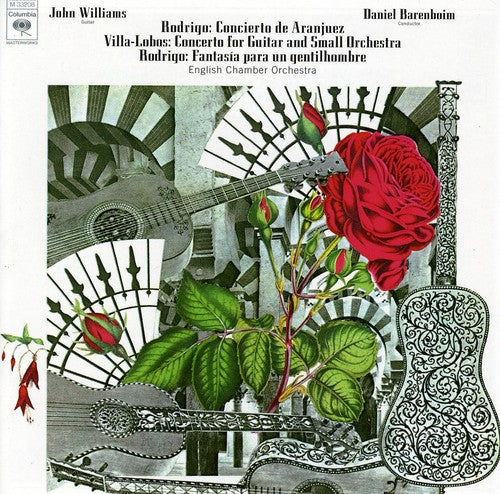
Rodrigo: Concierto De Aranjuez, Fantasia Para Un Gentilhombre; Villa-Lobos / John Williams
There has been no shortage of good versions of the Concierto de Aranjuez, a tribute to its unique charms in this virtually impossible concerto genre. John Williams himself has already made one of the finest, yet if possible even more conclusively this new one must be counted a winner, irresistible from first to last. The differences in interpretation are relatively minor but add up significantly. Broadly speaking Williams allows himself mole rhythmic freedom this time, more expressive rubato in the slow movement (taken a fraction slower), more infectious pointing in the outer movements. Quite simply it may be a question of Williams nowadays enjoying himself more in the recording studio, tensing-up a fraction less. The first movement is more carefree than before, and there the comparison with Bream is interesting. Bream has his lilting manner all right, but he is fiercer, less relaxed than the latter-day Williams. Williams before showed himself the most formidable technician, rigorously precise: now he shows himself as that and more, giving Rodrigo's haunting but trivial ideas extra flair and imagination.
The recording this time still puts the solo instrument well to the fore (how else can you balance a guitar concerto?) but there is more light and shade. Compare for example the passage in the first movement where the solo cello enters. The Philadelphia playing under Ormandy is marvellously well drilled, but the EGO under Barenboim matches the delicacy of Williams more subtly, helped by the recording.
Maybe it is my imagination but the balance in the Villa-Lobos Concerto on the reverse seems to balance the soloist closer still. In the first movement the closeness gives extra emphasis. The more natural balance given to Bream on his RCA version exposes the flimsiness of the argument—not difficult, I fear, in this work. In the last movement it is rather the other way about with Bream finding far more charm and fantasy, where Williams's fine playing is not helped by the closeness, the relative absence of light and shade. In any case comparisons are largely academic, when the couplings are so different. Anyone wanting the most delightful of guitar concertos—I refer to the Rodrigo— coupled with a different concerto from last time will be well satisfied with the new disc. Williams has rarely projected his musical personality more positively on record. Quite apart from balances, the recording is sweeter and clearer than last time.
– Gramophone [1/1975], reviewing the original LP
The recording this time still puts the solo instrument well to the fore (how else can you balance a guitar concerto?) but there is more light and shade. Compare for example the passage in the first movement where the solo cello enters. The Philadelphia playing under Ormandy is marvellously well drilled, but the EGO under Barenboim matches the delicacy of Williams more subtly, helped by the recording.
Maybe it is my imagination but the balance in the Villa-Lobos Concerto on the reverse seems to balance the soloist closer still. In the first movement the closeness gives extra emphasis. The more natural balance given to Bream on his RCA version exposes the flimsiness of the argument—not difficult, I fear, in this work. In the last movement it is rather the other way about with Bream finding far more charm and fantasy, where Williams's fine playing is not helped by the closeness, the relative absence of light and shade. In any case comparisons are largely academic, when the couplings are so different. Anyone wanting the most delightful of guitar concertos—I refer to the Rodrigo— coupled with a different concerto from last time will be well satisfied with the new disc. Williams has rarely projected his musical personality more positively on record. Quite apart from balances, the recording is sweeter and clearer than last time.
– Gramophone [1/1975], reviewing the original LP
There has been no shortage of good versions of the Concierto de Aranjuez, a tribute to its unique charms in this virtually impossible concerto genre. John Williams himself has already made one of the finest, yet if possible even more conclusively this new one must be counted a winner, irresistible from first to last. The differences in interpretation are relatively minor but add up significantly. Broadly speaking Williams allows himself mole rhythmic freedom this time, more expressive rubato in the slow movement (taken a fraction slower), more infectious pointing in the outer movements. Quite simply it may be a question of Williams nowadays enjoying himself more in the recording studio, tensing-up a fraction less. The first movement is more carefree than before, and there the comparison with Bream is interesting. Bream has his lilting manner all right, but he is fiercer, less relaxed than the latter-day Williams. Williams before showed himself the most formidable technician, rigorously precise: now he shows himself as that and more, giving Rodrigo's haunting but trivial ideas extra flair and imagination.
The recording this time still puts the solo instrument well to the fore (how else can you balance a guitar concerto?) but there is more light and shade. Compare for example the passage in the first movement where the solo cello enters. The Philadelphia playing under Ormandy is marvellously well drilled, but the EGO under Barenboim matches the delicacy of Williams more subtly, helped by the recording.
Maybe it is my imagination but the balance in the Villa-Lobos Concerto on the reverse seems to balance the soloist closer still. In the first movement the closeness gives extra emphasis. The more natural balance given to Bream on his RCA version exposes the flimsiness of the argument—not difficult, I fear, in this work. In the last movement it is rather the other way about with Bream finding far more charm and fantasy, where Williams's fine playing is not helped by the closeness, the relative absence of light and shade. In any case comparisons are largely academic, when the couplings are so different. Anyone wanting the most delightful of guitar concertos—I refer to the Rodrigo— coupled with a different concerto from last time will be well satisfied with the new disc. Williams has rarely projected his musical personality more positively on record. Quite apart from balances, the recording is sweeter and clearer than last time.
– Gramophone [1/1975], reviewing the original LP
The recording this time still puts the solo instrument well to the fore (how else can you balance a guitar concerto?) but there is more light and shade. Compare for example the passage in the first movement where the solo cello enters. The Philadelphia playing under Ormandy is marvellously well drilled, but the EGO under Barenboim matches the delicacy of Williams more subtly, helped by the recording.
Maybe it is my imagination but the balance in the Villa-Lobos Concerto on the reverse seems to balance the soloist closer still. In the first movement the closeness gives extra emphasis. The more natural balance given to Bream on his RCA version exposes the flimsiness of the argument—not difficult, I fear, in this work. In the last movement it is rather the other way about with Bream finding far more charm and fantasy, where Williams's fine playing is not helped by the closeness, the relative absence of light and shade. In any case comparisons are largely academic, when the couplings are so different. Anyone wanting the most delightful of guitar concertos—I refer to the Rodrigo— coupled with a different concerto from last time will be well satisfied with the new disc. Williams has rarely projected his musical personality more positively on record. Quite apart from balances, the recording is sweeter and clearer than last time.
– Gramophone [1/1975], reviewing the original LP
$9.99
Rodrigo: Concierto De Aranjuez, Fantasia Para Un Gentilhombre; Villa-Lobos / John Williams—
$9.99
Description
There has been no shortage of good versions of the Concierto de Aranjuez, a tribute to its unique charms in this virtually impossible concerto genre. John Williams himself has already made one of the finest, yet if possible even more conclusively this new one must be counted a winner, irresistible from first to last. The differences in interpretation are relatively minor but add up significantly. Broadly speaking Williams allows himself mole rhythmic freedom this time, more expressive rubato in the slow movement (taken a fraction slower), more infectious pointing in the outer movements. Quite simply it may be a question of Williams nowadays enjoying himself more in the recording studio, tensing-up a fraction less. The first movement is more carefree than before, and there the comparison with Bream is interesting. Bream has his lilting manner all right, but he is fiercer, less relaxed than the latter-day Williams. Williams before showed himself the most formidable technician, rigorously precise: now he shows himself as that and more, giving Rodrigo's haunting but trivial ideas extra flair and imagination.
The recording this time still puts the solo instrument well to the fore (how else can you balance a guitar concerto?) but there is more light and shade. Compare for example the passage in the first movement where the solo cello enters. The Philadelphia playing under Ormandy is marvellously well drilled, but the EGO under Barenboim matches the delicacy of Williams more subtly, helped by the recording.
Maybe it is my imagination but the balance in the Villa-Lobos Concerto on the reverse seems to balance the soloist closer still. In the first movement the closeness gives extra emphasis. The more natural balance given to Bream on his RCA version exposes the flimsiness of the argument—not difficult, I fear, in this work. In the last movement it is rather the other way about with Bream finding far more charm and fantasy, where Williams's fine playing is not helped by the closeness, the relative absence of light and shade. In any case comparisons are largely academic, when the couplings are so different. Anyone wanting the most delightful of guitar concertos—I refer to the Rodrigo— coupled with a different concerto from last time will be well satisfied with the new disc. Williams has rarely projected his musical personality more positively on record. Quite apart from balances, the recording is sweeter and clearer than last time.
– Gramophone [1/1975], reviewing the original LP
The recording this time still puts the solo instrument well to the fore (how else can you balance a guitar concerto?) but there is more light and shade. Compare for example the passage in the first movement where the solo cello enters. The Philadelphia playing under Ormandy is marvellously well drilled, but the EGO under Barenboim matches the delicacy of Williams more subtly, helped by the recording.
Maybe it is my imagination but the balance in the Villa-Lobos Concerto on the reverse seems to balance the soloist closer still. In the first movement the closeness gives extra emphasis. The more natural balance given to Bream on his RCA version exposes the flimsiness of the argument—not difficult, I fear, in this work. In the last movement it is rather the other way about with Bream finding far more charm and fantasy, where Williams's fine playing is not helped by the closeness, the relative absence of light and shade. In any case comparisons are largely academic, when the couplings are so different. Anyone wanting the most delightful of guitar concertos—I refer to the Rodrigo— coupled with a different concerto from last time will be well satisfied with the new disc. Williams has rarely projected his musical personality more positively on record. Quite apart from balances, the recording is sweeter and clearer than last time.
– Gramophone [1/1975], reviewing the original LP