🎉 Up to 70% Off Selected ItemsShop Sale

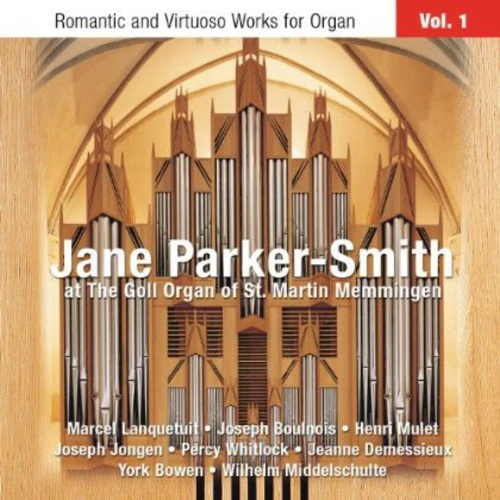
Romantic And Virtuoso Works For Organ / Jane Parker-smith
This release ably serves two purposes—to display the virtues of the new Caivillé-Coll-style Goll organ recently installed in St. Martin’s Church, Memmingen, and to showcase the talents of organist Jane Parker-Smith. The repertoire has been selected for its accessibility and its potential for virtuoso display. Composers Marcel Lanquetuit (1894–1985), Joseph Boulnois (1884–1918), Henri Mulet (1878–1967), and Joseph Jongen (1873–1953) are squarely in the Franco-Belgian tradition of Franck, Widor, and Vierne. Jeanne Demessieux (1921–1968), a student of Marcel Dupré, enters the world of Messiaen, and English composers Percy Whitlock (1903–1946) and York Bowen (1884–1961) present a parallel English ecclesiastical tradition, while German composer Wilhelm Middelschulte (1863–1943) is in the Bach-Busoni orb. This selection allows Jane Parker-Smith to show, at one extreme, her prowess in a series of pastel-colored works requiring sustained slow tempos and concomitantly revealing registrations (Boulnois’s Choral in F??Minor, Mulet’s Rosace), and, at the other, her ability to tackle the large-scale Lisztian utterances of Jongen’s Sonata eroica and Middelschulte’s stunning Passacaglia.
The success of an organ recording depends both on the prowess of the performer and on the interface between the instrument and its surrounding space. In this case, it is a felicitous marriage. The results are warm, transparent, and, where need be, highly resonant without blurring any details. The quality of the recording rivals that of the Loft label’s best production.
The advent of the CD freed organ recordings of the limitations imposed by the LP tape to disc transfer. A 16 Herz C organ pedal could not be cut at all, let alone at a realistic level. Only its upper harmonics had to suffice. Early organ CDs reveled in their ability to produce woofer-damaging lower frequencies at the expense of any realistic musical balance. Bit by bit, however, musical intelligence finally prevailed, and here it is eloquently made manifest.
Jane Parker-Smith studied at the Royal College of Music in London. She subsequently took instruction with Jean Langlais in Paris. Her performances have the clarity and guisto tempi of those of Keven Boyer and Christopher Herrick. In her readings, she successfully balances the demands for exactitude and linear coherence with that of her need to actually interpret (pardon my split infinitive) these largely post-Romantic pieces. In other words, to personalize them and thus make them really communicate with the contemporary listener. Her success is striking and immediately made manifest in track 1, Marcel Lanquetuit’s Toccata, a kinder and gentler version of the Toccata that closes Widor’s Organ Symphony No. 5.
Igor Stravinsky, an excellent writer for wind instruments once said of the organ, and I paraphrase: “It’s unnatural . . . it never breathes.” Here Jane Parker-Smith makes it breathe. That this is only Volume 1 delights me. I hope that she will continue to explore these still largely musicological byways and illuminate them as beautifully as she has done here.
Preaching to the converted has never been particularly satisfying to me. The result in this case is an illuminating, and in terms of repertoire, essential recording that will delight aficionados, but, most important, will appeal to those just discovering this literature. Full organ specs are provided. If you haven’t gotten the message by now, this one is most warmly recommended.
--William Zagorski, FANFARE
The success of an organ recording depends both on the prowess of the performer and on the interface between the instrument and its surrounding space. In this case, it is a felicitous marriage. The results are warm, transparent, and, where need be, highly resonant without blurring any details. The quality of the recording rivals that of the Loft label’s best production.
The advent of the CD freed organ recordings of the limitations imposed by the LP tape to disc transfer. A 16 Herz C organ pedal could not be cut at all, let alone at a realistic level. Only its upper harmonics had to suffice. Early organ CDs reveled in their ability to produce woofer-damaging lower frequencies at the expense of any realistic musical balance. Bit by bit, however, musical intelligence finally prevailed, and here it is eloquently made manifest.
Jane Parker-Smith studied at the Royal College of Music in London. She subsequently took instruction with Jean Langlais in Paris. Her performances have the clarity and guisto tempi of those of Keven Boyer and Christopher Herrick. In her readings, she successfully balances the demands for exactitude and linear coherence with that of her need to actually interpret (pardon my split infinitive) these largely post-Romantic pieces. In other words, to personalize them and thus make them really communicate with the contemporary listener. Her success is striking and immediately made manifest in track 1, Marcel Lanquetuit’s Toccata, a kinder and gentler version of the Toccata that closes Widor’s Organ Symphony No. 5.
Igor Stravinsky, an excellent writer for wind instruments once said of the organ, and I paraphrase: “It’s unnatural . . . it never breathes.” Here Jane Parker-Smith makes it breathe. That this is only Volume 1 delights me. I hope that she will continue to explore these still largely musicological byways and illuminate them as beautifully as she has done here.
Preaching to the converted has never been particularly satisfying to me. The result in this case is an illuminating, and in terms of repertoire, essential recording that will delight aficionados, but, most important, will appeal to those just discovering this literature. Full organ specs are provided. If you haven’t gotten the message by now, this one is most warmly recommended.
--William Zagorski, FANFARE
This release ably serves two purposes—to display the virtues of the new Caivillé-Coll-style Goll organ recently installed in St. Martin’s Church, Memmingen, and to showcase the talents of organist Jane Parker-Smith. The repertoire has been selected for its accessibility and its potential for virtuoso display. Composers Marcel Lanquetuit (1894–1985), Joseph Boulnois (1884–1918), Henri Mulet (1878–1967), and Joseph Jongen (1873–1953) are squarely in the Franco-Belgian tradition of Franck, Widor, and Vierne. Jeanne Demessieux (1921–1968), a student of Marcel Dupré, enters the world of Messiaen, and English composers Percy Whitlock (1903–1946) and York Bowen (1884–1961) present a parallel English ecclesiastical tradition, while German composer Wilhelm Middelschulte (1863–1943) is in the Bach-Busoni orb. This selection allows Jane Parker-Smith to show, at one extreme, her prowess in a series of pastel-colored works requiring sustained slow tempos and concomitantly revealing registrations (Boulnois’s Choral in F??Minor, Mulet’s Rosace), and, at the other, her ability to tackle the large-scale Lisztian utterances of Jongen’s Sonata eroica and Middelschulte’s stunning Passacaglia.
The success of an organ recording depends both on the prowess of the performer and on the interface between the instrument and its surrounding space. In this case, it is a felicitous marriage. The results are warm, transparent, and, where need be, highly resonant without blurring any details. The quality of the recording rivals that of the Loft label’s best production.
The advent of the CD freed organ recordings of the limitations imposed by the LP tape to disc transfer. A 16 Herz C organ pedal could not be cut at all, let alone at a realistic level. Only its upper harmonics had to suffice. Early organ CDs reveled in their ability to produce woofer-damaging lower frequencies at the expense of any realistic musical balance. Bit by bit, however, musical intelligence finally prevailed, and here it is eloquently made manifest.
Jane Parker-Smith studied at the Royal College of Music in London. She subsequently took instruction with Jean Langlais in Paris. Her performances have the clarity and guisto tempi of those of Keven Boyer and Christopher Herrick. In her readings, she successfully balances the demands for exactitude and linear coherence with that of her need to actually interpret (pardon my split infinitive) these largely post-Romantic pieces. In other words, to personalize them and thus make them really communicate with the contemporary listener. Her success is striking and immediately made manifest in track 1, Marcel Lanquetuit’s Toccata, a kinder and gentler version of the Toccata that closes Widor’s Organ Symphony No. 5.
Igor Stravinsky, an excellent writer for wind instruments once said of the organ, and I paraphrase: “It’s unnatural . . . it never breathes.” Here Jane Parker-Smith makes it breathe. That this is only Volume 1 delights me. I hope that she will continue to explore these still largely musicological byways and illuminate them as beautifully as she has done here.
Preaching to the converted has never been particularly satisfying to me. The result in this case is an illuminating, and in terms of repertoire, essential recording that will delight aficionados, but, most important, will appeal to those just discovering this literature. Full organ specs are provided. If you haven’t gotten the message by now, this one is most warmly recommended.
--William Zagorski, FANFARE
The success of an organ recording depends both on the prowess of the performer and on the interface between the instrument and its surrounding space. In this case, it is a felicitous marriage. The results are warm, transparent, and, where need be, highly resonant without blurring any details. The quality of the recording rivals that of the Loft label’s best production.
The advent of the CD freed organ recordings of the limitations imposed by the LP tape to disc transfer. A 16 Herz C organ pedal could not be cut at all, let alone at a realistic level. Only its upper harmonics had to suffice. Early organ CDs reveled in their ability to produce woofer-damaging lower frequencies at the expense of any realistic musical balance. Bit by bit, however, musical intelligence finally prevailed, and here it is eloquently made manifest.
Jane Parker-Smith studied at the Royal College of Music in London. She subsequently took instruction with Jean Langlais in Paris. Her performances have the clarity and guisto tempi of those of Keven Boyer and Christopher Herrick. In her readings, she successfully balances the demands for exactitude and linear coherence with that of her need to actually interpret (pardon my split infinitive) these largely post-Romantic pieces. In other words, to personalize them and thus make them really communicate with the contemporary listener. Her success is striking and immediately made manifest in track 1, Marcel Lanquetuit’s Toccata, a kinder and gentler version of the Toccata that closes Widor’s Organ Symphony No. 5.
Igor Stravinsky, an excellent writer for wind instruments once said of the organ, and I paraphrase: “It’s unnatural . . . it never breathes.” Here Jane Parker-Smith makes it breathe. That this is only Volume 1 delights me. I hope that she will continue to explore these still largely musicological byways and illuminate them as beautifully as she has done here.
Preaching to the converted has never been particularly satisfying to me. The result in this case is an illuminating, and in terms of repertoire, essential recording that will delight aficionados, but, most important, will appeal to those just discovering this literature. Full organ specs are provided. If you haven’t gotten the message by now, this one is most warmly recommended.
--William Zagorski, FANFARE
$14.99
Romantic And Virtuoso Works For Organ / Jane Parker-smith—
$14.99
Description
This release ably serves two purposes—to display the virtues of the new Caivillé-Coll-style Goll organ recently installed in St. Martin’s Church, Memmingen, and to showcase the talents of organist Jane Parker-Smith. The repertoire has been selected for its accessibility and its potential for virtuoso display. Composers Marcel Lanquetuit (1894–1985), Joseph Boulnois (1884–1918), Henri Mulet (1878–1967), and Joseph Jongen (1873–1953) are squarely in the Franco-Belgian tradition of Franck, Widor, and Vierne. Jeanne Demessieux (1921–1968), a student of Marcel Dupré, enters the world of Messiaen, and English composers Percy Whitlock (1903–1946) and York Bowen (1884–1961) present a parallel English ecclesiastical tradition, while German composer Wilhelm Middelschulte (1863–1943) is in the Bach-Busoni orb. This selection allows Jane Parker-Smith to show, at one extreme, her prowess in a series of pastel-colored works requiring sustained slow tempos and concomitantly revealing registrations (Boulnois’s Choral in F??Minor, Mulet’s Rosace), and, at the other, her ability to tackle the large-scale Lisztian utterances of Jongen’s Sonata eroica and Middelschulte’s stunning Passacaglia.
The success of an organ recording depends both on the prowess of the performer and on the interface between the instrument and its surrounding space. In this case, it is a felicitous marriage. The results are warm, transparent, and, where need be, highly resonant without blurring any details. The quality of the recording rivals that of the Loft label’s best production.
The advent of the CD freed organ recordings of the limitations imposed by the LP tape to disc transfer. A 16 Herz C organ pedal could not be cut at all, let alone at a realistic level. Only its upper harmonics had to suffice. Early organ CDs reveled in their ability to produce woofer-damaging lower frequencies at the expense of any realistic musical balance. Bit by bit, however, musical intelligence finally prevailed, and here it is eloquently made manifest.
Jane Parker-Smith studied at the Royal College of Music in London. She subsequently took instruction with Jean Langlais in Paris. Her performances have the clarity and guisto tempi of those of Keven Boyer and Christopher Herrick. In her readings, she successfully balances the demands for exactitude and linear coherence with that of her need to actually interpret (pardon my split infinitive) these largely post-Romantic pieces. In other words, to personalize them and thus make them really communicate with the contemporary listener. Her success is striking and immediately made manifest in track 1, Marcel Lanquetuit’s Toccata, a kinder and gentler version of the Toccata that closes Widor’s Organ Symphony No. 5.
Igor Stravinsky, an excellent writer for wind instruments once said of the organ, and I paraphrase: “It’s unnatural . . . it never breathes.” Here Jane Parker-Smith makes it breathe. That this is only Volume 1 delights me. I hope that she will continue to explore these still largely musicological byways and illuminate them as beautifully as she has done here.
Preaching to the converted has never been particularly satisfying to me. The result in this case is an illuminating, and in terms of repertoire, essential recording that will delight aficionados, but, most important, will appeal to those just discovering this literature. Full organ specs are provided. If you haven’t gotten the message by now, this one is most warmly recommended.
--William Zagorski, FANFARE
The success of an organ recording depends both on the prowess of the performer and on the interface between the instrument and its surrounding space. In this case, it is a felicitous marriage. The results are warm, transparent, and, where need be, highly resonant without blurring any details. The quality of the recording rivals that of the Loft label’s best production.
The advent of the CD freed organ recordings of the limitations imposed by the LP tape to disc transfer. A 16 Herz C organ pedal could not be cut at all, let alone at a realistic level. Only its upper harmonics had to suffice. Early organ CDs reveled in their ability to produce woofer-damaging lower frequencies at the expense of any realistic musical balance. Bit by bit, however, musical intelligence finally prevailed, and here it is eloquently made manifest.
Jane Parker-Smith studied at the Royal College of Music in London. She subsequently took instruction with Jean Langlais in Paris. Her performances have the clarity and guisto tempi of those of Keven Boyer and Christopher Herrick. In her readings, she successfully balances the demands for exactitude and linear coherence with that of her need to actually interpret (pardon my split infinitive) these largely post-Romantic pieces. In other words, to personalize them and thus make them really communicate with the contemporary listener. Her success is striking and immediately made manifest in track 1, Marcel Lanquetuit’s Toccata, a kinder and gentler version of the Toccata that closes Widor’s Organ Symphony No. 5.
Igor Stravinsky, an excellent writer for wind instruments once said of the organ, and I paraphrase: “It’s unnatural . . . it never breathes.” Here Jane Parker-Smith makes it breathe. That this is only Volume 1 delights me. I hope that she will continue to explore these still largely musicological byways and illuminate them as beautifully as she has done here.
Preaching to the converted has never been particularly satisfying to me. The result in this case is an illuminating, and in terms of repertoire, essential recording that will delight aficionados, but, most important, will appeal to those just discovering this literature. Full organ specs are provided. If you haven’t gotten the message by now, this one is most warmly recommended.
--William Zagorski, FANFARE