🎉 Up to 70% Off Selected ItemsShop Sale

1 / 2
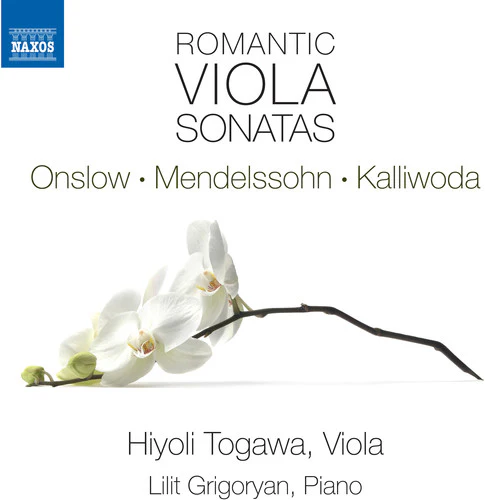
Romantic Viola Sonatas / Togawa, Grigoryan
These three works together constitute an attractive and generous programme. All three are little known although all have been recorded, if not necessarily on particularly high profile releases. There is not an abundance of chamber works involving solo viola and this disc certainly adds to our understanding of how a repertoire for the instrument emerged during the early years of what we now regard as the Romantic era. It also introduces a young recitalist who plays with an assured technique and no little passion. She is the German-born and trained violist Hiyoli Togawa who also has Japanese and Australian roots. Her well-matched accompanist is the Armenian Lilit Grigoryan. There is an interesting and rather confessional interview with Ms Togawa on the Naxos website in which she explains the appeal of these pieces and her philosophy in terms of their performance. To cut to the chase she characterises the works pithily as follows: “Onslow’s sonata reflects …..cheerfulness as well. …..Onslow’s sonata has nothing of Kalliwoda’s dreaminess nor does it have the deep seriousness of Mendelssohn’s sonata.”
Onslow’s Sonata is in fact his own transcription for viola of the first of his three Cello Sonatas Op 16. I have previously expressed enthusiasm for Onslow on this site, and this interesting sonata proves as imaginatively conceived and executed as his String Quintets which are currently being recorded by the Elan Quintet and released systematically by Naxos. While this sonata is not especially earth-shattering it is unusually democratic as the instrumental protagonists are clearly treated as equal collaborators. The opening Allegro is pleasing enough, amiable if rather conventional. The work’s true heart and highlight is the gorgeous Andante. It is odd how individual movements in Onslow’s large and unfamiliar output sometimes make one stop in one’s tracks. Such is the case with this limpid and tender Andante where violist and pianist demonstrate a deeply intuitive sympathy. Onslow’s stylistic influences tended to be Beethoven and Schubert but this early work hasn’t fully absorbed the spirit of these Romantic giants and I find there is something rather Gallic about it. Focusing on Grigoryan’s restrained accompaniment it’s possible to perceive something of French music’s future; it has a weirdly wistful and melancholic Faurean hue. The final Allegretto is contrastingly light as air and full of a youthful joie de vivre. It’s enjoyable, delightfully played and cleanly recorded.
There follows a rare outing for Mendelssohn’s Viola Sonata. I can hear some readers reacting with surprise – “Mendelssohn wrote a Viola Sonata??” Not only A viola sonata. In terms of the viola as we know it, ie not the viola d’amore, my research has thus far failed to turn up an earlier example of this form. (I’m sure somebody reading this will be far better informed….) It dates from 1824 when Mendelssohn was in teenage prodigy mode, although it has no opus number and wasn’t in fact published until 1966. It’s a dark inspiration and it nails its colours to the mast from the first bar of the opening Adagio-Allegro. Its gloomy countenance is tackled with great restraint by Hiyoli Tagowa as if to emphasise the contrast with the more conventional Allegro section which follows although this is not without its own moments of introspection (an 1820s example of teenage angst?). The melodic lines are unusually chromatic. The way the music simply fades at the conclusion of this movement is most novel, and beautifully managed by both players. Indeed the entire work is full of original touches and consequently its relative neglect is puzzling to me. It is scarcely believable that this sonata, with its unusual but utterly convincing structure and especially the brooding darkness of its melodic content could possibly have been produced by a boy of 15. The following Menuetto-Allegro molto will be familiar to anyone on nodding terms with Mendelssohn’s First Symphony (also in C minor) which followed soon after the sonata in March 1824 as it was reworked as the symphony’s third movement. The ensemble between the two players is again outstanding, the instruments have been very closely recorded but this doesn’t detract from the overall sound, which is truthful but never excessively so. The finale is more typically Mendelssohnian and employs his beloved variation form, though the final Allegro forms a kind of independent coda to the whole work, and sort of acts as a counterweight for the first movement fade-out. Another truly individual touch is the piano solo which dominates the final variation. This is lovingly played by Lilit Grigoryan who truly makes the most of her moment. It also underlines the fact that just as in the Onslow work, piano and viola are equals here. While this sonata is not necessarily a masterpiece of Octet proportions the viola repertoire is hardly overflowing and Mendelssohn’s early contribution to the form should surely be better known. It seems the most significant rival to this new recording is the one by Paul Coletti and Leslie Howard on a Hyperion disc from 1998 (CDA 66946), but this is a superlative account from Togawa and Grigoryan, the highlight of the disc for me.
It concludes with the equally unfamiliar set of Six Nocturnes Op 186 by the prolific Johann Kalliwoda, born in Prague in 1801. The notes tell us that these little pieces were among the works that kept his name alive at the start of the twentieth century, not least because they could be used for intimate family chamber performances. Nor do they appear to fulfil the stereotype of the ‘nocturne’ in the sense that the set alternates between slow and fast pieces. The fact that they were written a generation later than the Onslow and Mendelssohn works is reflected in a style that occasionally brings Schumann to mind, most notably in the last of the group which opens with a notably dark and chromatic flourish. Togawa most certainly does not hold back here, and the close microphones capture her 1749 Testore viola in really vivid sound which actually suits these brief and closely argued pieces admirably.
This is a terrific disc. My concern is that issues with generic titles like ‘Romantic Viola Sonatas’ often get overlooked by the record-buying public. I hope this review provides readers with the necessary encouragement to acquire it. It showcases another deeply impressive young violist (I was fortunate to be asked to review Ellen Nisbeth’s superb BIS disc of English repertoire late last year) doing her bit for the instrument. She also has the benefit of a sympathetic and generous accompanist and a warm, if close recording. While the Mendelssohn work is a standout, its companions here are far from makeweights.
– MusicWeb International (Richard Hanlon)
Onslow’s Sonata is in fact his own transcription for viola of the first of his three Cello Sonatas Op 16. I have previously expressed enthusiasm for Onslow on this site, and this interesting sonata proves as imaginatively conceived and executed as his String Quintets which are currently being recorded by the Elan Quintet and released systematically by Naxos. While this sonata is not especially earth-shattering it is unusually democratic as the instrumental protagonists are clearly treated as equal collaborators. The opening Allegro is pleasing enough, amiable if rather conventional. The work’s true heart and highlight is the gorgeous Andante. It is odd how individual movements in Onslow’s large and unfamiliar output sometimes make one stop in one’s tracks. Such is the case with this limpid and tender Andante where violist and pianist demonstrate a deeply intuitive sympathy. Onslow’s stylistic influences tended to be Beethoven and Schubert but this early work hasn’t fully absorbed the spirit of these Romantic giants and I find there is something rather Gallic about it. Focusing on Grigoryan’s restrained accompaniment it’s possible to perceive something of French music’s future; it has a weirdly wistful and melancholic Faurean hue. The final Allegretto is contrastingly light as air and full of a youthful joie de vivre. It’s enjoyable, delightfully played and cleanly recorded.
There follows a rare outing for Mendelssohn’s Viola Sonata. I can hear some readers reacting with surprise – “Mendelssohn wrote a Viola Sonata??” Not only A viola sonata. In terms of the viola as we know it, ie not the viola d’amore, my research has thus far failed to turn up an earlier example of this form. (I’m sure somebody reading this will be far better informed….) It dates from 1824 when Mendelssohn was in teenage prodigy mode, although it has no opus number and wasn’t in fact published until 1966. It’s a dark inspiration and it nails its colours to the mast from the first bar of the opening Adagio-Allegro. Its gloomy countenance is tackled with great restraint by Hiyoli Tagowa as if to emphasise the contrast with the more conventional Allegro section which follows although this is not without its own moments of introspection (an 1820s example of teenage angst?). The melodic lines are unusually chromatic. The way the music simply fades at the conclusion of this movement is most novel, and beautifully managed by both players. Indeed the entire work is full of original touches and consequently its relative neglect is puzzling to me. It is scarcely believable that this sonata, with its unusual but utterly convincing structure and especially the brooding darkness of its melodic content could possibly have been produced by a boy of 15. The following Menuetto-Allegro molto will be familiar to anyone on nodding terms with Mendelssohn’s First Symphony (also in C minor) which followed soon after the sonata in March 1824 as it was reworked as the symphony’s third movement. The ensemble between the two players is again outstanding, the instruments have been very closely recorded but this doesn’t detract from the overall sound, which is truthful but never excessively so. The finale is more typically Mendelssohnian and employs his beloved variation form, though the final Allegro forms a kind of independent coda to the whole work, and sort of acts as a counterweight for the first movement fade-out. Another truly individual touch is the piano solo which dominates the final variation. This is lovingly played by Lilit Grigoryan who truly makes the most of her moment. It also underlines the fact that just as in the Onslow work, piano and viola are equals here. While this sonata is not necessarily a masterpiece of Octet proportions the viola repertoire is hardly overflowing and Mendelssohn’s early contribution to the form should surely be better known. It seems the most significant rival to this new recording is the one by Paul Coletti and Leslie Howard on a Hyperion disc from 1998 (CDA 66946), but this is a superlative account from Togawa and Grigoryan, the highlight of the disc for me.
It concludes with the equally unfamiliar set of Six Nocturnes Op 186 by the prolific Johann Kalliwoda, born in Prague in 1801. The notes tell us that these little pieces were among the works that kept his name alive at the start of the twentieth century, not least because they could be used for intimate family chamber performances. Nor do they appear to fulfil the stereotype of the ‘nocturne’ in the sense that the set alternates between slow and fast pieces. The fact that they were written a generation later than the Onslow and Mendelssohn works is reflected in a style that occasionally brings Schumann to mind, most notably in the last of the group which opens with a notably dark and chromatic flourish. Togawa most certainly does not hold back here, and the close microphones capture her 1749 Testore viola in really vivid sound which actually suits these brief and closely argued pieces admirably.
This is a terrific disc. My concern is that issues with generic titles like ‘Romantic Viola Sonatas’ often get overlooked by the record-buying public. I hope this review provides readers with the necessary encouragement to acquire it. It showcases another deeply impressive young violist (I was fortunate to be asked to review Ellen Nisbeth’s superb BIS disc of English repertoire late last year) doing her bit for the instrument. She also has the benefit of a sympathetic and generous accompanist and a warm, if close recording. While the Mendelssohn work is a standout, its companions here are far from makeweights.
– MusicWeb International (Richard Hanlon)
These three works together constitute an attractive and generous programme. All three are little known although all have been recorded, if not necessarily on particularly high profile releases. There is not an abundance of chamber works involving solo viola and this disc certainly adds to our understanding of how a repertoire for the instrument emerged during the early years of what we now regard as the Romantic era. It also introduces a young recitalist who plays with an assured technique and no little passion. She is the German-born and trained violist Hiyoli Togawa who also has Japanese and Australian roots. Her well-matched accompanist is the Armenian Lilit Grigoryan. There is an interesting and rather confessional interview with Ms Togawa on the Naxos website in which she explains the appeal of these pieces and her philosophy in terms of their performance. To cut to the chase she characterises the works pithily as follows: “Onslow’s sonata reflects …..cheerfulness as well. …..Onslow’s sonata has nothing of Kalliwoda’s dreaminess nor does it have the deep seriousness of Mendelssohn’s sonata.”
Onslow’s Sonata is in fact his own transcription for viola of the first of his three Cello Sonatas Op 16. I have previously expressed enthusiasm for Onslow on this site, and this interesting sonata proves as imaginatively conceived and executed as his String Quintets which are currently being recorded by the Elan Quintet and released systematically by Naxos. While this sonata is not especially earth-shattering it is unusually democratic as the instrumental protagonists are clearly treated as equal collaborators. The opening Allegro is pleasing enough, amiable if rather conventional. The work’s true heart and highlight is the gorgeous Andante. It is odd how individual movements in Onslow’s large and unfamiliar output sometimes make one stop in one’s tracks. Such is the case with this limpid and tender Andante where violist and pianist demonstrate a deeply intuitive sympathy. Onslow’s stylistic influences tended to be Beethoven and Schubert but this early work hasn’t fully absorbed the spirit of these Romantic giants and I find there is something rather Gallic about it. Focusing on Grigoryan’s restrained accompaniment it’s possible to perceive something of French music’s future; it has a weirdly wistful and melancholic Faurean hue. The final Allegretto is contrastingly light as air and full of a youthful joie de vivre. It’s enjoyable, delightfully played and cleanly recorded.
There follows a rare outing for Mendelssohn’s Viola Sonata. I can hear some readers reacting with surprise – “Mendelssohn wrote a Viola Sonata??” Not only A viola sonata. In terms of the viola as we know it, ie not the viola d’amore, my research has thus far failed to turn up an earlier example of this form. (I’m sure somebody reading this will be far better informed….) It dates from 1824 when Mendelssohn was in teenage prodigy mode, although it has no opus number and wasn’t in fact published until 1966. It’s a dark inspiration and it nails its colours to the mast from the first bar of the opening Adagio-Allegro. Its gloomy countenance is tackled with great restraint by Hiyoli Tagowa as if to emphasise the contrast with the more conventional Allegro section which follows although this is not without its own moments of introspection (an 1820s example of teenage angst?). The melodic lines are unusually chromatic. The way the music simply fades at the conclusion of this movement is most novel, and beautifully managed by both players. Indeed the entire work is full of original touches and consequently its relative neglect is puzzling to me. It is scarcely believable that this sonata, with its unusual but utterly convincing structure and especially the brooding darkness of its melodic content could possibly have been produced by a boy of 15. The following Menuetto-Allegro molto will be familiar to anyone on nodding terms with Mendelssohn’s First Symphony (also in C minor) which followed soon after the sonata in March 1824 as it was reworked as the symphony’s third movement. The ensemble between the two players is again outstanding, the instruments have been very closely recorded but this doesn’t detract from the overall sound, which is truthful but never excessively so. The finale is more typically Mendelssohnian and employs his beloved variation form, though the final Allegro forms a kind of independent coda to the whole work, and sort of acts as a counterweight for the first movement fade-out. Another truly individual touch is the piano solo which dominates the final variation. This is lovingly played by Lilit Grigoryan who truly makes the most of her moment. It also underlines the fact that just as in the Onslow work, piano and viola are equals here. While this sonata is not necessarily a masterpiece of Octet proportions the viola repertoire is hardly overflowing and Mendelssohn’s early contribution to the form should surely be better known. It seems the most significant rival to this new recording is the one by Paul Coletti and Leslie Howard on a Hyperion disc from 1998 (CDA 66946), but this is a superlative account from Togawa and Grigoryan, the highlight of the disc for me.
It concludes with the equally unfamiliar set of Six Nocturnes Op 186 by the prolific Johann Kalliwoda, born in Prague in 1801. The notes tell us that these little pieces were among the works that kept his name alive at the start of the twentieth century, not least because they could be used for intimate family chamber performances. Nor do they appear to fulfil the stereotype of the ‘nocturne’ in the sense that the set alternates between slow and fast pieces. The fact that they were written a generation later than the Onslow and Mendelssohn works is reflected in a style that occasionally brings Schumann to mind, most notably in the last of the group which opens with a notably dark and chromatic flourish. Togawa most certainly does not hold back here, and the close microphones capture her 1749 Testore viola in really vivid sound which actually suits these brief and closely argued pieces admirably.
This is a terrific disc. My concern is that issues with generic titles like ‘Romantic Viola Sonatas’ often get overlooked by the record-buying public. I hope this review provides readers with the necessary encouragement to acquire it. It showcases another deeply impressive young violist (I was fortunate to be asked to review Ellen Nisbeth’s superb BIS disc of English repertoire late last year) doing her bit for the instrument. She also has the benefit of a sympathetic and generous accompanist and a warm, if close recording. While the Mendelssohn work is a standout, its companions here are far from makeweights.
– MusicWeb International (Richard Hanlon)
Onslow’s Sonata is in fact his own transcription for viola of the first of his three Cello Sonatas Op 16. I have previously expressed enthusiasm for Onslow on this site, and this interesting sonata proves as imaginatively conceived and executed as his String Quintets which are currently being recorded by the Elan Quintet and released systematically by Naxos. While this sonata is not especially earth-shattering it is unusually democratic as the instrumental protagonists are clearly treated as equal collaborators. The opening Allegro is pleasing enough, amiable if rather conventional. The work’s true heart and highlight is the gorgeous Andante. It is odd how individual movements in Onslow’s large and unfamiliar output sometimes make one stop in one’s tracks. Such is the case with this limpid and tender Andante where violist and pianist demonstrate a deeply intuitive sympathy. Onslow’s stylistic influences tended to be Beethoven and Schubert but this early work hasn’t fully absorbed the spirit of these Romantic giants and I find there is something rather Gallic about it. Focusing on Grigoryan’s restrained accompaniment it’s possible to perceive something of French music’s future; it has a weirdly wistful and melancholic Faurean hue. The final Allegretto is contrastingly light as air and full of a youthful joie de vivre. It’s enjoyable, delightfully played and cleanly recorded.
There follows a rare outing for Mendelssohn’s Viola Sonata. I can hear some readers reacting with surprise – “Mendelssohn wrote a Viola Sonata??” Not only A viola sonata. In terms of the viola as we know it, ie not the viola d’amore, my research has thus far failed to turn up an earlier example of this form. (I’m sure somebody reading this will be far better informed….) It dates from 1824 when Mendelssohn was in teenage prodigy mode, although it has no opus number and wasn’t in fact published until 1966. It’s a dark inspiration and it nails its colours to the mast from the first bar of the opening Adagio-Allegro. Its gloomy countenance is tackled with great restraint by Hiyoli Tagowa as if to emphasise the contrast with the more conventional Allegro section which follows although this is not without its own moments of introspection (an 1820s example of teenage angst?). The melodic lines are unusually chromatic. The way the music simply fades at the conclusion of this movement is most novel, and beautifully managed by both players. Indeed the entire work is full of original touches and consequently its relative neglect is puzzling to me. It is scarcely believable that this sonata, with its unusual but utterly convincing structure and especially the brooding darkness of its melodic content could possibly have been produced by a boy of 15. The following Menuetto-Allegro molto will be familiar to anyone on nodding terms with Mendelssohn’s First Symphony (also in C minor) which followed soon after the sonata in March 1824 as it was reworked as the symphony’s third movement. The ensemble between the two players is again outstanding, the instruments have been very closely recorded but this doesn’t detract from the overall sound, which is truthful but never excessively so. The finale is more typically Mendelssohnian and employs his beloved variation form, though the final Allegro forms a kind of independent coda to the whole work, and sort of acts as a counterweight for the first movement fade-out. Another truly individual touch is the piano solo which dominates the final variation. This is lovingly played by Lilit Grigoryan who truly makes the most of her moment. It also underlines the fact that just as in the Onslow work, piano and viola are equals here. While this sonata is not necessarily a masterpiece of Octet proportions the viola repertoire is hardly overflowing and Mendelssohn’s early contribution to the form should surely be better known. It seems the most significant rival to this new recording is the one by Paul Coletti and Leslie Howard on a Hyperion disc from 1998 (CDA 66946), but this is a superlative account from Togawa and Grigoryan, the highlight of the disc for me.
It concludes with the equally unfamiliar set of Six Nocturnes Op 186 by the prolific Johann Kalliwoda, born in Prague in 1801. The notes tell us that these little pieces were among the works that kept his name alive at the start of the twentieth century, not least because they could be used for intimate family chamber performances. Nor do they appear to fulfil the stereotype of the ‘nocturne’ in the sense that the set alternates between slow and fast pieces. The fact that they were written a generation later than the Onslow and Mendelssohn works is reflected in a style that occasionally brings Schumann to mind, most notably in the last of the group which opens with a notably dark and chromatic flourish. Togawa most certainly does not hold back here, and the close microphones capture her 1749 Testore viola in really vivid sound which actually suits these brief and closely argued pieces admirably.
This is a terrific disc. My concern is that issues with generic titles like ‘Romantic Viola Sonatas’ often get overlooked by the record-buying public. I hope this review provides readers with the necessary encouragement to acquire it. It showcases another deeply impressive young violist (I was fortunate to be asked to review Ellen Nisbeth’s superb BIS disc of English repertoire late last year) doing her bit for the instrument. She also has the benefit of a sympathetic and generous accompanist and a warm, if close recording. While the Mendelssohn work is a standout, its companions here are far from makeweights.
– MusicWeb International (Richard Hanlon)
$13.99
Romantic Viola Sonatas / Togawa, Grigoryan—
$13.99
Description
These three works together constitute an attractive and generous programme. All three are little known although all have been recorded, if not necessarily on particularly high profile releases. There is not an abundance of chamber works involving solo viola and this disc certainly adds to our understanding of how a repertoire for the instrument emerged during the early years of what we now regard as the Romantic era. It also introduces a young recitalist who plays with an assured technique and no little passion. She is the German-born and trained violist Hiyoli Togawa who also has Japanese and Australian roots. Her well-matched accompanist is the Armenian Lilit Grigoryan. There is an interesting and rather confessional interview with Ms Togawa on the Naxos website in which she explains the appeal of these pieces and her philosophy in terms of their performance. To cut to the chase she characterises the works pithily as follows: “Onslow’s sonata reflects …..cheerfulness as well. …..Onslow’s sonata has nothing of Kalliwoda’s dreaminess nor does it have the deep seriousness of Mendelssohn’s sonata.”
Onslow’s Sonata is in fact his own transcription for viola of the first of his three Cello Sonatas Op 16. I have previously expressed enthusiasm for Onslow on this site, and this interesting sonata proves as imaginatively conceived and executed as his String Quintets which are currently being recorded by the Elan Quintet and released systematically by Naxos. While this sonata is not especially earth-shattering it is unusually democratic as the instrumental protagonists are clearly treated as equal collaborators. The opening Allegro is pleasing enough, amiable if rather conventional. The work’s true heart and highlight is the gorgeous Andante. It is odd how individual movements in Onslow’s large and unfamiliar output sometimes make one stop in one’s tracks. Such is the case with this limpid and tender Andante where violist and pianist demonstrate a deeply intuitive sympathy. Onslow’s stylistic influences tended to be Beethoven and Schubert but this early work hasn’t fully absorbed the spirit of these Romantic giants and I find there is something rather Gallic about it. Focusing on Grigoryan’s restrained accompaniment it’s possible to perceive something of French music’s future; it has a weirdly wistful and melancholic Faurean hue. The final Allegretto is contrastingly light as air and full of a youthful joie de vivre. It’s enjoyable, delightfully played and cleanly recorded.
There follows a rare outing for Mendelssohn’s Viola Sonata. I can hear some readers reacting with surprise – “Mendelssohn wrote a Viola Sonata??” Not only A viola sonata. In terms of the viola as we know it, ie not the viola d’amore, my research has thus far failed to turn up an earlier example of this form. (I’m sure somebody reading this will be far better informed….) It dates from 1824 when Mendelssohn was in teenage prodigy mode, although it has no opus number and wasn’t in fact published until 1966. It’s a dark inspiration and it nails its colours to the mast from the first bar of the opening Adagio-Allegro. Its gloomy countenance is tackled with great restraint by Hiyoli Tagowa as if to emphasise the contrast with the more conventional Allegro section which follows although this is not without its own moments of introspection (an 1820s example of teenage angst?). The melodic lines are unusually chromatic. The way the music simply fades at the conclusion of this movement is most novel, and beautifully managed by both players. Indeed the entire work is full of original touches and consequently its relative neglect is puzzling to me. It is scarcely believable that this sonata, with its unusual but utterly convincing structure and especially the brooding darkness of its melodic content could possibly have been produced by a boy of 15. The following Menuetto-Allegro molto will be familiar to anyone on nodding terms with Mendelssohn’s First Symphony (also in C minor) which followed soon after the sonata in March 1824 as it was reworked as the symphony’s third movement. The ensemble between the two players is again outstanding, the instruments have been very closely recorded but this doesn’t detract from the overall sound, which is truthful but never excessively so. The finale is more typically Mendelssohnian and employs his beloved variation form, though the final Allegro forms a kind of independent coda to the whole work, and sort of acts as a counterweight for the first movement fade-out. Another truly individual touch is the piano solo which dominates the final variation. This is lovingly played by Lilit Grigoryan who truly makes the most of her moment. It also underlines the fact that just as in the Onslow work, piano and viola are equals here. While this sonata is not necessarily a masterpiece of Octet proportions the viola repertoire is hardly overflowing and Mendelssohn’s early contribution to the form should surely be better known. It seems the most significant rival to this new recording is the one by Paul Coletti and Leslie Howard on a Hyperion disc from 1998 (CDA 66946), but this is a superlative account from Togawa and Grigoryan, the highlight of the disc for me.
It concludes with the equally unfamiliar set of Six Nocturnes Op 186 by the prolific Johann Kalliwoda, born in Prague in 1801. The notes tell us that these little pieces were among the works that kept his name alive at the start of the twentieth century, not least because they could be used for intimate family chamber performances. Nor do they appear to fulfil the stereotype of the ‘nocturne’ in the sense that the set alternates between slow and fast pieces. The fact that they were written a generation later than the Onslow and Mendelssohn works is reflected in a style that occasionally brings Schumann to mind, most notably in the last of the group which opens with a notably dark and chromatic flourish. Togawa most certainly does not hold back here, and the close microphones capture her 1749 Testore viola in really vivid sound which actually suits these brief and closely argued pieces admirably.
This is a terrific disc. My concern is that issues with generic titles like ‘Romantic Viola Sonatas’ often get overlooked by the record-buying public. I hope this review provides readers with the necessary encouragement to acquire it. It showcases another deeply impressive young violist (I was fortunate to be asked to review Ellen Nisbeth’s superb BIS disc of English repertoire late last year) doing her bit for the instrument. She also has the benefit of a sympathetic and generous accompanist and a warm, if close recording. While the Mendelssohn work is a standout, its companions here are far from makeweights.
– MusicWeb International (Richard Hanlon)
Onslow’s Sonata is in fact his own transcription for viola of the first of his three Cello Sonatas Op 16. I have previously expressed enthusiasm for Onslow on this site, and this interesting sonata proves as imaginatively conceived and executed as his String Quintets which are currently being recorded by the Elan Quintet and released systematically by Naxos. While this sonata is not especially earth-shattering it is unusually democratic as the instrumental protagonists are clearly treated as equal collaborators. The opening Allegro is pleasing enough, amiable if rather conventional. The work’s true heart and highlight is the gorgeous Andante. It is odd how individual movements in Onslow’s large and unfamiliar output sometimes make one stop in one’s tracks. Such is the case with this limpid and tender Andante where violist and pianist demonstrate a deeply intuitive sympathy. Onslow’s stylistic influences tended to be Beethoven and Schubert but this early work hasn’t fully absorbed the spirit of these Romantic giants and I find there is something rather Gallic about it. Focusing on Grigoryan’s restrained accompaniment it’s possible to perceive something of French music’s future; it has a weirdly wistful and melancholic Faurean hue. The final Allegretto is contrastingly light as air and full of a youthful joie de vivre. It’s enjoyable, delightfully played and cleanly recorded.
There follows a rare outing for Mendelssohn’s Viola Sonata. I can hear some readers reacting with surprise – “Mendelssohn wrote a Viola Sonata??” Not only A viola sonata. In terms of the viola as we know it, ie not the viola d’amore, my research has thus far failed to turn up an earlier example of this form. (I’m sure somebody reading this will be far better informed….) It dates from 1824 when Mendelssohn was in teenage prodigy mode, although it has no opus number and wasn’t in fact published until 1966. It’s a dark inspiration and it nails its colours to the mast from the first bar of the opening Adagio-Allegro. Its gloomy countenance is tackled with great restraint by Hiyoli Tagowa as if to emphasise the contrast with the more conventional Allegro section which follows although this is not without its own moments of introspection (an 1820s example of teenage angst?). The melodic lines are unusually chromatic. The way the music simply fades at the conclusion of this movement is most novel, and beautifully managed by both players. Indeed the entire work is full of original touches and consequently its relative neglect is puzzling to me. It is scarcely believable that this sonata, with its unusual but utterly convincing structure and especially the brooding darkness of its melodic content could possibly have been produced by a boy of 15. The following Menuetto-Allegro molto will be familiar to anyone on nodding terms with Mendelssohn’s First Symphony (also in C minor) which followed soon after the sonata in March 1824 as it was reworked as the symphony’s third movement. The ensemble between the two players is again outstanding, the instruments have been very closely recorded but this doesn’t detract from the overall sound, which is truthful but never excessively so. The finale is more typically Mendelssohnian and employs his beloved variation form, though the final Allegro forms a kind of independent coda to the whole work, and sort of acts as a counterweight for the first movement fade-out. Another truly individual touch is the piano solo which dominates the final variation. This is lovingly played by Lilit Grigoryan who truly makes the most of her moment. It also underlines the fact that just as in the Onslow work, piano and viola are equals here. While this sonata is not necessarily a masterpiece of Octet proportions the viola repertoire is hardly overflowing and Mendelssohn’s early contribution to the form should surely be better known. It seems the most significant rival to this new recording is the one by Paul Coletti and Leslie Howard on a Hyperion disc from 1998 (CDA 66946), but this is a superlative account from Togawa and Grigoryan, the highlight of the disc for me.
It concludes with the equally unfamiliar set of Six Nocturnes Op 186 by the prolific Johann Kalliwoda, born in Prague in 1801. The notes tell us that these little pieces were among the works that kept his name alive at the start of the twentieth century, not least because they could be used for intimate family chamber performances. Nor do they appear to fulfil the stereotype of the ‘nocturne’ in the sense that the set alternates between slow and fast pieces. The fact that they were written a generation later than the Onslow and Mendelssohn works is reflected in a style that occasionally brings Schumann to mind, most notably in the last of the group which opens with a notably dark and chromatic flourish. Togawa most certainly does not hold back here, and the close microphones capture her 1749 Testore viola in really vivid sound which actually suits these brief and closely argued pieces admirably.
This is a terrific disc. My concern is that issues with generic titles like ‘Romantic Viola Sonatas’ often get overlooked by the record-buying public. I hope this review provides readers with the necessary encouragement to acquire it. It showcases another deeply impressive young violist (I was fortunate to be asked to review Ellen Nisbeth’s superb BIS disc of English repertoire late last year) doing her bit for the instrument. She also has the benefit of a sympathetic and generous accompanist and a warm, if close recording. While the Mendelssohn work is a standout, its companions here are far from makeweights.
– MusicWeb International (Richard Hanlon)