🎉 Up to 70% Off Selected ItemsShop Sale

1 / 2
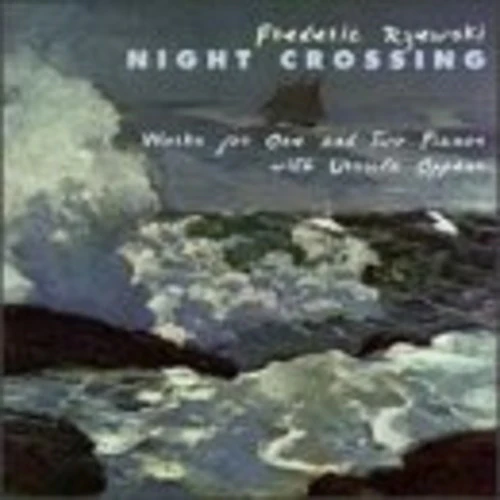
Rzewski - Night Crossing - Works For One And Two Pianos
Because it's the most immediately accessible of the piano disc's works, let's begin with this two-piano version of Rzewski's hard-driving, viscerally affecting Winnshoro Cotton Mill Blues of 1980. (For the original, spectacularly recorded solo assault, see hatART 6089, North American Ballads & Squares, Frederic Rzewski performing.) The piece pictures its subject, a cotton mill at full tilt, as handily as any tone poem I can think of, working itself thence into a neat transition to the eponymous job-lament dating from the 1930s ("Old man Sargent, sittin' at his desk I The damned old fool won't give us a rest I He'd take the nickels offa dead man's eyes . . . ").
Night Crossing with Fisherman (1994), for two pianos (Ursula Oppens is the dedicatee), isn't quite as thematically coherent as its title suggests. The work divides into three parts, "Night," a moody introspection for piano solo; the aptly titled "Crossing," for two pianos in intense conversation; and "Fisherman," for piano solo and Rzewski's recitation of a passage from the Arabian Nights (politically relevant, of course) about a fisherman who labors through the night for a man asleep. (Presumably it is Oppens who takes the "Night" solo.)
Winnshoro Cotton Mill Blues makes its mark by kicking subtlety out the door. By contrast, Ludes I and 2, of 12 short pieces each (the longest, 1:41, the shortest, 0:38), insinuate themselves into one's affections, playful, will-o'-the-wisp creatures that they are, by degree. Rzewski does an excellent, often fascinating job of explaining his music's background and form. So I won't trouble to summarize his "how these delights came about." Suffice that they range widely in substance and mood, happily short of Rzewski's affection for maul-driven social panaceas.
-- Mike Silverton, FANFARE
Night Crossing with Fisherman (1994), for two pianos (Ursula Oppens is the dedicatee), isn't quite as thematically coherent as its title suggests. The work divides into three parts, "Night," a moody introspection for piano solo; the aptly titled "Crossing," for two pianos in intense conversation; and "Fisherman," for piano solo and Rzewski's recitation of a passage from the Arabian Nights (politically relevant, of course) about a fisherman who labors through the night for a man asleep. (Presumably it is Oppens who takes the "Night" solo.)
Winnshoro Cotton Mill Blues makes its mark by kicking subtlety out the door. By contrast, Ludes I and 2, of 12 short pieces each (the longest, 1:41, the shortest, 0:38), insinuate themselves into one's affections, playful, will-o'-the-wisp creatures that they are, by degree. Rzewski does an excellent, often fascinating job of explaining his music's background and form. So I won't trouble to summarize his "how these delights came about." Suffice that they range widely in substance and mood, happily short of Rzewski's affection for maul-driven social panaceas.
-- Mike Silverton, FANFARE
Because it's the most immediately accessible of the piano disc's works, let's begin with this two-piano version of Rzewski's hard-driving, viscerally affecting Winnshoro Cotton Mill Blues of 1980. (For the original, spectacularly recorded solo assault, see hatART 6089, North American Ballads & Squares, Frederic Rzewski performing.) The piece pictures its subject, a cotton mill at full tilt, as handily as any tone poem I can think of, working itself thence into a neat transition to the eponymous job-lament dating from the 1930s ("Old man Sargent, sittin' at his desk I The damned old fool won't give us a rest I He'd take the nickels offa dead man's eyes . . . ").
Night Crossing with Fisherman (1994), for two pianos (Ursula Oppens is the dedicatee), isn't quite as thematically coherent as its title suggests. The work divides into three parts, "Night," a moody introspection for piano solo; the aptly titled "Crossing," for two pianos in intense conversation; and "Fisherman," for piano solo and Rzewski's recitation of a passage from the Arabian Nights (politically relevant, of course) about a fisherman who labors through the night for a man asleep. (Presumably it is Oppens who takes the "Night" solo.)
Winnshoro Cotton Mill Blues makes its mark by kicking subtlety out the door. By contrast, Ludes I and 2, of 12 short pieces each (the longest, 1:41, the shortest, 0:38), insinuate themselves into one's affections, playful, will-o'-the-wisp creatures that they are, by degree. Rzewski does an excellent, often fascinating job of explaining his music's background and form. So I won't trouble to summarize his "how these delights came about." Suffice that they range widely in substance and mood, happily short of Rzewski's affection for maul-driven social panaceas.
-- Mike Silverton, FANFARE
Night Crossing with Fisherman (1994), for two pianos (Ursula Oppens is the dedicatee), isn't quite as thematically coherent as its title suggests. The work divides into three parts, "Night," a moody introspection for piano solo; the aptly titled "Crossing," for two pianos in intense conversation; and "Fisherman," for piano solo and Rzewski's recitation of a passage from the Arabian Nights (politically relevant, of course) about a fisherman who labors through the night for a man asleep. (Presumably it is Oppens who takes the "Night" solo.)
Winnshoro Cotton Mill Blues makes its mark by kicking subtlety out the door. By contrast, Ludes I and 2, of 12 short pieces each (the longest, 1:41, the shortest, 0:38), insinuate themselves into one's affections, playful, will-o'-the-wisp creatures that they are, by degree. Rzewski does an excellent, often fascinating job of explaining his music's background and form. So I won't trouble to summarize his "how these delights came about." Suffice that they range widely in substance and mood, happily short of Rzewski's affection for maul-driven social panaceas.
-- Mike Silverton, FANFARE
$7.00
Original: $19.99
-65%Rzewski - Night Crossing - Works For One And Two Pianos—
$19.99
$7.00Description
Because it's the most immediately accessible of the piano disc's works, let's begin with this two-piano version of Rzewski's hard-driving, viscerally affecting Winnshoro Cotton Mill Blues of 1980. (For the original, spectacularly recorded solo assault, see hatART 6089, North American Ballads & Squares, Frederic Rzewski performing.) The piece pictures its subject, a cotton mill at full tilt, as handily as any tone poem I can think of, working itself thence into a neat transition to the eponymous job-lament dating from the 1930s ("Old man Sargent, sittin' at his desk I The damned old fool won't give us a rest I He'd take the nickels offa dead man's eyes . . . ").
Night Crossing with Fisherman (1994), for two pianos (Ursula Oppens is the dedicatee), isn't quite as thematically coherent as its title suggests. The work divides into three parts, "Night," a moody introspection for piano solo; the aptly titled "Crossing," for two pianos in intense conversation; and "Fisherman," for piano solo and Rzewski's recitation of a passage from the Arabian Nights (politically relevant, of course) about a fisherman who labors through the night for a man asleep. (Presumably it is Oppens who takes the "Night" solo.)
Winnshoro Cotton Mill Blues makes its mark by kicking subtlety out the door. By contrast, Ludes I and 2, of 12 short pieces each (the longest, 1:41, the shortest, 0:38), insinuate themselves into one's affections, playful, will-o'-the-wisp creatures that they are, by degree. Rzewski does an excellent, often fascinating job of explaining his music's background and form. So I won't trouble to summarize his "how these delights came about." Suffice that they range widely in substance and mood, happily short of Rzewski's affection for maul-driven social panaceas.
-- Mike Silverton, FANFARE
Night Crossing with Fisherman (1994), for two pianos (Ursula Oppens is the dedicatee), isn't quite as thematically coherent as its title suggests. The work divides into three parts, "Night," a moody introspection for piano solo; the aptly titled "Crossing," for two pianos in intense conversation; and "Fisherman," for piano solo and Rzewski's recitation of a passage from the Arabian Nights (politically relevant, of course) about a fisherman who labors through the night for a man asleep. (Presumably it is Oppens who takes the "Night" solo.)
Winnshoro Cotton Mill Blues makes its mark by kicking subtlety out the door. By contrast, Ludes I and 2, of 12 short pieces each (the longest, 1:41, the shortest, 0:38), insinuate themselves into one's affections, playful, will-o'-the-wisp creatures that they are, by degree. Rzewski does an excellent, often fascinating job of explaining his music's background and form. So I won't trouble to summarize his "how these delights came about." Suffice that they range widely in substance and mood, happily short of Rzewski's affection for maul-driven social panaceas.
-- Mike Silverton, FANFARE