🎉 Up to 70% Off Selected ItemsShop Sale

1 / 2
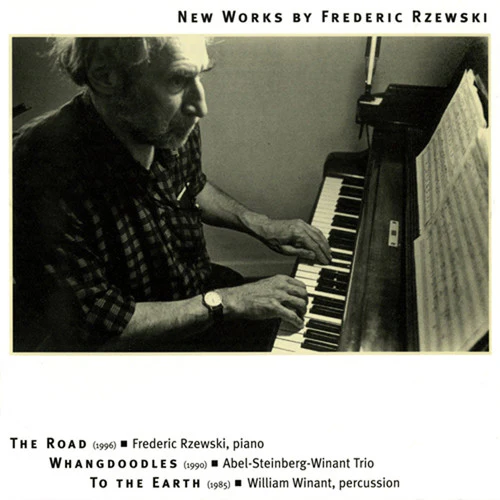
Rzewski: The Road, Whangdoodles, To The Earth / Rzewski, Etc
[A] must-have for Frederic Rzewski's fans, of whom, to judge from his large CDiscography, there exists a passel... This performance by the composer (an excellent pianist) of the solo-piano work, The Road (1996), consists of "Turns" and "Tracks," the first two of a projected eight parts, which Rzewski guesses will take about two and a half hours to play. The music shows to excellent advantage one of Rzewski's (for me) more engaging sides—a taste for the whimsically extravagant meander crafted in an anything but slipshod manner. From his remarks we learn what the music already demonstrates: a commitment to structure, schemata, form (more apparent, in the event, in the all-piano release). The Road also reveals Rzewski's fondness for broad effects: on toward the end of "Turns" we hear a stretch of hand-to-wood drumming; in the 25-minute "Tracks," which begins in silence, thence to some scarcely audible inside-the-piano scratching, we hear in addition to some impressively powerful keyboard writing renewed knocks on the instrument's body, a little vocalizing, and so on.
Rzewski's music rarely strays far from his social concerns. "'Turns' is a set of eight two-minute studies, some of which resemble fugues. No. 4 is a piano arrangement of a choral piece protesting the French nuclear tests in the South Pacific, 'Stop the Testing!' which I wrote on the 50th anniversary of the Hiroshima bombing... ."
Whangdoodles (1990), composed for its present performers, is a work of considerable charm and ingenuity. As its motivic device, Rzewski takes two songs, The Big Rock Candy Mountain, (O the birds and the bees and the cigarette trees I the rockrye springs where the whangdoodle sings. . . ), and Yidl mit 'n Fidi, which bounce about and mesh into a comely entity. As for acerb tonalities, the writing wouldn't trouble your maiden aunt. Winant's important percussion part consists largely of a hammered dulcimer, "a folk instrument of Persian origin . . . found . . . in both East European and Appalachian traditional music. 1 would like to think that the 'whangdoodle' of the American hobo song may suggest the whanging, or twanging, sound typical of the instrument." Rzewski goes on to say that for this work his "technique involves the intentional suppression of the censoring superego . . . while the writer dodges through the window thereby opened." In the parlance of the volk Rzewski celebrates, "Whatever gets you there," for indeed it does.
In the final work, To the Earth (1985), we hear another of Rzewski's penchants, which in this tidily concocted and brief (8:49) morsel works very nicely: chanted speech. Percussionist William Winant delicately drums on four flowerpots while reciting a "text based on a Homeric hymn," ("To the Earth, Mother of us all, I will sing . . . "). A paean to Mother Earth on flowerpots indeed!
Performances top-drawer, recorded sound very good.
-- Mike Silverton, FANFARE
Rzewski's music rarely strays far from his social concerns. "'Turns' is a set of eight two-minute studies, some of which resemble fugues. No. 4 is a piano arrangement of a choral piece protesting the French nuclear tests in the South Pacific, 'Stop the Testing!' which I wrote on the 50th anniversary of the Hiroshima bombing... ."
Whangdoodles (1990), composed for its present performers, is a work of considerable charm and ingenuity. As its motivic device, Rzewski takes two songs, The Big Rock Candy Mountain, (O the birds and the bees and the cigarette trees I the rockrye springs where the whangdoodle sings. . . ), and Yidl mit 'n Fidi, which bounce about and mesh into a comely entity. As for acerb tonalities, the writing wouldn't trouble your maiden aunt. Winant's important percussion part consists largely of a hammered dulcimer, "a folk instrument of Persian origin . . . found . . . in both East European and Appalachian traditional music. 1 would like to think that the 'whangdoodle' of the American hobo song may suggest the whanging, or twanging, sound typical of the instrument." Rzewski goes on to say that for this work his "technique involves the intentional suppression of the censoring superego . . . while the writer dodges through the window thereby opened." In the parlance of the volk Rzewski celebrates, "Whatever gets you there," for indeed it does.
In the final work, To the Earth (1985), we hear another of Rzewski's penchants, which in this tidily concocted and brief (8:49) morsel works very nicely: chanted speech. Percussionist William Winant delicately drums on four flowerpots while reciting a "text based on a Homeric hymn," ("To the Earth, Mother of us all, I will sing . . . "). A paean to Mother Earth on flowerpots indeed!
Performances top-drawer, recorded sound very good.
-- Mike Silverton, FANFARE
[A] must-have for Frederic Rzewski's fans, of whom, to judge from his large CDiscography, there exists a passel... This performance by the composer (an excellent pianist) of the solo-piano work, The Road (1996), consists of "Turns" and "Tracks," the first two of a projected eight parts, which Rzewski guesses will take about two and a half hours to play. The music shows to excellent advantage one of Rzewski's (for me) more engaging sides—a taste for the whimsically extravagant meander crafted in an anything but slipshod manner. From his remarks we learn what the music already demonstrates: a commitment to structure, schemata, form (more apparent, in the event, in the all-piano release). The Road also reveals Rzewski's fondness for broad effects: on toward the end of "Turns" we hear a stretch of hand-to-wood drumming; in the 25-minute "Tracks," which begins in silence, thence to some scarcely audible inside-the-piano scratching, we hear in addition to some impressively powerful keyboard writing renewed knocks on the instrument's body, a little vocalizing, and so on.
Rzewski's music rarely strays far from his social concerns. "'Turns' is a set of eight two-minute studies, some of which resemble fugues. No. 4 is a piano arrangement of a choral piece protesting the French nuclear tests in the South Pacific, 'Stop the Testing!' which I wrote on the 50th anniversary of the Hiroshima bombing... ."
Whangdoodles (1990), composed for its present performers, is a work of considerable charm and ingenuity. As its motivic device, Rzewski takes two songs, The Big Rock Candy Mountain, (O the birds and the bees and the cigarette trees I the rockrye springs where the whangdoodle sings. . . ), and Yidl mit 'n Fidi, which bounce about and mesh into a comely entity. As for acerb tonalities, the writing wouldn't trouble your maiden aunt. Winant's important percussion part consists largely of a hammered dulcimer, "a folk instrument of Persian origin . . . found . . . in both East European and Appalachian traditional music. 1 would like to think that the 'whangdoodle' of the American hobo song may suggest the whanging, or twanging, sound typical of the instrument." Rzewski goes on to say that for this work his "technique involves the intentional suppression of the censoring superego . . . while the writer dodges through the window thereby opened." In the parlance of the volk Rzewski celebrates, "Whatever gets you there," for indeed it does.
In the final work, To the Earth (1985), we hear another of Rzewski's penchants, which in this tidily concocted and brief (8:49) morsel works very nicely: chanted speech. Percussionist William Winant delicately drums on four flowerpots while reciting a "text based on a Homeric hymn," ("To the Earth, Mother of us all, I will sing . . . "). A paean to Mother Earth on flowerpots indeed!
Performances top-drawer, recorded sound very good.
-- Mike Silverton, FANFARE
Rzewski's music rarely strays far from his social concerns. "'Turns' is a set of eight two-minute studies, some of which resemble fugues. No. 4 is a piano arrangement of a choral piece protesting the French nuclear tests in the South Pacific, 'Stop the Testing!' which I wrote on the 50th anniversary of the Hiroshima bombing... ."
Whangdoodles (1990), composed for its present performers, is a work of considerable charm and ingenuity. As its motivic device, Rzewski takes two songs, The Big Rock Candy Mountain, (O the birds and the bees and the cigarette trees I the rockrye springs where the whangdoodle sings. . . ), and Yidl mit 'n Fidi, which bounce about and mesh into a comely entity. As for acerb tonalities, the writing wouldn't trouble your maiden aunt. Winant's important percussion part consists largely of a hammered dulcimer, "a folk instrument of Persian origin . . . found . . . in both East European and Appalachian traditional music. 1 would like to think that the 'whangdoodle' of the American hobo song may suggest the whanging, or twanging, sound typical of the instrument." Rzewski goes on to say that for this work his "technique involves the intentional suppression of the censoring superego . . . while the writer dodges through the window thereby opened." In the parlance of the volk Rzewski celebrates, "Whatever gets you there," for indeed it does.
In the final work, To the Earth (1985), we hear another of Rzewski's penchants, which in this tidily concocted and brief (8:49) morsel works very nicely: chanted speech. Percussionist William Winant delicately drums on four flowerpots while reciting a "text based on a Homeric hymn," ("To the Earth, Mother of us all, I will sing . . . "). A paean to Mother Earth on flowerpots indeed!
Performances top-drawer, recorded sound very good.
-- Mike Silverton, FANFARE
$7.00
Original: $19.99
-65%Rzewski: The Road, Whangdoodles, To The Earth / Rzewski, Etc—
$19.99
$7.00Description
[A] must-have for Frederic Rzewski's fans, of whom, to judge from his large CDiscography, there exists a passel... This performance by the composer (an excellent pianist) of the solo-piano work, The Road (1996), consists of "Turns" and "Tracks," the first two of a projected eight parts, which Rzewski guesses will take about two and a half hours to play. The music shows to excellent advantage one of Rzewski's (for me) more engaging sides—a taste for the whimsically extravagant meander crafted in an anything but slipshod manner. From his remarks we learn what the music already demonstrates: a commitment to structure, schemata, form (more apparent, in the event, in the all-piano release). The Road also reveals Rzewski's fondness for broad effects: on toward the end of "Turns" we hear a stretch of hand-to-wood drumming; in the 25-minute "Tracks," which begins in silence, thence to some scarcely audible inside-the-piano scratching, we hear in addition to some impressively powerful keyboard writing renewed knocks on the instrument's body, a little vocalizing, and so on.
Rzewski's music rarely strays far from his social concerns. "'Turns' is a set of eight two-minute studies, some of which resemble fugues. No. 4 is a piano arrangement of a choral piece protesting the French nuclear tests in the South Pacific, 'Stop the Testing!' which I wrote on the 50th anniversary of the Hiroshima bombing... ."
Whangdoodles (1990), composed for its present performers, is a work of considerable charm and ingenuity. As its motivic device, Rzewski takes two songs, The Big Rock Candy Mountain, (O the birds and the bees and the cigarette trees I the rockrye springs where the whangdoodle sings. . . ), and Yidl mit 'n Fidi, which bounce about and mesh into a comely entity. As for acerb tonalities, the writing wouldn't trouble your maiden aunt. Winant's important percussion part consists largely of a hammered dulcimer, "a folk instrument of Persian origin . . . found . . . in both East European and Appalachian traditional music. 1 would like to think that the 'whangdoodle' of the American hobo song may suggest the whanging, or twanging, sound typical of the instrument." Rzewski goes on to say that for this work his "technique involves the intentional suppression of the censoring superego . . . while the writer dodges through the window thereby opened." In the parlance of the volk Rzewski celebrates, "Whatever gets you there," for indeed it does.
In the final work, To the Earth (1985), we hear another of Rzewski's penchants, which in this tidily concocted and brief (8:49) morsel works very nicely: chanted speech. Percussionist William Winant delicately drums on four flowerpots while reciting a "text based on a Homeric hymn," ("To the Earth, Mother of us all, I will sing . . . "). A paean to Mother Earth on flowerpots indeed!
Performances top-drawer, recorded sound very good.
-- Mike Silverton, FANFARE
Rzewski's music rarely strays far from his social concerns. "'Turns' is a set of eight two-minute studies, some of which resemble fugues. No. 4 is a piano arrangement of a choral piece protesting the French nuclear tests in the South Pacific, 'Stop the Testing!' which I wrote on the 50th anniversary of the Hiroshima bombing... ."
Whangdoodles (1990), composed for its present performers, is a work of considerable charm and ingenuity. As its motivic device, Rzewski takes two songs, The Big Rock Candy Mountain, (O the birds and the bees and the cigarette trees I the rockrye springs where the whangdoodle sings. . . ), and Yidl mit 'n Fidi, which bounce about and mesh into a comely entity. As for acerb tonalities, the writing wouldn't trouble your maiden aunt. Winant's important percussion part consists largely of a hammered dulcimer, "a folk instrument of Persian origin . . . found . . . in both East European and Appalachian traditional music. 1 would like to think that the 'whangdoodle' of the American hobo song may suggest the whanging, or twanging, sound typical of the instrument." Rzewski goes on to say that for this work his "technique involves the intentional suppression of the censoring superego . . . while the writer dodges through the window thereby opened." In the parlance of the volk Rzewski celebrates, "Whatever gets you there," for indeed it does.
In the final work, To the Earth (1985), we hear another of Rzewski's penchants, which in this tidily concocted and brief (8:49) morsel works very nicely: chanted speech. Percussionist William Winant delicately drums on four flowerpots while reciting a "text based on a Homeric hymn," ("To the Earth, Mother of us all, I will sing . . . "). A paean to Mother Earth on flowerpots indeed!
Performances top-drawer, recorded sound very good.
-- Mike Silverton, FANFARE