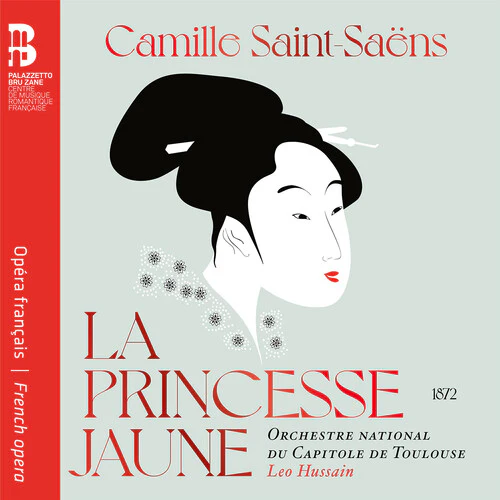
Saint-Saëns: La princesse jaune / Hussain, Toulouse Capitol National Orchestra
That globetrotting composer Camille Saint-Saëns wrote La Princesse jaune in 1872, exemplifying the current craze for all things Japanese. Kornélis, played by the tenor Mathias Vidal, dreams only of the Land of the Rising Sun. Under the influence of a hallucinogenic potion, he becomes infatuated with Ming, a fantasy princess. His cousin Léna – the soprano Judith van Wanroij – despairs of this passion and does not dare to confess her own feelings to Kornélis, who eventually comes to his senses. The running time of this opera enables us to offer a coupling in the shape of a previously unrecorded version of Saint-Saëns’s six Mélodies persanes, thus extending the guiding thread of a yearning for exotic horizons in another direction. Leo Hussain conducts the Orchestre National du Capitole de Toulouse in both works.
REVIEW:
With La Princesse jaune, Saint-Saëns, his librettist Gallet and the co-directors of the Opéra-Comique, who commissioned the opera, were attempting to take advantage of the Parisian vogue for the Orient, in particular Japan and its art and culture (the craze was known as japonisme). Gallet made a rather unlikely choice: he placed the Japanese-themed story in a Dutch town, in a room converted to an artists’ studio. There are just two characters. An overture is followed by arias and duets, all interspersed with spoken dialogue. Spoken word may be off-putting but the little there is – a few minutes all in all – integrates seamlessly with the sung text.
The story concerns Kornélis, a Dutch doctor fascinated with Japanese culture. His young cousin Léna is in love with him. Under the effects of a hallucinogenic drug, the fixated Kornélis falls in love with the subject of a portrait, a Japanese princess named Ming. His perception of reality is profoundly distorted. He believes Léna is Ming inhabiting a fairy-tale land. The potion wears off and Kornélis returns to reality. He yields to the charms of the despairing Léna and takes her in his arms.
Kornélis is sung by lyric tenor Mathias Vidal, who specialises in French and Italian roles. He clearly relishes this repertoire, and is well suited to Kornélis’s arias. He puts his sonorous tone to splendid use, with fine diction, projection and vitality. In the air J’aime, dans son lointain mystère (I love, in its different mystery) with its gently rocking accompaniment, Vidal increases the atmospheric mood as he extols to Léna the glories of Japan, a paradise he dreams of. Another highlight is the solo described as Kornélis’s vision: he drinks the potion and gazes at the portrait of Ming, imploring the image to come to life. At this key moment, Vidal provides all the necessary tenderness and a heartfelt sincerity.
Dutch soprano Judith van Wanroij is a convincing Léna. I have encountered her previously in mainly French Baroque opera including Lemoyne’s Phèdre on Bru Zane (review). She sings with plenty of character the air Outsou Sémisi Kamini when Léna finds a poem that Kornélis wrote to Ming. In her high range, Wanroij’s tone hardens slightly; I generally prefer a warmer soprano tone. In the second air Je faisais un rêve insensé (I was dreaming a foolish dream), there is suitable emotion and a pleasing honesty as Léna realises that Kornélis has fallen in love with a portrait.
Another highlight is the delightful and affecting duet Ah! Quel nuage d’or s’ouvre (Ah! what a golden cloud). Drugged, Kornélis believes that Léna is Ming who has come to life, and expresses his love. An unnamed women’s vocal ensemble adds to the mood: they sing a short passage in Japanese, just once.
The narrator is the soprano, and a French native speaker, Anaïs Constans. (Spoken word has been omitted in the Chandos recording of La Princesse jaune from 1996 at Lugano with soloists Carlo Allemano and Maria Costanza Nocentini and the Orchestra della Svizzera italiana under Francis Travis – review.)
A yearning for oriental and exotic vistas continues in Saint-Saëns’s six Mélodies persanes (Persian Melodies). Late 19th-century Parnassian poet Armand Renaud was attracted to Persian and Japanese verse. His collection of poems Les Nuits persanes (Persian Nights) was published in 1870. It is easy to imagine how Renaud’s verse would have inspired Saint-Saëns; that same year he set six of the poems for voice and piano. In 1891 he orchestrated Mélodies persanes for solo voices, chorus and orchestra. He also took the opportunity to ‘reorganise’ them into a Symphonic Ode or Cantata with the title Nuits persane by connecting the orchestral songs with “orchestral preludes and transitions and added a spoken narration with passages of melodrama”.
Bru Zane presents a new version, which strips away the choral contribution but adds an orchestral prelude and interlude taken from Nuits persane. It has been decided here to allocate a different soloist to each mélodie. I definitely respond to the exotic tone-pictures in this new guise. I savour Renaud’s imaginative if flowery text and the composer’s glorious setting. A stand-out: La Brise (The Breeze) sung by Philippe Estèphe in a hearty, rich-toned baritone; one relishes the exotic rhythms as the girl gives the sultan a special dance watched by the eunuch. Another highlight: the exquisitely beautiful Au cimetière (In the graveyard) sung by Anaïs Constans; she demonstrates her accomplished high register and produces a meaningful expression as the protagonist sitting at the warrior’s grave.
Leo Hussain conducts the Orchestre national du Capitole de Toulouse. They play impressively, with a fine balance between accuracy and expression. There also are a number of outstanding solo contributions. As shown on a promo video clip, the studio sessions at the Halle aux Grains in Toulouse were made under Covid-19 protocols: face masks when appropriate, social distancing and so on. No problems whatsoever with the satisfying recorded studio sound. As one has come to expect from the Bru Zane Opéra français series, the presentation of this CD-book maintains the label’s highest standards. The hardback book in French and English contains the full opera libretto, synopsis and four valuable essays, plus the texts of the Mélodies persanes.
I had been unsure of Louis Gallet’s libretto with just two characters. Yet La Princesse jaune has far exceeded my expectations. In a performance as notable as this, Saint-Saëns’s short opéra-comique is highly recommended, and the glorious Mélodies persanes are a bonus.
-- MusicWeb International
That globetrotting composer Camille Saint-Saëns wrote La Princesse jaune in 1872, exemplifying the current craze for all things Japanese. Kornélis, played by the tenor Mathias Vidal, dreams only of the Land of the Rising Sun. Under the influence of a hallucinogenic potion, he becomes infatuated with Ming, a fantasy princess. His cousin Léna – the soprano Judith van Wanroij – despairs of this passion and does not dare to confess her own feelings to Kornélis, who eventually comes to his senses. The running time of this opera enables us to offer a coupling in the shape of a previously unrecorded version of Saint-Saëns’s six Mélodies persanes, thus extending the guiding thread of a yearning for exotic horizons in another direction. Leo Hussain conducts the Orchestre National du Capitole de Toulouse in both works.
REVIEW:
With La Princesse jaune, Saint-Saëns, his librettist Gallet and the co-directors of the Opéra-Comique, who commissioned the opera, were attempting to take advantage of the Parisian vogue for the Orient, in particular Japan and its art and culture (the craze was known as japonisme). Gallet made a rather unlikely choice: he placed the Japanese-themed story in a Dutch town, in a room converted to an artists’ studio. There are just two characters. An overture is followed by arias and duets, all interspersed with spoken dialogue. Spoken word may be off-putting but the little there is – a few minutes all in all – integrates seamlessly with the sung text.
The story concerns Kornélis, a Dutch doctor fascinated with Japanese culture. His young cousin Léna is in love with him. Under the effects of a hallucinogenic drug, the fixated Kornélis falls in love with the subject of a portrait, a Japanese princess named Ming. His perception of reality is profoundly distorted. He believes Léna is Ming inhabiting a fairy-tale land. The potion wears off and Kornélis returns to reality. He yields to the charms of the despairing Léna and takes her in his arms.
Kornélis is sung by lyric tenor Mathias Vidal, who specialises in French and Italian roles. He clearly relishes this repertoire, and is well suited to Kornélis’s arias. He puts his sonorous tone to splendid use, with fine diction, projection and vitality. In the air J’aime, dans son lointain mystère (I love, in its different mystery) with its gently rocking accompaniment, Vidal increases the atmospheric mood as he extols to Léna the glories of Japan, a paradise he dreams of. Another highlight is the solo described as Kornélis’s vision: he drinks the potion and gazes at the portrait of Ming, imploring the image to come to life. At this key moment, Vidal provides all the necessary tenderness and a heartfelt sincerity.
Dutch soprano Judith van Wanroij is a convincing Léna. I have encountered her previously in mainly French Baroque opera including Lemoyne’s Phèdre on Bru Zane (review). She sings with plenty of character the air Outsou Sémisi Kamini when Léna finds a poem that Kornélis wrote to Ming. In her high range, Wanroij’s tone hardens slightly; I generally prefer a warmer soprano tone. In the second air Je faisais un rêve insensé (I was dreaming a foolish dream), there is suitable emotion and a pleasing honesty as Léna realises that Kornélis has fallen in love with a portrait.
Another highlight is the delightful and affecting duet Ah! Quel nuage d’or s’ouvre (Ah! what a golden cloud). Drugged, Kornélis believes that Léna is Ming who has come to life, and expresses his love. An unnamed women’s vocal ensemble adds to the mood: they sing a short passage in Japanese, just once.
The narrator is the soprano, and a French native speaker, Anaïs Constans. (Spoken word has been omitted in the Chandos recording of La Princesse jaune from 1996 at Lugano with soloists Carlo Allemano and Maria Costanza Nocentini and the Orchestra della Svizzera italiana under Francis Travis – review.)
A yearning for oriental and exotic vistas continues in Saint-Saëns’s six Mélodies persanes (Persian Melodies). Late 19th-century Parnassian poet Armand Renaud was attracted to Persian and Japanese verse. His collection of poems Les Nuits persanes (Persian Nights) was published in 1870. It is easy to imagine how Renaud’s verse would have inspired Saint-Saëns; that same year he set six of the poems for voice and piano. In 1891 he orchestrated Mélodies persanes for solo voices, chorus and orchestra. He also took the opportunity to ‘reorganise’ them into a Symphonic Ode or Cantata with the title Nuits persane by connecting the orchestral songs with “orchestral preludes and transitions and added a spoken narration with passages of melodrama”.
Bru Zane presents a new version, which strips away the choral contribution but adds an orchestral prelude and interlude taken from Nuits persane. It has been decided here to allocate a different soloist to each mélodie. I definitely respond to the exotic tone-pictures in this new guise. I savour Renaud’s imaginative if flowery text and the composer’s glorious setting. A stand-out: La Brise (The Breeze) sung by Philippe Estèphe in a hearty, rich-toned baritone; one relishes the exotic rhythms as the girl gives the sultan a special dance watched by the eunuch. Another highlight: the exquisitely beautiful Au cimetière (In the graveyard) sung by Anaïs Constans; she demonstrates her accomplished high register and produces a meaningful expression as the protagonist sitting at the warrior’s grave.
Leo Hussain conducts the Orchestre national du Capitole de Toulouse. They play impressively, with a fine balance between accuracy and expression. There also are a number of outstanding solo contributions. As shown on a promo video clip, the studio sessions at the Halle aux Grains in Toulouse were made under Covid-19 protocols: face masks when appropriate, social distancing and so on. No problems whatsoever with the satisfying recorded studio sound. As one has come to expect from the Bru Zane Opéra français series, the presentation of this CD-book maintains the label’s highest standards. The hardback book in French and English contains the full opera libretto, synopsis and four valuable essays, plus the texts of the Mélodies persanes.
I had been unsure of Louis Gallet’s libretto with just two characters. Yet La Princesse jaune has far exceeded my expectations. In a performance as notable as this, Saint-Saëns’s short opéra-comique is highly recommended, and the glorious Mélodies persanes are a bonus.
-- MusicWeb International
Description
That globetrotting composer Camille Saint-Saëns wrote La Princesse jaune in 1872, exemplifying the current craze for all things Japanese. Kornélis, played by the tenor Mathias Vidal, dreams only of the Land of the Rising Sun. Under the influence of a hallucinogenic potion, he becomes infatuated with Ming, a fantasy princess. His cousin Léna – the soprano Judith van Wanroij – despairs of this passion and does not dare to confess her own feelings to Kornélis, who eventually comes to his senses. The running time of this opera enables us to offer a coupling in the shape of a previously unrecorded version of Saint-Saëns’s six Mélodies persanes, thus extending the guiding thread of a yearning for exotic horizons in another direction. Leo Hussain conducts the Orchestre National du Capitole de Toulouse in both works.
REVIEW:
With La Princesse jaune, Saint-Saëns, his librettist Gallet and the co-directors of the Opéra-Comique, who commissioned the opera, were attempting to take advantage of the Parisian vogue for the Orient, in particular Japan and its art and culture (the craze was known as japonisme). Gallet made a rather unlikely choice: he placed the Japanese-themed story in a Dutch town, in a room converted to an artists’ studio. There are just two characters. An overture is followed by arias and duets, all interspersed with spoken dialogue. Spoken word may be off-putting but the little there is – a few minutes all in all – integrates seamlessly with the sung text.
The story concerns Kornélis, a Dutch doctor fascinated with Japanese culture. His young cousin Léna is in love with him. Under the effects of a hallucinogenic drug, the fixated Kornélis falls in love with the subject of a portrait, a Japanese princess named Ming. His perception of reality is profoundly distorted. He believes Léna is Ming inhabiting a fairy-tale land. The potion wears off and Kornélis returns to reality. He yields to the charms of the despairing Léna and takes her in his arms.
Kornélis is sung by lyric tenor Mathias Vidal, who specialises in French and Italian roles. He clearly relishes this repertoire, and is well suited to Kornélis’s arias. He puts his sonorous tone to splendid use, with fine diction, projection and vitality. In the air J’aime, dans son lointain mystère (I love, in its different mystery) with its gently rocking accompaniment, Vidal increases the atmospheric mood as he extols to Léna the glories of Japan, a paradise he dreams of. Another highlight is the solo described as Kornélis’s vision: he drinks the potion and gazes at the portrait of Ming, imploring the image to come to life. At this key moment, Vidal provides all the necessary tenderness and a heartfelt sincerity.
Dutch soprano Judith van Wanroij is a convincing Léna. I have encountered her previously in mainly French Baroque opera including Lemoyne’s Phèdre on Bru Zane (review). She sings with plenty of character the air Outsou Sémisi Kamini when Léna finds a poem that Kornélis wrote to Ming. In her high range, Wanroij’s tone hardens slightly; I generally prefer a warmer soprano tone. In the second air Je faisais un rêve insensé (I was dreaming a foolish dream), there is suitable emotion and a pleasing honesty as Léna realises that Kornélis has fallen in love with a portrait.
Another highlight is the delightful and affecting duet Ah! Quel nuage d’or s’ouvre (Ah! what a golden cloud). Drugged, Kornélis believes that Léna is Ming who has come to life, and expresses his love. An unnamed women’s vocal ensemble adds to the mood: they sing a short passage in Japanese, just once.
The narrator is the soprano, and a French native speaker, Anaïs Constans. (Spoken word has been omitted in the Chandos recording of La Princesse jaune from 1996 at Lugano with soloists Carlo Allemano and Maria Costanza Nocentini and the Orchestra della Svizzera italiana under Francis Travis – review.)
A yearning for oriental and exotic vistas continues in Saint-Saëns’s six Mélodies persanes (Persian Melodies). Late 19th-century Parnassian poet Armand Renaud was attracted to Persian and Japanese verse. His collection of poems Les Nuits persanes (Persian Nights) was published in 1870. It is easy to imagine how Renaud’s verse would have inspired Saint-Saëns; that same year he set six of the poems for voice and piano. In 1891 he orchestrated Mélodies persanes for solo voices, chorus and orchestra. He also took the opportunity to ‘reorganise’ them into a Symphonic Ode or Cantata with the title Nuits persane by connecting the orchestral songs with “orchestral preludes and transitions and added a spoken narration with passages of melodrama”.
Bru Zane presents a new version, which strips away the choral contribution but adds an orchestral prelude and interlude taken from Nuits persane. It has been decided here to allocate a different soloist to each mélodie. I definitely respond to the exotic tone-pictures in this new guise. I savour Renaud’s imaginative if flowery text and the composer’s glorious setting. A stand-out: La Brise (The Breeze) sung by Philippe Estèphe in a hearty, rich-toned baritone; one relishes the exotic rhythms as the girl gives the sultan a special dance watched by the eunuch. Another highlight: the exquisitely beautiful Au cimetière (In the graveyard) sung by Anaïs Constans; she demonstrates her accomplished high register and produces a meaningful expression as the protagonist sitting at the warrior’s grave.
Leo Hussain conducts the Orchestre national du Capitole de Toulouse. They play impressively, with a fine balance between accuracy and expression. There also are a number of outstanding solo contributions. As shown on a promo video clip, the studio sessions at the Halle aux Grains in Toulouse were made under Covid-19 protocols: face masks when appropriate, social distancing and so on. No problems whatsoever with the satisfying recorded studio sound. As one has come to expect from the Bru Zane Opéra français series, the presentation of this CD-book maintains the label’s highest standards. The hardback book in French and English contains the full opera libretto, synopsis and four valuable essays, plus the texts of the Mélodies persanes.
I had been unsure of Louis Gallet’s libretto with just two characters. Yet La Princesse jaune has far exceeded my expectations. In a performance as notable as this, Saint-Saëns’s short opéra-comique is highly recommended, and the glorious Mélodies persanes are a bonus.
-- MusicWeb International