🎉 Up to 70% Off Selected ItemsShop Sale

1 / 2
Saint-Saens: Symphony No 3 "Organ"… / Slatkin
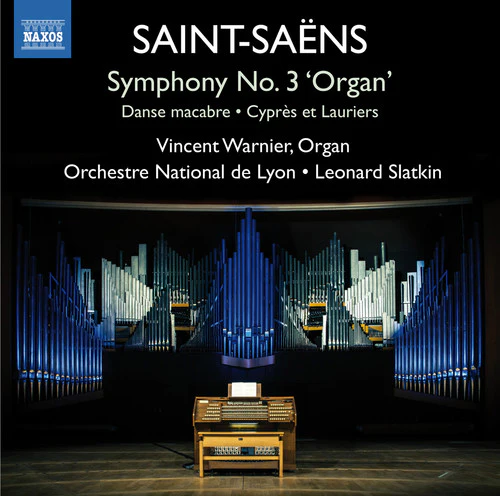
Having been unimpressed with previous releases by Slatkin and the Lyon orchestra in music by Ravel and Berlioz, I am happy to report that the team finally rises to its potential in this enterprising disc of Saint-Saëns’ music for organ and orchestra. First, however, we need to discuss the organ, because this release is as much about that instrument as it concerns the orchestra. The Lyon auditorium houses the famous Paris Trocadero organ built by the illustrious Cavaillé-Coll in 1878. It was one of the first, and certainly the greatest, concert hall organ in its day. As presently restored, the instrument incorporates changes made in 1939 from a prior refurbishment, and so is not in its original condition, but it does still contain many of the imitative “orchestral” stops that made these “symphonic” organs so revolutionary for the period.
By the time noted organist Edwin Lemare made his transcription of the Danse macabre decades later, the concept of the symphonic organ had expanded to include complete divisions of (allegedly) string-toned pipes. Some of these were more successful than others at creating the proper illusion. Lemare’s own organ in Chattanooga, Tennessee, for example–recently restored–had both violin and cello vibrato, celeste and orchestral violin stops in its string division. None of these except the vibrato-producing celeste were present in the Trocadero instrument, and so organist Vincent Warnier has had to modify Lemare’s registration accordingly. This he has managed with great sensitivity, and his performance, while a touch on the slow side (inevitably, in order to keep the rhythms clean), is still remarkably convincing, and an excellent example of how a symphonic organ can be used to play highly entertaining transcriptions of basic repertoire.
Cyprès et Lauriers is a diptych consisting of an elegiac organ solo linked to an organ-and-orchestra finale. It’s not great Saint-Saëns, but its 13 minutes pass by enjoyably, and it gives the organist the opportunity to display his instrument’s power and coloristic subtleties equally well. It has to be said that the current restoration has created a very pleasant-sounding instrument, with few of those excessively reedy, nasal stops that we often hear in 19th century organs, especially in France. Some aficionados love that particular gravelly sonority, but I’m not one of them.
And so to the symphony. Slatkin has finally whipped the orchestra into shape and they deliver a very enjoyable performance. The first movement is basically unplayable if you take Saint-Saëns’ double-note rhythms seriously, and so most performances kind of mush them together, creating an atmosphere of generalized agitation. This works perfectly well, but Slatkin has his players really articulate the principal theme of the allegro, and while it robs the music of some of its potential excitement, the result is effective and expressively apt. The same rhythmic precision characterizes the scherzo, whose 6/8 theme begins on an upbeat, which often somehow degenerates in many performances (Ormandy’s on Sony, for example) to the point where the tune seems to enter on a downbeat. Not here.
As for the two movements with organ, the balances with the orchestra are very naturally caught by the Radio France engineers. The transfer to disc is a bit low level, so you really need to turn up the volume for the best effect, and there’s plenty of room around the instruments. You won’t be overwhelmed by the organ’s sonority–no 747 jet engine revving up for takeoff here–but that’s a good thing. You get music, not noise. The interplay between the orchestra and the organ is a constant source of delight, and the finale still builds to a truly rousing conclusion. Altogether this is a very pleasing and worthwhile release, and a belated vindication for Slatkin and the Lyon players.
-- David Hurwitz, ClassicsToday.com
By the time noted organist Edwin Lemare made his transcription of the Danse macabre decades later, the concept of the symphonic organ had expanded to include complete divisions of (allegedly) string-toned pipes. Some of these were more successful than others at creating the proper illusion. Lemare’s own organ in Chattanooga, Tennessee, for example–recently restored–had both violin and cello vibrato, celeste and orchestral violin stops in its string division. None of these except the vibrato-producing celeste were present in the Trocadero instrument, and so organist Vincent Warnier has had to modify Lemare’s registration accordingly. This he has managed with great sensitivity, and his performance, while a touch on the slow side (inevitably, in order to keep the rhythms clean), is still remarkably convincing, and an excellent example of how a symphonic organ can be used to play highly entertaining transcriptions of basic repertoire.
Cyprès et Lauriers is a diptych consisting of an elegiac organ solo linked to an organ-and-orchestra finale. It’s not great Saint-Saëns, but its 13 minutes pass by enjoyably, and it gives the organist the opportunity to display his instrument’s power and coloristic subtleties equally well. It has to be said that the current restoration has created a very pleasant-sounding instrument, with few of those excessively reedy, nasal stops that we often hear in 19th century organs, especially in France. Some aficionados love that particular gravelly sonority, but I’m not one of them.
And so to the symphony. Slatkin has finally whipped the orchestra into shape and they deliver a very enjoyable performance. The first movement is basically unplayable if you take Saint-Saëns’ double-note rhythms seriously, and so most performances kind of mush them together, creating an atmosphere of generalized agitation. This works perfectly well, but Slatkin has his players really articulate the principal theme of the allegro, and while it robs the music of some of its potential excitement, the result is effective and expressively apt. The same rhythmic precision characterizes the scherzo, whose 6/8 theme begins on an upbeat, which often somehow degenerates in many performances (Ormandy’s on Sony, for example) to the point where the tune seems to enter on a downbeat. Not here.
As for the two movements with organ, the balances with the orchestra are very naturally caught by the Radio France engineers. The transfer to disc is a bit low level, so you really need to turn up the volume for the best effect, and there’s plenty of room around the instruments. You won’t be overwhelmed by the organ’s sonority–no 747 jet engine revving up for takeoff here–but that’s a good thing. You get music, not noise. The interplay between the orchestra and the organ is a constant source of delight, and the finale still builds to a truly rousing conclusion. Altogether this is a very pleasing and worthwhile release, and a belated vindication for Slatkin and the Lyon players.
-- David Hurwitz, ClassicsToday.com
Having been unimpressed with previous releases by Slatkin and the Lyon orchestra in music by Ravel and Berlioz, I am happy to report that the team finally rises to its potential in this enterprising disc of Saint-Saëns’ music for organ and orchestra. First, however, we need to discuss the organ, because this release is as much about that instrument as it concerns the orchestra. The Lyon auditorium houses the famous Paris Trocadero organ built by the illustrious Cavaillé-Coll in 1878. It was one of the first, and certainly the greatest, concert hall organ in its day. As presently restored, the instrument incorporates changes made in 1939 from a prior refurbishment, and so is not in its original condition, but it does still contain many of the imitative “orchestral” stops that made these “symphonic” organs so revolutionary for the period.
By the time noted organist Edwin Lemare made his transcription of the Danse macabre decades later, the concept of the symphonic organ had expanded to include complete divisions of (allegedly) string-toned pipes. Some of these were more successful than others at creating the proper illusion. Lemare’s own organ in Chattanooga, Tennessee, for example–recently restored–had both violin and cello vibrato, celeste and orchestral violin stops in its string division. None of these except the vibrato-producing celeste were present in the Trocadero instrument, and so organist Vincent Warnier has had to modify Lemare’s registration accordingly. This he has managed with great sensitivity, and his performance, while a touch on the slow side (inevitably, in order to keep the rhythms clean), is still remarkably convincing, and an excellent example of how a symphonic organ can be used to play highly entertaining transcriptions of basic repertoire.
Cyprès et Lauriers is a diptych consisting of an elegiac organ solo linked to an organ-and-orchestra finale. It’s not great Saint-Saëns, but its 13 minutes pass by enjoyably, and it gives the organist the opportunity to display his instrument’s power and coloristic subtleties equally well. It has to be said that the current restoration has created a very pleasant-sounding instrument, with few of those excessively reedy, nasal stops that we often hear in 19th century organs, especially in France. Some aficionados love that particular gravelly sonority, but I’m not one of them.
And so to the symphony. Slatkin has finally whipped the orchestra into shape and they deliver a very enjoyable performance. The first movement is basically unplayable if you take Saint-Saëns’ double-note rhythms seriously, and so most performances kind of mush them together, creating an atmosphere of generalized agitation. This works perfectly well, but Slatkin has his players really articulate the principal theme of the allegro, and while it robs the music of some of its potential excitement, the result is effective and expressively apt. The same rhythmic precision characterizes the scherzo, whose 6/8 theme begins on an upbeat, which often somehow degenerates in many performances (Ormandy’s on Sony, for example) to the point where the tune seems to enter on a downbeat. Not here.
As for the two movements with organ, the balances with the orchestra are very naturally caught by the Radio France engineers. The transfer to disc is a bit low level, so you really need to turn up the volume for the best effect, and there’s plenty of room around the instruments. You won’t be overwhelmed by the organ’s sonority–no 747 jet engine revving up for takeoff here–but that’s a good thing. You get music, not noise. The interplay between the orchestra and the organ is a constant source of delight, and the finale still builds to a truly rousing conclusion. Altogether this is a very pleasing and worthwhile release, and a belated vindication for Slatkin and the Lyon players.
-- David Hurwitz, ClassicsToday.com
By the time noted organist Edwin Lemare made his transcription of the Danse macabre decades later, the concept of the symphonic organ had expanded to include complete divisions of (allegedly) string-toned pipes. Some of these were more successful than others at creating the proper illusion. Lemare’s own organ in Chattanooga, Tennessee, for example–recently restored–had both violin and cello vibrato, celeste and orchestral violin stops in its string division. None of these except the vibrato-producing celeste were present in the Trocadero instrument, and so organist Vincent Warnier has had to modify Lemare’s registration accordingly. This he has managed with great sensitivity, and his performance, while a touch on the slow side (inevitably, in order to keep the rhythms clean), is still remarkably convincing, and an excellent example of how a symphonic organ can be used to play highly entertaining transcriptions of basic repertoire.
Cyprès et Lauriers is a diptych consisting of an elegiac organ solo linked to an organ-and-orchestra finale. It’s not great Saint-Saëns, but its 13 minutes pass by enjoyably, and it gives the organist the opportunity to display his instrument’s power and coloristic subtleties equally well. It has to be said that the current restoration has created a very pleasant-sounding instrument, with few of those excessively reedy, nasal stops that we often hear in 19th century organs, especially in France. Some aficionados love that particular gravelly sonority, but I’m not one of them.
And so to the symphony. Slatkin has finally whipped the orchestra into shape and they deliver a very enjoyable performance. The first movement is basically unplayable if you take Saint-Saëns’ double-note rhythms seriously, and so most performances kind of mush them together, creating an atmosphere of generalized agitation. This works perfectly well, but Slatkin has his players really articulate the principal theme of the allegro, and while it robs the music of some of its potential excitement, the result is effective and expressively apt. The same rhythmic precision characterizes the scherzo, whose 6/8 theme begins on an upbeat, which often somehow degenerates in many performances (Ormandy’s on Sony, for example) to the point where the tune seems to enter on a downbeat. Not here.
As for the two movements with organ, the balances with the orchestra are very naturally caught by the Radio France engineers. The transfer to disc is a bit low level, so you really need to turn up the volume for the best effect, and there’s plenty of room around the instruments. You won’t be overwhelmed by the organ’s sonority–no 747 jet engine revving up for takeoff here–but that’s a good thing. You get music, not noise. The interplay between the orchestra and the organ is a constant source of delight, and the finale still builds to a truly rousing conclusion. Altogether this is a very pleasing and worthwhile release, and a belated vindication for Slatkin and the Lyon players.
-- David Hurwitz, ClassicsToday.com
$13.99
Saint-Saens: Symphony No 3 "Organ"… / Slatkin—
$13.99
Description
Having been unimpressed with previous releases by Slatkin and the Lyon orchestra in music by Ravel and Berlioz, I am happy to report that the team finally rises to its potential in this enterprising disc of Saint-Saëns’ music for organ and orchestra. First, however, we need to discuss the organ, because this release is as much about that instrument as it concerns the orchestra. The Lyon auditorium houses the famous Paris Trocadero organ built by the illustrious Cavaillé-Coll in 1878. It was one of the first, and certainly the greatest, concert hall organ in its day. As presently restored, the instrument incorporates changes made in 1939 from a prior refurbishment, and so is not in its original condition, but it does still contain many of the imitative “orchestral” stops that made these “symphonic” organs so revolutionary for the period.
By the time noted organist Edwin Lemare made his transcription of the Danse macabre decades later, the concept of the symphonic organ had expanded to include complete divisions of (allegedly) string-toned pipes. Some of these were more successful than others at creating the proper illusion. Lemare’s own organ in Chattanooga, Tennessee, for example–recently restored–had both violin and cello vibrato, celeste and orchestral violin stops in its string division. None of these except the vibrato-producing celeste were present in the Trocadero instrument, and so organist Vincent Warnier has had to modify Lemare’s registration accordingly. This he has managed with great sensitivity, and his performance, while a touch on the slow side (inevitably, in order to keep the rhythms clean), is still remarkably convincing, and an excellent example of how a symphonic organ can be used to play highly entertaining transcriptions of basic repertoire.
Cyprès et Lauriers is a diptych consisting of an elegiac organ solo linked to an organ-and-orchestra finale. It’s not great Saint-Saëns, but its 13 minutes pass by enjoyably, and it gives the organist the opportunity to display his instrument’s power and coloristic subtleties equally well. It has to be said that the current restoration has created a very pleasant-sounding instrument, with few of those excessively reedy, nasal stops that we often hear in 19th century organs, especially in France. Some aficionados love that particular gravelly sonority, but I’m not one of them.
And so to the symphony. Slatkin has finally whipped the orchestra into shape and they deliver a very enjoyable performance. The first movement is basically unplayable if you take Saint-Saëns’ double-note rhythms seriously, and so most performances kind of mush them together, creating an atmosphere of generalized agitation. This works perfectly well, but Slatkin has his players really articulate the principal theme of the allegro, and while it robs the music of some of its potential excitement, the result is effective and expressively apt. The same rhythmic precision characterizes the scherzo, whose 6/8 theme begins on an upbeat, which often somehow degenerates in many performances (Ormandy’s on Sony, for example) to the point where the tune seems to enter on a downbeat. Not here.
As for the two movements with organ, the balances with the orchestra are very naturally caught by the Radio France engineers. The transfer to disc is a bit low level, so you really need to turn up the volume for the best effect, and there’s plenty of room around the instruments. You won’t be overwhelmed by the organ’s sonority–no 747 jet engine revving up for takeoff here–but that’s a good thing. You get music, not noise. The interplay between the orchestra and the organ is a constant source of delight, and the finale still builds to a truly rousing conclusion. Altogether this is a very pleasing and worthwhile release, and a belated vindication for Slatkin and the Lyon players.
-- David Hurwitz, ClassicsToday.com
By the time noted organist Edwin Lemare made his transcription of the Danse macabre decades later, the concept of the symphonic organ had expanded to include complete divisions of (allegedly) string-toned pipes. Some of these were more successful than others at creating the proper illusion. Lemare’s own organ in Chattanooga, Tennessee, for example–recently restored–had both violin and cello vibrato, celeste and orchestral violin stops in its string division. None of these except the vibrato-producing celeste were present in the Trocadero instrument, and so organist Vincent Warnier has had to modify Lemare’s registration accordingly. This he has managed with great sensitivity, and his performance, while a touch on the slow side (inevitably, in order to keep the rhythms clean), is still remarkably convincing, and an excellent example of how a symphonic organ can be used to play highly entertaining transcriptions of basic repertoire.
Cyprès et Lauriers is a diptych consisting of an elegiac organ solo linked to an organ-and-orchestra finale. It’s not great Saint-Saëns, but its 13 minutes pass by enjoyably, and it gives the organist the opportunity to display his instrument’s power and coloristic subtleties equally well. It has to be said that the current restoration has created a very pleasant-sounding instrument, with few of those excessively reedy, nasal stops that we often hear in 19th century organs, especially in France. Some aficionados love that particular gravelly sonority, but I’m not one of them.
And so to the symphony. Slatkin has finally whipped the orchestra into shape and they deliver a very enjoyable performance. The first movement is basically unplayable if you take Saint-Saëns’ double-note rhythms seriously, and so most performances kind of mush them together, creating an atmosphere of generalized agitation. This works perfectly well, but Slatkin has his players really articulate the principal theme of the allegro, and while it robs the music of some of its potential excitement, the result is effective and expressively apt. The same rhythmic precision characterizes the scherzo, whose 6/8 theme begins on an upbeat, which often somehow degenerates in many performances (Ormandy’s on Sony, for example) to the point where the tune seems to enter on a downbeat. Not here.
As for the two movements with organ, the balances with the orchestra are very naturally caught by the Radio France engineers. The transfer to disc is a bit low level, so you really need to turn up the volume for the best effect, and there’s plenty of room around the instruments. You won’t be overwhelmed by the organ’s sonority–no 747 jet engine revving up for takeoff here–but that’s a good thing. You get music, not noise. The interplay between the orchestra and the organ is a constant source of delight, and the finale still builds to a truly rousing conclusion. Altogether this is a very pleasing and worthwhile release, and a belated vindication for Slatkin and the Lyon players.
-- David Hurwitz, ClassicsToday.com