🎉 Up to 70% Off Selected ItemsShop Sale

1 / 2
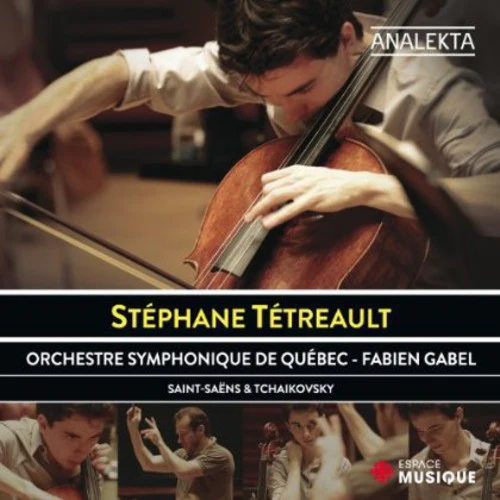
Saint-Saens & Tchaikovsky / Gabel, Tetreault, Quebec Symphony
The early 1870s saw Saint-Saëns driven by a constant desire to surpass himself, which led to several powerful compositions, including the Cello Concerto No. 1. His creative decisions—the expressive treatment of the solo part, the thematic concentration, the concise orchestral developments, the juxtaposition of contrasts, the lack of a traditional orchestral introduction, and the merging of the usual three movements into one—place this concerto in a class of its own.
When German cellist Wilhelm Fitzenhagen—a colleague of Tchaikovsky’s at the Moscow Conservatory who took part in the premieres of three of the latter’s string quartets—received the Variations on a Rococo Theme in 1877, which he had commissioned from Tchaikovsky, he immediately took it on tour.
Quickly realizing how deeply moving audiences found the third variation, “Andante” (they frequently applauded it), Fitzenhagen decided to rework the score by moving this variation to the end and rewriting certain transitions. Tchaikovsky was unaware of this until the work was published in 1889.
Although outraged, the composer let the publication stand, and Tchaikovsky’s original version would not be heard again before 1941; indeed, most cellists did not start playing the original version until the late 1970s.
When German cellist Wilhelm Fitzenhagen—a colleague of Tchaikovsky’s at the Moscow Conservatory who took part in the premieres of three of the latter’s string quartets—received the Variations on a Rococo Theme in 1877, which he had commissioned from Tchaikovsky, he immediately took it on tour.
Quickly realizing how deeply moving audiences found the third variation, “Andante” (they frequently applauded it), Fitzenhagen decided to rework the score by moving this variation to the end and rewriting certain transitions. Tchaikovsky was unaware of this until the work was published in 1889.
Although outraged, the composer let the publication stand, and Tchaikovsky’s original version would not be heard again before 1941; indeed, most cellists did not start playing the original version until the late 1970s.
The early 1870s saw Saint-Saëns driven by a constant desire to surpass himself, which led to several powerful compositions, including the Cello Concerto No. 1. His creative decisions—the expressive treatment of the solo part, the thematic concentration, the concise orchestral developments, the juxtaposition of contrasts, the lack of a traditional orchestral introduction, and the merging of the usual three movements into one—place this concerto in a class of its own.
When German cellist Wilhelm Fitzenhagen—a colleague of Tchaikovsky’s at the Moscow Conservatory who took part in the premieres of three of the latter’s string quartets—received the Variations on a Rococo Theme in 1877, which he had commissioned from Tchaikovsky, he immediately took it on tour.
Quickly realizing how deeply moving audiences found the third variation, “Andante” (they frequently applauded it), Fitzenhagen decided to rework the score by moving this variation to the end and rewriting certain transitions. Tchaikovsky was unaware of this until the work was published in 1889.
Although outraged, the composer let the publication stand, and Tchaikovsky’s original version would not be heard again before 1941; indeed, most cellists did not start playing the original version until the late 1970s.
When German cellist Wilhelm Fitzenhagen—a colleague of Tchaikovsky’s at the Moscow Conservatory who took part in the premieres of three of the latter’s string quartets—received the Variations on a Rococo Theme in 1877, which he had commissioned from Tchaikovsky, he immediately took it on tour.
Quickly realizing how deeply moving audiences found the third variation, “Andante” (they frequently applauded it), Fitzenhagen decided to rework the score by moving this variation to the end and rewriting certain transitions. Tchaikovsky was unaware of this until the work was published in 1889.
Although outraged, the composer let the publication stand, and Tchaikovsky’s original version would not be heard again before 1941; indeed, most cellists did not start playing the original version until the late 1970s.
$3.67
Original: $10.50
-65%Saint-Saens & Tchaikovsky / Gabel, Tetreault, Quebec Symphony—
$10.50
$3.67Description
The early 1870s saw Saint-Saëns driven by a constant desire to surpass himself, which led to several powerful compositions, including the Cello Concerto No. 1. His creative decisions—the expressive treatment of the solo part, the thematic concentration, the concise orchestral developments, the juxtaposition of contrasts, the lack of a traditional orchestral introduction, and the merging of the usual three movements into one—place this concerto in a class of its own.
When German cellist Wilhelm Fitzenhagen—a colleague of Tchaikovsky’s at the Moscow Conservatory who took part in the premieres of three of the latter’s string quartets—received the Variations on a Rococo Theme in 1877, which he had commissioned from Tchaikovsky, he immediately took it on tour.
Quickly realizing how deeply moving audiences found the third variation, “Andante” (they frequently applauded it), Fitzenhagen decided to rework the score by moving this variation to the end and rewriting certain transitions. Tchaikovsky was unaware of this until the work was published in 1889.
Although outraged, the composer let the publication stand, and Tchaikovsky’s original version would not be heard again before 1941; indeed, most cellists did not start playing the original version until the late 1970s.
When German cellist Wilhelm Fitzenhagen—a colleague of Tchaikovsky’s at the Moscow Conservatory who took part in the premieres of three of the latter’s string quartets—received the Variations on a Rococo Theme in 1877, which he had commissioned from Tchaikovsky, he immediately took it on tour.
Quickly realizing how deeply moving audiences found the third variation, “Andante” (they frequently applauded it), Fitzenhagen decided to rework the score by moving this variation to the end and rewriting certain transitions. Tchaikovsky was unaware of this until the work was published in 1889.
Although outraged, the composer let the publication stand, and Tchaikovsky’s original version would not be heard again before 1941; indeed, most cellists did not start playing the original version until the late 1970s.