🎉 Up to 70% Off Selected ItemsShop Sale

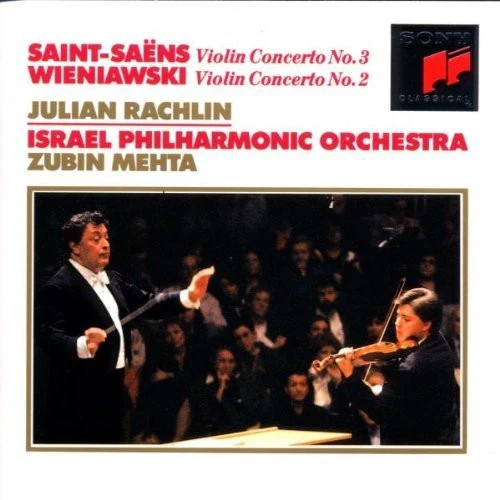
Saint-Saens, Wieniawski: Violin Concertos / Rachlin, Mehta
I enjoyed this new Sony coupling of Saint-Saëns and Wieniawski concertos very much indeed. They are both highly rewarding works, well crafted in the best sense. Their special charm is that the quality of the invention and the manner in which the themes are discussed is exactly right for the music's modest scale. Julian Rachlin has their full measure and continually beguiles us with the spontaneous melodic flow. He is a Lithuanian prodigy (beginning his concert career at the age of ten!) and is utterly in command of the galaxy of colour his instrument can create in that special way that seems to come so readily and easily to Jewish fiddlers, when they are so naturally gifted. Not for a single bar throughout this music is his virtuosity displayed for its own sake: it is always put at the service of the two composers. The Saint-Saëns was taken from a live concert, although this is not made clear in the presentation material. Both concertos were recorded in the Mann Auditorium and there are subtle differences in the sound, although the balance is basically excellent throughout. In Saint-Saëns the audience absorbion cushions the orchestral textures, but also makes the solo image warmer, more seductive; in the Wieniawski the orchestra] focus is fresher, the body of the string tone has more tangibility, and the violin is made to 'stand tall', more positively up front. But Julian Rachlin's playing can take any amount of scrutiny and in the live performance, where there were no chances for retakes, he is just as technically assured as when recording under studio conditions. Mehta, too, is on top form and so is the orchestra.
The Saint-Saëns comes first and has many delights to offer. The first movement has a splendidly passionate lyrical impulse and the Andantino is sheer delight: it has one of the composer's most delicious inspirations, a siciliano which is relished here by one and all (including us). Note Rachlin's gentle reprise of the lovely lyrical theme, surrounded by delicate touches of woodwind colour at 4'53" and again his re-presentation at 6'41", high up and exquisite. This is what fine fiddling is all about. But the performance reaches its peak in the splendid finale, the longest movement, which has wit and fire and a memorable chorale melody thrown in for good measure. It appears ethereally on the violins at 3'55" (Mehta and his orchestra wonderfully persuasive); then at 4'18" the soloist relishes its beauty. When the brass finally get their teeth into it (843") they let rip with real gusto, and then the soloist admonishes them with a gentle riposte which includes a disarming pianissimo echo. The sinuously flowing opening of the Wieniawski is beautifully and naturally moulded by the orchestra, with fine contributions from the principal oboe and solo horn, and when the soloist arrives the music's rhapsodic feeling continues most pleasingly. The second subject is beguiling enough when it first appears, but at its reprise (6'14") Rachlin's 50110 voce playing makes one's toes curl with pleasure. At 1135" the orchestra's principal clarinet shows what he is made of in the preparation for the glorious Andante, where the violin enters gently but with a simmering, sultry tone. The chimerical finale is full of joy and has the lightest touch from all concerned. I have played this record a lot and shall return to it with much pleasure. Not all music has to move mountains like Beethoven's Eroica.
-- Gramophone [12/1992]
The Saint-Saëns comes first and has many delights to offer. The first movement has a splendidly passionate lyrical impulse and the Andantino is sheer delight: it has one of the composer's most delicious inspirations, a siciliano which is relished here by one and all (including us). Note Rachlin's gentle reprise of the lovely lyrical theme, surrounded by delicate touches of woodwind colour at 4'53" and again his re-presentation at 6'41", high up and exquisite. This is what fine fiddling is all about. But the performance reaches its peak in the splendid finale, the longest movement, which has wit and fire and a memorable chorale melody thrown in for good measure. It appears ethereally on the violins at 3'55" (Mehta and his orchestra wonderfully persuasive); then at 4'18" the soloist relishes its beauty. When the brass finally get their teeth into it (843") they let rip with real gusto, and then the soloist admonishes them with a gentle riposte which includes a disarming pianissimo echo. The sinuously flowing opening of the Wieniawski is beautifully and naturally moulded by the orchestra, with fine contributions from the principal oboe and solo horn, and when the soloist arrives the music's rhapsodic feeling continues most pleasingly. The second subject is beguiling enough when it first appears, but at its reprise (6'14") Rachlin's 50110 voce playing makes one's toes curl with pleasure. At 1135" the orchestra's principal clarinet shows what he is made of in the preparation for the glorious Andante, where the violin enters gently but with a simmering, sultry tone. The chimerical finale is full of joy and has the lightest touch from all concerned. I have played this record a lot and shall return to it with much pleasure. Not all music has to move mountains like Beethoven's Eroica.
-- Gramophone [12/1992]
I enjoyed this new Sony coupling of Saint-Saëns and Wieniawski concertos very much indeed. They are both highly rewarding works, well crafted in the best sense. Their special charm is that the quality of the invention and the manner in which the themes are discussed is exactly right for the music's modest scale. Julian Rachlin has their full measure and continually beguiles us with the spontaneous melodic flow. He is a Lithuanian prodigy (beginning his concert career at the age of ten!) and is utterly in command of the galaxy of colour his instrument can create in that special way that seems to come so readily and easily to Jewish fiddlers, when they are so naturally gifted. Not for a single bar throughout this music is his virtuosity displayed for its own sake: it is always put at the service of the two composers. The Saint-Saëns was taken from a live concert, although this is not made clear in the presentation material. Both concertos were recorded in the Mann Auditorium and there are subtle differences in the sound, although the balance is basically excellent throughout. In Saint-Saëns the audience absorbion cushions the orchestral textures, but also makes the solo image warmer, more seductive; in the Wieniawski the orchestra] focus is fresher, the body of the string tone has more tangibility, and the violin is made to 'stand tall', more positively up front. But Julian Rachlin's playing can take any amount of scrutiny and in the live performance, where there were no chances for retakes, he is just as technically assured as when recording under studio conditions. Mehta, too, is on top form and so is the orchestra.
The Saint-Saëns comes first and has many delights to offer. The first movement has a splendidly passionate lyrical impulse and the Andantino is sheer delight: it has one of the composer's most delicious inspirations, a siciliano which is relished here by one and all (including us). Note Rachlin's gentle reprise of the lovely lyrical theme, surrounded by delicate touches of woodwind colour at 4'53" and again his re-presentation at 6'41", high up and exquisite. This is what fine fiddling is all about. But the performance reaches its peak in the splendid finale, the longest movement, which has wit and fire and a memorable chorale melody thrown in for good measure. It appears ethereally on the violins at 3'55" (Mehta and his orchestra wonderfully persuasive); then at 4'18" the soloist relishes its beauty. When the brass finally get their teeth into it (843") they let rip with real gusto, and then the soloist admonishes them with a gentle riposte which includes a disarming pianissimo echo. The sinuously flowing opening of the Wieniawski is beautifully and naturally moulded by the orchestra, with fine contributions from the principal oboe and solo horn, and when the soloist arrives the music's rhapsodic feeling continues most pleasingly. The second subject is beguiling enough when it first appears, but at its reprise (6'14") Rachlin's 50110 voce playing makes one's toes curl with pleasure. At 1135" the orchestra's principal clarinet shows what he is made of in the preparation for the glorious Andante, where the violin enters gently but with a simmering, sultry tone. The chimerical finale is full of joy and has the lightest touch from all concerned. I have played this record a lot and shall return to it with much pleasure. Not all music has to move mountains like Beethoven's Eroica.
-- Gramophone [12/1992]
The Saint-Saëns comes first and has many delights to offer. The first movement has a splendidly passionate lyrical impulse and the Andantino is sheer delight: it has one of the composer's most delicious inspirations, a siciliano which is relished here by one and all (including us). Note Rachlin's gentle reprise of the lovely lyrical theme, surrounded by delicate touches of woodwind colour at 4'53" and again his re-presentation at 6'41", high up and exquisite. This is what fine fiddling is all about. But the performance reaches its peak in the splendid finale, the longest movement, which has wit and fire and a memorable chorale melody thrown in for good measure. It appears ethereally on the violins at 3'55" (Mehta and his orchestra wonderfully persuasive); then at 4'18" the soloist relishes its beauty. When the brass finally get their teeth into it (843") they let rip with real gusto, and then the soloist admonishes them with a gentle riposte which includes a disarming pianissimo echo. The sinuously flowing opening of the Wieniawski is beautifully and naturally moulded by the orchestra, with fine contributions from the principal oboe and solo horn, and when the soloist arrives the music's rhapsodic feeling continues most pleasingly. The second subject is beguiling enough when it first appears, but at its reprise (6'14") Rachlin's 50110 voce playing makes one's toes curl with pleasure. At 1135" the orchestra's principal clarinet shows what he is made of in the preparation for the glorious Andante, where the violin enters gently but with a simmering, sultry tone. The chimerical finale is full of joy and has the lightest touch from all concerned. I have played this record a lot and shall return to it with much pleasure. Not all music has to move mountains like Beethoven's Eroica.
-- Gramophone [12/1992]
$17.99
Saint-Saens, Wieniawski: Violin Concertos / Rachlin, Mehta—
$17.99
Description
I enjoyed this new Sony coupling of Saint-Saëns and Wieniawski concertos very much indeed. They are both highly rewarding works, well crafted in the best sense. Their special charm is that the quality of the invention and the manner in which the themes are discussed is exactly right for the music's modest scale. Julian Rachlin has their full measure and continually beguiles us with the spontaneous melodic flow. He is a Lithuanian prodigy (beginning his concert career at the age of ten!) and is utterly in command of the galaxy of colour his instrument can create in that special way that seems to come so readily and easily to Jewish fiddlers, when they are so naturally gifted. Not for a single bar throughout this music is his virtuosity displayed for its own sake: it is always put at the service of the two composers. The Saint-Saëns was taken from a live concert, although this is not made clear in the presentation material. Both concertos were recorded in the Mann Auditorium and there are subtle differences in the sound, although the balance is basically excellent throughout. In Saint-Saëns the audience absorbion cushions the orchestral textures, but also makes the solo image warmer, more seductive; in the Wieniawski the orchestra] focus is fresher, the body of the string tone has more tangibility, and the violin is made to 'stand tall', more positively up front. But Julian Rachlin's playing can take any amount of scrutiny and in the live performance, where there were no chances for retakes, he is just as technically assured as when recording under studio conditions. Mehta, too, is on top form and so is the orchestra.
The Saint-Saëns comes first and has many delights to offer. The first movement has a splendidly passionate lyrical impulse and the Andantino is sheer delight: it has one of the composer's most delicious inspirations, a siciliano which is relished here by one and all (including us). Note Rachlin's gentle reprise of the lovely lyrical theme, surrounded by delicate touches of woodwind colour at 4'53" and again his re-presentation at 6'41", high up and exquisite. This is what fine fiddling is all about. But the performance reaches its peak in the splendid finale, the longest movement, which has wit and fire and a memorable chorale melody thrown in for good measure. It appears ethereally on the violins at 3'55" (Mehta and his orchestra wonderfully persuasive); then at 4'18" the soloist relishes its beauty. When the brass finally get their teeth into it (843") they let rip with real gusto, and then the soloist admonishes them with a gentle riposte which includes a disarming pianissimo echo. The sinuously flowing opening of the Wieniawski is beautifully and naturally moulded by the orchestra, with fine contributions from the principal oboe and solo horn, and when the soloist arrives the music's rhapsodic feeling continues most pleasingly. The second subject is beguiling enough when it first appears, but at its reprise (6'14") Rachlin's 50110 voce playing makes one's toes curl with pleasure. At 1135" the orchestra's principal clarinet shows what he is made of in the preparation for the glorious Andante, where the violin enters gently but with a simmering, sultry tone. The chimerical finale is full of joy and has the lightest touch from all concerned. I have played this record a lot and shall return to it with much pleasure. Not all music has to move mountains like Beethoven's Eroica.
-- Gramophone [12/1992]
The Saint-Saëns comes first and has many delights to offer. The first movement has a splendidly passionate lyrical impulse and the Andantino is sheer delight: it has one of the composer's most delicious inspirations, a siciliano which is relished here by one and all (including us). Note Rachlin's gentle reprise of the lovely lyrical theme, surrounded by delicate touches of woodwind colour at 4'53" and again his re-presentation at 6'41", high up and exquisite. This is what fine fiddling is all about. But the performance reaches its peak in the splendid finale, the longest movement, which has wit and fire and a memorable chorale melody thrown in for good measure. It appears ethereally on the violins at 3'55" (Mehta and his orchestra wonderfully persuasive); then at 4'18" the soloist relishes its beauty. When the brass finally get their teeth into it (843") they let rip with real gusto, and then the soloist admonishes them with a gentle riposte which includes a disarming pianissimo echo. The sinuously flowing opening of the Wieniawski is beautifully and naturally moulded by the orchestra, with fine contributions from the principal oboe and solo horn, and when the soloist arrives the music's rhapsodic feeling continues most pleasingly. The second subject is beguiling enough when it first appears, but at its reprise (6'14") Rachlin's 50110 voce playing makes one's toes curl with pleasure. At 1135" the orchestra's principal clarinet shows what he is made of in the preparation for the glorious Andante, where the violin enters gently but with a simmering, sultry tone. The chimerical finale is full of joy and has the lightest touch from all concerned. I have played this record a lot and shall return to it with much pleasure. Not all music has to move mountains like Beethoven's Eroica.
-- Gramophone [12/1992]






















