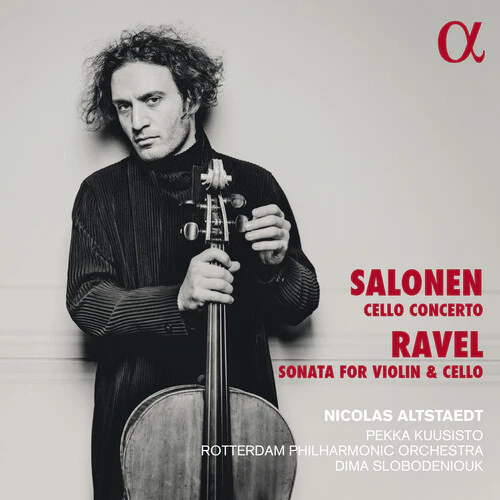
Salonen: Cello Concerto; Ravel: Duo / Altstaedt, Kuusisto, Slobodeniouk, Rotterdam Philharmonic
Nicolas Altstaedt presents here his version of Esa-Pekka Salonen’s monumental Cello Concerto, originally composed for Yo-Yo Ma, and given its Finnish premiere by the Franco-German cellist under the composer’s direction. In partnership with the Rotterdam Philharmonic Orchestra and conductor Dima Slobodeniouk, he reveals its full expressive dimension here: ‘The first movement opens with what, in my sketchbook, was called “Chaos to line”’, says Esa-Pekka Salonen. Chaos, a metaphorical comet, a rhythmic mantra with congas and bongos, a wild dance . . . Salonen goes on to say of the third movement: ‘I imagined the orchestra as some kind of gigantic lung, expanding and contracting first slowly, but accelerating to a point of mild hyperventilation which leads back to the dance-like material.’
The coupling is the famous ‘Duo Ravel’ (to give it the original title used at its premiere), which Nicolas Altstaedt and Pekka Kuusisto have been performing and refining ever since 2010, and which it was high time to record.
REVIEW:
After the “defining” opening of Esa-Pekka Salonen’s Cello Concerto, the cello enters—soulful, almost tonal, and lyrical with long-lined modulations, as the orchestra holds the tonal-like center. In all three movements the orchestration reminds me of Ravel’s: delicate and transparent, whatever the size of the ensemble.
The second movement has a concave shape, with a strong cluttered opening from which the solo cello emerges, flowing to a mid-section dialogue with the alto flute, before bird-like twitters expand to a bed of seagull-like cries (are they string glissandos or electronic?) over growing strings and winds.
The music grows without a break into the kinetic, dance-like final movement. Salonen describes it as “lung music” that swells and exhales repeatedly, as light congas and bongos set the pace.
But what about the performers? I listened twice, and both times Altstaedt was so mesmerizing that I found it difficult to listen analytically. It’ll take more than a couple hearings for me to “own” the work, despite Altstaedt’s consuming magnetic draw. Slobodeniouk is his hand-in-glove partner. Each movement flows with integrity.
The exhilaration and esthetic pleasure Altsteadt and Kuusisto bring to Ravel's Duo Sonata as they respond is remarkable. The opening Allegro is flowing and lithe. In the tres vif scherzo, the duo grabs hold of the insane pulse; the “harmonic sound set” is somewhat like hearing The Rite of Spring for the first time...
Ravel had fears of the sonata “being assassinated by amateurs.” I’ve never heard it more alive than with Altsteadt-Kuusisto!
--Fanfare (Gil French)
Nicolas Altstaedt presents here his version of Esa-Pekka Salonen’s monumental Cello Concerto, originally composed for Yo-Yo Ma, and given its Finnish premiere by the Franco-German cellist under the composer’s direction. In partnership with the Rotterdam Philharmonic Orchestra and conductor Dima Slobodeniouk, he reveals its full expressive dimension here: ‘The first movement opens with what, in my sketchbook, was called “Chaos to line”’, says Esa-Pekka Salonen. Chaos, a metaphorical comet, a rhythmic mantra with congas and bongos, a wild dance . . . Salonen goes on to say of the third movement: ‘I imagined the orchestra as some kind of gigantic lung, expanding and contracting first slowly, but accelerating to a point of mild hyperventilation which leads back to the dance-like material.’
The coupling is the famous ‘Duo Ravel’ (to give it the original title used at its premiere), which Nicolas Altstaedt and Pekka Kuusisto have been performing and refining ever since 2010, and which it was high time to record.
REVIEW:
After the “defining” opening of Esa-Pekka Salonen’s Cello Concerto, the cello enters—soulful, almost tonal, and lyrical with long-lined modulations, as the orchestra holds the tonal-like center. In all three movements the orchestration reminds me of Ravel’s: delicate and transparent, whatever the size of the ensemble.
The second movement has a concave shape, with a strong cluttered opening from which the solo cello emerges, flowing to a mid-section dialogue with the alto flute, before bird-like twitters expand to a bed of seagull-like cries (are they string glissandos or electronic?) over growing strings and winds.
The music grows without a break into the kinetic, dance-like final movement. Salonen describes it as “lung music” that swells and exhales repeatedly, as light congas and bongos set the pace.
But what about the performers? I listened twice, and both times Altstaedt was so mesmerizing that I found it difficult to listen analytically. It’ll take more than a couple hearings for me to “own” the work, despite Altstaedt’s consuming magnetic draw. Slobodeniouk is his hand-in-glove partner. Each movement flows with integrity.
The exhilaration and esthetic pleasure Altsteadt and Kuusisto bring to Ravel's Duo Sonata as they respond is remarkable. The opening Allegro is flowing and lithe. In the tres vif scherzo, the duo grabs hold of the insane pulse; the “harmonic sound set” is somewhat like hearing The Rite of Spring for the first time...
Ravel had fears of the sonata “being assassinated by amateurs.” I’ve never heard it more alive than with Altsteadt-Kuusisto!
--Fanfare (Gil French)
Original: $15.99
-65%$15.99
$5.60Description
Nicolas Altstaedt presents here his version of Esa-Pekka Salonen’s monumental Cello Concerto, originally composed for Yo-Yo Ma, and given its Finnish premiere by the Franco-German cellist under the composer’s direction. In partnership with the Rotterdam Philharmonic Orchestra and conductor Dima Slobodeniouk, he reveals its full expressive dimension here: ‘The first movement opens with what, in my sketchbook, was called “Chaos to line”’, says Esa-Pekka Salonen. Chaos, a metaphorical comet, a rhythmic mantra with congas and bongos, a wild dance . . . Salonen goes on to say of the third movement: ‘I imagined the orchestra as some kind of gigantic lung, expanding and contracting first slowly, but accelerating to a point of mild hyperventilation which leads back to the dance-like material.’
The coupling is the famous ‘Duo Ravel’ (to give it the original title used at its premiere), which Nicolas Altstaedt and Pekka Kuusisto have been performing and refining ever since 2010, and which it was high time to record.
REVIEW:
After the “defining” opening of Esa-Pekka Salonen’s Cello Concerto, the cello enters—soulful, almost tonal, and lyrical with long-lined modulations, as the orchestra holds the tonal-like center. In all three movements the orchestration reminds me of Ravel’s: delicate and transparent, whatever the size of the ensemble.
The second movement has a concave shape, with a strong cluttered opening from which the solo cello emerges, flowing to a mid-section dialogue with the alto flute, before bird-like twitters expand to a bed of seagull-like cries (are they string glissandos or electronic?) over growing strings and winds.
The music grows without a break into the kinetic, dance-like final movement. Salonen describes it as “lung music” that swells and exhales repeatedly, as light congas and bongos set the pace.
But what about the performers? I listened twice, and both times Altstaedt was so mesmerizing that I found it difficult to listen analytically. It’ll take more than a couple hearings for me to “own” the work, despite Altstaedt’s consuming magnetic draw. Slobodeniouk is his hand-in-glove partner. Each movement flows with integrity.
The exhilaration and esthetic pleasure Altsteadt and Kuusisto bring to Ravel's Duo Sonata as they respond is remarkable. The opening Allegro is flowing and lithe. In the tres vif scherzo, the duo grabs hold of the insane pulse; the “harmonic sound set” is somewhat like hearing The Rite of Spring for the first time...
Ravel had fears of the sonata “being assassinated by amateurs.” I’ve never heard it more alive than with Altsteadt-Kuusisto!
--Fanfare (Gil French)