🎉 Up to 70% Off Selected ItemsShop Sale

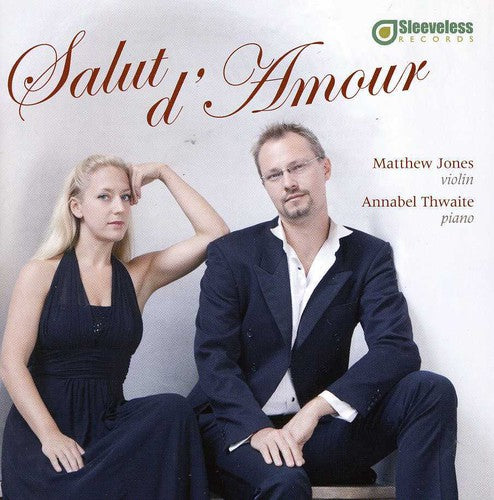
Salut d'Amour / Jones, Thwaite
SALUT D’AMOUR • Matthew Jones (vn); Annabel Thwaite (pn) • SLEEVELESS 1006 (62:17)
GERSHWIN (arr. Heifetz) It Ain’t Necessarily So. MASSENET Méditation. CHOPIN Nocturnes: in c?; in D?. ELGAR Salut d’amour. FAURÉ (arr. Bachmann) Après un rêve. PONCE (arr. Heifetz) Estrellita. CASPI La Trenza. MONTI Czardas. SCHUBERT Impromptu in B?. HAHN Nocturne. IRELAND Cavatina. SIBELIUS Romance. KREISLER Praeludium and Allegro. TRADITIONAL (arr. Gover) Suo Gân
Serious-minded programmers (or, at least, programmers of a certain well-delineated stripe) almost banished short pieces, which had been the meat and potatoes of the recital program as well as of the recording industry, from stages and discs for about a generation. Now intrepid artists Matthew Jones and Annabel Thwaite have torn down the “Do Not Enter” signs and have risked their musical lives exploring the dangerous proscribed (politically incorrect?) repertoire that arguably ruined careers and reputations 50 years ago (but, of course, made them 50 years before that). And to their credit—or discredit—they play stylishly in Jascha Heifetz’s saucy transcription of George Gershwin’s song, It Ain’t Necessarily So —if not with Heifetz’s own dazzling aplomb, pleasantly excitingly at least. Jules Massenet’s Méditation may be the most beloved short piece ever played on the violin, and the duo plays it that way. The tone of Jones’s violin exhibits a sort of acidulous edge—just as did Aaron Rosand’s or Zino Francescatti’s, although in the cases of both those older violinists, the edge lent what they played a sort of sizzle that Jones’s playing lacks. Nathan Milstein made a very violinistic-sounding arrangement of Chopin’s Nocturne in C? Minor; and though that piece might have fit well in the program, Thwaite plays it as a piano solo—so sensitively and atmospherically that even violinists might be glad not to have heard the arrangement for violin. Jones and Thwaite realize much of the veiled emotion of Elgar’s popular miniature Salut d’amour as well as the quiet intensity of the beginning of Gabriel Fauré’s short piece, Après un rêve . Heifetz’s arrangement of Estrellita might have been his calling card, but Jones makes it his own as well in a reading that’s warmer and more tender.
The program includes some less well-known but no less effective interludes, of which Avshalom Caspi’s brooding miniature La Trenza proves to be the first example. Vittorio Monti’s Czardas , like Massenet’s Méditation , has been one of the most frequently heard of violin encores, penetrating the popular repertoire almost as deeply as the standard one. Jones remains faithful to the original version, but he plays it with gusto and appealing ethnic coloration. Thwaite takes Franz Schubert’s Impromptu as a piano solo, exhibiting a firm grasp of the piece’s shape and making the most of its growling lower registers. Reynaldo Hahn’s Nocturne, another of the less familiar cameos, sounds allusive and affecting in Jones’s reading, as does John Ireland’s Cavatina , a piece that may strike some listeners as perhaps a bit more effective than the vastly better known piece by the same name by Joachim Raff. Sibelius’s Romance provides yet another example of a relative unknown that fits perfectly into the program, and Jones invests it with melting warmth and insinuating subtlety. Chopin’s Nocturne in D? Major serves as the last of the Thwaite’s three effective piano solos.
Fritz Kreisler never recorded his own Praeludium and Allegro —by many accounts his very best short violin piece. Also, by Carl Flesch’s account, Kreisler didn’t take the Allegro particularly fast. And while the opening quarter notes may look bland on the page, violinists like Francescatti could bring them to life. So does Jones, who belts them out with the panache of Ethel Merman the first time and plays them almost tentatively the second. Like Kreisler himself, however, Jones makes no attempt to rush through the Allegro and deploys a variety of bow strokes to give extra personality to the perpetual motion. Following Francescatti in a way, he’s dazzling in the cadenza over a pedal point. The duo brings the program to a quiet conclusion with a Welsh lullaby, reflecting Jones’s ethnic origins.
If this isn’t the very CD of choice for a sojourn on a desert isle, I certainly wouldn’t use it as a Frisbee in that setting either. For its interesting repertoire, familiar and unfamiliar alike, for its sensitive and idiomatic performances, for its clear recorded sound, and, not least, for the novelty of including piano solos to punctuate it, Jones and Thwaite’s unpretentious but prepossessing recital should wear well after many, many hearings, whatever the venue. Strongly recommended.
FANFARE: Robert Maxham
SALUT D’AMOUR • Matthew Jones (vn); Annabel Thwaite (pn) • SLEEVELESS 1006 (62:17)
GERSHWIN (arr. Heifetz) It Ain’t Necessarily So. MASSENET Méditation. CHOPIN Nocturnes: in c?; in D?. ELGAR Salut d’amour. FAURÉ (arr. Bachmann) Après un rêve. PONCE (arr. Heifetz) Estrellita. CASPI La Trenza. MONTI Czardas. SCHUBERT Impromptu in B?. HAHN Nocturne. IRELAND Cavatina. SIBELIUS Romance. KREISLER Praeludium and Allegro. TRADITIONAL (arr. Gover) Suo Gân
Serious-minded programmers (or, at least, programmers of a certain well-delineated stripe) almost banished short pieces, which had been the meat and potatoes of the recital program as well as of the recording industry, from stages and discs for about a generation. Now intrepid artists Matthew Jones and Annabel Thwaite have torn down the “Do Not Enter” signs and have risked their musical lives exploring the dangerous proscribed (politically incorrect?) repertoire that arguably ruined careers and reputations 50 years ago (but, of course, made them 50 years before that). And to their credit—or discredit—they play stylishly in Jascha Heifetz’s saucy transcription of George Gershwin’s song, It Ain’t Necessarily So —if not with Heifetz’s own dazzling aplomb, pleasantly excitingly at least. Jules Massenet’s Méditation may be the most beloved short piece ever played on the violin, and the duo plays it that way. The tone of Jones’s violin exhibits a sort of acidulous edge—just as did Aaron Rosand’s or Zino Francescatti’s, although in the cases of both those older violinists, the edge lent what they played a sort of sizzle that Jones’s playing lacks. Nathan Milstein made a very violinistic-sounding arrangement of Chopin’s Nocturne in C? Minor; and though that piece might have fit well in the program, Thwaite plays it as a piano solo—so sensitively and atmospherically that even violinists might be glad not to have heard the arrangement for violin. Jones and Thwaite realize much of the veiled emotion of Elgar’s popular miniature Salut d’amour as well as the quiet intensity of the beginning of Gabriel Fauré’s short piece, Après un rêve . Heifetz’s arrangement of Estrellita might have been his calling card, but Jones makes it his own as well in a reading that’s warmer and more tender.
The program includes some less well-known but no less effective interludes, of which Avshalom Caspi’s brooding miniature La Trenza proves to be the first example. Vittorio Monti’s Czardas , like Massenet’s Méditation , has been one of the most frequently heard of violin encores, penetrating the popular repertoire almost as deeply as the standard one. Jones remains faithful to the original version, but he plays it with gusto and appealing ethnic coloration. Thwaite takes Franz Schubert’s Impromptu as a piano solo, exhibiting a firm grasp of the piece’s shape and making the most of its growling lower registers. Reynaldo Hahn’s Nocturne, another of the less familiar cameos, sounds allusive and affecting in Jones’s reading, as does John Ireland’s Cavatina , a piece that may strike some listeners as perhaps a bit more effective than the vastly better known piece by the same name by Joachim Raff. Sibelius’s Romance provides yet another example of a relative unknown that fits perfectly into the program, and Jones invests it with melting warmth and insinuating subtlety. Chopin’s Nocturne in D? Major serves as the last of the Thwaite’s three effective piano solos.
Fritz Kreisler never recorded his own Praeludium and Allegro —by many accounts his very best short violin piece. Also, by Carl Flesch’s account, Kreisler didn’t take the Allegro particularly fast. And while the opening quarter notes may look bland on the page, violinists like Francescatti could bring them to life. So does Jones, who belts them out with the panache of Ethel Merman the first time and plays them almost tentatively the second. Like Kreisler himself, however, Jones makes no attempt to rush through the Allegro and deploys a variety of bow strokes to give extra personality to the perpetual motion. Following Francescatti in a way, he’s dazzling in the cadenza over a pedal point. The duo brings the program to a quiet conclusion with a Welsh lullaby, reflecting Jones’s ethnic origins.
If this isn’t the very CD of choice for a sojourn on a desert isle, I certainly wouldn’t use it as a Frisbee in that setting either. For its interesting repertoire, familiar and unfamiliar alike, for its sensitive and idiomatic performances, for its clear recorded sound, and, not least, for the novelty of including piano solos to punctuate it, Jones and Thwaite’s unpretentious but prepossessing recital should wear well after many, many hearings, whatever the venue. Strongly recommended.
FANFARE: Robert Maxham
$7.35
Original: $20.99
-65%Salut d'Amour / Jones, Thwaite—
$20.99
$7.35Description
SALUT D’AMOUR • Matthew Jones (vn); Annabel Thwaite (pn) • SLEEVELESS 1006 (62:17)
GERSHWIN (arr. Heifetz) It Ain’t Necessarily So. MASSENET Méditation. CHOPIN Nocturnes: in c?; in D?. ELGAR Salut d’amour. FAURÉ (arr. Bachmann) Après un rêve. PONCE (arr. Heifetz) Estrellita. CASPI La Trenza. MONTI Czardas. SCHUBERT Impromptu in B?. HAHN Nocturne. IRELAND Cavatina. SIBELIUS Romance. KREISLER Praeludium and Allegro. TRADITIONAL (arr. Gover) Suo Gân
Serious-minded programmers (or, at least, programmers of a certain well-delineated stripe) almost banished short pieces, which had been the meat and potatoes of the recital program as well as of the recording industry, from stages and discs for about a generation. Now intrepid artists Matthew Jones and Annabel Thwaite have torn down the “Do Not Enter” signs and have risked their musical lives exploring the dangerous proscribed (politically incorrect?) repertoire that arguably ruined careers and reputations 50 years ago (but, of course, made them 50 years before that). And to their credit—or discredit—they play stylishly in Jascha Heifetz’s saucy transcription of George Gershwin’s song, It Ain’t Necessarily So —if not with Heifetz’s own dazzling aplomb, pleasantly excitingly at least. Jules Massenet’s Méditation may be the most beloved short piece ever played on the violin, and the duo plays it that way. The tone of Jones’s violin exhibits a sort of acidulous edge—just as did Aaron Rosand’s or Zino Francescatti’s, although in the cases of both those older violinists, the edge lent what they played a sort of sizzle that Jones’s playing lacks. Nathan Milstein made a very violinistic-sounding arrangement of Chopin’s Nocturne in C? Minor; and though that piece might have fit well in the program, Thwaite plays it as a piano solo—so sensitively and atmospherically that even violinists might be glad not to have heard the arrangement for violin. Jones and Thwaite realize much of the veiled emotion of Elgar’s popular miniature Salut d’amour as well as the quiet intensity of the beginning of Gabriel Fauré’s short piece, Après un rêve . Heifetz’s arrangement of Estrellita might have been his calling card, but Jones makes it his own as well in a reading that’s warmer and more tender.
The program includes some less well-known but no less effective interludes, of which Avshalom Caspi’s brooding miniature La Trenza proves to be the first example. Vittorio Monti’s Czardas , like Massenet’s Méditation , has been one of the most frequently heard of violin encores, penetrating the popular repertoire almost as deeply as the standard one. Jones remains faithful to the original version, but he plays it with gusto and appealing ethnic coloration. Thwaite takes Franz Schubert’s Impromptu as a piano solo, exhibiting a firm grasp of the piece’s shape and making the most of its growling lower registers. Reynaldo Hahn’s Nocturne, another of the less familiar cameos, sounds allusive and affecting in Jones’s reading, as does John Ireland’s Cavatina , a piece that may strike some listeners as perhaps a bit more effective than the vastly better known piece by the same name by Joachim Raff. Sibelius’s Romance provides yet another example of a relative unknown that fits perfectly into the program, and Jones invests it with melting warmth and insinuating subtlety. Chopin’s Nocturne in D? Major serves as the last of the Thwaite’s three effective piano solos.
Fritz Kreisler never recorded his own Praeludium and Allegro —by many accounts his very best short violin piece. Also, by Carl Flesch’s account, Kreisler didn’t take the Allegro particularly fast. And while the opening quarter notes may look bland on the page, violinists like Francescatti could bring them to life. So does Jones, who belts them out with the panache of Ethel Merman the first time and plays them almost tentatively the second. Like Kreisler himself, however, Jones makes no attempt to rush through the Allegro and deploys a variety of bow strokes to give extra personality to the perpetual motion. Following Francescatti in a way, he’s dazzling in the cadenza over a pedal point. The duo brings the program to a quiet conclusion with a Welsh lullaby, reflecting Jones’s ethnic origins.
If this isn’t the very CD of choice for a sojourn on a desert isle, I certainly wouldn’t use it as a Frisbee in that setting either. For its interesting repertoire, familiar and unfamiliar alike, for its sensitive and idiomatic performances, for its clear recorded sound, and, not least, for the novelty of including piano solos to punctuate it, Jones and Thwaite’s unpretentious but prepossessing recital should wear well after many, many hearings, whatever the venue. Strongly recommended.
FANFARE: Robert Maxham