🎉 Up to 70% Off Selected ItemsShop Sale

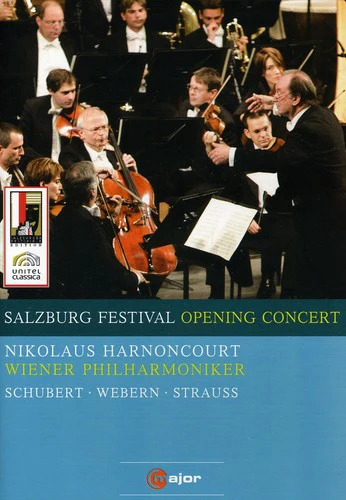
Salzburg Festival Opening Concert 2009 / Harnoncourt
In one of the most unusual opening concerts of recent decades, Nikolaus Harnoncourt launched the 2009 Salzburg Festival with an exploration of the dance element in Austrian music. Dances by Schubert and Josef Strauss provided an introduction to the magnificent "Dance of Death" that emerged from the octogenarian maestro´s hands in Schubert´s C major Symphony ("Great"). The perfect orchestra for these authentically Viennese and yet universally valid works was, of course, the Vienna Philharmonic. "An interpretation of incomparable richness" (Münchner Merkusr).
Recorded live at the Salzburg Festival, 2009.
Picture format: NTSC 16:9
Sound format: PCM Stereo 2.0 / DTS 5.1
Region code: 0 (worldwide)
Booklet notes: English, German, French
Running time: 95 mins
No. of DVDs: 1 (DVD 9)
----------------------------------------------------------------
3433990.zz6_SALZBURG_FESTIVAL_2009_OPENING.html
SALZBURG FESTIVAL 2009 OPENING CONCERT • Nikolaus Harnoncourt, cond; Vienna PO • MAJOR 702708 (DVD: 95:00) Live: Salzburg 7/26/2009
SCHUBERT/WEBERN 6 German Dances. JOS. STRAUSS Frauenherz Polka . Delirien Waltz . Pêle Mêle Polka. SCHUBERT Symphony No. 9
I need to begin with a confession. I frequently find myself out of sympathy with the music-making of Nikolaus Harnoncourt. I recognize that he is very highly regarded not only by critics and music lovers throughout the world, but by many of the great musicians of our time. It is probably fair to say that the problem is me, not Harnoncourt, and I would imagine that those who respond to his approach will find this a compelling DVD. Certainly the Vienna Philharmonic, an orchestra that can impose its will on lesser conductors, gives Harnoncourt what he wants—and the performances are, for the most part, deeply committed and well played, exciting on their own terms. It is those terms with which I have a problem.
I would guess that even some of Harnoncourt’s admirers might have trouble with the grey, charmless reading of the Schubert German Dances. Even in Webern’s arrangements these works need to sing, and certainly need to dance, and they do little of that here. The string tone is hard-edged, and the lack of grace is alarming. For some reason, perhaps it was its reaction to the performance, the audience doesn’t applaud after these (whereas it does clap between the Josef Strauss pieces).
It is clear from Harnoncourt’s conducting, from his severe facial expression, and from Harald Reiter’s notes that accompany this DVD, that the conductor had something completely different in mind than the usual charm and smiles that we associate with the music of any of the Strauss family. “To Josef Strauss’s works Harnoncourt brought a military precision and a sobriety that at times seemed almost disturbing.” That is what the program notes tell us, and indeed that is what we hear. The notes talk about attentive playing, and for the most part that is true, though there are one or two moments of insecurity at tempo changes in the Delirien Waltz. But for the most part, the VPO is right there with Harnoncourt, digging in and giving us sober, fierce Josef Strauss. If you believe that will appeal to you, you will never hear it done better.
It becomes clear with the detached notes of the opening horn solo that the Schubert Ninth will be in a similar vein. Once again, let me quote the accompanying notes: “It was a dance of death that Harnoncourt, using the simplest of means and on the basis of a detailed study of the score, conjured up from behind the musical glories of Schubert’s Ninth. In passages where we have been used to hearing a plaintive horn, he suggested the trumpet fanfares of war.” (By the way, I listened and reacted before I read the notes, so they did not influence, but rather they confirmed.) If you believe that you would like this kind of take on the Schubert Ninth, the chances are that you will find much to like here. The performance is dynamic, played with an edge-of-the-seat intensity that cannot be denied, and is certainly all of a piece. There are a few moments when the string tone seems a bit wiry to me, as if Harnoncourt was minimizing vibrato, but there are some other moments of uncommon grace, particularly in the second movement. Harnoncourt does take all the repeats, as one would expect from him. And I must note that the strong diminuendo he takes at the end seems starkly at odds with his view of the piece.
The direction for the cameras, by Michael Beyer, is standard orchestra concert direction—but less fussy and jerky than most. Beyer doesn’t feel the need to jump from shot to shot every two seconds, and his camerawork seems musically sensitive. The sound quality, heard in the PCM 2.0 format, is extremely clear and full, and very well balanced. The high-definition filming is crystal clear.
It is difficult to criticize a conductor for achieving at a high level precisely what he set out to achieve. Far better a performance with a real force of personality like this than a score-bound read-through. This is energized, spontaneous, communicative music-making. I probably will not return to it, because it is simply not the way I hear this symphony in my mind’s ear (and I enjoy a wide range of performances of it, from Furtwängler to Szell). I hear in this work a beauty and songfulness that Harnoncourt seems to deny. But there is no doubt that it left a strong impression, and I suspect it will have many admirers.
FANFARE: Henry Fogel
Recorded live at the Salzburg Festival, 2009.
Picture format: NTSC 16:9
Sound format: PCM Stereo 2.0 / DTS 5.1
Region code: 0 (worldwide)
Booklet notes: English, German, French
Running time: 95 mins
No. of DVDs: 1 (DVD 9)
----------------------------------------------------------------
SALZBURG FESTIVAL 2009 OPENING CONCERT • Nikolaus Harnoncourt, cond; Vienna PO • MAJOR 702708 (DVD: 95:00) Live: Salzburg 7/26/2009
SCHUBERT/WEBERN 6 German Dances. JOS. STRAUSS Frauenherz Polka . Delirien Waltz . Pêle Mêle Polka. SCHUBERT Symphony No. 9
I need to begin with a confession. I frequently find myself out of sympathy with the music-making of Nikolaus Harnoncourt. I recognize that he is very highly regarded not only by critics and music lovers throughout the world, but by many of the great musicians of our time. It is probably fair to say that the problem is me, not Harnoncourt, and I would imagine that those who respond to his approach will find this a compelling DVD. Certainly the Vienna Philharmonic, an orchestra that can impose its will on lesser conductors, gives Harnoncourt what he wants—and the performances are, for the most part, deeply committed and well played, exciting on their own terms. It is those terms with which I have a problem.
I would guess that even some of Harnoncourt’s admirers might have trouble with the grey, charmless reading of the Schubert German Dances. Even in Webern’s arrangements these works need to sing, and certainly need to dance, and they do little of that here. The string tone is hard-edged, and the lack of grace is alarming. For some reason, perhaps it was its reaction to the performance, the audience doesn’t applaud after these (whereas it does clap between the Josef Strauss pieces).
It is clear from Harnoncourt’s conducting, from his severe facial expression, and from Harald Reiter’s notes that accompany this DVD, that the conductor had something completely different in mind than the usual charm and smiles that we associate with the music of any of the Strauss family. “To Josef Strauss’s works Harnoncourt brought a military precision and a sobriety that at times seemed almost disturbing.” That is what the program notes tell us, and indeed that is what we hear. The notes talk about attentive playing, and for the most part that is true, though there are one or two moments of insecurity at tempo changes in the Delirien Waltz. But for the most part, the VPO is right there with Harnoncourt, digging in and giving us sober, fierce Josef Strauss. If you believe that will appeal to you, you will never hear it done better.
It becomes clear with the detached notes of the opening horn solo that the Schubert Ninth will be in a similar vein. Once again, let me quote the accompanying notes: “It was a dance of death that Harnoncourt, using the simplest of means and on the basis of a detailed study of the score, conjured up from behind the musical glories of Schubert’s Ninth. In passages where we have been used to hearing a plaintive horn, he suggested the trumpet fanfares of war.” (By the way, I listened and reacted before I read the notes, so they did not influence, but rather they confirmed.) If you believe that you would like this kind of take on the Schubert Ninth, the chances are that you will find much to like here. The performance is dynamic, played with an edge-of-the-seat intensity that cannot be denied, and is certainly all of a piece. There are a few moments when the string tone seems a bit wiry to me, as if Harnoncourt was minimizing vibrato, but there are some other moments of uncommon grace, particularly in the second movement. Harnoncourt does take all the repeats, as one would expect from him. And I must note that the strong diminuendo he takes at the end seems starkly at odds with his view of the piece.
The direction for the cameras, by Michael Beyer, is standard orchestra concert direction—but less fussy and jerky than most. Beyer doesn’t feel the need to jump from shot to shot every two seconds, and his camerawork seems musically sensitive. The sound quality, heard in the PCM 2.0 format, is extremely clear and full, and very well balanced. The high-definition filming is crystal clear.
It is difficult to criticize a conductor for achieving at a high level precisely what he set out to achieve. Far better a performance with a real force of personality like this than a score-bound read-through. This is energized, spontaneous, communicative music-making. I probably will not return to it, because it is simply not the way I hear this symphony in my mind’s ear (and I enjoy a wide range of performances of it, from Furtwängler to Szell). I hear in this work a beauty and songfulness that Harnoncourt seems to deny. But there is no doubt that it left a strong impression, and I suspect it will have many admirers.
FANFARE: Henry Fogel
In one of the most unusual opening concerts of recent decades, Nikolaus Harnoncourt launched the 2009 Salzburg Festival with an exploration of the dance element in Austrian music. Dances by Schubert and Josef Strauss provided an introduction to the magnificent "Dance of Death" that emerged from the octogenarian maestro´s hands in Schubert´s C major Symphony ("Great"). The perfect orchestra for these authentically Viennese and yet universally valid works was, of course, the Vienna Philharmonic. "An interpretation of incomparable richness" (Münchner Merkusr).
Recorded live at the Salzburg Festival, 2009.
Picture format: NTSC 16:9
Sound format: PCM Stereo 2.0 / DTS 5.1
Region code: 0 (worldwide)
Booklet notes: English, German, French
Running time: 95 mins
No. of DVDs: 1 (DVD 9)
----------------------------------------------------------------
3433990.zz6_SALZBURG_FESTIVAL_2009_OPENING.html
SALZBURG FESTIVAL 2009 OPENING CONCERT • Nikolaus Harnoncourt, cond; Vienna PO • MAJOR 702708 (DVD: 95:00) Live: Salzburg 7/26/2009
SCHUBERT/WEBERN 6 German Dances. JOS. STRAUSS Frauenherz Polka . Delirien Waltz . Pêle Mêle Polka. SCHUBERT Symphony No. 9
I need to begin with a confession. I frequently find myself out of sympathy with the music-making of Nikolaus Harnoncourt. I recognize that he is very highly regarded not only by critics and music lovers throughout the world, but by many of the great musicians of our time. It is probably fair to say that the problem is me, not Harnoncourt, and I would imagine that those who respond to his approach will find this a compelling DVD. Certainly the Vienna Philharmonic, an orchestra that can impose its will on lesser conductors, gives Harnoncourt what he wants—and the performances are, for the most part, deeply committed and well played, exciting on their own terms. It is those terms with which I have a problem.
I would guess that even some of Harnoncourt’s admirers might have trouble with the grey, charmless reading of the Schubert German Dances. Even in Webern’s arrangements these works need to sing, and certainly need to dance, and they do little of that here. The string tone is hard-edged, and the lack of grace is alarming. For some reason, perhaps it was its reaction to the performance, the audience doesn’t applaud after these (whereas it does clap between the Josef Strauss pieces).
It is clear from Harnoncourt’s conducting, from his severe facial expression, and from Harald Reiter’s notes that accompany this DVD, that the conductor had something completely different in mind than the usual charm and smiles that we associate with the music of any of the Strauss family. “To Josef Strauss’s works Harnoncourt brought a military precision and a sobriety that at times seemed almost disturbing.” That is what the program notes tell us, and indeed that is what we hear. The notes talk about attentive playing, and for the most part that is true, though there are one or two moments of insecurity at tempo changes in the Delirien Waltz. But for the most part, the VPO is right there with Harnoncourt, digging in and giving us sober, fierce Josef Strauss. If you believe that will appeal to you, you will never hear it done better.
It becomes clear with the detached notes of the opening horn solo that the Schubert Ninth will be in a similar vein. Once again, let me quote the accompanying notes: “It was a dance of death that Harnoncourt, using the simplest of means and on the basis of a detailed study of the score, conjured up from behind the musical glories of Schubert’s Ninth. In passages where we have been used to hearing a plaintive horn, he suggested the trumpet fanfares of war.” (By the way, I listened and reacted before I read the notes, so they did not influence, but rather they confirmed.) If you believe that you would like this kind of take on the Schubert Ninth, the chances are that you will find much to like here. The performance is dynamic, played with an edge-of-the-seat intensity that cannot be denied, and is certainly all of a piece. There are a few moments when the string tone seems a bit wiry to me, as if Harnoncourt was minimizing vibrato, but there are some other moments of uncommon grace, particularly in the second movement. Harnoncourt does take all the repeats, as one would expect from him. And I must note that the strong diminuendo he takes at the end seems starkly at odds with his view of the piece.
The direction for the cameras, by Michael Beyer, is standard orchestra concert direction—but less fussy and jerky than most. Beyer doesn’t feel the need to jump from shot to shot every two seconds, and his camerawork seems musically sensitive. The sound quality, heard in the PCM 2.0 format, is extremely clear and full, and very well balanced. The high-definition filming is crystal clear.
It is difficult to criticize a conductor for achieving at a high level precisely what he set out to achieve. Far better a performance with a real force of personality like this than a score-bound read-through. This is energized, spontaneous, communicative music-making. I probably will not return to it, because it is simply not the way I hear this symphony in my mind’s ear (and I enjoy a wide range of performances of it, from Furtwängler to Szell). I hear in this work a beauty and songfulness that Harnoncourt seems to deny. But there is no doubt that it left a strong impression, and I suspect it will have many admirers.
FANFARE: Henry Fogel
Recorded live at the Salzburg Festival, 2009.
Picture format: NTSC 16:9
Sound format: PCM Stereo 2.0 / DTS 5.1
Region code: 0 (worldwide)
Booklet notes: English, German, French
Running time: 95 mins
No. of DVDs: 1 (DVD 9)
----------------------------------------------------------------
SALZBURG FESTIVAL 2009 OPENING CONCERT • Nikolaus Harnoncourt, cond; Vienna PO • MAJOR 702708 (DVD: 95:00) Live: Salzburg 7/26/2009
SCHUBERT/WEBERN 6 German Dances. JOS. STRAUSS Frauenherz Polka . Delirien Waltz . Pêle Mêle Polka. SCHUBERT Symphony No. 9
I need to begin with a confession. I frequently find myself out of sympathy with the music-making of Nikolaus Harnoncourt. I recognize that he is very highly regarded not only by critics and music lovers throughout the world, but by many of the great musicians of our time. It is probably fair to say that the problem is me, not Harnoncourt, and I would imagine that those who respond to his approach will find this a compelling DVD. Certainly the Vienna Philharmonic, an orchestra that can impose its will on lesser conductors, gives Harnoncourt what he wants—and the performances are, for the most part, deeply committed and well played, exciting on their own terms. It is those terms with which I have a problem.
I would guess that even some of Harnoncourt’s admirers might have trouble with the grey, charmless reading of the Schubert German Dances. Even in Webern’s arrangements these works need to sing, and certainly need to dance, and they do little of that here. The string tone is hard-edged, and the lack of grace is alarming. For some reason, perhaps it was its reaction to the performance, the audience doesn’t applaud after these (whereas it does clap between the Josef Strauss pieces).
It is clear from Harnoncourt’s conducting, from his severe facial expression, and from Harald Reiter’s notes that accompany this DVD, that the conductor had something completely different in mind than the usual charm and smiles that we associate with the music of any of the Strauss family. “To Josef Strauss’s works Harnoncourt brought a military precision and a sobriety that at times seemed almost disturbing.” That is what the program notes tell us, and indeed that is what we hear. The notes talk about attentive playing, and for the most part that is true, though there are one or two moments of insecurity at tempo changes in the Delirien Waltz. But for the most part, the VPO is right there with Harnoncourt, digging in and giving us sober, fierce Josef Strauss. If you believe that will appeal to you, you will never hear it done better.
It becomes clear with the detached notes of the opening horn solo that the Schubert Ninth will be in a similar vein. Once again, let me quote the accompanying notes: “It was a dance of death that Harnoncourt, using the simplest of means and on the basis of a detailed study of the score, conjured up from behind the musical glories of Schubert’s Ninth. In passages where we have been used to hearing a plaintive horn, he suggested the trumpet fanfares of war.” (By the way, I listened and reacted before I read the notes, so they did not influence, but rather they confirmed.) If you believe that you would like this kind of take on the Schubert Ninth, the chances are that you will find much to like here. The performance is dynamic, played with an edge-of-the-seat intensity that cannot be denied, and is certainly all of a piece. There are a few moments when the string tone seems a bit wiry to me, as if Harnoncourt was minimizing vibrato, but there are some other moments of uncommon grace, particularly in the second movement. Harnoncourt does take all the repeats, as one would expect from him. And I must note that the strong diminuendo he takes at the end seems starkly at odds with his view of the piece.
The direction for the cameras, by Michael Beyer, is standard orchestra concert direction—but less fussy and jerky than most. Beyer doesn’t feel the need to jump from shot to shot every two seconds, and his camerawork seems musically sensitive. The sound quality, heard in the PCM 2.0 format, is extremely clear and full, and very well balanced. The high-definition filming is crystal clear.
It is difficult to criticize a conductor for achieving at a high level precisely what he set out to achieve. Far better a performance with a real force of personality like this than a score-bound read-through. This is energized, spontaneous, communicative music-making. I probably will not return to it, because it is simply not the way I hear this symphony in my mind’s ear (and I enjoy a wide range of performances of it, from Furtwängler to Szell). I hear in this work a beauty and songfulness that Harnoncourt seems to deny. But there is no doubt that it left a strong impression, and I suspect it will have many admirers.
FANFARE: Henry Fogel
$8.75
Original: $24.99
-65%Salzburg Festival Opening Concert 2009 / Harnoncourt—
$24.99
$8.75Description
In one of the most unusual opening concerts of recent decades, Nikolaus Harnoncourt launched the 2009 Salzburg Festival with an exploration of the dance element in Austrian music. Dances by Schubert and Josef Strauss provided an introduction to the magnificent "Dance of Death" that emerged from the octogenarian maestro´s hands in Schubert´s C major Symphony ("Great"). The perfect orchestra for these authentically Viennese and yet universally valid works was, of course, the Vienna Philharmonic. "An interpretation of incomparable richness" (Münchner Merkusr).
Recorded live at the Salzburg Festival, 2009.
Picture format: NTSC 16:9
Sound format: PCM Stereo 2.0 / DTS 5.1
Region code: 0 (worldwide)
Booklet notes: English, German, French
Running time: 95 mins
No. of DVDs: 1 (DVD 9)
----------------------------------------------------------------
3433990.zz6_SALZBURG_FESTIVAL_2009_OPENING.html
SALZBURG FESTIVAL 2009 OPENING CONCERT • Nikolaus Harnoncourt, cond; Vienna PO • MAJOR 702708 (DVD: 95:00) Live: Salzburg 7/26/2009
SCHUBERT/WEBERN 6 German Dances. JOS. STRAUSS Frauenherz Polka . Delirien Waltz . Pêle Mêle Polka. SCHUBERT Symphony No. 9
I need to begin with a confession. I frequently find myself out of sympathy with the music-making of Nikolaus Harnoncourt. I recognize that he is very highly regarded not only by critics and music lovers throughout the world, but by many of the great musicians of our time. It is probably fair to say that the problem is me, not Harnoncourt, and I would imagine that those who respond to his approach will find this a compelling DVD. Certainly the Vienna Philharmonic, an orchestra that can impose its will on lesser conductors, gives Harnoncourt what he wants—and the performances are, for the most part, deeply committed and well played, exciting on their own terms. It is those terms with which I have a problem.
I would guess that even some of Harnoncourt’s admirers might have trouble with the grey, charmless reading of the Schubert German Dances. Even in Webern’s arrangements these works need to sing, and certainly need to dance, and they do little of that here. The string tone is hard-edged, and the lack of grace is alarming. For some reason, perhaps it was its reaction to the performance, the audience doesn’t applaud after these (whereas it does clap between the Josef Strauss pieces).
It is clear from Harnoncourt’s conducting, from his severe facial expression, and from Harald Reiter’s notes that accompany this DVD, that the conductor had something completely different in mind than the usual charm and smiles that we associate with the music of any of the Strauss family. “To Josef Strauss’s works Harnoncourt brought a military precision and a sobriety that at times seemed almost disturbing.” That is what the program notes tell us, and indeed that is what we hear. The notes talk about attentive playing, and for the most part that is true, though there are one or two moments of insecurity at tempo changes in the Delirien Waltz. But for the most part, the VPO is right there with Harnoncourt, digging in and giving us sober, fierce Josef Strauss. If you believe that will appeal to you, you will never hear it done better.
It becomes clear with the detached notes of the opening horn solo that the Schubert Ninth will be in a similar vein. Once again, let me quote the accompanying notes: “It was a dance of death that Harnoncourt, using the simplest of means and on the basis of a detailed study of the score, conjured up from behind the musical glories of Schubert’s Ninth. In passages where we have been used to hearing a plaintive horn, he suggested the trumpet fanfares of war.” (By the way, I listened and reacted before I read the notes, so they did not influence, but rather they confirmed.) If you believe that you would like this kind of take on the Schubert Ninth, the chances are that you will find much to like here. The performance is dynamic, played with an edge-of-the-seat intensity that cannot be denied, and is certainly all of a piece. There are a few moments when the string tone seems a bit wiry to me, as if Harnoncourt was minimizing vibrato, but there are some other moments of uncommon grace, particularly in the second movement. Harnoncourt does take all the repeats, as one would expect from him. And I must note that the strong diminuendo he takes at the end seems starkly at odds with his view of the piece.
The direction for the cameras, by Michael Beyer, is standard orchestra concert direction—but less fussy and jerky than most. Beyer doesn’t feel the need to jump from shot to shot every two seconds, and his camerawork seems musically sensitive. The sound quality, heard in the PCM 2.0 format, is extremely clear and full, and very well balanced. The high-definition filming is crystal clear.
It is difficult to criticize a conductor for achieving at a high level precisely what he set out to achieve. Far better a performance with a real force of personality like this than a score-bound read-through. This is energized, spontaneous, communicative music-making. I probably will not return to it, because it is simply not the way I hear this symphony in my mind’s ear (and I enjoy a wide range of performances of it, from Furtwängler to Szell). I hear in this work a beauty and songfulness that Harnoncourt seems to deny. But there is no doubt that it left a strong impression, and I suspect it will have many admirers.
FANFARE: Henry Fogel
Recorded live at the Salzburg Festival, 2009.
Picture format: NTSC 16:9
Sound format: PCM Stereo 2.0 / DTS 5.1
Region code: 0 (worldwide)
Booklet notes: English, German, French
Running time: 95 mins
No. of DVDs: 1 (DVD 9)
----------------------------------------------------------------
SALZBURG FESTIVAL 2009 OPENING CONCERT • Nikolaus Harnoncourt, cond; Vienna PO • MAJOR 702708 (DVD: 95:00) Live: Salzburg 7/26/2009
SCHUBERT/WEBERN 6 German Dances. JOS. STRAUSS Frauenherz Polka . Delirien Waltz . Pêle Mêle Polka. SCHUBERT Symphony No. 9
I need to begin with a confession. I frequently find myself out of sympathy with the music-making of Nikolaus Harnoncourt. I recognize that he is very highly regarded not only by critics and music lovers throughout the world, but by many of the great musicians of our time. It is probably fair to say that the problem is me, not Harnoncourt, and I would imagine that those who respond to his approach will find this a compelling DVD. Certainly the Vienna Philharmonic, an orchestra that can impose its will on lesser conductors, gives Harnoncourt what he wants—and the performances are, for the most part, deeply committed and well played, exciting on their own terms. It is those terms with which I have a problem.
I would guess that even some of Harnoncourt’s admirers might have trouble with the grey, charmless reading of the Schubert German Dances. Even in Webern’s arrangements these works need to sing, and certainly need to dance, and they do little of that here. The string tone is hard-edged, and the lack of grace is alarming. For some reason, perhaps it was its reaction to the performance, the audience doesn’t applaud after these (whereas it does clap between the Josef Strauss pieces).
It is clear from Harnoncourt’s conducting, from his severe facial expression, and from Harald Reiter’s notes that accompany this DVD, that the conductor had something completely different in mind than the usual charm and smiles that we associate with the music of any of the Strauss family. “To Josef Strauss’s works Harnoncourt brought a military precision and a sobriety that at times seemed almost disturbing.” That is what the program notes tell us, and indeed that is what we hear. The notes talk about attentive playing, and for the most part that is true, though there are one or two moments of insecurity at tempo changes in the Delirien Waltz. But for the most part, the VPO is right there with Harnoncourt, digging in and giving us sober, fierce Josef Strauss. If you believe that will appeal to you, you will never hear it done better.
It becomes clear with the detached notes of the opening horn solo that the Schubert Ninth will be in a similar vein. Once again, let me quote the accompanying notes: “It was a dance of death that Harnoncourt, using the simplest of means and on the basis of a detailed study of the score, conjured up from behind the musical glories of Schubert’s Ninth. In passages where we have been used to hearing a plaintive horn, he suggested the trumpet fanfares of war.” (By the way, I listened and reacted before I read the notes, so they did not influence, but rather they confirmed.) If you believe that you would like this kind of take on the Schubert Ninth, the chances are that you will find much to like here. The performance is dynamic, played with an edge-of-the-seat intensity that cannot be denied, and is certainly all of a piece. There are a few moments when the string tone seems a bit wiry to me, as if Harnoncourt was minimizing vibrato, but there are some other moments of uncommon grace, particularly in the second movement. Harnoncourt does take all the repeats, as one would expect from him. And I must note that the strong diminuendo he takes at the end seems starkly at odds with his view of the piece.
The direction for the cameras, by Michael Beyer, is standard orchestra concert direction—but less fussy and jerky than most. Beyer doesn’t feel the need to jump from shot to shot every two seconds, and his camerawork seems musically sensitive. The sound quality, heard in the PCM 2.0 format, is extremely clear and full, and very well balanced. The high-definition filming is crystal clear.
It is difficult to criticize a conductor for achieving at a high level precisely what he set out to achieve. Far better a performance with a real force of personality like this than a score-bound read-through. This is energized, spontaneous, communicative music-making. I probably will not return to it, because it is simply not the way I hear this symphony in my mind’s ear (and I enjoy a wide range of performances of it, from Furtwängler to Szell). I hear in this work a beauty and songfulness that Harnoncourt seems to deny. But there is no doubt that it left a strong impression, and I suspect it will have many admirers.
FANFARE: Henry Fogel