🎉 Up to 70% Off Selected ItemsShop Sale

1 / 2
Scattered Ashes: Josquin's Miserere and the Savonarolan Legacy / Cave, Magnificat

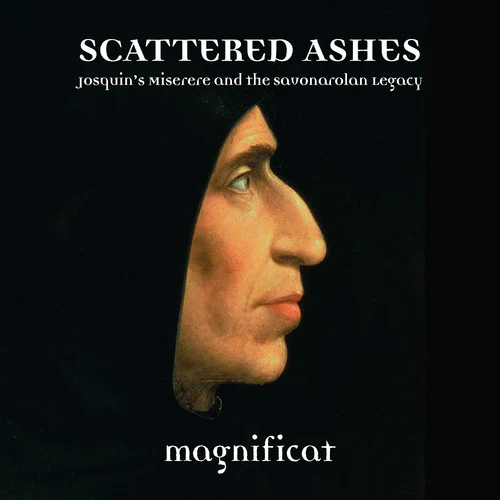
The disc’s title refers to the fate of the outspoken and for a time widely popular 15th-century friar Girolamo Savonarola, executed in Florence in 1498 following his continued calls for church reforms, his criticism of papal corruption, and finally his direct defiance of papal orders. Awaiting execution, he composed a meditation on Psalm 50, Miserere mei, Deus, and another on Psalm 30, In te, Domine, speravi, texts that were secreted out of the prison and eventually disseminated throughout Europe. During the next century composers latched on to these writings and many of the works on this program include settings of Savonarola’s meditation texts.
A notable feature of these works is their length: the shortest is nearly six minutes; the longest more than 17. Most fall in the nine to ten-minute range. Whatever the timing, writing polyphonic works of this scope, not only sustaining momentum over long-breathed phrase after long-breathed phrase–indeed, full cadences are few and far between!–and keeping the music interesting while articulating the texts within the greater musical framework takes more than ordinary skill.
The mastery on display here, by composers such as Josquin, Palestrina, Gombert, and Byrd, expertly supported by the talented and distinguished voices of Magnificat (long-time choral fans will notice a few familiar names in the 16-voice ensemble), is clear from the beginning of Josquin’s Miserere mei, and certainly needs no defense nor explanation to serious choral music listeners. Conductor Philip Cave, in his excellent perfomance note, describes these works as “extraordinarily intense”, and as you listen you won’t disagree with him.
Although Cave also claims Josquin’s Miserere, which opens Disc 1, as the “heart of the program”, I suggest skipping to Disc 2 and going right for Jean Lhéritier’s Miserere mei, Domine. To hear this exquisite, lesser-known work first, without distraction or the influence of previous listening, is worth upsetting Cave’s undoubtedly well-thought-out program order. Every time I hear a piece by Lhéritier (whose name doesn’t even appear in some music dictionaries) I wonder why his motets do not have wider advocacy by world-class choirs. (Notably, most of the performing editions used here, including the Lhéritier piece, are the work of musicologist, veteran professional choral musician, and member of Magnificat, Sally Dunkley, who has been responsible for bringing many works from manuscript obscurity to the concert hall and recordings.)
Lhéritier, who, according to Patrick Macey, the writer of the disc’s first-rate liner notes, “may have been a student of Josquin in the early 1500s”, and who spent most of his career in Italy, creates works like those of his contemporary Gombert, that draw you in and then surround you in a world of sound that’s at once sensuous and spiritual, that glories in rich harmonies, complexly interweaving melodies, and the timbre of combined voices. Exactly what we should expect from really good choral music sung by world-class singers.
Hearing Josquin’s five-part, 17-minute-plus setting of Psalm 50, it’s easy to understand Cave’s choice of this piece as an anchor and inspiration for the selection of other works on the program. It’s also easy to hear how the kind of musical standard Josquin set–in his particular attention to text, its clarity, and its specific musical treatment; to the organization of musical structure both in use of voices and in the larger context of contrapuntal and alternating homophonic sections–would demand much from his contemporaries and followers.
That they succeeded–at least those featured on this recording–is quite clear, and the tribute to the music’s excellence is confirmed in these performances, so sensitively phrased and caringly inflected, carried by an exceptionally well-balanced ensemble of compatible voices. Highly recommended.
- ClassicsToday
The disc’s title refers to the fate of the outspoken and for a time widely popular 15th-century friar Girolamo Savonarola, executed in Florence in 1498 following his continued calls for church reforms, his criticism of papal corruption, and finally his direct defiance of papal orders. Awaiting execution, he composed a meditation on Psalm 50, Miserere mei, Deus, and another on Psalm 30, In te, Domine, speravi, texts that were secreted out of the prison and eventually disseminated throughout Europe. During the next century composers latched on to these writings and many of the works on this program include settings of Savonarola’s meditation texts.
A notable feature of these works is their length: the shortest is nearly six minutes; the longest more than 17. Most fall in the nine to ten-minute range. Whatever the timing, writing polyphonic works of this scope, not only sustaining momentum over long-breathed phrase after long-breathed phrase–indeed, full cadences are few and far between!–and keeping the music interesting while articulating the texts within the greater musical framework takes more than ordinary skill.
The mastery on display here, by composers such as Josquin, Palestrina, Gombert, and Byrd, expertly supported by the talented and distinguished voices of Magnificat (long-time choral fans will notice a few familiar names in the 16-voice ensemble), is clear from the beginning of Josquin’s Miserere mei, and certainly needs no defense nor explanation to serious choral music listeners. Conductor Philip Cave, in his excellent perfomance note, describes these works as “extraordinarily intense”, and as you listen you won’t disagree with him.
Although Cave also claims Josquin’s Miserere, which opens Disc 1, as the “heart of the program”, I suggest skipping to Disc 2 and going right for Jean Lhéritier’s Miserere mei, Domine. To hear this exquisite, lesser-known work first, without distraction or the influence of previous listening, is worth upsetting Cave’s undoubtedly well-thought-out program order. Every time I hear a piece by Lhéritier (whose name doesn’t even appear in some music dictionaries) I wonder why his motets do not have wider advocacy by world-class choirs. (Notably, most of the performing editions used here, including the Lhéritier piece, are the work of musicologist, veteran professional choral musician, and member of Magnificat, Sally Dunkley, who has been responsible for bringing many works from manuscript obscurity to the concert hall and recordings.)
Lhéritier, who, according to Patrick Macey, the writer of the disc’s first-rate liner notes, “may have been a student of Josquin in the early 1500s”, and who spent most of his career in Italy, creates works like those of his contemporary Gombert, that draw you in and then surround you in a world of sound that’s at once sensuous and spiritual, that glories in rich harmonies, complexly interweaving melodies, and the timbre of combined voices. Exactly what we should expect from really good choral music sung by world-class singers.
Hearing Josquin’s five-part, 17-minute-plus setting of Psalm 50, it’s easy to understand Cave’s choice of this piece as an anchor and inspiration for the selection of other works on the program. It’s also easy to hear how the kind of musical standard Josquin set–in his particular attention to text, its clarity, and its specific musical treatment; to the organization of musical structure both in use of voices and in the larger context of contrapuntal and alternating homophonic sections–would demand much from his contemporaries and followers.
That they succeeded–at least those featured on this recording–is quite clear, and the tribute to the music’s excellence is confirmed in these performances, so sensitively phrased and caringly inflected, carried by an exceptionally well-balanced ensemble of compatible voices. Highly recommended.
- ClassicsToday
$10.50
Original: $29.99
-65%Scattered Ashes: Josquin's Miserere and the Savonarolan Legacy / Cave, Magnificat—
$29.99
$10.50Description
The disc’s title refers to the fate of the outspoken and for a time widely popular 15th-century friar Girolamo Savonarola, executed in Florence in 1498 following his continued calls for church reforms, his criticism of papal corruption, and finally his direct defiance of papal orders. Awaiting execution, he composed a meditation on Psalm 50, Miserere mei, Deus, and another on Psalm 30, In te, Domine, speravi, texts that were secreted out of the prison and eventually disseminated throughout Europe. During the next century composers latched on to these writings and many of the works on this program include settings of Savonarola’s meditation texts.
A notable feature of these works is their length: the shortest is nearly six minutes; the longest more than 17. Most fall in the nine to ten-minute range. Whatever the timing, writing polyphonic works of this scope, not only sustaining momentum over long-breathed phrase after long-breathed phrase–indeed, full cadences are few and far between!–and keeping the music interesting while articulating the texts within the greater musical framework takes more than ordinary skill.
The mastery on display here, by composers such as Josquin, Palestrina, Gombert, and Byrd, expertly supported by the talented and distinguished voices of Magnificat (long-time choral fans will notice a few familiar names in the 16-voice ensemble), is clear from the beginning of Josquin’s Miserere mei, and certainly needs no defense nor explanation to serious choral music listeners. Conductor Philip Cave, in his excellent perfomance note, describes these works as “extraordinarily intense”, and as you listen you won’t disagree with him.
Although Cave also claims Josquin’s Miserere, which opens Disc 1, as the “heart of the program”, I suggest skipping to Disc 2 and going right for Jean Lhéritier’s Miserere mei, Domine. To hear this exquisite, lesser-known work first, without distraction or the influence of previous listening, is worth upsetting Cave’s undoubtedly well-thought-out program order. Every time I hear a piece by Lhéritier (whose name doesn’t even appear in some music dictionaries) I wonder why his motets do not have wider advocacy by world-class choirs. (Notably, most of the performing editions used here, including the Lhéritier piece, are the work of musicologist, veteran professional choral musician, and member of Magnificat, Sally Dunkley, who has been responsible for bringing many works from manuscript obscurity to the concert hall and recordings.)
Lhéritier, who, according to Patrick Macey, the writer of the disc’s first-rate liner notes, “may have been a student of Josquin in the early 1500s”, and who spent most of his career in Italy, creates works like those of his contemporary Gombert, that draw you in and then surround you in a world of sound that’s at once sensuous and spiritual, that glories in rich harmonies, complexly interweaving melodies, and the timbre of combined voices. Exactly what we should expect from really good choral music sung by world-class singers.
Hearing Josquin’s five-part, 17-minute-plus setting of Psalm 50, it’s easy to understand Cave’s choice of this piece as an anchor and inspiration for the selection of other works on the program. It’s also easy to hear how the kind of musical standard Josquin set–in his particular attention to text, its clarity, and its specific musical treatment; to the organization of musical structure both in use of voices and in the larger context of contrapuntal and alternating homophonic sections–would demand much from his contemporaries and followers.
That they succeeded–at least those featured on this recording–is quite clear, and the tribute to the music’s excellence is confirmed in these performances, so sensitively phrased and caringly inflected, carried by an exceptionally well-balanced ensemble of compatible voices. Highly recommended.
- ClassicsToday